
GET IN TOUCH
Ask For Sample?
What Makes Polyquat Algaecide Different from Copper-Based Algaecides?
When algae appear in a swimming pool, most owners want the same thing: clear, clean water without extra trouble. But choosing the right algaecide isn’t always simple. Two products may promise similar results, yet their chemistry, side effects, and long-term impact on pool maintenance can be quite different.
That’s especially true when comparing Polyquat algaecide and copper-based algaecides.
Both can help control algae. Both have a place in pool care. Yet one uses a metal-free polymer, while the other relies on copper ions. That single difference affects everything from stain risk to water chemistry and product selection.
For pool chemical distributors, private label brands, and professional service companies, understanding these differences is more than a technical exercise. It can help prevent customer complaints, improve product recommendations, and build a stronger pool care range.
So, what really sets Polyquat apart from copper-based treatments? And is a copper-free algaecide always the better choice?
Polyquat vs. Copper-Based Algaecides: A Quick Comparison
| Feature | Polyquat 60 Algaecide | Copper-Based Algaecide |
|---|---|---|
| Active chemistry | Cationic polymer | Copper salts or copper complexes |
| Contains copper | No | Yes |
| Main action | Disrupts algae cell membranes | Interferes with algae cell processes |
| Pool staining risk | No copper-related staining | Possible copper staining |
| Foaming | Non-foaming | Generally non-foaming |
| Chlorine compatibility | Compatible in normal pool programs; strong oxidation can degrade it | Depends on formulation and water conditions |
| Metal accumulation | Adds no copper | Can increase dissolved copper |
| pH considerations | Effective across normal pool pH ranges | Copper stability and staining depend on water chemistry |
| Typical applications | Routine prevention, seasonal care, algae control | Prevention and certain stubborn algae problems |
| Typical product positioning | Premium, metal-free treatment | Economical or specialty algae control |
The most important distinction isn’t simply which product kills algae faster. It’s how each product controls algae and what it leaves behind in the pool.
The CDC’s Model Aquatic Health Code guidance identifies polymeric quaternary ammonium algaecides as non-staining and non-foaming, while noting that copper-based treatments require attention to water chemistry to reduce staining risk. cdc.gov+1
First, What Exactly Is Polyquat Algaecide?
Polyquat algaecide belongs to a family of polymeric quaternary ammonium compounds. These polymers carry positive electrical charges along their molecular chains.
In swimming pool applications, one well-known active ingredient is Polixetonium Chloride, also associated with Polyquaternium-42 and CAS No. 31512-74-0.
A typical Polyquat 60 product contains approximately 60% active polymer, although exact active content and formulation specifications depend on the manufacturer.
Unlike copper algaecides, Polyquat doesn’t depend on metal ions to control algae.
Instead, its positively charged polymer chains interact with negatively charged structures on algae cells. These interactions can damage the cells and interfere with normal biological functions.
Think of the polymer as a long chain with many points of contact. Rather than acting through one metal ion, the chain can attach to a cell surface at multiple sites.
This helps explain why polymeric algaecides have become an established choice for routine algae prevention and maintenance.
What makes Polyquat 60 special?
Polyquat 60 is valued for several practical characteristics:
- Metal-free chemistry that avoids adding copper to pool water.
- Non-foaming performance, including in pools with waterfalls and fountains.
- Compatibility with conventional chlorinated pool maintenance when applied correctly.
- Suitability for routine algae prevention and certain corrective treatments.
- Potential use in seasonal pool closing programs, subject to product labeling.
There is one important distinction, though: Polyquat is an algaecide, not a replacement for chlorine or another approved primary sanitizer.
A pool still needs proper disinfection, filtration, circulation, and balanced water chemistry.
And What Are Copper-Based Algaecides?
Copper-based algaecides use copper compounds to control algae growth.
Common forms include copper sulfate and copper complexes made with organic compounds that help keep copper in solution.
Once added to pool water, biologically available copper can interfere with essential processes inside algae cells. Copper can affect enzymes, proteins, and cellular metabolism, making it difficult for algae to survive or multiply.
Copper has a long history in water treatment because it can be effective at relatively low concentrations.
Some copper formulations also provide lasting algae suppression, which can make them attractive for maintenance programs.
But there’s a catch.
Copper doesn’t simply disappear once the algae are gone.
It may remain dissolved, bind to other substances, or form deposits depending on pool chemistry. Repeated treatment can increase the total copper introduced into the system.
That is why copper monitoring matters.
Does chelated copper solve the problem?
Chelated copper products are designed to help stabilize copper in water.
Chelating agents bind copper ions and reduce their tendency to form unwanted deposits under certain conditions. This can lower staining risk compared with less stabilized copper formulations.
However, chelation doesn’t remove copper from the pool.
Water chemistry can change. The stability of copper complexes can also change over time.
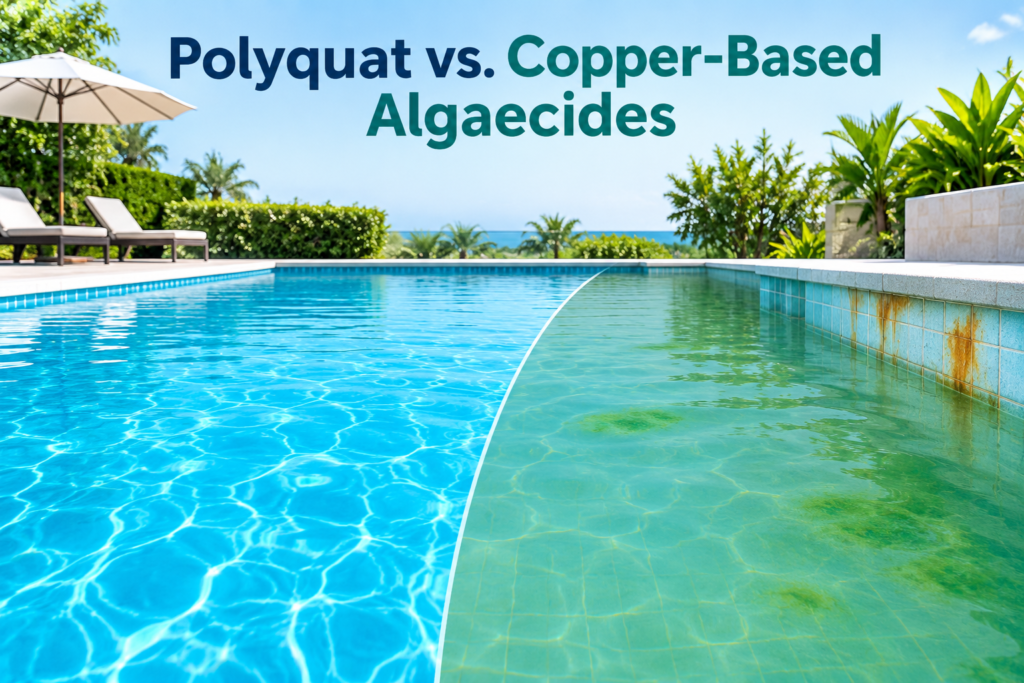
So, while chelated copper products may be easier to manage than basic copper salts, they aren’t completely free from staining concerns. Taylor Technologies+1Hero image alt text: “Polyquat algaecide versus copper-based algaecides comparison, showing clear blue swimming pool water alongside greenish water and copper staining on pool tiles.”
1. Staining Risk: Why Metal-Free Chemistry Matters
One of the biggest differences between Polyquat and copper-based algaecides is their potential to cause pool surface stains.
Picture a beautiful swimming pool with white plaster walls and pale blue tiles. The water looks clear, but greenish marks begin to appear near the steps.
The owner may suspect algae. Yet the real problem could be copper deposits.
Copper can form colored deposits when water chemistry changes. High copper concentrations, shifts in pH, and interactions with other pool chemicals may increase the risk.
Copper staining can affect plaster, grout, fittings, and other pool surfaces. In some cases, copper exposure can also contribute to green discoloration of light-colored hair.
Polyquat avoids this particular problem because it doesn’t introduce copper.
That doesn’t mean Polyquat prevents every type of pool stain. Iron, manganese, organic debris, and other contaminants can still cause discoloration.
However, a copper-free algaecide removes one important source of metal-related staining risk.
For commercial pool operators, that’s a practical advantage. Removing stains can take time, require extra chemicals, and sometimes involve professional surface treatment.
Preventing an avoidable problem is often easier than fixing it.
2. Algae Control: Which Chemistry Works Better?
Here’s where the comparison becomes more interesting.
Copper-based algaecides can be effective against several types of algae, including some stubborn outbreaks. Their metal ions interfere with processes algae need to survive.
Polyquat uses a different mechanism, targeting cell surfaces through its cationic polymer structure.
Both approaches can work, but neither should be treated as a universal cure.
Green algae
Green algae are among the most common problems in swimming pools. They often appear when sanitizer levels fall, circulation becomes poor, or debris builds up.
Both Polyquat and copper-based algaecides can help control green algae when used according to their approved labels.
Polyquat is especially attractive for preventive programs where avoiding copper accumulation is a priority.
Yellow or mustard algae
Mustard algae often appear as yellowish or brownish patches on shaded pool surfaces.
They can return if cleaning and treatment are incomplete.
Certain copper-based formulations are marketed for these stubborn algae problems. Polyquat products may also carry claims for mustard algae control, depending on their registered uses.
Neither chemistry eliminates the need for brushing, adequate sanitization, and cleaning contaminated equipment.
Black algae
Black algae are particularly difficult because colonies can develop protective layers and attach firmly to pool surfaces.
Specialized treatment may be required.
Some copper-based algaecides and Polyquat formulations are labeled for black algae control. Actual results depend on concentration, application, pool conditions, and the extent of growth.
Professional guidance emphasizes brushing and proper treatment rather than relying on an algaecide alone. aquatictrainingservice.com+1
The key point? A product’s approved algae-control claims matter more than broad statements that one chemical family is always stronger.
3. Foaming: An Often Overlooked Difference
Nobody wants a swimming pool that looks like a bubble bath.
Foaming can be a concern with some conventional quaternary ammonium algaecides, especially when overdosed or used in pools with strong water movement.
Polyquat is different.
Its polymeric structure gives it low-foaming characteristics, making it suitable for applications where surface foam would be undesirable.
Copper-based algaecides are also generally non-foaming, so foaming isn’t the main difference between Polyquat and copper.
Instead, it helps distinguish Polyquat from simpler quaternary ammonium formulations.
This distinction matters for product distributors. Customers may assume every quat-based algaecide behaves the same way, but polymeric and simple quat products have different performance profiles.
4. What Happens When Chlorine Enters the Picture?
Chlorine remains a central part of conventional swimming pool sanitation.
It helps control microorganisms and oxidize contaminants. Algaecides play a supporting role by helping prevent or manage algae growth.
Polyquat 60 can be used in chlorinated pool programs, but compatibility needs to be understood correctly.
Normal sanitizer operation and direct exposure to concentrated oxidizing chemicals aren’t the same thing.
High chlorine concentrations can oxidize Polyquat molecules, reducing their effectiveness. For this reason, many product labels recommend separating Polyquat application from shock chlorination.
Copper-based algaecides also require attention to chemical interactions. Strong oxidizers, pH changes, and other water conditions can influence copper chemistry and staining risk.
Never mix concentrated pool chemicals together. Add them separately and follow the product labels.
A well-managed treatment program considers the order and timing of chemical additions rather than assuming that every pool chemical can be added at once.
5. Water Chemistry: Is Polyquat More Forgiving?
Swimming pool water is constantly changing.
Rain introduces new water. Swimmers bring oils and other contaminants. Chlorine treatment changes water chemistry, and evaporation concentrates dissolved substances.
These changes affect algaecide performance.
Polyquat 60 is generally suitable for use across normal swimming pool pH conditions. Because it contains no copper, it doesn’t introduce the metal precipitation and staining concerns associated with copper chemistry.
Copper-based algaecides can be more sensitive to changes in water balance.
As pH and other conditions shift, copper may change its chemical form. Some forms remain dissolved, while others can form deposits.
Chelating agents can help control these reactions, but they don’t eliminate the need for water testing.
For pool service companies managing dozens of pools with different water conditions, a metal-free treatment can simplify one part of their maintenance work.
Still, water balance matters with either product.
Polyquat doesn’t make poor pH control, inadequate filtration, or insufficient chlorine acceptable.
6. Long-Term Use: What Builds Up in the Water?
This may be the most important difference for ongoing maintenance.
Copper is an element. Once introduced into pool water, it cannot be chemically destroyed through normal oxidation.
It may remain dissolved, attach to surfaces, or be removed through water replacement and other treatment methods.
Repeated copper-based algaecide applications can therefore increase the amount of copper introduced over time.
Polyquat is an organic polymer. It doesn’t create a copper residual, although it can interact with suspended particles, organic matter, and pool treatment chemicals.
Polyquat can also be degraded by strong oxidizing conditions.
Neither chemistry should be described as completely free from environmental impact. Both are biologically active substances, and concentrated products must be handled and disposed of according to their labels and local requirements.
However, when the goal is to avoid adding persistent metal content to pool water, Polyquat has a clear chemical advantage.
7. Does Polyquat Help with Water Clarity?
Polyquat’s cationic polymer structure can interact with negatively charged suspended material in pool water.
Under suitable conditions, this interaction may help particles come together into larger groups that filters can capture more easily.
This behavior is related to the principles used in polymer-based water clarification.
However, an algaecide shouldn’t automatically be treated as a dedicated clarifier.
The extent of any clarification benefit depends on the polymer, formulation, dosage, and water conditions.
For pools with persistent fine particles or cloudy water, a dedicated polymer clarifier may be a more appropriate supporting product.
Eautrix also supplies PolyDADMAC-based Polymer Pool Clarifier for applications where particle removal and improved filtration are the primary goals.
The two product categories can complement a professional pool maintenance program, but they perform different jobs.
8. Price vs. Value: Which Is More Economical?
Copper-based algaecides often compete well on initial purchase price.
Polyquat 60 products may cost more per liter, particularly when compared with basic copper formulations.
But a lower bottle price doesn’t always mean a lower treatment cost.
Consider a pool service company responsible for multiple residential or commercial pools.
If a copper-based treatment requires additional metal monitoring or leads to staining problems, the operator may face extra labor, chemicals, and customer complaints.
A premium metal-free treatment may help avoid some of these costs.
On the other hand, a properly managed copper program can provide good value, especially where the product’s approved uses match the customer’s needs.
A useful purchasing comparison should include:
- Cost per treated pool volume, based on approved label doses.
- Application frequency and expected maintenance schedule.
- Testing and monitoring requirements.
- Pool surface compatibility.
- Risk of staining or other corrective work.
- Customer expectations and local product regulations.
For distributors, this creates two distinct commercial positions.
Copper-based products may appeal to cost-sensitive buyers or customers seeking particular algae-control properties.
Polyquat 60 can appeal to buyers who place greater value on metal-free chemistry, non-foaming performance, and long-term surface care.
9. Which Algaecide Is Better for Different Pool Types?
The right product depends on the pool, its maintenance program, and the customer’s priorities.
| Pool application | Main consideration | Potential Polyquat advantage |
|---|---|---|
| Residential swimming pools | Simple routine maintenance | No added copper |
| Commercial hotel pools | Appearance and service reliability | Metal-free, non-foaming |
| Light-colored plaster pools | Visible surface staining | Avoids copper-related staining |
| Pools with fountains | Foam control | Non-foaming |
| Saltwater chlorinated pools | Water balance and equipment care | No additional copper |
| Seasonal outdoor pools | Closing and reopening maintenance | Available in seasonal formulations |
| Pools with stubborn algae | Corrective treatment performance | Depends on registered claims and treatment program |
For hotels and resorts, visual quality is especially important.
A pool may meet its routine water testing requirements yet still look unattractive if surfaces are stained or the water is cloudy.
Guests notice appearance immediately.
That’s one reason a premium algaecide may offer value beyond its direct algae-control function.
10. What Should Pool Chemical Distributors Look for?
For B2B buyers, choosing an algaecide isn’t only about chemistry.
It’s also about product consistency, documentation, packaging, and the ability to serve different markets.
A reliable Polyquat supplier should provide clear technical information about the active ingredient and finished formulation.
For a Polyquat 60 product, buyers should review the active content, appearance, pH, viscosity, and batch consistency.
They should also request appropriate documents, including a Certificate of Analysis (COA) and Safety Data Sheet (SDS).
For private label projects, packaging compatibility and local labeling rules deserve equal attention.
A product intended for a retail pool store may need a different package size and label design from one supplied to a commercial pool maintenance contractor.
And there’s another issue that buyers sometimes overlook: product registration.
In markets such as the United States, algaecidal claims generally fall under pesticide regulations. A chemical raw material specification alone doesn’t establish that a finished product is authorized for sale as a swimming pool algaecide.
Distributors should confirm registration responsibilities, approved claims, and label requirements before launching a new product.
11. Polyquat 60 Algaecide from Eautrix
Eautrix supplies Polixetonium Chloride (CAS No. 31512-74-0) for industrial water treatment and swimming pool algaecide formulation applications.
Our standard Polyquat 60 grade is an amber, transparent, viscous liquid with approximately 60% active polymer.
For distributors and pool chemical brands, we support bulk supply and discussions around custom concentration, packaging, and private label requirements.
Common packaging formats include 1L bottles, 5L containers, 25L drums, 200L drums, and 1000L IBCs.
For brands considering a premium copper-free product range, Polyquat 60 offers a clear position: polymer-based algae control without introducing copper into pool water.
Eautrix can discuss technical specifications, sample evaluation, and packaging requirements for different markets.
For more information, visit Eautrix or contact info@eautrix.com.
Any finished algaecide product must meet the applicable registration, labeling, and use requirements in its intended market.
12. So, Is Polyquat Better Than Copper-Based Algaecide?
Not in every situation.
Copper-based algaecides remain useful because they can provide effective algae control, including in certain specialized treatment programs.
But Polyquat 60 offers a different combination of benefits.
It doesn’t introduce copper, doesn’t create copper-related staining risk, and provides non-foaming performance.
For routine pool maintenance, premium pool care brands, and customers concerned about metal buildup, those characteristics can be compelling.
The smartest choice is the one that matches the pool’s water chemistry, surface materials, algae problem, and maintenance needs.
A clear pool isn’t just about killing algae. It’s also about avoiding problems that make the next maintenance visit harder.
And that’s where Polyquat can make a meaningful difference.
Frequently Asked Questions
1. Is Polyquat 60 algaecide safer for pool surfaces than copper algaecide?
Polyquat 60 doesn’t contain copper, so it avoids the copper-related staining risk associated with metal-based algaecides. It can be an attractive choice for light-colored plaster, tiles, and other surfaces where staining is a concern. Always follow the product label.
2. Can Polyquat algaecide remove green, yellow, and black algae?
Polyquat formulations can help control several algae types, but approved claims and effectiveness vary by product. Established algae growth may also require brushing, appropriate sanitizer treatment, and thorough filtration.
3. Does copper-based algaecide cause green hair or pool stains?
Excess copper in pool water can contribute to green discoloration of light-colored hair and staining of pool surfaces. The risk depends on copper concentration, water chemistry, and the specific formulation. Chelated copper can reduce, but not completely eliminate, staining concerns.
4. Can Polyquat 60 be used in a saltwater swimming pool?
Many Polyquat 60 products are suitable for saltwater pools that use chlorine generators, provided their labels permit this application. Polyquat doesn’t add copper to the water, but normal sanitizer levels and water balance must still be maintained.
5. Is Polyquat 60 more cost-effective than copper-based algaecide for commercial pools?
Polyquat 60 may have a higher purchase price, but its metal-free chemistry can reduce concerns about copper monitoring and staining. The actual cost-effectiveness depends on dosage, treatment frequency, pool conditions, and maintenance expenses. Commercial buyers should compare the total treatment cost rather than bottle price alone.