
GET IN TOUCH
Ask For Sample?
Understanding the Science Behind Polymeric Pool Algaecides
A swimming pool can look crystal clear one day and develop a green tint the next. For pool owners, that’s frustrating. For pool professionals, it raises a deeper question: why do algae keep coming back, even when chlorine levels seem normal?
The answer lies partly in how algae survive, reproduce, and interact with pool water chemistry.
Chlorine remains the main sanitizer in most swimming pools. Yet chlorine alone doesn’t explain the full science of algae prevention. Water circulation, filtration, sunlight, organic contaminants, and chemical treatment all affect whether algae can gain a foothold.
That’s where polymeric pool algaecides come into the picture.
Unlike traditional oxidizing chemicals, many polymeric algaecides work through interactions between positively charged polymer molecules and negatively charged biological surfaces. This approach can help control algae without relying on oxidation as the primary mode of action.
But how does that process work? Why does polymer structure matter? And what makes products such as Polyquat 60 attractive to professional pool chemical brands?
This guide explains the chemistry behind polymeric pool algaecides, their practical benefits, their limitations, and the factors that influence their performance.
What Are Polymeric Pool Algaecides?
Polymeric pool algaecides are chemical products that use polymer molecules as active ingredients to help prevent or control algae growth in swimming pools.
A polymer is a large molecule made from many smaller repeating units. Think of it as a long chain built from linked chemical blocks.
The length, structure, charge, and composition of that chain determine how the polymer behaves in water.
Many polymeric algaecides belong to a class of compounds called cationic polymers.
“Cationic” simply means positively charged.
This positive charge is central to their biological activity because many algal cell surfaces carry a net negative charge under typical pool water conditions.
When a cationic polymer approaches an algal cell, electrostatic attraction can bring the polymer into contact with the cell surface.
That contact may disrupt essential cellular functions, depending on the polymer’s chemical structure, concentration, and the type of algae present.
One important example is Polyquaternium-42, associated with the ingredient name Polixetonium Chloride and CAS No. 31512-74-0.
It is used in certain polymeric algaecide formulations, including products commonly described as Polyquat 60.
A typical commercial Polyquat 60 concentrate contains approximately 60% active polymer, although the exact specification should always be confirmed through the supplier’s technical documentation.
The remaining portion generally includes water and formulation-related components.
Not all polymeric algaecides have the same chemistry, however. Their molecular structures and biological effects can differ significantly.
The Science Starts with Electrical Charge
To understand how polymeric algaecides work, we first need to look at something we cannot see: electrical charge at the surface of an algal cell.
Algae are living organisms. Their cells contain membranes, proteins, pigments, and other structures that help them survive in water.
Many algae also have negatively charged chemical groups on their outer surfaces.
These groups may include carboxylate, phosphate, and other ionizable components.
Meanwhile, many cationic polymers contain positively charged quaternary ammonium groups.
Unlike some amine groups, quaternary ammonium centers retain their formal positive charge across the normal swimming pool pH range.
When positively charged polymer molecules encounter negatively charged algal surfaces, electrostatic attraction can occur.
Conceptual illustration: positively charged polymer groups are attracted to negatively charged sites on an algal cell surface. Not to molecular scale.
This interaction is not the same as oxidation.
Oxidizing chemicals can damage biological molecules through chemical reactions involving electron transfer. Cationic polymers may act through adsorption, membrane interactions, and other non-oxidative processes.
That distinction helps explain why polymeric algaecides can play a supporting role in routine pool maintenance.
Still, positive charge alone does not guarantee strong algae control. Polymer chemistry, dose, contact time, and algal species all matter.
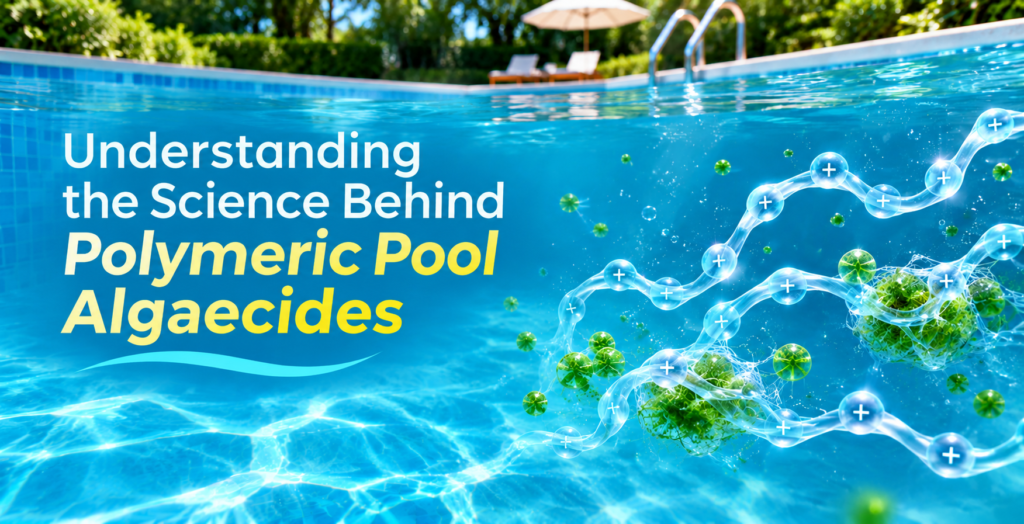
Featured image — Polymeric pool algaecide science
Polymeric pool algaecide molecules interacting with green algae cells in clear blue swimming pool waterImage alt text: Conceptual visualization of positively charged polymeric pool algaecide molecules interacting with green algae cells in clear swimming pool water.
How Do Polymeric Algaecides Actually Control Algae?
Electrical attraction is only the beginning.
Once a polymer reaches an algal surface, several biological and physical processes may follow. Their relative importance depends on the active ingredient and the organism being treated.
Research on quaternary ammonium compounds describes membrane interactions as an important part of their antimicrobial activity. However, findings for small-molecule quats should not automatically be treated as proof of the exact mechanism of every polymeric algaecide. pubmed.ncbi.nlm.nih.gov+1
1. Adsorption onto algal cell surfaces
Adsorption means that molecules attach to a surface.
Cationic polymer chains can attach to negatively charged sites on algal cells. Multiple charged groups along a polymer chain may contribute to these interactions.
This helps bring the active ingredient into close contact with the organism.
However, adsorption is not necessarily permanent. Water chemistry, competing substances, and polymer structure influence how strongly the material binds.
2. Disruption of cell membrane functions
Cell membranes regulate the movement of water, nutrients, ions, and other substances.
They work rather like security gates at a busy facility: certain materials can enter, others must stay outside, and the whole system depends on carefully controlled movement.
Membrane-active quaternary ammonium compounds can disturb this organization.
Depending on the compound and exposure conditions, these interactions may change membrane permeability and interfere with normal cell functions.
For some susceptible microorganisms, sufficiently severe damage can lead to cell death.
The precise contribution of this process to a particular Polyquat 60 formulation requires product-specific evidence.
3. Inhibition of algal growth
An algaecide doesn’t always need to destroy every existing cell to provide useful control.
Some treatments inhibit the growth or reproduction of susceptible algae. This effect is called algistatic activity.
When growth is suppressed, routine filtration, brushing, and sanitation have a better chance of keeping the pool clean.
This is one reason preventive maintenance can be easier than dealing with a fully developed algae bloom.
4. Interactions with suspended particles
Certain cationic polymers can also interact with negatively charged suspended particles.
These interactions may reduce particle repulsion and encourage aggregation, depending on the formulation.
The principle is related to coagulation and flocculation in water treatment.
But there’s an important distinction: an algaecide is not automatically an effective pool clarifier.
A polymer formulated for algae control may have different molecular properties from one designed specifically to improve filtration.
Any dual-function claim should be supported by testing.
Why Does Polymer Structure Matter So Much?
Two algaecides can contain positively charged polymers and still perform quite differently.
Why?
Because the number of positive charges is only one part of the chemical picture.
Molecular weight
Molecular weight describes the mass of a molecule.
For polymers, commercial products contain a distribution of chain lengths rather than molecules of one identical size.
Molecular weight can influence:
- Diffusion through water
- Adsorption onto biological surfaces
- Solution viscosity
- Interactions with suspended solids
- Product handling and formulation behavior
A larger polymer isn’t automatically a stronger algaecide.
Very large molecules may interact differently with biological surfaces than smaller molecules. The most suitable molecular weight depends on the intended function.
Charge density
Charge density describes the amount of electrical charge relative to the polymer’s mass or structure.
A polymer with more accessible positive charge sites may show stronger attraction to negatively charged surfaces.
However, high charge density can also increase interactions with unwanted targets, including organic matter and aquatic organisms.
This makes charge density an important factor in both performance and environmental safety. Springer Nature Link+1
Polymer backbone and chemical composition
The polymer backbone is the main chain connecting the repeating chemical units.
Its flexibility, chemical groups, and arrangement affect how the molecule behaves.
Two polymers with similar active concentrations may have different biological effects because their backbones and functional groups are different.
For buyers, this means the active ingredient’s identity matters just as much as its concentration.
Active concentration
A 60% concentrate contains more active material per kilogram than a 10% solution of the same ingredient.
That can affect shipping efficiency, packaging needs, and the amount of product required to deliver a given mass of active ingredient.
Yet higher concentration doesn’t necessarily mean better performance in the pool.
What matters is the final dose, formulation stability, and compliance with the approved product label.
Polyquat 60: A Practical Example of Polymeric Algaecide Chemistry
Polyquat 60 is a familiar name in the pool chemical industry.
The term generally refers to a concentrated polymeric quaternary ammonium algaecide with approximately 60% active ingredient.
A common chemistry associated with this category is Polixetonium Chloride, CAS No. 31512-74-0.
Its chemical structure contains cationic nitrogen centers incorporated into a polymer chain.
This allows the molecule to interact with negatively charged surfaces in water.
Commercial concentrates may be supplied as amber-colored, transparent, viscous liquids.
These physical characteristics are relevant to storage, packaging, pumping, and blending.
Illustrative laboratory image. Polymeric algaecide concentrates may be amber and viscous; actual appearance varies by grade and formulation.
Why is Polyquat 60 often described as non-foaming?
Foam formation is a common concern with some simple quaternary ammonium algaecides.
Products that contain certain low-molecular-weight surfactants can promote foam, particularly in pools with waterfalls, jets, or other water features.
Polymeric quaternary ammonium algaecides generally have a much lower tendency to foam.
The CDC’s Model Aquatic Health Code annex specifically distinguishes simple quats from polyquats in this respect. stacks.cdc.gov
That makes polymeric formulations attractive where appearance matters.
A hotel pool, for example, may have fountains, overflow channels, or decorative water features.
Unwanted foam can make otherwise clean water look poorly maintained.
Still, low-foam performance should be checked in the finished formulation, not assumed from the ingredient name alone.
Why don’t metal-free polyquats cause copper staining?
Some traditional algaecides contain copper compounds.
Copper can provide useful algae control, but dissolved copper may contribute to stains under certain water conditions.
A metal-free polymeric algaecide avoids introducing copper through the algaecide itself.
That reduces one potential source of metal staining.
It doesn’t prevent stains caused by copper already present in the pool water, corroding equipment, or other contamination.
Can Polyquat 60 work with chlorine?
Polymeric algaecides are commonly used in chlorinated pool maintenance programs.
Their non-oxidizing mode of action makes them different from chlorine-based sanitizers.
However, compatibility in a treated pool doesn’t mean that concentrated algaecide and concentrated chlorine products can be mixed together.
Never combine pool chemical concentrates unless the manufacturer explicitly authorizes the procedure.
Follow the product labels for application order, separation intervals, circulation, and swimmer re-entry.
Polymeric Algaecides vs. Traditional Algaecides
Not all algae-control products work in the same way.
Some contain copper. Others use simple quaternary ammonium compounds, while polymeric products rely on larger cationic molecules.
Here is how the major categories compare.
| Feature | Polymeric quats | Simple quats | Copper-based algaecides |
|---|---|---|---|
| Main active chemistry | Cationic polymers | Smaller quaternary ammonium compounds | Copper ions or complexes |
| Primary activity | Non-oxidizing biological interactions | Non-oxidizing membrane interactions | Copper toxicity to susceptible algae |
| Foaming tendency | Generally low | Can be significant | Generally low |
| Metal staining concern | No copper introduced by metal-free products | No copper introduced by metal-free products | Possible |
| Performance | Depends on formulation and algae species | Depends on formulation and algae species | Depends on copper availability and water chemistry |
| Typical role | Preventive and supplemental algae control | Preventive or corrective control | Preventive or corrective control |
There is no universal winner.
A product that performs well against one algal species under controlled laboratory conditions may behave differently in a heavily used outdoor swimming pool.
This is why reputable suppliers should evaluate finished formulations under realistic conditions.
What Affects the Performance of Polymeric Pool Algaecides?
A good formulation is only half the story.
Pool conditions also influence chemical performance.
Pool water pH
Pool pH affects chlorine chemistry, mineral balance, and the behavior of many dissolved substances.
Quaternary ammonium centers remain positively charged across typical swimming pool pH values.
However, that doesn’t mean polymeric algaecides perform identically at every pH.
Changes in surface charge, mineral precipitation, and other water chemistry factors may affect their interactions.
Maintaining pH within the recommended operating range remains essential.
Water temperature
Warm water can favor the growth of some algae.
Higher temperatures may also affect chemical reaction rates and biological activity.
A pool in a hot climate can therefore face different algae-control challenges from one in a cooler region.
Temperature tolerance should be assessed using product-specific stability and performance data.
Sunlight and ultraviolet exposure
Outdoor pools receive ultraviolet radiation from sunlight.
UV exposure influences chlorine demand and can affect the stability of certain chemical ingredients.
However, it would be misleading to claim that all polymeric algaecides are completely resistant to UV degradation.
Their environmental persistence and stability depend on their molecular structure and exposure conditions.
Organic matter
Leaves, pollen, oils, and other contaminants can introduce additional substances into pool water.
Some of these materials may interact with cationic polymers.
Such interactions can reduce the amount of active material available for its intended purpose.
Regular cleaning and filtration help limit this problem.
Water circulation
Even a well-designed algaecide cannot perform effectively if it fails to reach the areas where algae are growing.
Poor circulation creates zones where chemicals may not distribute evenly.
Steps, corners, ladders, and areas behind fittings can become problem spots.
Good circulation and physical brushing remain important parts of algae control.
Why Prevention Is Often Easier Than Treatment
Imagine two swimming pools.
The first is well maintained. Its sanitizer residual is kept within the required range, its filtration system works properly, and algae growth is not visible.
The second has green deposits along the walls, cloudy water, and poor circulation.
Both pools may use the same algaecide.
Will the results be identical?
Of course not.
In the first pool, an appropriately registered polymeric algaecide may help prevent algae from becoming established.
In the second, the pool may need a more extensive corrective treatment program.
Visible algae can form dense growth on surfaces. Organic deposits and poor circulation may make control more difficult.
Brushing, debris removal, filtration, and proper sanitization become especially important.
A polymeric algaecide should be viewed as one component of a broader pool care system, not a substitute for basic water management.
The CDC’s aquatic facility guidance also emphasizes using algaecides according to their accepted label directions alongside thorough brushing. stacks.cdc.gov
Can Polymeric Algaecides Replace Chlorine?
No.
This is one of the most important distinctions in pool chemistry.
Chlorine is used to maintain a disinfectant residual that helps control microorganisms of public health concern.
Polymeric algaecides are designed primarily for algae control.
Even if an algaecide has activity against certain microorganisms in laboratory tests, that does not establish it as a replacement for an approved swimming pool sanitizer.
A safe pool maintenance program must maintain the required sanitizer residual and follow applicable public health rules.
Think of chlorine as the pool’s main defense system.
A polymeric algaecide can serve as an additional layer of algae prevention.
The two products have different roles, and neither good water clarity nor the absence of algae proves that pool water is microbiologically safe.
What Happens When Too Much Polymeric Algaecide Is Added?
More chemical doesn’t always mean better water.
Excessive dosing can increase treatment costs and create unnecessary exposure or environmental concerns.
Depending on the formulation, overdosing may also affect water appearance or interactions with other pool chemicals.
For cationic polymers, excess active material can interact with suspended particles and dissolved substances in ways that differ from the intended treatment.
Some polymer-based water treatment products can even reduce clarification performance when overdosed.
However, that doesn’t mean every polymeric algaecide will cause cloudiness at a particular concentration.
The response is formulation-specific.
For this reason, suppliers should not publish arbitrary universal dosing instructions.
The correct application rate depends on the registered product, active concentration, pool volume, treatment purpose, and label directions.
Why Does Formulation Quality Matter?
Two suppliers may offer products labeled “Polyquat 60,” yet their commercial quality may not be identical.
Differences in manufacturing control, raw materials, dilution, and packaging can influence product consistency.
For distributors and private label brands, this matters.
A customer expects the same performance from one bottle to the next.
If the appearance, viscosity, or active concentration changes significantly between batches, complaints can follow.
Important quality control parameters include:
| Parameter | Why it matters |
|---|---|
| Active ingredient content | Confirms the concentration of the intended polymer |
| Chemical identity | Helps establish that the correct ingredient is supplied |
| pH | Supports consistency and formulation compatibility |
| Viscosity | Affects handling, pumping, and filling |
| Density | Supports filling and inventory calculations |
| Appearance | Helps identify unexpected color, haze, or contamination |
| Storage stability | Indicates whether the formulation remains suitable over time |
These measurements should be supported by defined test methods and acceptance limits.
A Certificate of Analysis (COA) provides batch-specific test results, while a Safety Data Sheet (SDS) communicates relevant hazard and handling information.
Neither document alone proves algaecidal effectiveness.
That requires appropriate performance evidence.
From Laboratory Chemistry to Commercial Pool Products
Understanding the science is especially useful for pool chemical distributors developing private label products.
A polymeric algaecide must do more than demonstrate activity in a laboratory.
It must also remain stable during storage, fit the chosen packaging, meet local regulatory requirements, and provide consistent quality.
For commercial supply, common packaging formats include 1L bottles, 5L containers, 25L drums, 200L drums, and 1000L IBCs.
Smaller packages often suit retail distribution.
Larger containers may suit professional pool service businesses, industrial buyers, and companies that carry out their own filling operations.
The choice depends on the customer’s market, handling equipment, and local chemical packaging requirements.
Custom concentrations
Some manufacturers can supply different polymer concentrations for downstream formulation or private label projects.
For example, a buyer may request a concentrated raw material for local filling or a diluted formulation intended for a specific product line.
But changing concentration can affect more than the amount of water in the product.
It may influence viscosity, preservation needs, stability, packaging compatibility, and regulatory labeling.
The finished product should therefore be evaluated as a complete formulation.
Private label development
A successful private label product needs a clear technical identity.
The label should accurately identify the active ingredient and concentration where required.
Claims about algae prevention, treatment, low foaming, or compatibility should be supported by relevant evidence.
Packaging design can help communicate quality, but it cannot replace reliable chemistry.
That is particularly important for professional buyers who may compare products using technical specifications rather than marketing language alone.
What Should Professional Buyers Ask a Polymeric Algaecide Supplier?
Before placing a bulk order, buyers should understand what they are purchasing.
Useful questions include:
- What is the exact active ingredient name and CAS number?
- What is the specified active concentration?
- Which analytical method verifies that concentration?
- Can the supplier provide a representative COA and current SDS?
- Is performance data available for the intended application?
- Has the formulation been evaluated for storage stability?
- Which packaging materials have been tested for compatibility?
- What is the regulatory status in the destination market?
- Can the supplier support consistent quality across production batches?
These questions help separate a technically documented product from one sold mainly through broad promotional claims.
For a private label brand, that difference can be significant.
Regulatory Requirements: Chemistry Alone Is Not Enough
An algaecide’s chemical identity does not automatically authorize its sale in every country.
In the United States, products making claims to prevent, control, or eliminate algae generally fall under EPA pesticide requirements.
Such products typically require registration and approved labeling before lawful sale or distribution, unless a specific exemption applies. US EPA
Other markets have their own requirements.
For example, the European Union regulates relevant biocidal products under the Biocidal Products Regulation, while Canada regulates applicable pool algaecides under its pest control products framework.
Importers and private label companies should verify the status of both the active substance and the finished product.
They should also confirm that proposed marketing claims are permitted.
A supplier’s ability to manufacture a chemical concentrate is not the same as having regulatory authorization to market it as an algaecide.
This distinction is especially important in international B2B trade.
Environmental Considerations: What Happens After Treatment?
Polymeric algaecides are useful chemicals, but their environmental behavior deserves attention.
Cationic polymers can interact with negatively charged biological surfaces beyond algae.
Some may present hazards to aquatic organisms, particularly under conditions that increase their biological availability.
Research has shown that the environmental effects of water-soluble cationic polymers depend on factors such as charge density, polymer structure, and water composition. Springer Nature Link
That means terms such as “polymeric,” “non-oxidizing,” or “metal-free” should not be interpreted as guarantees of environmental safety.
Disposal practices matter.
Pool water containing treatment chemicals should not be discharged into natural waterways without considering applicable local rules.
For commercial buyers, environmental assessment should include the finished product’s hazard classification, SDS information, and relevant ecological data.
How Eautrix Supports Polymeric Pool Algaecide Development
At Eautrix, polymer-based water treatment chemistry is a core product focus.
Our product portfolio includes Polixetonium Chloride (CAS No. 31512-74-0), which is used in Polyquat 60 algaecide formulations, alongside other cationic polymers for water treatment applications.
We support B2B buyers interested in bulk chemical supply, concentration customization, packaging development, and private label projects.
Depending on the project, available packaging options can include retail bottles, professional-use containers, drums, and IBCs.
We also recognize that every market has its own technical and regulatory requirements.
Product specifications, formulation suitability, documentation, and destination-market compliance should be reviewed before commercial supply.
For more information, explore Eautrix’s polymer and pool chemical products or contact info@eautrix.com to discuss your technical requirements.
The Bigger Picture: Better Chemistry Supports Better Pool Care
Polymeric pool algaecides offer an interesting example of how molecular chemistry becomes a practical water treatment tool.
Their performance begins with polymer structure and electrical charge.
Those molecular properties influence interactions with algal surfaces, biological activity, and formulation behavior.
Yet the science doesn’t stop at the molecule.
Water chemistry, circulation, filtration, application methods, and product quality all shape real-world results.
For pool owners, the lesson is simple: preventing algae requires a complete maintenance program.
For professional buyers, the lesson goes further.
Choosing a polymeric algaecide means evaluating the chemistry, the formulation, the supplier, and the regulatory requirements together.
A well-documented product supported by reliable manufacturing and appropriate testing provides a stronger foundation for long-term customer confidence.
Frequently Asked Questions About Polymeric Pool Algaecides
1. How do polymeric pool algaecides kill algae?
Many polymeric algaecides contain positively charged groups that interact with negatively charged algal surfaces. Depending on the polymer and treatment conditions, these interactions may interfere with cell membrane functions and inhibit algae growth. The exact mechanism and effectiveness vary by active ingredient and algal species.
2. Is Polyquat 60 better than a regular quaternary ammonium algaecide?
Polyquat 60 is often preferred where low-foaming performance is important, particularly in pools with fountains or other water features. Simple quats can have a greater tendency to foam. However, overall algae-control performance depends on the formulation, target algae, water conditions, and approved application rate.
3. Can I use polymeric pool algaecide and chlorine in the same swimming pool?
Yes, certain registered polymeric algaecides are intended for use in properly chlorinated pools. Follow both product labels, including any required application intervals. Never mix concentrated pool chemicals directly, and never use algaecide as a replacement for the required sanitizer residual.
4. Does a 60% polymeric pool algaecide work better than a 10% formulation?
A 60% product contains more active material per unit mass than a 10% formulation of the same polymer. However, that doesn’t automatically mean it provides better algae control after application. Performance depends on the final active dose, product formulation, and label directions.
5. What should distributors check when sourcing Polyquat 60 algaecide in bulk?
Distributors should verify the active ingredient identity, CAS number, concentration, COA, SDS, stability information, packaging suitability, and available performance evidence. They should also confirm that the product meets the registration and labeling requirements of the destination market before selling it as a swimming pool algaecide.