
GET IN TOUCH
Ask For Sample?
Why Professional Pool Service Companies Prefer Concentrated Clarifiers?
A pool service technician’s day involves far more than checking water and brushing walls. There are routes to plan, chemicals to load, filters to clean, and customers who want to know why their pool still looks a little dull.
Every product in the service vehicle has to earn its space.
That’s where concentrated pool clarifiers can make a strong case. When a well-formulated product provides effective treatment at a lower application volume, it may help a service company carry less liquid, manage stock more easily, and control chemical costs.
Yet there’s a catch: a higher concentration does not automatically mean better clarification.
Professionals need a product that works at a clear, practical dose and fits the pools they maintain. Concentration matters, but so do polymer chemistry, filtration, packaging, and technical support.
So, why do concentrated clarifiers appeal to professional pool service companies? The answer starts with how those companies work.
A Service Company Buys Treatments, Not Just Bottles
A homeowner may buy one bottle of clarifier and keep it on a shelf for months. A service company views the same product through a different lens.
How many pools can it treat? How much does each application cost? Will technicians need extra stock halfway through a busy route?
These questions matter more than the price printed beside a bottle.
A low-priced clarifier may require a larger dose. A more expensive concentrate may require less product per visit. Depending on the actual treatment results, either could offer better value.
That’s why a useful purchasing question is:
“What does it cost to achieve the required result in this pool?”
This shifts attention from purchase price to working value. It also makes room for costs that are easy to miss, such as handling, storage, delivery, and repeat visits.
For a company maintaining dozens of pools, small differences can add up over a season.
What Does “Concentrated Pool Clarifier” Actually Mean?
A concentrated pool clarifier generally contains more of its functional treatment ingredients per unit of product than a more dilute version.
With polymer clarifiers, those ingredients help fine suspended particles form aggregates that a suitable filter can capture more easily. Some cationic polymers support this process by reducing the electrical repulsion that helps keep particles apart.
Think of fine particles as guests who refuse to stand close enough for a group photo. The right treatment helps bring them together.
However, “concentrated” is a relative description. It does not give buyers a complete technical specification.
Two products with that word on the label may differ in:
- Polymer type and molecular characteristics.
- Active polymer content.
- Recommended application volume.
- Viscosity and ease of dispensing.
- Suitable filters and treatment conditions.
- Supporting ingredients.
Even percentage claims need context. Buyers should ask whether a figure refers to active polymer, total solids, or another measurement.
A concentration figure becomes useful when it connects to a tested dose and a clear application method.
Lower Cost per Treatment Can Matter More Than Price per Liter
Chemical cost is one of the clearest reasons to consider a concentrate.
Here’s a hypothetical comparison. These figures illustrate the calculation; they are not dosing instructions or market prices.
| Comparison point | Product A | Product B |
|---|---|---|
| Price per liter | $6.00 | $12.00 |
| Assumed validated dose for the same pool and task | 100 mL | 30 mL |
| Product cost per treatment | $0.60 | $0.36 |
| Treatments per liter | 10 | About 33 |
Product B costs twice as much per liter. Under these assumptions, it still costs less per treatment.
The calculation is straightforward:
Cost per treatment = price per liter × dose in milliliters ÷ 1,000
Of course, the comparison only holds if both products achieve an acceptable result under comparable conditions.
If the lower-volume product leaves persistent haze, creates handling problems, or requires more visits, the apparent saving may disappear.
Professional buyers therefore need to compare both treatment cost and treatment outcome. A spreadsheet can show the first. A controlled field trial helps establish the second.
Less Product Volume Can Make a Busy Route Easier
Space in a service vehicle is limited.
Nets, poles, hoses, test equipment, spare parts, cleaning tools, and treatment products all compete for room. A clarifier that treats more pools from the same container volume can ease that pressure.
For example, if a validated concentrate requires less liquid per application, a technician may be able to carry enough for the planned route in fewer containers.
That can mean less loading and fewer stock checks during the day.
Still, reduced product volume does not guarantee a measurable fuel saving. Vehicle fuel use depends on the full load, route, traffic, and driving conditions. The more direct benefit is simpler handling and better use of available space.
And there’s a practical distinction worth making: lower total liquid requirements do not mean the largest container is best for field use.
A service business may prefer bulk stock at its base and smaller, properly labeled working containers for technicians, where permitted and supported by safe handling procedures.
The right arrangement should make measuring and carrying the product straightforward.
Storage Becomes Easier to Plan
A growing service business can outgrow its chemical storage area surprisingly fast.
More customers mean more stock, but not always more shelf space.
When less clarifier volume is needed for the same amount of work, purchasing teams may be able to reduce the space devoted to that product. Fewer containers can also simplify counting and replenishment.
The benefit depends on actual consumption, pack size, and delivery frequency. Buying a large quantity of concentrate that sits unused is not efficient stock management.
A better approach is to connect orders to route demand:
- How much product does each team use?
- How does usage change during busy periods?
- What stock level covers the supplier’s lead time?
- How much can be used within the stated shelf life?
Storage conditions matter too. Follow the product label and safety data sheet for temperature limits, segregation, and handling.
Concentration offers a possible space advantage. Good stock rotation turns that advantage into something useful.
Concentration Can Support More Consistent Dosing
A professional service company needs repeatable work.
If one technician measures a dose and another pours by eye, the company is using two different treatment methods—even if both people hold the same bottle.
A concentrated clarifier can fit a consistent service routine when the company provides accurate measuring tools and clear instructions.
For each pool, the record should identify the water volume, product used, measured dose, and relevant treatment conditions.
That helps technicians answer a useful question on the next visit: what happened after the last application?
However, a stronger product can also make small measuring errors more significant.
Suppose an approved dose is 20 mL. An extra 10 mL represents a 50% increase. That is not a trivial difference.
The practical lesson is simple: the lower the dose, the more important suitable measuring equipment becomes.
A bottle cap is only a measuring device if its capacity is known and the application instructions support its use.
More Concentrate Does Not Mean Faster Clearing
When water stays hazy, adding another splash can feel tempting.
But polymer clarification has an effective treatment range. Depending on the formulation and conditions, excess product can interfere with particle removal, contribute to lingering haze, or increase filter loading.
A more concentrated formulation makes disciplined dosing especially important.
Before adding more, a technician should check the likely reason for the slow response. Has the water circulated long enough under the product instructions? Is the filter clean and working? Is there an ongoing source of contamination?
The first dose may still be moving through the system.
Professionals should also avoid transferring the dose from one product to another based only on concentration percentages. Different polymer systems do not necessarily behave alike.
A product with twice the stated active content cannot automatically be assigned half the application volume.
That relationship needs support from the supplier’s instructions and suitable performance testing.
The Filter Still Has to Do Its Job
A clarifier helps prepare fine particles for removal. The filtration system must then remove them.
That partnership is central to the result.
If water bypasses damaged filter media, circulation is poor, or the filter needs maintenance, a concentrated clarifier cannot repair the underlying fault.
CDC guidance for pool operators emphasizes maintaining filtration and recirculation systems according to manufacturer recommendations. Clarifier use belongs within that wider maintenance routine.
Filter compatibility also deserves attention.
A product intended for use with one filter arrangement may require different precautions with another. Sand, cartridge, and diatomaceous earth systems should not be treated as interchangeable.
Check the clarifier instructions and the filter manufacturer’s guidance before use.
It is equally important to distinguish a filter-aid clarifier from a settling flocculant. A product designed to settle particles for vacuuming to waste may call for a different process from one designed to support ongoing filtration.
The label should make that difference clear.
Clearer Water Is Valuable, but Diagnosis Comes First
Customers notice appearance quickly.
They may not know the latest test results, but they can see whether the pool looks bright or dull. That makes water clarity an important part of how they judge the service.
Still, visual improvement should follow sound diagnosis.
Cloudiness can come from fine debris, algae, mineral precipitation, poor filtration, or several problems at once. Adding clarifier without checking the cause may delay the work the pool actually needs.
Nor does clear water prove that the water is adequately disinfected. Clarification and disinfection serve different purposes. CDC guidance treats disinfectant control and water testing as essential parts of pool care.
For a service company, this distinction protects both treatment quality and customer communication.
A useful explanation might be: “We’ve corrected the underlying issue. This product will help the filter remove the remaining fine particles.”
That gives the customer a clear reason for the treatment without promising an instant cure.
Could Concentrates Help Reduce Repeat Visits?
They can contribute, but the claim needs care.
A suitable clarifier used correctly may help resolve a fine-particle problem within the planned maintenance process. If that prevents an otherwise necessary extra visit, the service company gains more than a small chemical saving.
It gains time.
Yet concentration alone does not prevent callbacks. Better diagnosis, working filters, clear instructions, and reliable follow-up may have a greater effect.
A field trial should therefore track the whole service result:
- Was the target clarity achieved?
- Was extra chemical needed?
- Did the filter require unusual attention?
- Was an additional visit necessary?
- Did the customer report a recurring problem?
These records help distinguish a useful concentrate from one that merely looks economical on paper.
The best product is the one that supports a dependable service routine at a sensible total cost.
Packaging Can Make or Break the Advantage
A concentrate may perform well in water and still frustrate technicians every day.
Perhaps the container pours poorly. Perhaps the liquid is hard to measure in cool weather. Perhaps the neck drips after each use.
These details matter because handling happens at every application.
For route work, buyers should assess the closure, handle, pouring control, label readability, and compatibility with any dispensing equipment.
Ask technicians to use the proposed pack during the trial. A purchasing decision made at a desk can miss problems that become obvious beside a pool.
Pack size should fit the task as well.
Small bottles may suit low-volume use and precise handling. Larger jerrycans may fit a depot or higher-consumption team. Bulk containers require an appropriate storage and transfer arrangement.
The goal is practical access to the correct dose, with as little mess and confusion as possible.
Professional Buyers Need More Than a “High Strength” Claim
A good supplier should be able to explain what the product contains, where it fits, and how to use it.
Before choosing a concentrated pool clarifier, request the technical data sheet, safety data sheet, product specification, and application instructions. Batch documentation can help verify agreed quality requirements.
Useful questions include:
“What does your concentration figure measure?”
“What filters has the product been assessed with?”
“What conditions may reduce performance?”
“Does this grade require dilution?”
“What evidence supports the suggested dose?”
These questions do not need complicated answers. They need clear ones.
Consistent supply matters too. A service company that trains its team around one product needs notice of changes that affect dosing, handling, or specifications.
An attractive price loses some appeal if each delivery creates a new learning curve.
A Short Field Trial Beats Guesswork
Before changing products across the whole business, run a structured trial on selected pools.
Choose sites with known volumes, sound filtration, and reasonably well-understood water conditions. Record the starting condition and follow the proposed product instructions.
Where a comparison is practical, use similar treatment tasks rather than expecting two very different pools to give a fair result.
Keep the evaluation focused. Measure product consumption, note clarity at consistent intervals, and record any extra labor or filter maintenance.
Photographs can support the record, especially when taken from the same position under similar light. They should sit alongside test results and service notes, not replace them.
Include technician feedback.
Was the dose easy to measure? Was the container manageable? Were the instructions clear enough to use without repeated calls to the office?
A concentrate earns its place when both the water results and the daily handling make sense.
When a Less Concentrated Product May Be the Better Fit
Not every service company needs the strongest available formulation.
For small pools or occasional treatment, a larger application volume may be easier to measure accurately. A less concentrated product may also fit an existing dispensing system or staff routine.
If a concentrate requires an additional dilution step, that work has to be considered. It may introduce extra equipment, labeling, storage, and training needs.
Never assume that a concentrate must be diluted, though. Some are designed for direct application at a small measured dose. Others have specific preparation requirements.
Follow the instructions for the actual product.
The aim is to choose an appropriate working formulation. Maximum concentration is not a goal by itself.
A product that is easy to dose correctly can be more valuable than one that saves a little container space but causes repeated mistakes.
Choosing a Concentrated Clarifier for Your Service Business
Professional pool service companies have good reasons to consider concentrates: potentially lower treatment costs, less product volume to handle, and simpler stock planning.
Those benefits become credible when supported by suitable chemistry, verified performance, clear dosing, and practical packaging.
For businesses reviewing supply choices, Eautrix’s Polymer Pool Clarifier is based on PolyDADMAC technology. Its product information lists concentration adjustment, packaging choices, and private-label support for buyers with different market needs.
Start the discussion with your pool types, filters, current product consumption, and preferred container size. These details help define a meaningful sample trial.
Then let the working results guide the purchase.
A bottle labeled “concentrated” makes a promise about formulation strength. Your service records should show whether it delivers better value for the business.
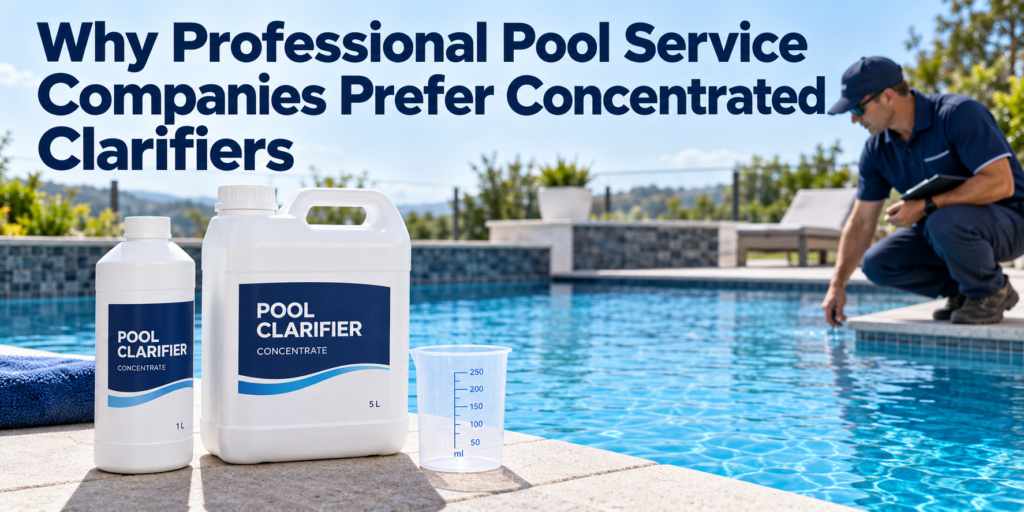
Featured image alt text: Concentrated pool clarifier bottle and jerrycan beside a measuring cup, with a professional technician checking clear swimming pool water.
Frequently Asked Questions
1. Are concentrated pool clarifiers better for professional pool service routes?
They can be a good fit when a validated lower dose reduces the product volume technicians need to carry. The advantage depends on treatment results, measuring accuracy, packaging, and cost per application.
2. How do I compare concentrated pool clarifier prices?
Calculate the cost at each product’s recommended dose for the same pool volume and treatment task. Then consider labor, delivery, filter maintenance, and any repeat applications needed to achieve an acceptable result.
3. Can concentrated polymer pool clarifier cause cloudy water if overdosed?
Yes. Depending on the formulation and pool conditions, excess polymer can interfere with clarification or contribute to persistent haze. Measure carefully and investigate a slow response before adding more product.
4. Should professional pool technicians dilute concentrated clarifier before use?
Only when the product instructions require or permit it. Some concentrates are applied directly at a measured dose. Others need specific preparation. Do not mix concentrated clarifier directly with other pool chemicals.
5. What should a pool service company check before buying clarifier in bulk?
Check performance, filter compatibility, dosing instructions, shelf life, storage conditions, batch consistency, and packaging. A field trial should confirm that the product works well and is practical for technicians to handle.