
GET IN TOUCH
Ask For Sample?
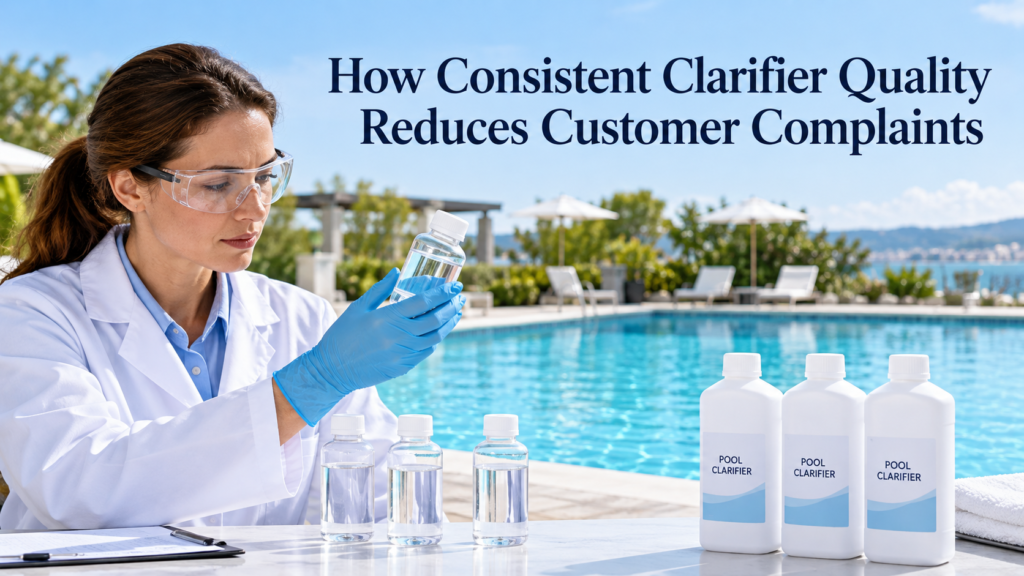
How Consistent Clarifier Quality Reduces Customer Complaints?
“The last bottle worked well. Why isn’t this one doing the same?”
For a pool chemical brand or distributor, that question deserves attention. A customer who has used a product with good results expects the next purchase to behave in a familiar way. The liquid should pour as expected. The directions should make sense. And, under comparable conditions, the treatment should deliver comparable performance.
When that experience changes without explanation, trust starts to slip.
Consistent clarifier quality helps reduce this uncertainty. It gives customers a more dependable product, helps service teams give sound advice, and makes complaints easier to investigate when something does go wrong.
That doesn’t mean every pool will clear at the same speed. Water conditions, filter performance, circulation, and dosing all affect the outcome. Yet a well-controlled clarifier removes one avoidable source of variation: the product itself.
For pool chemical suppliers, that can mean fewer preventable returns, less time spent on repeated support calls, and a stronger reason for customers to buy again.
Customers Buy the Same Bottle Because They Expect the Same Experience
Think about a pool service technician who maintains several pools each week.
After using a clarifier for a while, the technician learns how it fits into the maintenance routine. They know how to measure it, how it pours, and what to check before applying it. That familiarity saves time.
Now imagine a new shipment arrives. The product looks much thicker, the dosing statement has changed, and no explanation comes with it.
Even if the change has a reasonable cause, the technician must pause and ask questions. Has the concentration changed? Is the old dose still correct? Was the product stored badly?
A homeowner may have even less patience. They may simply conclude that the new bottle is faulty.
Consistency protects the experience customers have already learned to trust. It lets them follow a familiar process without having to solve a new puzzle each time they reorder.
The aim is controlled variation within agreed limits, supported by clear communication whenever a meaningful change occurs.
What Does Consistent Pool Clarifier Quality Actually Mean?
A consistent clarifier meets a defined specification from batch to batch and remains suitable for its intended use throughout its stated shelf life when stored as directed.
That sounds straightforward. But quality involves more than checking whether the liquid is blue or clear.
For a polymer pool clarifier, relevant controls may include:
- Correct polymer identity and grade
- Active polymer content or another clearly defined concentration measure
- Appearance and uniformity
- pH within an agreed range
- Viscosity measured under stated conditions
- Density, where useful for quality control or dosing
- Storage stability
- Packaging integrity and correct filling
- Performance in a suitable comparison test
The exact list depends on the formula. A single set of limits won’t suit every clarifier.
It also matters how each property is measured. A viscosity result without a test temperature or method may be hard to compare with another result. Likewise, total solids and active polymer content should not be treated as interchangeable unless the formulation and test method support that interpretation.
Good specifications make these details clear. They turn “the product seems fine” into something a buyer and supplier can both assess.
Stable Concentration Makes Dosing More Dependable
Customers usually measure a liquid clarifier by volume. They follow a label that gives a certain amount for a certain pool size.
That approach assumes the product concentration stays within its specified range.
Consider a simplified example. Two otherwise comparable batches contain 10% and 8% active polymer by weight. For an equal mass of product, the second batch supplies 20% less active polymer. Equal-volume dosing would also depend on density.
This example is not a dosing recommendation. It shows why concentration control matters.
If a product contains less active material than expected, customers may see a weaker response under comparable conditions. They may add another dose, wait longer, or call the retailer.
If it contains more than expected, the established directions may no longer match the product as closely.
A higher concentration is not automatically a better customer experience. The formula, dose, and label need to work together.
A dependable concentration helps make the stated dose meaningful. Customers still need to assess their pool, but they shouldn’t have to compensate for unexplained batch changes.
The Right Polymer Matters as Much as the Percentage
Two clarifiers can carry the same stated concentration and still behave differently.
Why? Because the polymer itself matters.
Polymer chemistry, molecular characteristics, and charge properties influence how a formulation interacts with suspended particles. Simply matching a percentage does not establish that two products will perform alike.
For cationic polymer clarifiers, positive charges can help reduce the repulsion that keeps certain fine particles dispersed. Depending on the polymer and conditions, particle aggregation may also involve bridging between particles. The resulting aggregates may be easier for a suitable filter to capture.
The practical lesson for buyers is simple: ask about the grade, not just the strength.
A supplier change that looks minor on a purchase order may affect the finished formula. A different raw material should therefore be assessed before it replaces the approved material in routine production.
Otherwise, a brand may discover the difference through customer complaints. That is an expensive way to learn.
Predictable Product Behavior Helps Prevent Repeat Dosing
When cloudy water doesn’t improve as expected, a customer may reach for the bottle again.
The thought is understandable: perhaps the first dose wasn’t enough.
Yet repeated dosing without checking the cause can create more uncertainty. The problem might involve a dirty filter, poor circulation, unsuitable water conditions, or a treatment that needs more time.
With some polymer systems, excessive dosing can impair clarification or add to filtration problems. The response depends on the chemistry and the pool, so the product’s directions should guide use.
Consistent quality helps by giving users a more dependable starting point. When the product stays within specification, support staff can focus on the dose, application method, water condition, and equipment.
Clear instructions should explain:
- How to calculate the initial dose
- How to measure it accurately
- What circulation is required
- When to assess the result
- What to check before adding more
A product that works well but leaves these questions unanswered can still generate avoidable complaints.
Appearance Changes Can Damage Trust Before Treatment Begins
Customers notice appearance long before they can judge performance.
They may spot a different shade of blue, an unusual haze in the bottle, or material near the bottom. A service technician may notice that the liquid pours differently.
None of these observations, by itself, proves that a batch is defective. Temperature can affect viscosity, and some formulations may have an acceptable range of color.
Still, unexplained changes raise fair questions.
For dyed clarifiers, shade control helps maintain a familiar appearance. The dye does not establish clarifying strength, and a darker product should not be presented as stronger without supporting evidence.
For clear products, an agreed appearance standard is equally useful.
Suppliers should define acceptable variation and explain any known, harmless changes. Unexpected separation, deposits, or major changes in appearance should be investigated against the specification.
Customers don’t need a chemistry lesson with every bottle. They do need confidence that someone has checked what they are receiving.
Consistent Quality Makes Customer Support More Useful
A complaint often starts with a brief message: “The clarifier didn’t work.”
That message leaves a lot unanswered.
Was the dose correct? Was the filter operating? What other chemicals were added? Was the pool cloudy from fine debris, active algae, or a different cause?
When batch quality is documented, the support team has a firmer basis for investigating those questions.
A useful complaint record includes the product name, batch number, purchase date, storage conditions, pool volume, dose, filter type, and treatment sequence. Photos and water test results can add context.
The team can then compare the reported batch with its production records and, where available, a retained sample.
This approach also helps avoid a common mistake: dismissing a complaint as user error before checking the evidence.
A well-controlled product can still have a genuine defect. Records make it easier to find that defect, limit its scope, and correct it.
Clear Water Still Depends on the Whole Pool System
Consistent clarifier quality improves reliability, but it cannot guarantee the same result in every pool.
A fine-particle haze in a well-maintained pool differs from cloudiness caused by algae, mineral precipitation, or poor filtration. The water may look similar from the pool deck, while the treatment needs differ.
Clarifier also relies on the removal process that follows particle aggregation. If circulation is weak or the filter needs attention, the outcome may disappoint even when the product meets specification.
CDC guidance for pool operators emphasizes maintaining filtration and recirculation systems according to manufacturer recommendations. That supports a key point: water clarity depends on the treatment system as a whole.
Brands should build this reality into their product guidance.
Instead of promising that every cloudy pool will clear within one fixed period, explain the conditions needed for good performance. Customers can accept that different pools take different amounts of work. What frustrates them is a promise that ignores those differences.
Clear Labels Are Part of Consistent Quality
A carefully blended product can still disappoint if its label is confusing.
One common source of trouble is concentration and dose language. A statement such as “dose at 2 ppm” may leave users wondering whether it refers to the supplied product or its active ingredient.
Retail directions should use clear units suited to the market and state the pool volume to which the dose applies. Technical documents should define any concentration basis used.
Labels should also agree with the current formula.
If a brand changes the concentration, it should review the dose, measuring method, packaging, and technical guidance together. Leaving old directions on a revised product creates an avoidable gap.
Filter suitability needs equal care. A product intended to assist filtration should not carry directions copied from a settling treatment that requires vacuuming to waste.
The words on the bottle are part of the product experience. Customers use those words to decide what to do next.
Packaging Problems Become Product Complaints
A leaking cap can undo the value of a good formulation.
Customers may receive a wet carton, a damaged label, or a bottle that appears partly empty. At that point, the complaint is about the clarifier brand, even if the liquid inside meets every chemical specification.
Useful packaging checks include:
| Packaging feature | Complaint it can help prevent |
|---|---|
| Suitable bottle and closure | Leakage or container damage |
| Controlled fill quantity | Concerns about short filling |
| Secure seal, where used | Doubts about leakage or prior opening |
| Legible, durable label | Lost directions and product confusion |
| Clear batch marking | Delays during complaint investigation |
| Suitable outer carton | Damage during handling and transport |
Measuring aids deserve attention too. If the directions refer to a capful, the cap’s usable measuring volume must be defined and suitable for the dose.
For larger containers, controlled pouring matters. A product that splashes or is hard to measure can lead to dosing mistakes even when the instructions are sound.
Storage Stability Helps the Product Reach Customers in Good Condition
A clarifier may pass its release checks and still face a demanding journey.
It may spend time in transport, a distributor’s warehouse, a retail storeroom, and a service vehicle. Those conditions can differ from the supplier’s test area.
Shelf-life claims and storage instructions should therefore reflect evidence for the finished formulation in its intended packaging.
Depending on the product, stability assessment may examine appearance, viscosity, pH, concentration, packaging compatibility, and performance over time. The test program should reflect realistic conditions for the markets being served.
A short heat exposure test alone does not establish every aspect of long-term shelf life.
Clear storage guidance also helps distributors manage stock. Readable date codes and sensible stock rotation reduce uncertainty about older inventory.
Consistency needs to last beyond the day of manufacture. Customers judge the bottle when they open it.
A Certificate of Analysis Helps—When It Answers the Right Questions
For bulk buyers, a certificate of analysis, or COA, provides a record of the batch supplied.
Its value depends on what it contains.
A useful COA identifies the product and batch, lists relevant acceptance limits, and reports the results of the stated checks. Where needed, the method or measurement conditions should be available.
Some properties are assessed as pass or fail. Others benefit from numerical results.
However, a COA cannot replace every other part of quality assurance. It may confirm selected chemical and physical properties without proving performance in every pool.
Buyers should ask which checks are completed for each batch, which are periodic, and how application performance was established.
The goal is a practical quality agreement. Both sides should understand what has been checked and what the results mean.
Comparison Testing Helps Catch Changes Before Customers Do
A controlled comparison can reveal differences that routine appearance checks may miss.
A supplier might compare a new batch with an approved reference using the same test water, dose, mixing procedure, contact time, and measurement method.
Depending on the formula’s intended use, the assessment may include residual turbidity, visual clarity, particle behavior, or a suitable filtration test.
The method needs a clear purpose. A simple settling test, for example, may not fully represent a product intended to work through continuous pool filtration.
Testing should also have defined limits. If “looks about right” is the only acceptance rule, different staff may reach different decisions.
A small, repeatable test with a clear interpretation can be more useful than an elaborate demonstration that changes each time.
It gives the supplier a chance to catch variation while the batch is still under its control.
Fewer Complaints Can Lower Costs Across the Supply Chain
A complaint costs more than the replacement bottle.
Someone must answer the message, collect information, review records, and arrange the response. A distributor may need to visit the customer. A pool service company may need to return to the site.
These costs can spread through the supply chain.
Consistent quality can help reduce the share of complaints caused by product variation. It may also shorten investigations because the supplier has reliable records.
The size of that benefit should be measured rather than assumed.
Brands can track complaints per defined sales volume, replacement costs, repeat complaints, and the causes found during investigation. Complaint rates should be interpreted alongside sales growth and reporting changes; fewer reports alone do not prove better quality.
There is no sound universal percentage for complaint reduction. The useful figure is the one supported by a company’s own records.
Private-Label Brands Have an Extra Reason to Care
With private-label supply, customers usually see the brand owner’s name first.
They may know nothing about the manufacturer behind the product. If a batch behaves differently, the brand owner receives the questions.
That makes an agreed specification especially valuable.
Before routine supply begins, the buyer and supplier should establish the approved formulation, packaging, appearance, dose guidance, quality documents, and process for handling changes.
The approved sample should represent the intended commercial product. Bulk shipments then need to meet the agreed requirements.
Eautrix’s <u>Polymer Pool Clarifier</u> page describes a PolyDADMAC-based product with formulation adjustment, packaging, and private-label services. Buyers discussing a customized product should confirm the specification and label directions for that exact version. Eautrix
A clear agreement helps both parties protect the experience promised under the label.
Build Quality Around the Complaints You Want to Prevent
The most useful quality program connects checks with real customer concerns.
If customers report leaks, examine closures and transport conditions. If they report changing pour behavior, review viscosity records and temperature effects. If results vary, check the formula, dose guidance, water conditions, and filtration requirements.
Complaint trends can reveal where a specification or instruction needs work.
They can also show that a product change is unnecessary. Sometimes clearer measuring directions solve the problem more effectively than adjusting the formula.
For pool brands and distributors, the aim is dependable use: a product that meets its specification, arrives in good condition, and comes with directions customers can follow.
That combination gives buyers fewer reasons to call with a problem—and more confidence when it is time to reorder.
Frequently Asked Questions
1. Can consistent pool clarifier quality eliminate customer complaints?
No. It can reduce complaints linked to product variation, but dosing errors, poor filtration, storage problems, and different causes of cloudy water can still affect results.
2. Which quality checks matter when buying polymer pool clarifier in bulk?
Confirm polymer identity, the concentration basis, relevant physical properties, storage stability, packaging quality, and suitable performance testing. Agree on test methods and acceptance limits before routine supply.
3. Why might the same clarifier dose give different results in two pools?
Pool volume, particle type, water chemistry, circulation, and filter condition can differ. Consistent clarifier quality improves the reliability of the product input; it does not make the pools identical.
4. Does a darker blue pool clarifier have a higher active concentration?
Not necessarily. Dye controls color, while active polymer content is a separate property. Compare the stated specification and supporting test information rather than judging strength by shade.
5. How can private-label pool clarifier brands reduce repeat complaints?
Approve a clear product specification, verify commercial batches, use accurate labels, and maintain batch traceability. Record complaint details so the supplier can distinguish product defects from application or equipment issues.