
GET IN TOUCH
Ask For Sample?
Building a Complete Pool Maintenance Line with Polymer Pool Clarifier
A pool owner buys chlorine, checks the water, and runs the pump. Yet the pool still looks a little dull.
It’s a familiar problem. The water may have a faint haze, or fine dust may linger after a busy weekend. The owner wants a clear answer: “What should I use next?”
For pool chemical brands and distributors, that question reveals a gap worth addressing. A well-planned maintenance line should help customers understand the different jobs involved in pool care—and choose a product that fits the problem.
Polymer pool clarifier fills the fine particle removal role. It can support filtration by helping certain small suspended particles form larger aggregates that a suitable filter can capture.
That makes it a useful addition to a broader range. But adding one more bottle is only the start. The real work lies in giving each product a clear purpose, writing sound instructions, and making the whole range easy to use.
Here’s how to build that system.
Start with Pool Problems, Then Build the Product Range
It’s tempting to begin with a supplier’s catalog. There are dozens of products, plenty of pack sizes, and enough label ideas to fill a warehouse.
A better starting point is the customer’s maintenance routine.
What does the customer need to measure? What needs to be controlled? What can go wrong? And which problems require physical cleaning rather than another chemical?
Most pool care needs fall into a few broad groups:
- Maintaining an appropriate disinfectant level.
- Managing pH and other water balance factors.
- Removing leaves, dirt, and suspended particles.
- Addressing algae when needed.
- Managing site-specific issues such as metals, scale, or oily deposits.
- Keeping filters and circulation equipment working.
These needs overlap, but they aren’t interchangeable.
A pH adjuster won’t fix a broken filter. A clarifier won’t remove leaves from the pool floor. An algaecide won’t take the place of routine water testing.
A complete maintenance line makes those boundaries clear. Customers should be able to look at the range and understand where each product belongs.
Give Polymer Pool Clarifier a Clear Job
The simplest useful description is this:
A polymer pool clarifier helps a compatible filtration system remove certain fine suspended particles.
Many fine particles in pool water carry surface charges that help keep them dispersed. A suitable cationic polymer can interact with those particles and encourage them to come together. The exact process depends on the polymer, the particles, and the surrounding water chemistry.
Think of loose crumbs on a table. Gathering them into a small pile makes them easier to collect. Clarification works through chemistry rather than a brush, but the idea is similar: change how small particles behave so removal becomes easier.
The filter still does essential work.
If water bypasses the filter, circulation is weak, or the filter needs service, clarifier may produce a poor result. Likewise, cloudiness caused by active algae or mineral precipitation requires attention to the underlying cause.
For a brand, this leads to a stronger product promise: support the removal of fine particles under stated conditions. Claims such as “fixes all cloudy water” invite confusion.
Build the Core Line Around Complementary Functions
A useful product range doesn’t need a long list of specialty bottles on day one. It needs a solid core.
The following framework can help brands plan their offer:
| Product category | Main role | Connection to polymer clarifier |
|---|---|---|
| Pool sanitizer | Maintains disinfection according to its label | Clarifier supports particle removal but does not replace sanitation |
| pH and water balance products | Correct measured water balance needs | Help address conditions that may contribute to poor clarity |
| Algaecide | Provides the algae control stated on its label | Clarifier may help remove residual particles after appropriate treatment |
| Polymer pool clarifier | Supports removal of fine suspended particles | Works with compatible filtration |
| Pool flocculant | Produces aggregates for a defined removal process, often settling | Serves a different treatment method and needs separate instructions |
| Filter cleaner | Removes deposits from suitable filter media or components | Helps maintain the equipment needed for particle removal |
| Metal and scale treatment | Addresses specific metal or scale concerns | Deals with issues that a general clarifier may not resolve |
Not every customer needs every category.
A residential brand may begin with a compact range. A distributor serving hotels, service firms, and public pools may need more specialized products, along with stronger technical support.
The goal is coverage with purpose. Each addition should solve a real need that the existing range does not handle well.
Keep Clear Water and Safe Water Distinct
Clear water is appealing. It helps customers see the result of their maintenance work.
But appearance alone cannot show whether water is properly disinfected.
The CDC emphasizes regular disinfectant and pH testing as part of pool care. Its guidance for public facilities also calls for maintaining adequate disinfectant levels and checking water before opening. These responsibilities remain in place when a clarifier is used.
That distinction belongs in product training and customer communication.
A label should not imply that a clarifier sanitizes water unless that specific product has the required evidence and authorization for such a claim. Even a dramatic improvement in appearance does not establish microbiological safety.
For sales teams, a short explanation works well:
“Clarifier helps with fine particle removal. Keep testing and maintaining your sanitizer and water balance as usual.”
It’s clear, useful, and easy to remember.
Decide Who the Clarifier Is For
One formulation and one label may struggle to serve every buyer.
A homeowner with a small pool needs simple directions and a practical measuring method. A pool service technician may care more about pack handling, dose consistency, and use across several sites. A commercial operator may need detailed documentation and approval within an existing treatment program.
Before choosing a formula, define the main customer.
Consider:
- Typical pool volume.
- Common filter types.
- Indoor or outdoor use.
- The buyer’s level of technical knowledge.
- Local water conditions.
- Expected storage and transport conditions.
- Whether dosing will be manual or through approved equipment.
These details affect both product design and customer support.
For example, a highly concentrated product may reduce the amount shipped per treatment. Yet if the dose is too small for a homeowner to measure well, that advantage can turn into a practical problem.
A product should suit the person who will use it.
Choose the Formulation Through Testing
Polymer chemistry matters, but an ingredient name does not tell the whole performance story.
PolyDADMAC, for example, is a cationic polymer used in some clarification formulations. Its suitability for a finished pool product depends on the grade, concentration, formulation, dose, and intended conditions.
Even two products with similar stated polymer content may behave differently.
A sensible development program should examine:
- Clarity improvement in representative test water.
- The useful dose range.
- Performance when the dose is too low or too high.
- Filter compatibility.
- Handling and pourability.
- Storage stability.
- Packaging compatibility.
Testing should reflect the market you intend to serve. A result from one prepared water sample offers useful information, but it does not establish performance in every pool.
Where field trials are possible, record the starting conditions, dose, filter type, circulation details, and observations. Without that context, “it worked well” is hard to interpret.
The aim is a formula with dependable behavior and instructions that match the evidence.
Don’t Let “More Concentrated” Do All the Selling
Concentration is easy to compare on a specification sheet. Value is harder.
Buyers may assume that a higher percentage always means a better clarifier. Yet finished-product performance also depends on polymer properties, water conditions, dosing accuracy, and the removal system.
For a distributor, the useful comparison is often cost per validated treatment, rather than cost per bottle or percentage alone.
That comparison needs care. Different products may have different dose ranges and treatment conditions. A low theoretical treatment cost means little if the product is difficult to measure or performs poorly in the target application.
Ask practical questions:
Can users measure the dose with the supplied cap? Does the liquid pour cleanly? Are the units clear? Will the bottle last so long that customers struggle to store it correctly?
The strongest product is one that combines sound performance with manageable use.
Make the Clarifier Fit the Maintenance Routine
A complete range should tell a coherent story.
For clarifier, that story usually begins with checks rather than immediate dosing:
- Test the water and address measured maintenance needs.
- Remove visible debris and inspect circulation.
- Check that the filter is operating properly.
- Consider whether fine suspended particles are the likely cause of haze.
- Use a suitable clarifier according to its label.
- Monitor the result and service the filter as directed.
This is a decision path, not a universal treatment recipe. Particular situations may call for a different response.
For example, green water with active algae needs appropriate diagnosis and treatment. Adding clarifier alone may leave the main problem untouched.
Customer instructions should also explain when to stop and seek help. Persistent cloudiness after treatment is a reason to reassess water conditions and equipment, rather than keep adding more product.
Separate Clarifier from Flocculant on the Shelf
Clarifiers and flocculants can confuse customers because both involve particle aggregation.
The practical difference often lies in the intended removal process.
A filter-aid clarifier is typically designed to work with filtration. A settling flocculant may require a separate procedure involving settling and vacuuming to waste, where the pool system supports it. Product labels determine the actual method.
That distinction should be visible on the packaging.
If your range includes both products, use plain descriptions such as:
- “Helps the filter capture fine particles.”
- “Settles suspended material for removal using the stated procedure.”
These descriptions still need to match the tested product.
Avoid giving both bottles nearly identical names and relying on small print to explain the difference. A rushed customer may choose the wrong one, especially during a cloudy-water problem.
Good shelf design reduces that risk before a support call is needed.
Treat Compatibility as a Specific Claim
“Compatible with pool chemicals” sounds reassuring. It is also broad.
A product may be suitable for use in a pool maintained with chlorine while being unsuitable for direct mixing with concentrated chlorine products. Those are very different conditions.
Training materials should keep them distinct.
The same care applies to filter claims. Sand, cartridge, and diatomaceous earth systems do not all behave in the same way. Compatibility should be supported for the finished formulation, with attention to filter manufacturer instructions.
Saltwater pool claims also need a clear basis. A salt chlorinator produces chlorine, but salt content, equipment requirements, and the finished formula still matter.
Build a claim list during development. For each proposed statement, record the evidence behind it and any limits.
That small step can prevent sweeping claims from slipping into labels, brochures, or distributor presentations.
Use Packaging That Helps People Dose Well
Packaging is part of the treatment experience.
A bottle that leaks, glugs, or drips can make a sound formula frustrating to use. A cap without clear markings can turn a simple dose into a guess.
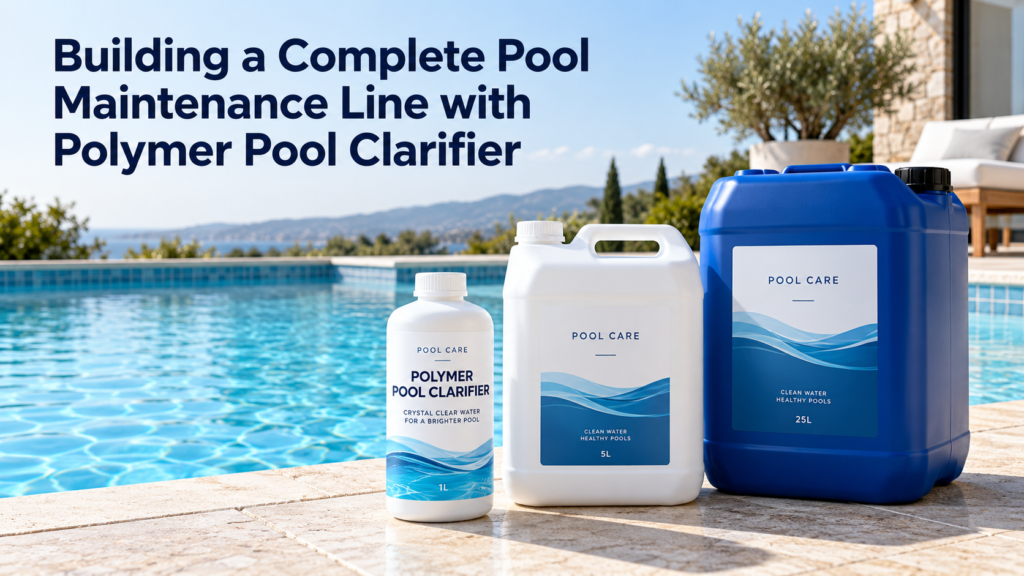
For a polymer pool clarifier range, possible formats include a 1L bottle for smaller users, a 5L container for repeat use, and a 25L container for suitable professional channels. The right sizes depend on dose rate, shelf life, handling, and local demand.
Evaluate the complete pack:
- Can users lift and pour it safely?
- Is the closure secure?
- Are measuring marks readable?
- Does the label remain legible after handling?
- Is the container suitable for the formulation?
- Can distributors store and ship it efficiently?
Use a shared visual style across the line, but give each function a clear identity.
Color can help people find a bottle. It should not be the only way they distinguish clarifier from sanitizer or algaecide.
Write Instructions for a Busy Person
People rarely read pool chemical labels in perfect conditions.
They may be standing in bright sun, wearing gloves, or trying to solve a problem before guests arrive. Instructions need to work in that setting.
A useful clarifier label should address pool volume, dose, application method, relevant circulation requirements, filter compatibility, and repeat-treatment limits. Any dilution step must be supported by the formula and clearly described.
Avoid vague directions such as “add as needed.”
Also avoid transferring a dose from another clarifier. Different formulations can require different amounts, even when the products have similar names.
Overdosing deserves clear attention. Depending on the formulation and conditions, excessive polymer can interfere with clarification or create extra filtration problems. More product is not a dependable route to faster results.
If no improvement occurs, customers need a reassessment step—not an open invitation to keep dosing.
Build Private Label Supply Around Consistency
Private label pool clarifier gives a brand control over presentation, pack sizes, and market positioning. Long-term success, though, depends on repeatable supply.
The buyer and manufacturer should agree on a finished-product specification before regular orders begin.
Useful control points may include appearance, pH with a stated test method, viscosity where relevant, density, and a suitable measure of polymer or solids content. These terms need careful definition: solids content and active polymer content are not automatically the same thing.
The supply agreement should also cover batch identification, retained samples, documentation, and notice of meaningful changes.
Ask what happens if a raw material source changes. Will the supplier assess the effect? Will the brand be informed? Could the label directions need review?
Customers expect the next bottle to behave like the last. Consistency makes that expectation easier to meet.
Give Distributors a Simple Training Kit
A distributor does not need a chemistry lecture to explain clarifier well.
A short training kit can do more than a dense technical brochure. Include a product-role chart, a filter compatibility summary, a dosing example based on the approved label, and a troubleshooting sheet.
Teach staff to ask a few useful questions:
What does the water look like? What do the test results show? Is the filter running normally? What has already been added?
Those questions help prevent a quick sale from becoming a poor recommendation.
Keep treatment records during service trials, too. A before-and-after photo can show appearance, but it cannot show dose accuracy, water balance, or filtration conditions.
When images are used in marketing, describe them honestly. Controlled trials and real customer cases should remain distinct from illustrative product photography.
Launch a Useful Range, Then Expand with Evidence
A small, well-supported range is easier to manage than a crowded catalog.
For a new brand, one validated clarifier in a few practical pack sizes may be a sensible start. Expansion can follow when sales data and customer feedback show a clear need.
Track more than shipment volume.
Look at repeat orders, dose-related questions, packaging complaints, filter compatibility queries, and cases where customers expected clarifier to solve another problem.
These details reveal where the product or its explanation needs work.
A new specialty SKU may be justified. Or the answer may be a clearer label, better staff training, or a more useful troubleshooting page.
Building a complete pool maintenance line is an ongoing process of making the range easier to understand and more dependable to use. Polymer pool clarifier earns its place when its role is clear, its claims are supported, and its instructions help customers achieve the intended result.
That is what turns an extra bottle into a useful part of the brand.
FAQs
1. Where Does Polymer Pool Clarifier Fit in a Complete Pool Chemical Line?
Polymer pool clarifier fills the fine particle removal role. It supports compatible filtration and complements sanitizers, water balance products, and other targeted treatments. It does not replace those maintenance steps.
2. Can a Private Label Pool Clarifier Be Sold Alongside Algaecide?
Yes. The products can serve complementary roles within a range, provided their labels explain their separate functions. Selling them together does not mean they can be mixed directly or applied at the same time.
3. What Is the Best Pack Size for a Pool Clarifier Product Range?
It depends on the dose rate and customer. A 1L bottle may suit smaller users, while 5L or 25L containers may suit service channels. Confirm demand, handling needs, and storage conditions before choosing sizes.
4. Is a Higher Polymer Concentration Always Better for Pool Clarifier?
No. Performance also depends on polymer properties, formulation, water conditions, dose, and filtration. Compare validated treatment performance and ease of use, rather than concentration alone.
5. What Should Buyers Check Before Ordering Bulk Polymer Pool Clarifier?
Check the finished-product specification, supported dose, filter compatibility, stability information, packaging suitability, batch traceability, and available technical documents. Test samples under representative conditions before committing to regular supply.