
GET IN TOUCH
Ask For Sample?
Why Pool Water Chemistry Requires Balanced Algae Control?
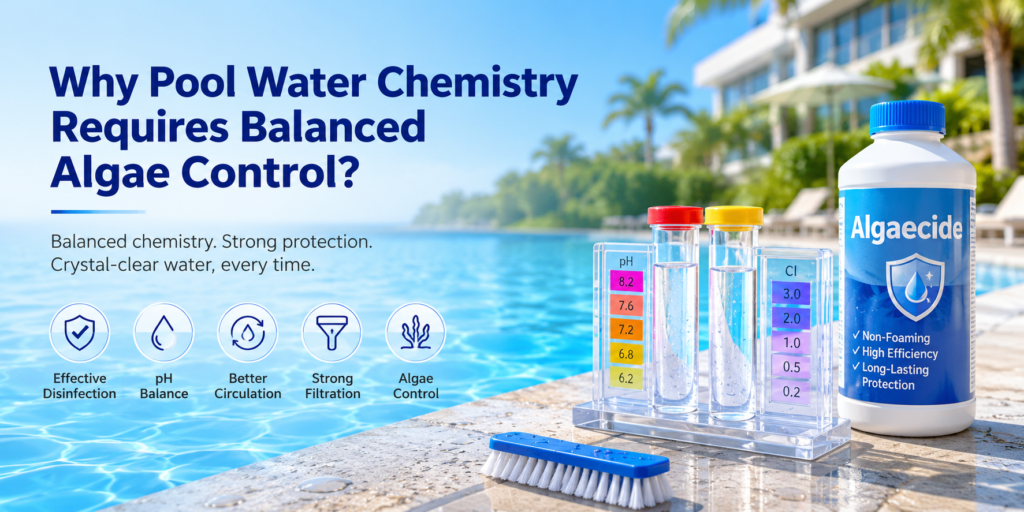
A swimming pool can look perfectly clear on Monday and start showing a faint green tint by Thursday. Sometimes chlorine is still present. The filtration system is running. The maintenance team may even have checked the pH.
So, what happened?
The problem is that algae control doesn’t work in isolation. It sits inside a much larger chemical system where sanitizer level, pH, water circulation, organic load, temperature, filtration, and algaecide treatment all affect one another.
That is why good pool maintenance isn’t simply about adding more chlorine whenever something looks wrong. Nor is it about pouring in algaecide and hoping for the best.
It is about balance.
When pool water chemistry stays within a suitable operating range, chlorine can work more effectively, algaecides can support the sanitation program, and the filtration system has a better chance of keeping the water visually clean. When that balance slips, algae can gain an opening surprisingly quickly.
This matters for backyard pools, of course. But it matters even more for hotels, resorts, water parks, public pools, pool service companies, and chemical brands responsible for maintaining many pools under changing conditions.
Pool Chemistry Is a System, Not a Collection of Bottles
Walk into a pool equipment room and you’ll probably see several chemical containers. Chlorine products, pH adjusters, alkalinity products, perhaps a clarifier and an algaecide may all be sitting there.
It is tempting to think of each product as solving one separate problem.
Chlorine kills microorganisms. Acid lowers pH. Algaecide controls algae. Clarifier improves water clarity.
Simple, right?
Not quite.
Pool water behaves more like a small ecosystem combined with a chemical reactor. Change one condition and another part of the system may respond.
For example, pH influences sanitizer effectiveness. Heavy swimmer load introduces organic material that increases sanitizer demand. Poor circulation creates areas where chemicals are not distributed evenly. Warm weather can increase biological pressure. Debris and nutrients entering the pool may provide better conditions for algae.
That is why algae control needs to be considered within the entire water-treatment program.
A maintenance technician who only looks at whether “algaecide was added” is missing half the picture.
Chlorine Is Powerful—but Its Performance Depends on Water Chemistry
Chlorine remains one of the most important tools used in swimming pool sanitation.
But chlorine doesn’t behave exactly the same under every water condition.
One particularly important variable is pH.
When chlorine is added to water, part of it exists as hypochlorous acid (HOCl), while another part exists as hypochlorite ion (OCl⁻). The balance between these forms changes with pH.
Hypochlorous acid is the more effective disinfecting form.
As pH rises, a larger proportion shifts toward hypochlorite ion. In practical terms, excessively high pH can reduce the effectiveness of a given free-chlorine concentration.
This leads to a situation that sometimes confuses pool owners.
They test the water and see chlorine.
Yet algae still begins developing.
The chlorine reading isn’t necessarily meaningless. It simply doesn’t tell the entire story.
The chemical environment determines how effectively that sanitizer can perform.
A Chlorine Reading Doesn’t Tell You Everything
Imagine two pools showing similar free-chlorine readings.
Pool A has good circulation, controlled pH, relatively low organic contamination, clean filtration equipment, and a consistent maintenance schedule.
Pool B has warm water, heavy swimmer use, debris collecting near the steps, weak circulation in one corner, and chemistry that has been allowed to drift.
Should we expect exactly the same algae risk?
Probably not.
This is where routine pool maintenance becomes more interesting than simply chasing numbers on a test strip.
Algae tends to exploit weak points.
It may begin around ladders, steps, corners, behind fittings, or other places where circulation is weaker. Once growth becomes established, the maintenance challenge can become much larger.
Preventive control therefore requires looking beyond a single sanitizer measurement.
pH Deserves More Attention Than It Usually Gets
pH sometimes feels like the boring number on a pool test.
People get excited about green water. Nobody gets particularly excited about a pH reading.
Yet pH affects several aspects of pool operation, including sanitizer behavior and swimmer comfort.
For many conventional chlorinated pools, operators commonly manage pH within a relatively narrow range suitable for both chlorine performance and comfortable swimming.
When pH climbs too high, sanitizer performance can suffer. Other water-quality issues may also become more difficult to manage.
Push it too low and different problems appear, including potentially corrosive water and swimmer discomfort.
The goal, then, isn’t “lower pH is better.”
It is balanced pH.
That distinction matters because algae control isn’t about maximizing every chemical parameter. It is about keeping several parameters in ranges where they can work together.
Think of an orchestra. Making the trumpet louder doesn’t improve the music if everything else falls apart.
Pool chemistry is surprisingly similar.
Then There Is Circulation—the Invisible Part of Algae Control
Chemical treatment receives most of the attention because chemicals are easy to measure and easy to blame.
Circulation is less obvious.
Yet even well-adjusted pool water can develop trouble if treated water doesn’t move effectively throughout the entire pool.
Weak circulation may create localized areas where sanitizer concentrations are less consistent. These areas can become favorable locations for algae establishment, especially when combined with warm surfaces, sunlight, or accumulated debris.
Steps and corners are common suspects.
So are areas around fixtures and other surfaces where water movement is limited.
This explains why brushing remains useful even when a pool has automatic chemical dosing. Physical maintenance disrupts material attached to surfaces and helps expose those areas to properly treated water.
Chemistry and mechanics need each other.
Filtration Has a Seat at the Table Too
Algae control is often discussed as if it were purely a chemical battle.
It isn’t.
Filtration removes suspended material from pool water and helps maintain clarity. When algae has been damaged or killed through treatment, the resulting particles still need to go somewhere.
If filtration performance is poor, those particles can remain suspended.
The pool may technically have undergone successful treatment while still looking cloudy or unattractive.
For commercial operators, that distinction doesn’t offer much comfort. Guests judge a swimming pool with their eyes first.
Clear-looking water therefore depends on several processes happening together:
- adequate sanitation;
- balanced water chemistry;
- effective circulation;
- proper filtration;
- physical cleaning;
- suitable algae prevention.
Remove one piece and the others may need to work much harder.
Algae Loves Opportunity
Algae problems rarely come from one dramatic event.
More often, several small conditions line up.
A hot week arrives. Swimmer traffic increases. Leaves blow into the pool. Chlorine demand rises. The filter hasn’t been cleaned recently. One corner isn’t getting much circulation.
Nothing sounds catastrophic by itself.
Together? That’s different.
Organic contamination can increase sanitizer demand, while environmental material may contribute nutrients that support biological growth. Outdoor pools face additional pressure from dust, rainwater, vegetation, insects, and whatever else the wind decides to deliver that afternoon.
This is why a pool that behaves beautifully during mild spring weather may become considerably more demanding during peak summer.
The maintenance program hasn’t necessarily stopped working. The operating conditions have changed.
Why “Just Add More Chlorine” Isn’t Always a Great Strategy
When algae appears, increasing sanitizer treatment may be part of corrective action.
But continually responding to every algae risk with more sanitizer isn’t the same as having a balanced preventive program.
Chemical over-treatment can increase operating costs and may contribute to undesirable water conditions. More importantly, it can distract operators from the underlying reason algae keeps returning.
Suppose the real issue is poor circulation behind a pool ladder.
Adding chemicals again and again without correcting that weak spot is rather like repeatedly drying the kitchen floor while ignoring the leaking pipe.
You may temporarily improve the situation.
You haven’t solved it.
Professional algae management therefore asks a better question:
Why are conditions allowing algae to establish in the first place?
Once that question is answered, chemical treatment becomes much more purposeful.
So, Where Does Algaecide Fit?
An algaecide can provide an additional layer of algae control within the broader pool maintenance program.
That word—additional—matters.
An algaecide should generally be viewed as part of a coordinated treatment approach rather than as a substitute for proper sanitation, circulation, filtration, and water balance.
Different algaecide chemistries work in different ways.
Some formulations are metal-based. Others rely on quaternary ammonium compounds or polymeric quaternary ammonium chemistry. Their characteristics can differ in areas such as foaming tendency, compatibility, treatment concentration, and suitability for particular maintenance programs.
For commercial pool-care programs, operators often pay close attention not only to whether a product controls algae but also to what else it does—or doesn’t do—to the pool.
Does it create persistent foam?
Could it contribute unwanted metals?
Does it fit comfortably alongside the existing sanitizer program?
Can it be incorporated into routine preventive maintenance?
These practical questions matter just as much as the chemistry printed on a technical data sheet.
Why Polymeric Algaecides Have a Place in Preventive Pool Care
Polymeric quaternary ammonium compounds are used in some pool algaecide formulations because they can provide algae-control activity while offering useful formulation characteristics.
One well-known example is Polyquat 60, a concentrated polymer-based algaecide used in swimming pool treatment programs.
Unlike some conventional low-molecular-weight quaternary ammonium algaecides, properly formulated polymeric products are valued particularly where low-foaming or non-foaming performance is important.
That becomes relevant in pools with strong water movement.
Think about spas, fountains, return jets, water features, or busy commercial pools. Nobody wants a layer of foam appearing across the water after routine algae treatment.
For pool chemical formulators and professional maintenance companies evaluating this type of chemistry, Polyquat 60 Algaecide can be considered as one component of a broader preventive algae-control program rather than a replacement for the primary sanitizer.
The distinction may sound small, but it prevents a lot of misunderstanding.
Preventive and Reactive Algae Treatment Are Different Jobs
There is another piece of the puzzle: timing.
Preventing algae and treating an established algae problem aren’t exactly the same task.
Preventive maintenance tries to keep conditions unfavorable for algae establishment. Reactive treatment deals with growth that has already become visible or otherwise evident.
Once a pool has developed significant algae growth, the maintenance program may require more intensive treatment, brushing, filtration, cleaning, and chemistry correction.
Preventive treatment tends to be less dramatic.
And that’s actually the point.
The best algae-control event is often the one nobody notices because the water simply stays clear.
This is especially important for commercial pools. A hotel cannot exactly tell guests, “The pool should look great again on Thursday.”
Appearance is part of the product being sold.
Weather Can Change the Chemistry Faster Than You Think
Outdoor pools never operate in laboratory conditions.
Sunlight, temperature, rainfall, wind, and seasonal debris constantly change the treatment environment.
Warm weather can increase biological activity and often coincides with heavier pool use. More swimmers mean more material entering the water—sweat, sunscreen, cosmetics, and other organic contaminants.
Rain can also alter water conditions, while storms may carry significant amounts of environmental debris into outdoor pools.
Then comes the day after the storm.
The water may still look fine.
That can create false confidence.
Algae growth doesn’t always announce itself immediately. Preventive maintenance becomes especially valuable during periods when environmental pressure is rising but visible water quality hasn’t deteriorated yet.
Heavy Swimmer Load Changes the Equation Again
A residential pool used by three people over a quiet weekend doesn’t face the same operating conditions as a resort pool serving hundreds of guests.
Commercial pool operators have to think in terms of changing load.
More swimmers generally mean greater sanitizer demand and more contamination entering the water. Filters work harder. Chemical consumption changes. Maintenance intervals may need adjustment.
A fixed treatment routine that works during a quiet period may therefore become inadequate during holidays or peak summer occupancy.
This is why professional pool management should respond to actual operating conditions rather than follow a chemical schedule blindly.
Testing tells you what the water is doing.
Observation tells you what the pool is experiencing.
You need both.
Balanced Algae Control Also Means Avoiding Unwanted Side Effects
There is a subtle point here.
A chemical can solve one problem while creating another.
Some algaecide approaches, for example, may raise concerns about foaming or the introduction of metals depending on the chemistry and formulation being used.
For a commercial facility, water appearance matters enormously. Staining, discoloration, excessive foam, or persistent cloudiness can damage the customer’s perception of cleanliness even when microbiological conditions are being managed.
This makes product selection more nuanced.
“Does it kill algae?” is only the first question.
A better purchasing discussion might include:
How does this product behave within the complete pool treatment system?
That is where chemistry, formulation experience, and real operating conditions meet.
A Balanced Program Is Usually a Preventive Program
There is a pattern behind well-maintained pools: problems are managed before they become visually obvious.
That doesn’t mean endlessly adding chemicals.
Quite the opposite.
A balanced preventive approach aims to maintain conditions where each part of the treatment program can perform its intended job.
Sanitizer handles primary disinfection.
Water balance supports effective treatment and protects pool infrastructure.
Circulation distributes treated water.
Filtration removes suspended contaminants.
Brushing and cleaning address surfaces and debris.
Algaecide provides additional support against algae where appropriate.
None of these should be expected to carry the entire workload alone.
That is what balanced algae control really means.
The Goal Isn’t More Chemistry—It’s More Stable Water
It is easy to assume that sophisticated pool maintenance means using more products.
Often, good maintenance means needing fewer emergency corrections.
Stable water chemistry reduces surprises.
When pH, sanitizer residual, circulation, filtration, cleaning, and preventive algae control are managed together, operators have a better chance of keeping water consistently clear rather than moving through an exhausting cycle of clear water, green water, shock treatment, cloudy water, and recovery.
Commercial operators benefit in another way: predictability.
Emergency algae treatment costs labor. It consumes chemicals. It may interrupt pool availability. And for hotels or resorts, an unattractive pool can affect guest experience immediately.
Prevention isn’t glamorous.
Neither is changing the oil in your car. But skipping it tends to make life more interesting later—and not in a good way.
Bringing Everything Together
Balanced algae control starts with recognizing that algae is not an isolated chemical problem.
It is influenced by the entire pool environment.
Sanitizer concentration matters, but so does pH. Algaecide can help, but circulation still matters. Filtration removes material, but surfaces also need cleaning. Weather, swimmer load, organic contamination, and seasonal conditions can shift the treatment requirement from one week to the next.
This is why professional pool maintenance programs combine routine testing with preventive treatment and physical pool care.
For chemical formulators, pool brands, and maintenance companies, product selection should follow the same logic.
An algaecide shouldn’t simply be judged by how aggressively it attacks algae. Compatibility, foaming behavior, formulation characteristics, and its role within the overall treatment program deserve attention too.
Clear water is rarely the result of one powerful chemical.
It is the result of several things quietly working together.
And when that balance is right, most swimmers will never know how much chemistry is happening beneath the surface.
Frequently Asked Questions
1. Why can algae grow even when chlorine is present in a swimming pool?
A measurable chlorine residual doesn’t automatically mean algae pressure is fully controlled. pH, circulation, organic contamination, sanitizer demand, sunlight, temperature, and localized low-flow areas can all affect actual pool conditions. Balanced pool chemistry and good physical maintenance remain important.
2. Does an algaecide replace chlorine in pool maintenance?
Generally, no. Pool algaecides are commonly used as supplemental algae-control products within a broader sanitation and maintenance program. The primary sanitizer, filtration, circulation, cleaning, and balanced water chemistry still perform essential roles.
3. Why is pH important for swimming pool algae control?
pH affects chlorine chemistry and therefore influences sanitizer performance. Keeping pH within the appropriate operating range helps the sanitation program work effectively while also supporting swimmer comfort and protection of pool equipment.
4. What are the advantages of a non-foaming Polyquat 60 pool algaecide?
A properly formulated Polyquat 60 algaecide can provide supplemental algae control without the persistent foaming associated with some conventional quaternary ammonium products. This characteristic can be useful for commercial pools, spas, water features, and other systems with substantial water movement.
5. What is the best way to prevent recurring algae in commercial swimming pools?
A strong preventive algae-control program combines suitable sanitizer levels, balanced pH and other water parameters, effective circulation and filtration, routine brushing and cleaning, regular testing, and an appropriate preventive algaecide where needed. Treatment should also be adjusted for swimmer load, weather, temperature, and other changing operating conditions.