
GET IN TOUCH
Ask For Sample?
What Pool Owners Should Know About Polyquat Technology?
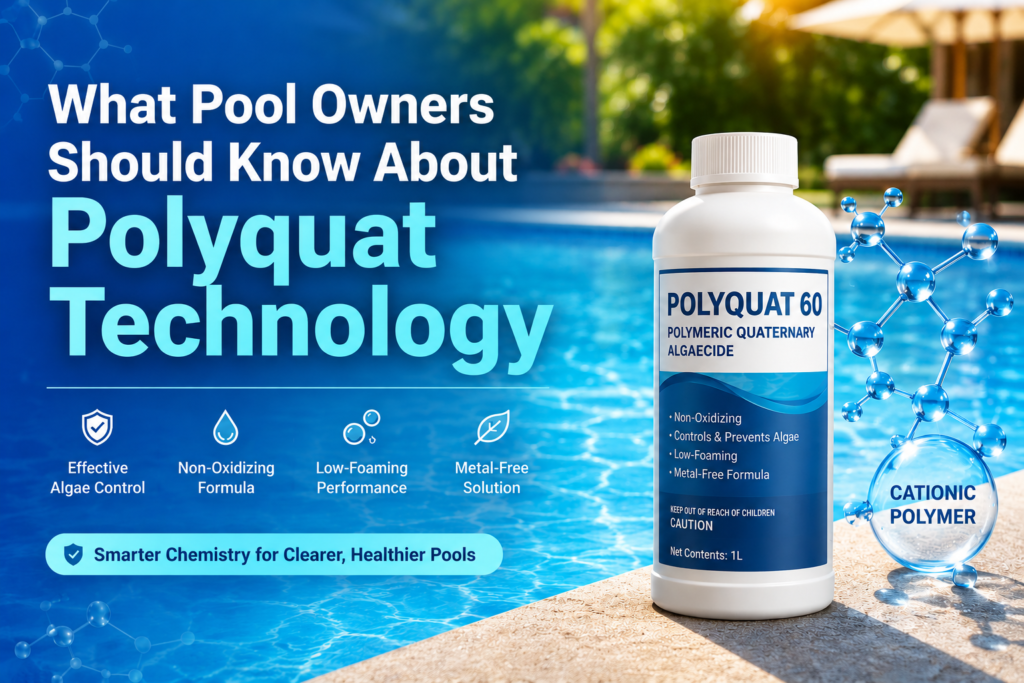
A swimming pool can look wonderfully simple from the deck: clear blue water, a clean tile line, sunlight moving across the surface. Behind that calm appearance, though, there’s quite a bit going on.
Warm water, sunlight, swimmers, rain, leaves, sunscreen, dust, and changing sanitizer levels all affect water quality. Give algae the right combination of nutrients, warmth, and weak sanitizer coverage, and that sparkling pool can begin to look dull surprisingly fast.
That’s one reason pool owners often hear about Polyquat technology when researching algae control.
Polyquat-based algaecides have become a familiar part of preventive pool maintenance because they offer a different approach from traditional metallic algaecides and some simple quaternary ammonium compounds. They’re generally valued for their non-metal chemistry, low-foaming characteristics, and ability to support an existing pool sanitation program.
But what exactly is a Polyquat? How does it work? And, perhaps more importantly, what can it not do?
Here’s what pool owners should know.
So, What Exactly Is Polyquat Technology?
The name sounds more complicated than the basic idea.
“Polyquat” is commonly used in the pool industry to describe polymeric quaternary ammonium compounds. These materials contain positively charged, or cationic, groups distributed along a polymer chain.
That polymer structure matters.
A conventional quaternary ammonium compound is a relatively small molecule. A polymeric quat, by comparison, contains repeating structural units connected into a much larger chain.
Think of the difference between a single hook and a strip containing many hooks. The analogy isn’t chemically perfect, of course, but it helps explain why polymeric quats can behave differently from simpler quaternary compounds.
One well-known chemistry used in this area is Polixetonium Chloride, a cationic polymer also associated with Polyquaternium-42 terminology in certain commercial and technical contexts. Concentrated grades can be formulated into pool algaecide products such as Polyquat 60-type formulations.
There is one important detail here: “Polyquat” is a category-style industry term rather than a guarantee that every product has exactly the same chemistry or concentration.
So don’t judge a bottle by the word Polyquat alone. Check its active ingredient, concentration, intended use, and product directions.
Why Does the Positive Charge Matter?
Here comes the chemistry—but don’t worry, we can keep it poolside-friendly.
Many biological surfaces and suspended particles in water carry negatively charged sites. Polymeric quaternary ammonium compounds are cationic, meaning their chains contain positive charges.
Opposite charges attract.
That electrostatic attraction can help the polymer associate with biological surfaces, including algae cells. Once the active material interacts with the cell surface, it can disturb normal membrane functions and contribute to algae control.
The polymeric structure also creates multiple points of interaction along a single molecular chain.
That’s part of what makes Polyquat chemistry interesting.
Rather than relying on oxidation in the same way chlorine does, Polyquat algaecides work through a non-oxidizing mechanism.
This distinction is worth remembering:
Chlorine is primarily an oxidizing sanitizer. Polyquat is a non-oxidizing algaecide.
They aren’t simply two versions of the same chemical.
Polyquat Isn’t Chlorine—and That’s Actually the Point
Pool owners sometimes approach algaecides with the wrong expectation.
“If Polyquat kills algae, can I just use it instead of chlorine?”
No.
A Polyquat algaecide should normally be viewed as part of a broader water-care program, not as a replacement for an approved primary sanitizer.
Chlorine has several jobs. It controls a broad range of microorganisms, oxidizes contaminants introduced by swimmers and the environment, and maintains a sanitizer residual when properly managed.
Polyquat has a more focused role.
Its value is mainly in algae control and prevention.
That makes the two technologies complementary.
Imagine maintaining a garden. Regular watering, soil care, pruning, and weed control all contribute to the result, but one doesn’t make the others unnecessary. Pool chemistry works in much the same way.
A well-maintained pool may use sanitizer, filtration, circulation, pH management, brushing, and an algaecide as different parts of the same maintenance strategy.
So when algae appear despite the presence of chlorine, the useful question isn’t necessarily, “Why didn’t the chlorine work?”
A better question may be:
What changed in the pool environment?
Wait—Why Can Algae Grow in a Chlorinated Pool?
This catches plenty of pool owners by surprise.
You test the water. There’s chlorine. Yet the walls begin feeling slippery, the steps develop a faint green tint, or the water loses that crisp clarity.
How?
Because a chlorine reading alone doesn’t tell the entire story.
Algae pressure can increase when:
- sanitizer levels temporarily fall too low;
- pH moves outside the desired operating range;
- circulation is poor in steps, corners, ladders, or other low-flow areas;
- filters are dirty or operating inefficiently;
- heavy rain introduces contaminants and dilutes pool chemistry;
- hot, sunny weather accelerates sanitizer demand;
- leaves, pollen, dust, and other organic material enter the water;
- swimmer load rises sharply;
- maintenance is delayed.
And sometimes several of these happen together.
Picture a hot summer weekend. Ten people use the pool. Sunscreen and body oils enter the water. Then a thunderstorm arrives that night. Monday is hot again.
That’s a very different chemical environment from a quiet pool that hasn’t been used all week.
Polyquat technology can provide an additional layer of algae control during these kinds of changing conditions, but it doesn’t remove the need to manage the underlying water chemistry.
Why the Polymer Structure Changes the Story
Traditional quaternary ammonium algaecides can be effective, but certain types are known for producing foam, particularly when overdosed or used in pools with strong water movement.
Polymeric quaternary ammonium compounds behave differently.
Their larger molecular structure is one reason Polyquat formulations are generally associated with low-foaming or non-foaming algae control.
For a pool owner, that isn’t a minor cosmetic detail.
Imagine walking outside and discovering a layer of foam around the return jets, spa spillover, or water features. Even if the water is technically being treated, the pool suddenly looks as though someone emptied bubble bath into it.
Not exactly the luxury-resort effect you were going for.
Low-foaming behavior is therefore one of the practical reasons Polyquat technology has become popular for swimming pools, especially where water circulation, fountains, spillovers, or other forms of agitation are present.
No Metal? That’s Another Important Difference
Some traditional algaecide formulations use metals, particularly copper compounds.
Copper is effective against algae, which explains its long history in water treatment. Yet dissolved metals can introduce another set of water-management concerns.
Under certain conditions, metal-containing pool water can contribute to staining or discoloration. Chemistry matters here: concentration, pH, oxidation conditions, source water, and other factors can all influence what happens.
Polyquat algaecides offer a different route because the active chemistry can be metal-free.
That means you’re not adding copper simply to obtain algae-control activity.
For pool owners already dealing with metals in their fill water, this can be particularly attractive. Why add another variable if you don’t need it?
This doesn’t mean every copper-containing product is automatically problematic. Nor does it mean every Polyquat product is automatically appropriate for every pool.
It simply means the technologies come with different chemical considerations.
Preventing Algae Is Usually Easier Than Fighting a Bloom
Here’s a lesson many pool owners learn the unpleasant way.
A slightly neglected pool doesn’t always stay slightly neglected.
Algae populations can grow quickly when conditions become favorable. A faint green haze can become cloudy green water, followed by a much larger cleanup job involving chemical adjustment, brushing, filtration, and repeated testing.
Prevention is far less dramatic.
And frankly, boring pool maintenance is often good pool maintenance.
When Polyquat is incorporated into a preventive maintenance program according to the product label, the objective is to reduce the opportunity for algae to establish itself in the first place.
That is quite different from waiting until the water resembles pea soup and then expecting one bottle of algaecide to fix everything overnight.
Once a substantial algae bloom develops, the pool may require a broader corrective process. Depending on the pool and the applicable product instructions, that may include correcting water balance, restoring sanitizer levels, brushing surfaces, cleaning the filter, removing debris, and improving circulation.
An algaecide can play a role, but the physical and chemical causes still need attention.
Where Does Polyquat Fit Into Routine Pool Care?
Polyquat makes the most sense when viewed as a supporting technology.
A typical pool maintenance program may involve:
- Maintaining the recommended sanitizer residual.
- Keeping pH and other balance parameters within suitable ranges.
- Running circulation and filtration long enough for the pool’s conditions.
- Removing leaves and debris.
- Brushing areas where circulation is weaker.
- Cleaning or backwashing the filter when needed.
- Using an appropriate algaecide according to its label and the pool’s requirements.
Notice something?
The algaecide isn’t carrying the entire maintenance program.
For pool owners who want to add polymer-based algae prevention to routine maintenance, a Polyquat 60 Algaecide can provide a concentrated, non-oxidizing option designed around Polyquat chemistry. Its low-foaming and metal-free characteristics make it especially relevant for regular algae-control programs where maintaining clear water without introducing copper is a priority. As with any pool treatment, the finished product should always be used according to its label directions.
That’s important.
Even an effective algae-control chemistry can’t compensate indefinitely for a clogged filter, dead circulation zones, badly unbalanced water, or consistently inadequate sanitizer levels.
Summer Is Where Polyquat Often Earns Its Keep
Algae doesn’t read the calendar, but pool owners certainly notice seasonal patterns.
Warm temperatures, strong sunlight, heavy swimming, afternoon storms, pollen, and airborne debris can make summer pool maintenance much less forgiving.
A pool that stays perfectly clear in mild spring weather may become surprisingly demanding in July or August.
This is where preventive algae control becomes attractive.
Rather than reacting every time conditions deteriorate, a pool owner can build additional algae protection into a regular maintenance schedule.
The same logic applies when the pool experiences predictable stress:
- before or after periods of heavy use;
- during extended hot weather;
- after severe weather;
- when algae has historically been a recurring problem;
- during certain seasonal maintenance periods.
The exact treatment rate and timing should always come from the label of the specific registered or approved pool product being used.
More chemical isn’t automatically more protection.
Sometimes it’s just…more chemical.
What About Pool Closing and Winter Maintenance?
Seasonal pools present another interesting use case.
Once a pool is closed, normal circulation and routine maintenance may stop or become limited for months. Yet the water doesn’t enter suspended animation.
Temperature changes, organic contamination, sunlight exposure, and residual nutrients can still influence what happens beneath the cover.
Depending on climate, closing method, pool design, and local practices, an appropriate algaecide may be incorporated into a winterization program.
Polyquat-based products are often considered for this role because of their non-metal and low-foaming characteristics.
For seasonal pool-care brands and owners preparing for longer closing periods, a purpose-formulated Winter Algaecide can extend this approach into off-season maintenance. Rather than treating winterization as a last-minute chemical addition, it makes more sense to combine algae prevention with balanced water, thorough cleaning, and proper pool-closing procedures before the cover goes on.
Still, closing chemistry isn’t simply a matter of pouring in algaecide and covering the pool.
Water should be properly balanced, debris removed, surfaces cleaned, equipment prepared, and the pool winterized according to local conditions and equipment requirements.
Come spring, you’ll be glad you did the boring stuff.
Polyquat Can Help With Algae—But It Can’t Repair Poor Circulation
This distinction deserves its own section.
Chemical treatment happens in physical equipment.
Your pump moves water. Your filter removes suspended material. Returns distribute treated water. Brushing disrupts deposits on surfaces.
If circulation is poor, chemicals may not distribute evenly throughout the pool.
Corners, steps, behind ladders, around light niches, and other low-flow areas can become troublesome spots.
Have you ever noticed algae returning to exactly the same place?
That’s a clue.
The issue may not be that the algaecide “doesn’t work.” The local water movement may simply be inadequate, or that surface may require more regular brushing.
Pool chemistry and pool hydraulics are partners. Ignore either one and maintenance becomes harder.
Does Polyquat Also Clarify Pool Water?
This is where the polymer story gets more interesting.
Because Polyquat compounds are cationic polymers, interactions with negatively charged suspended material may influence particle behavior in water. Depending on the specific chemistry and formulation, some polymeric products can contribute to aggregation of fine suspended particles.
That doesn’t mean every Polyquat algaecide should automatically be treated as a dedicated pool clarifier.
Formulation matters.
Concentration matters.
Molecular structure matters.
And product labeling matters.
If your main problem is cloudy water, first determine why the water is cloudy. Poor filtration, dead algae, incorrect water balance, high swimmer load, fine suspended particles, and other causes may require different responses.
Trying to fix every water problem with the same bottle is tempting.
Pools rarely cooperate with that plan.
What Does “Polyquat 60” Mean?
This is one of the most common sources of confusion.
In the pool chemical market, Polyquat 60 generally refers to a concentrated polymeric quaternary ammonium algaecide formulation associated with roughly 60% active or concentrated polymer chemistry, depending on the particular product specification and how concentration is defined.
However, buyers should not assume that every product carrying similar marketing language is chemically identical.
Always examine technical documentation.
For commercial buyers and formulators, this becomes even more important because the concentrated raw material and the finished retail pool product are not necessarily the same thing.
A concentrated polymer such as Polixetonium Chloride 60% can serve as an industrial raw material for downstream formulation, while the finished algaecide sold to a pool owner may contain a different concentration and its own use directions.
In other words:
Raw material specification ≠ finished pool-product instructions.
That’s a small distinction on paper and a very important one in practice.
Is Stronger Always Better?
Not necessarily.
Concentrated chemistry is useful because manufacturers can formulate different finished products from it. But pool owners should dose according to the actual finished product they’re using—not according to assumptions about another Polyquat formulation.
A 10% formulation and a 60% concentrated material obviously aren’t interchangeable volume for volume.
Even two products described as polymeric algaecides may have different active ingredients or use concentrations.
Read the label.
Yes, that sounds painfully obvious. Yet with pool chemicals, the label may be the most important few minutes of reading you do all summer.
Common Mistakes Pool Owners Make With Polyquat Algaecides
Polyquat technology is relatively straightforward when used correctly, but several mistakes can reduce results.
Treating algaecide as a sanitizer replacement.
Polyquat is primarily used for algae control. Maintain the required primary sanitizer system.
Ignoring the reason algae appeared.
If the pump isn’t circulating properly or sanitizer keeps falling, adding more algaecide addresses only part of the problem.
Guessing the dose.
Different formulations have different concentrations. Follow the specific product label.
Assuming every “Polyquat” is identical.
Check the active ingredient and concentration.
Skipping brushing.
Chemical treatment and physical cleaning often work better together, especially when algae has already attached to surfaces.
Adding several products without checking compatibility.
Pool chemicals can interact. Follow label directions and avoid casually mixing concentrated chemicals.
That last point deserves emphasis: never mix concentrated pool chemicals together unless the product instructions explicitly direct you to do so.
What Should You Look for When Buying a Polyquat Algaecide?
Ignore flashy packaging for a moment and look at the technical information.
Start with the active ingredient.
You want to understand what polymeric quat is actually present rather than relying solely on the front-label phrase “advanced algae control.”
Then check the concentration and recommended application rate.
For commercial buyers, private-label brands, and formulators purchasing concentrated raw material, the specification becomes more detailed. Relevant parameters may include:
- active content;
- appearance;
- pH;
- density;
- viscosity;
- storage recommendations;
- packaging;
- batch consistency;
- COA documentation;
- SDS information.
For an ordinary residential pool owner, you don’t need to become a polymer chemist.
You simply need a properly labeled product designed for your intended pool application and clear directions for using it.
Why Formulation Quality Still Matters
Two bottles can contain the same general category of active chemistry without delivering an identical user experience.
Raw-material purity, concentration control, viscosity, formulation components, manufacturing consistency, storage conditions, and packaging can all influence a commercial product.
For pool chemical brands, this becomes especially important.
A manufacturer producing a Polyquat-based private-label algaecide isn’t simply buying “some polymer.” It needs repeatable raw-material specifications so that one production batch behaves like the next.
Imagine producing thousands of bottles for a retail season and discovering that the viscosity of the incoming concentrate changes dramatically between shipments.
That’s not merely a chemistry problem anymore. It’s a production problem.
This is why professional buyers typically evaluate technical specifications, batch COAs, SDS documentation, sample performance, packaging compatibility, and supplier consistency before establishing a long-term raw-material program.
A Clear Pool Is Really a System
It’s easy to search for the one chemical that will keep a pool perfect.
Unfortunately, that chemical doesn’t exist.
Clear water is usually the result of several systems working together:
sanitation + balanced water + circulation + filtration + physical cleaning + algae prevention.
Polyquat technology fits neatly into that last part, and sometimes contributes useful secondary effects as a cationic polymer. But its greatest value comes when the rest of the pool is already being managed sensibly.
That’s the real lesson.
Don’t ask Polyquat to rescue a maintenance program that has been neglected for weeks. Use it as one component of a program designed to stop algae from getting comfortable in the first place.
Because algae is much easier to discourage than evict.
The Bottom Line
Polyquat technology gives pool owners a practical non-oxidizing approach to algae control.
Its polymeric quaternary ammonium structure distinguishes it from simpler quaternary ammonium compounds, while metal-free formulations provide an alternative to copper-based algae treatments. Low-foaming behavior is another major practical advantage, particularly in pools with active circulation or water features.
Still, Polyquat isn’t magic—and it shouldn’t be treated as such.
It doesn’t replace chlorine or another approved primary sanitizer. It can’t correct poor filtration. It won’t repair circulation problems. And adding more than the recommended amount doesn’t turn neglected water into perfect water overnight.
Used correctly, though, a Polyquat-based algaecide can become a useful part of a balanced preventive maintenance program.
For residential pool owners, the takeaway is simple: keep the water balanced, maintain sanitation and circulation, clean the pool physically, and use algae-control chemistry as support rather than a substitute for good maintenance.
For pool chemical brands and formulators, the conversation goes one step further. Understanding the active polymer, concentration, specification, and consistency of the raw material becomes essential when developing reliable Polyquat-based finished products.
Sometimes clear water really does start with chemistry you can’t see.
Frequently Asked Questions
1. What is Polyquat algaecide used for in swimming pools?
Polyquat algaecide is primarily used to help prevent and control algae growth in swimming pools. It is normally used alongside proper sanitation, filtration, circulation, and water-balance practices rather than as a replacement for chlorine or another primary sanitizer.
2. Is Polyquat 60 the same as chlorine?
No. Chlorine is an oxidizing sanitizer with broad water-treatment functions, while Polyquat 60-type chemistry is a polymeric, non-oxidizing algaecide. They perform different roles within a pool maintenance program.
3. Does Polyquat algaecide cause foam in swimming pools?
Polymeric quaternary ammonium algaecides are generally valued for low-foaming or non-foaming performance compared with some traditional simple quat algaecides. Actual behavior still depends on the formulation, concentration, dosage, and pool conditions.
4. Is Polyquat algaecide better than copper algaecide?
They use different approaches. Copper compounds provide effective algae control but introduce metal ions into the pool. Polyquat formulations can provide algae control without adding copper, which may be desirable where pool owners want to minimize concerns related to metal accumulation, staining, or discoloration.
5. Can Polyquat 60 prevent algae if chlorine levels are low?
Polyquat can provide additional algae-control support, but it should not be relied upon to compensate for consistently inadequate sanitizer levels. The most reliable approach combines appropriate sanitizer residuals, balanced water, good circulation and filtration, physical cleaning, and properly dosed algae-control products.