GET IN TOUCH
Ask For Sample?
Why Low-Maintenance Pools Need Long-Lasting Algaecides?
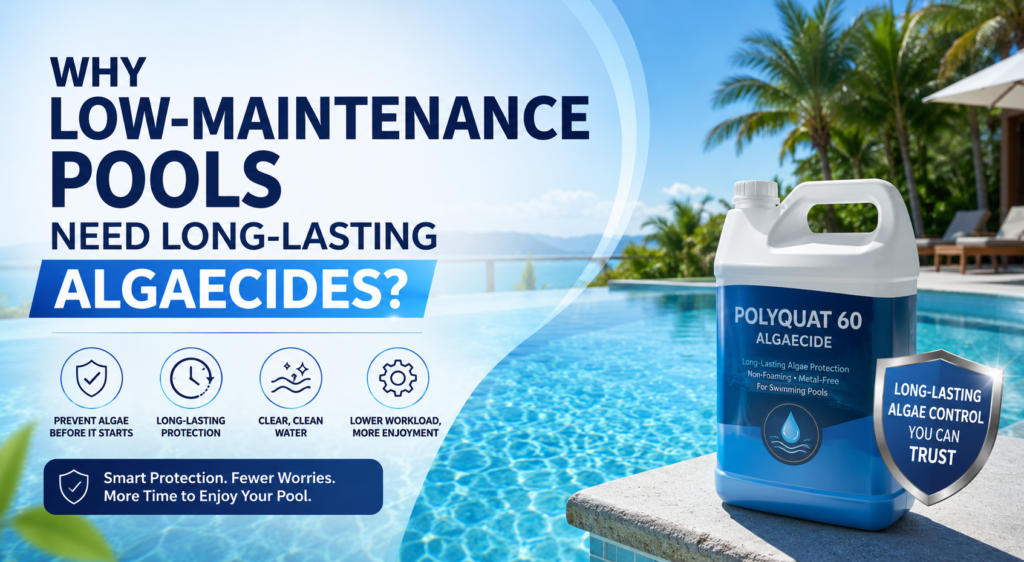
A low-maintenance swimming pool sounds almost effortless: fewer service visits, less chemical handling, less brushing, and more time simply enjoying clear water.
But there is a catch.
Reducing maintenance does not reduce the biological pressure on pool water. Sunlight still reaches the pool. Wind still carries dust and organic matter. Swimmers still introduce nutrients. Warm water still creates favorable conditions for algae. And chlorine is still consumed every hour.
This creates an interesting problem. The less frequently a pool is checked, the more important it becomes for its water-treatment program to keep working between maintenance visits.
That is where long-lasting algaecides become particularly useful.
Rather than treating algae only after green water appears, a well-designed preventive program can provide another layer of algae control during the days when nobody is standing beside the pool with a test kit.
Low Maintenance Doesn’t Mean No Maintenance
First, let’s clear up a common misunderstanding.
A low-maintenance pool isn’t a pool that takes care of itself.
Even highly automated pools still require filtration, circulation, sanitation, water-balance management, and periodic cleaning. Automation simply reduces how often someone needs to intervene manually.
Think of it like cruise control in a car. It reduces the driver’s workload, but nobody would suggest removing the steering wheel.
The same principle applies to swimming pools.
Salt chlorinators, automated dosing systems, variable-speed pumps, robotic cleaners, cartridge filters, and smart pool controllers have all helped reduce routine labor. Yet algae remains a biological organism responding to environmental conditions—not to the owner’s maintenance schedule.
If conditions become favorable, algae can begin developing whether the next service visit is tomorrow or six days away.
That gap matters.
Algae Doesn’t Check Your Maintenance Calendar
Algae spores can enter pools through wind, rain, soil, landscaping debris, swimsuits, equipment, and other environmental sources.
Their presence alone doesn’t guarantee an algae bloom. Problems usually develop when several conditions come together:
- insufficient sanitizer concentration
- poor circulation in certain areas
- warm water
- strong sunlight
- elevated nutrient levels
- heavy swimmer loads
- inadequate filtration
- long intervals between maintenance visits
A frequently serviced commercial pool may have water chemistry checked every day. A residential pool, vacation property, or lightly staffed facility might go several days—or longer—without close inspection.
That changes the risk profile.
Suppose chlorine begins dropping on Monday afternoon. Nobody checks the pool until Friday.
Four days can be plenty of time for a small biological problem to become a very visible one.
You know the familiar scene: slightly dull water becomes cloudy, steps start feeling slippery, and then somebody notices that unmistakable green tint along the wall.
Suddenly, the “low-maintenance” pool requires a lot of maintenance.
Chlorine Is Essential, but Its Concentration Can Change Quickly
Chlorine remains the primary sanitizer in most swimming pools, and nothing here changes its importance.
The issue is persistence.
Free chlorine concentration can change considerably as conditions change. Sunlight, swimmer activity, organic contamination, temperature, rainfall, and other factors influence chlorine demand.
A pool that had an appropriate sanitizer concentration after servicing may not maintain exactly the same concentration several days later.
That is one reason algae-prevention programs sometimes combine routine chlorination with a compatible algaecide.
The two products don’t necessarily perform identical jobs.
Chlorine provides broad oxidation and sanitation. A suitable algaecide adds another mechanism specifically aimed at controlling algae.
This distinction becomes more valuable when maintenance intervals become longer.
So, What Does “Long-Lasting” Actually Mean?
It’s easy to misunderstand the phrase.
A long-lasting algaecide does not mean adding a chemical once and forgetting the pool for the rest of the season.
Rather, it describes an algaecide capable of remaining functionally useful in the pool for a meaningful period after application, subject to water chemistry, dilution, contamination, treatment concentration, and other operating conditions.
This is particularly relevant to certain polymeric quaternary ammonium compounds.
Polymeric quats—often shortened to polyquats—are cationic polymers. In simple terms, their molecular chains carry positive electrical charges.
Many biological surfaces, including algae cells, have negatively charged characteristics.
That electrostatic difference helps polyquats interact with algae cells and interfere with normal cellular functions.
It’s a little like static cling, except the chemistry is far more consequential for the microorganism.
Because these materials are polymeric rather than small conventional quat molecules, their behavior in water can differ significantly from traditional quaternary ammonium algaecides.
Why Polymeric Algaecides Make Sense for Low-Maintenance Pools
One product category often considered for preventive pool algae control is Polyquat 60.
Polyquat 60 generally refers to a concentrated polymeric quaternary ammonium algaecide designed for algae prevention and control. One of its attractive characteristics for pool applications is its non-foaming behavior compared with some conventional quaternary ammonium products.
That matters more than it might sound.
Nobody wants a sparkling pool to suddenly resemble a bubble bath.
More importantly for low-maintenance systems, polymeric algae-control chemistry can support preventive treatment between routine service intervals.
For buyers, formulators, and pool chemical brands evaluating this type of chemistry, our Polyquat 60 Algaecide product page provides additional information about concentrated polymer-based algae control for swimming pool formulations.
The practical idea is straightforward: maintain normal pool sanitation while adding a complementary preventive barrier against algae.
Residual Protection Changes the Maintenance Equation
Imagine two pools.
Both are serviced every seven days.
Pool A depends entirely on sanitizer concentration remaining within its desired operating range throughout that interval.
Pool B also maintains its normal sanitizer program but includes a compatible long-lasting algaecide as part of preventive maintenance.
If chlorine demand unexpectedly rises halfway through the week, Pool B has another algae-control mechanism present in the water.
That doesn’t make Pool B immune to algae. Chemistry doesn’t work like magic.
But it can make the overall treatment program more forgiving.
And forgiving is an underrated word in pool maintenance.
Real pools don’t operate under perfect laboratory conditions. Someone forgets to empty a skimmer basket. A thunderstorm dumps debris into the water. Twelve children jump into a backyard pool during a birthday party. The temperature suddenly climbs for three days.
A robust maintenance program needs enough tolerance to handle these little surprises.
Longer-lasting algae control can contribute to that tolerance.
Fewer Service Visits Make Prevention More Valuable
Professional pool companies face a practical business problem.
Labor is expensive.
Driving to a property, testing the water, carrying chemicals, brushing surfaces, cleaning equipment, and documenting service all require time.
So naturally, operators want each service visit to accomplish as much as possible.
If a chemical program helps maintain stable water quality between visits, it can support more efficient service schedules.
Consider weekly residential pool maintenance.
The technician cannot watch the pool continuously for seven days. The treatment program must essentially “carry” the water until the next visit.
That makes chemical persistence an important consideration.
A fast-working product may look impressive immediately after application. But if its useful activity disappears quickly, it may not suit a maintenance program built around longer service intervals.
Sometimes the less dramatic chemistry is the more useful chemistry.
Vacation Homes Are a Perfect Example
Seasonal and vacation properties show the problem particularly well.
A homeowner may leave for two weeks. A property manager might inspect the pool periodically, but certainly not every morning.
Meanwhile, the pool remains outdoors.
Sunlight keeps shining. Leaves fall. Rain arrives. Temperatures change.
The pool doesn’t know its owner is on vacation.
This is where preventive algae treatment becomes attractive. Before an extended period of reduced maintenance, operators can establish appropriate sanitizer levels, balance the water, clean the filtration system, and incorporate suitable algae prevention.
For even longer shutdown periods, especially seasonal pool closing, the treatment requirements change again. Products designed specifically for extended storage or winterization may be more appropriate.
Our Winter Algaecide is intended for this type of seasonal algae-control strategy, where maintaining water quality through a prolonged low-maintenance period becomes especially important.
That brings us to an important distinction: weekly maintenance and winter closing are not the same problem, even though both benefit from chemical persistence.
What About Automated Pools?
Automation reduces labor beautifully, but it can create a false sense of security.
A controller can measure certain water parameters. A chlorinator can add sanitizer. A robotic cleaner can remove debris.
None of those systems makes algae biologically impossible.
Dead spots may still exist behind ladders, around steps, inside corners, beneath floating covers, or where circulation is weak.
Sensors also measure conditions where the probe is located. They don’t necessarily tell you exactly what is happening on every square centimeter of the pool surface.
This is why physical inspection remains useful even in sophisticated systems.
Long-lasting algaecides should therefore be viewed as part of an integrated maintenance program—not as a replacement for circulation, filtration, sanitation, brushing, or water testing.
That distinction is worth repeating.
Good pool chemistry works as a system.
Preventing Algae Is Usually Easier Than Removing It
Here’s where economics enters the conversation.
Preventive algae control usually requires relatively modest chemical treatment.
Correcting a developed algae bloom can require considerably more work.
Once visible growth appears, the operator may need to adjust water chemistry, increase sanitizer treatment, brush surfaces, run filtration for extended periods, clean or backwash the filter, vacuum debris, and retest repeatedly.
In commercial environments, there may also be downtime.
A hotel pool that looks green isn’t merely experiencing a water-treatment issue. It’s experiencing a guest-experience issue.
A homeowner has a similar reaction, just on a smaller scale.
Nobody looks at green pool water and thinks, “Ah, fascinating microbiology.”
They think something is wrong.
Preventive chemistry therefore has value beyond the chemical cost itself. It can reduce labor, troubleshooting, customer complaints, and emergency service calls.
Long-Lasting Doesn’t Mean “Add More”
There is another important point.
If longer residual activity is desirable, wouldn’t using more algaecide provide even longer protection?
Not necessarily.
Pool chemicals should be used according to the intended formulation, product directions, local regulatory requirements, and actual pool conditions.
Overdosing does not automatically improve performance.
It may simply increase chemical consumption or interfere with the overall water-treatment program.
The goal is not maximum chemical concentration.
The goal is stable water quality with appropriate chemical input.
That’s a very different philosophy.
Non-Foaming Performance Matters Too
Low-maintenance pool chemistry shouldn’t solve one problem while creating another.
Traditional quaternary ammonium compounds can sometimes generate foam, particularly when circulation, aeration, spas, waterfalls, or water features introduce substantial agitation.
Foam doesn’t necessarily mean the treatment has failed, but visually it can be unacceptable.
Polymeric quaternary ammonium algaecides such as Polyquat 60 became attractive partly because they can provide algae-control performance without the pronounced foaming commonly associated with some conventional quat chemistries.
For residential pools, that’s convenient.
For hotels, resorts, public pools, and professionally maintained properties, appearance becomes even more important.
Clear water should look clear—not like somebody accidentally emptied dish soap into the return line.
Metal-Free Chemistry Can Simplify Another Concern
Some algae-control products rely on copper or other metals.
Metal-based products can be effective in appropriate applications, but pool operators must consider metal accumulation and the potential for staining or discoloration under certain conditions.
Polymeric quaternary ammonium algaecides provide a different approach.
They don’t depend on copper ions for their primary algae-control mechanism.
For maintenance programs seeking non-metal algae control, this can be attractive—particularly where pool appearance, surface finishes, or repeated treatment over a long season are important considerations.
Again, there isn’t one chemical that fits every pool.
Water chemistry rarely rewards that kind of thinking.
The better question is: Which chemistry fits this maintenance program?
Where Long-Lasting Algaecides Are Especially Useful
Although almost any outdoor pool can experience algae pressure, longer-lasting preventive treatments become particularly relevant for pools with extended intervals between manual inspections.
Examples include vacation homes, rental properties, residential pools on weekly service schedules, seasonal facilities, hotel pools, community pools, and pools managed with automated equipment.
They may also be useful during periods when algae pressure naturally increases.
Hot weather is an obvious example.
As water temperature rises, biological activity can increase while sanitizer demand may also become harder to manage. Add heavy swimming and a summer thunderstorm, and the water chemistry can change surprisingly quickly.
A preventive algae-control program provides another margin of protection during these demanding periods.
Choosing a Long-Lasting Algaecide Is About the Whole System
Pool professionals and chemical formulators shouldn’t evaluate an algaecide based on one property alone.
Residual activity matters, but so do compatibility, foaming behavior, active concentration, water conditions, application method, regulatory status, storage stability, and the broader maintenance program.
For concentrated polymeric algaecides, product quality and consistency also matter.
A commercial formulation has to behave predictably from batch to batch. Concentration, viscosity, pH, appearance, and handling characteristics can affect manufacturing and finished-product performance.
For B2B buyers, that means the conversation shouldn’t stop at “What’s your price per kilogram?”
Specification consistency can be worth far more than a tiny difference in raw-material cost—especially once a product enters private-label production or regular distribution.
The Real Goal Is a Pool That Stays Boring
Strangely enough, boring is exactly what good pool maintenance should be.
No sudden green walls.
No frantic Saturday phone calls.
No unexplained foam.
No emergency chemical corrections the morning before guests arrive.
Just clear, predictable water.
Long-lasting algaecides can help create that predictability because they support preventive algae management during the gaps between manual maintenance.
They don’t replace chlorine. They don’t eliminate filtration. They don’t remove the need for proper circulation or balanced water.
What they can do is strengthen the overall algae-control program.
And for a genuinely low-maintenance pool, that extra margin can make all the difference.
Frequently Asked Questions
1. What is the best type of algaecide for a low-maintenance pool?
A non-foaming, polymeric algaecide such as Polyquat 60 is often considered for preventive algae-control programs because it can complement normal sanitation without relying on metal-based active ingredients. The appropriate choice still depends on pool conditions and the finished product’s directions.
2. How long does Polyquat 60 algaecide last in pool water?
There is no universal number of days that applies to every pool. Effective persistence depends on treatment concentration, sanitizer conditions, sunlight, swimmer load, filtration, dilution, contamination, and overall water chemistry. Follow the finished product label and maintenance instructions rather than assuming a fixed residual period.
3. Can a long-lasting algaecide replace chlorine in a swimming pool?
No. An algaecide should not be treated as a substitute for an appropriate pool sanitation program. Polymeric algaecides are commonly used as complementary preventive treatments alongside normal sanitizer, filtration, circulation, and water-balance management.
4. Why is non-foaming algaecide better for low-maintenance pools?
Non-foaming chemistry reduces the chance that algae treatment itself creates an unwanted appearance problem. This is particularly useful in pools with strong circulation, waterfalls, spas, or other features that agitate the water.
5. Is Polyquat 60 suitable for weekly pool maintenance programs?
Polyquat 60 can be used in finished products intended for routine preventive algae-control programs, including applications where maintaining protection between service visits is important. Actual dosage and treatment frequency should always follow the specific finished-product instructions and applicable regulatory requirements.