
GET IN TOUCH
Ask For Sample?
The Future of Pool Water Treatment Chemicals
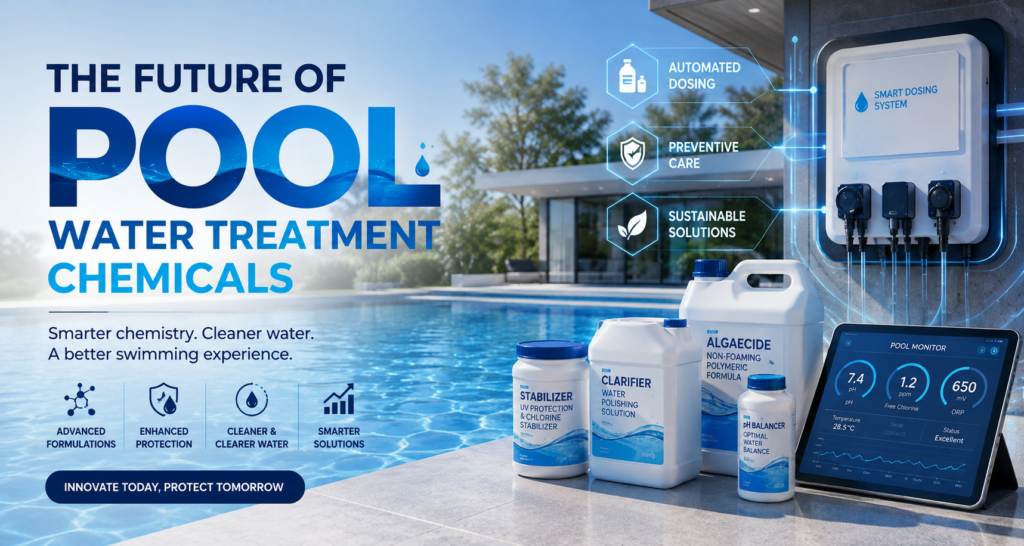
Pool water treatment has always been a balancing act.
We want water that looks crystal clear, feels comfortable on the skin, stays safe for swimmers, and does not demand constant attention from the person maintaining it. Sounds simple enough. Yet anyone who has managed a pool through a hot summer knows otherwise. Sunlight eats away at sanitizer. Swimmers bring organic contaminants into the water. Rain changes chemistry. Algae finds neglected corners. Then there are filters, pumps, surfaces, metals, and dozens of small variables quietly interacting behind the scenes.
For decades, the standard answer was often straightforward: test the water, add more chemicals, circulate, and repeat.
That approach is changing.
The future of pool water treatment chemicals is likely to be less about simply increasing chemical dosage and more about precision, longer-lasting performance, complementary treatment, automation, and chemistry designed for specific problems.
Chlorine will remain important. So will pH control. But around that foundation, a more sophisticated chemical ecosystem is emerging—one that includes polymeric algaecides, specialty clarifiers, enzymes, phosphate-control products, oxidation systems, and smarter chemical feeding.
Here is where the industry appears to be heading.
Pool Chemistry Isn’t Disappearing—It’s Getting Smarter
Every few years, someone predicts that a new technology will make traditional pool chemicals almost unnecessary.
That hasn’t happened.
There’s a good reason.
A swimming pool is an open water system exposed to people, sunlight, dust, leaves, microorganisms, cosmetics, sweat, rainwater, and changing temperatures. Even sophisticated circulation equipment cannot remove the need to control microorganisms and water chemistry.
The U.S. Centers for Disease Control and Prevention (CDC) still describes chlorine and pH as the first defense against germs in residential pools and hot tubs. It recommends routine monitoring because sanitizer concentrations can be reduced by sunlight and contaminants introduced by swimmers.
So the future probably isn’t a “chemical-free pool.”
It’s a better-controlled chemical pool.
That distinction matters.
Future treatment programs will increasingly ask questions such as:
How much chemical does this particular pool actually need?
Can we prevent algae rather than treating a green pool afterward?
Can one treatment stay effective longer?
Can we reduce unwanted side effects such as foam, staining, cloudiness, or deposits?
Can sensors detect changes before swimmers can see them?
Those questions move pool treatment away from the old “add and hope” mentality.
Chlorine Is Staying—but It Won’t Have to Do Every Job
Let’s clear up one common misconception.
Chlorine isn’t going away anytime soon.
It remains one of the most practical tools for maintaining microbiological control in swimming pools. CDC guidance continues to emphasize proper free chlorine concentrations together with controlled pH.
But chlorine has limitations.
Its concentration can fall because of UV exposure, swimmer contamination, environmental debris, and other chlorine-demanding substances. Its effectiveness also depends strongly on water conditions, including pH.
Then there’s another issue: not every microorganism responds equally quickly.
CDC notes, for example, that Cryptosporidium is highly chlorine tolerant compared with many common bacteria. This is one reason modern aquatic treatment increasingly considers layers of protection rather than expecting a single chemical to solve everything.
That gives us a useful picture of the future:
Primary sanitizer + supporting chemistry + filtration + circulation + monitoring + supplemental treatment where appropriate.
Think of chlorine as the goalkeeper rather than the whole football team.
You still need it. You just shouldn’t expect it to play every position.
Preventive Treatment Will Become More Important Than Rescue Treatment
You know that familiar pool-maintenance nightmare.
The water looked fine on Friday.
By Monday morning, there’s a faint green tint along the steps. The walls feel slippery. A few hours later, the entire pool suddenly looks tired and cloudy.
Now the operator has to respond aggressively.
That may mean more sanitizer, brushing, filtration, algaecide treatment, backwashing, retesting, and perhaps temporary pool closure.
Prevention is usually less disruptive.
This is one reason maintenance-dose chemistry is likely to gain greater attention.
Instead of waiting for visible algae growth, pool operators can use a treatment program designed to make the environment less favorable for algae from the beginning.
That may involve maintaining sanitizer levels, controlling pH, improving circulation, managing nutrients, and adding a compatible preventive algaecide when appropriate.
The difference sounds subtle, but commercially it is significant.
Reactive treatment sells a chemical to fix a problem.
Preventive treatment sells predictability.
For hotels, resorts, health clubs, public pools, property managers, and professional pool service companies, predictability has real value. A green pool isn’t merely a water chemistry problem. It’s a customer experience problem.
Non-Metal Algaecides Are Likely to Gain More Attention
Copper-based chemistry has a long history in algae control, and metal-based products still have applications.
Yet future formulations are likely to place increasing emphasis on non-metal alternatives where operators want to minimize concerns associated with metal accumulation, discoloration, or staining.
That is where polymeric quaternary ammonium compounds become particularly interesting.
Polymeric algaecides—often discussed in the pool industry under the broad “polyquat” category—can provide algae-control performance without relying on copper ions.
Certain formulations are also valued because they can be designed for low-foaming or non-foaming performance, an important consideration in pools with strong circulation, water features, spas, fountains, or other conditions where persistent foam is unwelcome.
For pool brands and professional maintenance companies looking for this type of non-metal algae control, Polyquat 60 Algaecide offers a concentrated polymer-based option designed for preventive pool maintenance. Its non-foaming characteristics make it particularly useful where operators want effective algae control without the staining concerns associated with copper-based treatments.
There is a broader lesson here.
The future won’t necessarily belong to the “strongest” chemical.
It will belong to chemicals that solve one problem without creating three new ones.
That is a much higher standard.
Polymeric Chemistry Has More Room to Grow
Polymer chemistry may become one of the more interesting areas of specialty pool treatment.
Why?
Because polymers can interact with contaminants differently from small conventional molecules.
Cationic polymers, for example, carry positive charges along their molecular structures. Many suspended particles and biological surfaces in water carry negative charges. Electrostatic attraction can therefore play an important role in how certain polymers interact with those materials.
Depending on the polymer and formulation, this chemistry can be useful in areas such as:
- algae control;
- coagulation and flocculation support;
- clarification;
- fine-particle removal;
- surface interaction;
- water polishing.
This doesn’t mean one polymer should perform all these jobs. Quite the opposite.
Specialization will matter more.
A polymer selected primarily as an algaecide may have different molecular characteristics from one intended primarily for clarification.
For chemical manufacturers, this creates room for product development based on molecular weight, charge density, active concentration, viscosity, compatibility, and final-use conditions.
For pool chemical brands, it creates opportunities to move beyond generic “one bottle fixes everything” positioning.
Algaecides May Become More Targeted
The word algaecide makes the product category sound remarkably simple.
It isn’t.
Pools operate under very different conditions.
A lightly used residential pool in a dry climate does not face the same treatment challenge as a tropical hotel pool receiving hundreds of swimmers per day. An indoor therapy pool isn’t the same as an outdoor resort pool. A pool being winterized for five months has different needs again.
Seasonal pool care is a good example of why one formulation cannot fit every situation. A Winter Algaecide is intended to support algae prevention during extended off-season periods, when circulation, sanitizer management, and routine maintenance may be reduced. For pool chemical brands, this also creates a natural seasonal product category alongside regular maintenance algaecides.
So why should every algaecide look the same?
Future products will probably become more application-specific.
We may see clearer distinctions between routine maintenance algaecides, high-active concentrates, seasonal products, winter algaecides, non-metal formulations, low-foaming products, and formulations intended for professional service companies.
This approach already makes practical sense.
A concentrated polymeric algaecide, for example, may suit professional users who prefer lower transport volume and flexible dilution. A ready-to-use maintenance formulation may be easier for homeowners. A winter product may emphasize prolonged protection during months when circulation and routine maintenance are reduced.
Same basic problem—algae.
Very different chemistry strategy.
Clarifiers Are Becoming Part of a Bigger Water-Quality Story
Not every cloudy pool has a sanitizer problem.
Sometimes the water contains extremely fine suspended particles that are simply difficult for the filter to capture efficiently.
Imagine trying to catch flour with a kitchen colander. You can keep pouring it through, but much of the material won’t behave the way you want.
Pool clarifiers help address a similar problem.
Certain polymeric clarifiers encourage fine suspended particles to associate into larger structures that filtration systems can capture more readily. The result can be visibly brighter water without treating every clarity problem as if it were microbial contamination.
When fine suspended particles are the real reason a pool looks dull or hazy, adding more sanitizer may not solve the problem. A Polymer Pool Clarifier can help bring these tiny particles together so the filtration system can remove them more efficiently, supporting brighter, more polished-looking water as part of a balanced maintenance program.
This distinction will become increasingly important.
Future pool maintenance programs are likely to separate:
sanitation, algae prevention, oxidation, clarification, filtration, and water balance more clearly.
Why?
Because overdosing one chemical to compensate for a completely different problem wastes money and may complicate the water further.
Smart treatment begins with diagnosis.
Automation Will Change How Chemicals Are Used
This may be the biggest practical shift.
For years, pool chemistry depended heavily on manual testing.
Take a water sample. Add reagent. Compare colors. Adjust chemicals. Come back later.
Manual testing remains useful, but connected sensors and automated dosing equipment can add another layer of control.
Modern systems can monitor parameters such as pH and oxidation-reduction potential (ORP), then communicate with chemical feeders. More sophisticated systems can record trends, send alerts, and help operators recognize abnormal conditions.
The important change isn’t simply automation.
It’s data.
Imagine looking at pool chemistry as a graph rather than a single test result.
Suddenly, you can see that sanitizer demand rises every Saturday afternoon. Or that pH consistently drifts after fresh water is added. Or that a particular outdoor pool consumes noticeably more sanitizer during a week of intense sunlight.
Once those patterns become visible, chemical dosing becomes less reactive.
That’s a big deal.
The Future Is Chemical + Physical Treatment
Pool treatment is sometimes discussed as if chemistry and equipment are competing solutions.
They’re not.
They work better together.
The latest CDC Model Aquatic Health Code continues to address secondary treatment approaches for aquatic venues, while CDC materials also discuss technologies such as UV and ozone as supplemental treatment methods in appropriate applications.
This points toward a hybrid future.
A modern commercial pool might combine:
primary disinfection, balanced pH, algae-control chemistry, high-efficiency filtration, automated dosing, and secondary treatment.
Each component handles a different part of the problem.
UV, for example, does not leave the same type of persistent disinfectant residual throughout the pool that properly maintained chlorine provides. Chemistry therefore remains essential even when sophisticated treatment equipment is installed.
EPA guidance also distinguishes between pesticidal devices and pesticidal substances, including in areas involving pool electrolysis and ozonation equipment.
So the industry’s future isn’t “chemicals versus technology.”
It is chemicals working with technology.
Sustainability Will Mean More Than Simply Using Less Chemical
“Sustainable pool chemistry” sounds attractive, but the phrase needs careful handling.
Using less chemical isn’t automatically better.
If an operator reduces sanitizer below an effective level and then has to recover an algae-filled pool, the result may involve more chemicals, more filtration, more water replacement, and more energy.
A better goal is chemical efficiency.
Use the right material.
Use the right concentration.
Use it at the right time.
Avoid unnecessary corrective treatment.
Prevent repeated water-quality failures.
Longer-lasting treatments can contribute to this approach. So can concentrated products that reduce packaging and transportation requirements per unit of active ingredient.
Accurate automated dosing can help as well.
And there is an overlooked sustainability factor: water.
When poor chemistry leads to severe water problems, operators may resort to partial draining and refilling. Better chemical management can help reduce avoidable interventions, although draining can still be necessary under specific water-quality or contamination conditions.
The greenest gallon of pool water may simply be the gallon you didn’t have to replace.
Formulation Compatibility Will Become a Bigger Selling Point
Here’s a slightly unglamorous prediction.
Compatibility will become sexy.
Well, sexy by water-treatment standards.
Pool owners increasingly use multiple products in the same water system: sanitizers, algaecides, clarifiers, stabilizers, pH adjusters, scale-control agents, oxidizers, and specialty treatments.
These chemicals do not exist in isolation.
Future formulations therefore need to be evaluated not merely for what they do alone but for how they behave inside a complete treatment program.
Does the algaecide create foam?
Could a metal-containing product contribute to staining under certain conditions?
Does the clarifier interfere with another treatment?
Can overdosing affect filtration?
How does the product behave across the expected pH range?
These are practical questions, not laboratory trivia.
For professional buyers, compatibility data may become almost as important as active ingredient concentration.
Regulation Will Keep Shaping Product Development
Pool chemical innovation cannot be separated from regulation.
In the United States, products making claims to control algae or microorganisms can fall under pesticide regulation. EPA states that products claiming prevention, removal, control, or elimination of algae or bacteria are considered pesticides, with applicable products requiring EPA registration and approved labeling before lawful sale or distribution.
That has major implications for future product development.
A clever formulation isn’t enough.
Claims matter.
Labels matter.
Active ingredients matter.
Target applications matter.
Regulatory status matters.
Meanwhile, public-health guidance continues to evolve. CDC says the current Model Aquatic Health Code is the 2024 fifth edition, illustrating how pool operation guidance itself changes as evidence and industry knowledge develop.
Manufacturers selling internationally face another layer of complexity because regulatory requirements differ by market.
Future suppliers will therefore need something beyond manufacturing capability.
They will need technical documentation capability.
COAs, SDS documentation, specification control, active-content testing, stability information, application guidance, traceability, and regulatory awareness will increasingly separate serious suppliers from commodity sellers.
Concentrated Products Could Become More Attractive
Shipping water around the planet isn’t particularly efficient.
Yet many pool chemicals are aqueous solutions.
This makes concentration an important formulation consideration, especially for B2B distribution.
Higher-active concentrates may offer advantages in transportation, warehouse space, packaging consumption, and formulation flexibility. Distributors can potentially use concentrated raw materials as the basis for several finished formulations.
There are limits, of course.
Higher concentration may increase viscosity. Handling can become harder. Pumpability may change. Dilution needs to be controlled. Packaging materials must remain compatible.
So concentration alone isn’t the goal.
Practical concentration is.
A successful product has to survive manufacturing, transport, storage, formulation, and final application—not just look impressive on a specification sheet.
Private-Label Pool Chemicals May Become More Specialized
Another interesting shift is happening behind the label.
Pool chemical brands do not always need to manufacture every active ingredient themselves.
Instead, specialist chemical manufacturers can supply concentrated actives or provide formulation, blending, packaging, and private-label services.
This allows distributors and regional brands to create product ranges tailored to their markets.
A distributor might want:
- a concentrated non-foaming algaecide;
- a lower-active weekly maintenance product;
- a polymer clarifier;
- a winter algae-control formulation;
- custom 1 L, 5 L, or 25 L packaging.
That flexibility could become increasingly valuable as regional pool markets mature.
The pool owner sees a bottle.
Behind that bottle may sit a surprisingly sophisticated chain involving polymer manufacturing, formulation development, compatibility testing, packaging, regulatory review, logistics, and local distribution.
Commercial Pools Will Push the Industry Toward Reliability
Residential pools matter enormously to the chemical market, but commercial facilities may influence the direction of higher-performance chemistry.
Why?
Because failure costs more.
A homeowner discovering slightly cloudy water on Tuesday morning may be annoyed.
A hotel discovering a green pool while 200 guests are eating breakfast beside it has a different problem entirely.
Commercial facilities care about consistency.
Hotels, resorts, water parks, health clubs, schools, therapy centers, and public aquatic facilities also deal with variable bather loads. Their water can experience rapid changes that residential maintenance schedules don’t always reflect.
CDC’s MAHC exists specifically to provide science-based guidance for public aquatic venues, covering their design, operation, and maintenance.
This environment creates demand for treatment chemicals that behave predictably and integrate well with professional maintenance programs.
Reliability becomes part of the product.
Climate May Quietly Change Pool Chemical Demand
Hotter weather deserves attention too.
Temperature, sunlight, rainfall, dust, and pool usage all affect maintenance conditions.
Long periods of warm weather can extend swimming seasons in some regions. More pool use means more contaminants entering the water. Strong sunlight can increase sanitizer-management challenges in outdoor pools. Storms can suddenly introduce debris and alter water chemistry.
So future treatment programs may need to respond more dynamically to environmental conditions.
A fixed weekly routine may not always be enough.
Imagine instead a treatment system that considers water temperature, sanitizer trend, bather load, weather conditions, and historical chemical consumption.
We’re not quite at the point where every backyard pool behaves like a miniature smart water-treatment plant.
But we’re heading closer.
So, What Will the Pool Chemical Shelf Look Like in the Future?
Probably familiar—and surprisingly different.
You’ll still see chlorine products.
You’ll still see pH adjusters.
You’ll still see algaecides and clarifiers.
But behind those familiar categories, formulations may become more sophisticated.
Expect greater emphasis on concentrated chemistry, polymeric treatment, non-metal algae control, low-foaming formulations, targeted maintenance products, automated dosing compatibility, and chemicals designed to work alongside physical treatment technologies.
The industry may also shift from selling individual bottles toward selling treatment programs.
That’s perhaps the biggest change of all.
Instead of asking:
“Which chemical should I add?”
Pool professionals will increasingly ask:
“What is happening in this water, and what combination of chemistry and equipment will control it efficiently?”
That’s a much better question.
The Pool of the Future Still Needs Chemistry
It is tempting to imagine the future swimming pool as almost self-maintaining—sensors everywhere, automated feeders humming quietly in an equipment room, perhaps an app telling the owner that everything is perfect.
Some of that future is already arriving.
But sensors don’t kill algae.
Apps don’t balance water.
Automation only works when the chemistry behind it works.
The future of pool water treatment chemicals therefore isn’t about replacing chemistry. It’s about making chemistry more precise, more specialized, more compatible, and easier to control.
Chlorine will remain fundamental. Supporting products will become smarter. Polymeric algaecides and clarifiers will have more room to develop. Non-metal formulations may become increasingly attractive for certain applications. Sensors will improve dosing decisions. UV, ozone, filtration, and chemical treatment will increasingly operate as parts of one water-management system.
And perhaps most importantly, preventive maintenance will continue replacing the old cycle of neglect, green water, heavy correction, and frustration.
Clear water may look simple.
The chemistry behind it never really was.
FAQs
1. What is the future of swimming pool water treatment?
The future of swimming pool water treatment will likely combine traditional sanitizers with automated monitoring, specialty algaecides, polymeric clarifiers, improved filtration, and supplemental technologies such as UV or ozone. The goal is more precise and reliable water management rather than simply adding more chemicals.
2. Will chlorine be replaced in swimming pools?
Chlorine is unlikely to disappear from mainstream pool treatment soon. It provides an important disinfectant residual in pool water, while technologies such as UV and ozone are generally better viewed as complementary tools in systems where they are appropriate.
3. Why are non-metal pool algaecides becoming more important?
Non-metal pool algaecides can provide algae control without adding copper or other algaecidal metals to the water. Polymeric formulations are particularly interesting where buyers want long-lasting, low-foaming algae control while minimizing concerns related to metal accumulation and staining.
4. What role will Polyquat 60 play in future pool maintenance?
Polyquat 60-type polymeric algaecides can support preventive algae-control programs, particularly where non-metal and non-foaming characteristics are desired. Their role is complementary to proper sanitation, circulation, filtration, and balanced pool chemistry rather than a replacement for primary disinfectants.
5. Are automated pool chemical systems better than manual treatment?
Automated pool chemical systems can improve consistency by continuously or frequently monitoring selected water parameters and controlling chemical feeders. However, they still require calibration, maintenance, chemical verification, and periodic manual testing. Good automation improves chemical management; it doesn’t eliminate the need for knowledgeable pool operation.