
GET IN TOUCH
Ask For Sample?
Why 1L Pool Clarifier Packaging Works for Retail Markets?
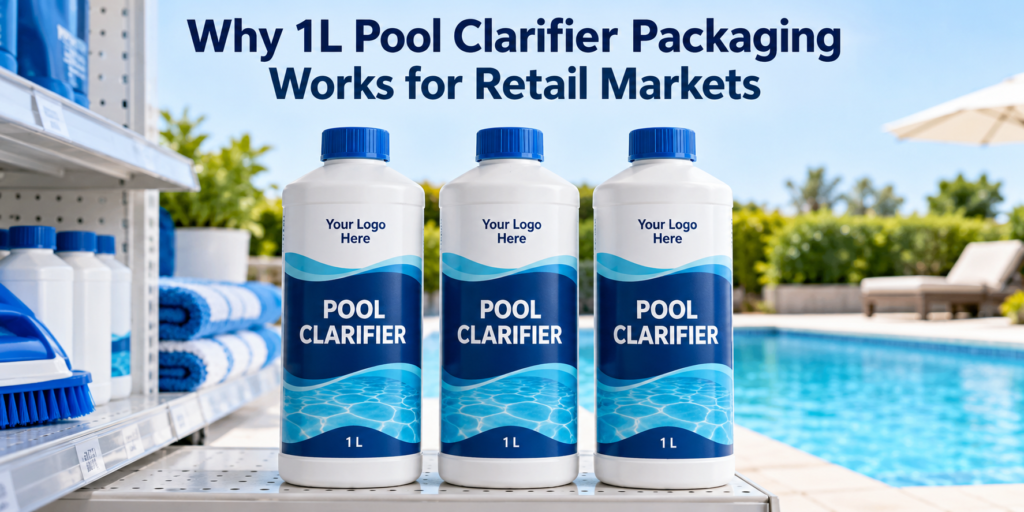
A pool owner walks into a shop with a simple problem: the water looks dull, and they want to know what might help.
They scan the shelf. Some containers look too large for their needs. Others have small print, vague claims, or directions that take too much effort to understand. Then they pick up a neat 1L bottle with a clear product name and readable instructions.
That bottle has already done part of the sales work.
For pool chemical brands and distributors, 1L pool clarifier packaging can offer a useful balance of shelf presence, manageable size, and purchase price. It gives retailers a practical format to display and customers a bottle they can carry, store, and handle with relative ease.
Still, bottle size alone does not create a successful retail product. Formula strength, dosing instructions, closure quality, and price all shape the result.
So, why does the 1L format deserve a place in a retail pool care range? Let’s look at the buying experience from both sides of the counter.
A Retail Bottle Has Several Jobs to Do
A pool clarifier bottle holds a liquid, of course. But on a retail shelf, it also acts as a sign, a guide, and a small piece of your brand.
Before a shopper speaks to a sales assistant, the pack should help answer a few basic questions:
- What is this product?
- What pool water problem does it address?
- How should I use it?
- How much will I need?
- Can I store the bottle safely between uses?
That is a lot to ask of one container.
A well-designed 1L pack gives brands room to present those answers without moving to a large, heavy container. The front can carry the product name and a focused benefit statement. The back can explain dosage, application, storage, and precautions.
The goal is simple: make the product easy to understand while keeping the information accurate.
A bottle that looks good may earn a closer look. A bottle that explains itself can help a shopper make a more confident purchase.
The Purchase Price Can Feel More Manageable
Buying an unfamiliar pool chemical involves some hesitation.
Will it suit the pool? Will the owner use it correctly? Is a large container worth buying before they have tried the product?
A 1L bottle can lower that first purchase commitment compared with a larger pack of the same formula. The customer buys less liquid at once, which may allow a lower price per bottle.
For a brand entering a new store or market, that can be helpful. Customers have a way to try the product without committing to a 5L container.
There is a tradeoff, though.
Smaller packs often carry higher packaging costs per litre. Each litre needs its own bottle, cap, label, and filling operation. A larger pack may offer better value per litre even when its shelf price is higher.
Retail positioning should reflect that difference. The 1L bottle can sell on convenience and an accessible purchase price, while larger containers serve buyers who want volume and lower packaging cost per litre.
Both can have a place in the same range.
One Litre Is a Pack Size, Not a Treatment Claim
Here is a point worth making clear: two 1L pool clarifier bottles may provide very different treatment coverage.
The amount needed depends on the finished formula, the approved directions, pool volume, and water conditions. A concentrated product may require a smaller dose than a more dilute formula, but the label must establish the actual application rate.
A large “1L” on the front tells shoppers how much liquid they are buying. It does not tell them how many treatments they will get.
That distinction matters when presenting value.
Consider a purely hypothetical example. If a product’s validated directions call for 50mL per treatment for a stated pool volume, a 1L bottle contains 20 such doses. That calculation applies only to that formula and those directions. It should never become a general dosing rule for pool clarifiers.
For retailers, the useful sales question is:
“What does one bottle provide when used as directed?”
A clear answer helps customers compare products more fairly than bottle size alone.
It Fits the Way Many Homeowners Handle Pool Products
Retail packaging should suit the person who will use it.
A homeowner may carry the bottle from the shop, place it in a suitable storage area, and take it out again when needed. They may hold a measuring cup in one hand and the bottle in the other.
A 1L container can be easier to manage during those steps than a larger container of the same product.
Yet capacity is only part of the story. Bottle shape makes a real difference.
A tall, slippery bottle with a wide neck may be awkward to pour from. A stable bottle with a comfortable grip and controlled opening may feel much more practical.
When reviewing samples, brands should assess:
- Grip comfort when the bottle is full.
- Stability on a flat surface.
- Control during pouring.
- Ease of opening and closing.
- Whether liquid drips down the neck after use.
These small details become part of the customer’s view of quality. A polished label cannot make up for a cap that is hard to close.
Shelf Space Is Limited—The Bottle Must Earn Its Place
Retail shelves have boundaries. Buyers must decide how many products fit and how much space each one deserves.
A 1L pool clarifier bottle can give a store flexibility when building its pool care section. Depending on its dimensions, it may fit beside other maintenance products without taking the space needed by a larger can.
That can support a coordinated display with clarifier, algaecide, test supplies, and other pool care items.
But “1L” is not a shelf measurement.
Two bottles with the same capacity can have very different footprints. One may be broad and short; another may be narrow and tall. The shape affects the number of bottles per shelf, the visible label area, and the ease of restocking.
Before approving a pack, check its actual width, depth, and height against the intended retail shelf.
Also check how it looks in a row. A bottle can look attractive in a studio photo yet lose its identity when surrounded by other products.
A Clear Front Label Helps Shoppers Find the Right Product
A shopper should not need to study the whole bottle to discover that it is a pool clarifier.
The product category should be easy to see.
That sounds obvious, but front labels can become crowded with waves, badges, slogans, and several competing claims. The main message gets buried.
For a 1L retail pack, a useful front label hierarchy is:
- Brand name.
- Product name: “Pool Clarifier.”
- A short, supported description.
- Net contents.
A phrase such as “Helps filtration remove fine suspended particles” may explain the role more clearly than a vague promise of perfect water.
Claims should match the finished product and the evidence behind it. Avoid implying that a clarifier fixes every cause of cloudy water or replaces proper sanitation.
The bottle should help customers choose the right tool for the problem. That makes the sales conversation easier, too.
Good Dosing Instructions Turn Packaging into Customer Support
Once the customer gets home, the sales assistant is no longer beside them.
The label takes over.
A useful back label should state the dose, the pool volume it applies to, and the steps needed for application. Units must be clear and suited to the destination market.
For example, “Add a small amount” leaves too much room for guesswork. A formula-specific table is easier to follow when it lists defined pool volumes and matching doses.
Where initial treatment and maintenance treatment differ, the label should explain the distinction.
Measuring tools deserve attention as well. If the cap serves as a measure, its capacity and markings should be checked. If it does not, the directions should identify the suitable measuring method.
Avoid telling users to add “one capful” unless the closure has been designed and verified for that purpose.
A 1L bottle may be easy to hold. Clear directions help make it easy to use correctly.
The Back Label Should Set Realistic Expectations
Customers often buy clarifier because they want a visible result. That makes expectation-setting part of good packaging.
The label should explain that performance depends on the cause of cloudiness, the condition of the pool, and the filtration system.
A clarifier is not a substitute for sanitizer. Nor can packaging promise that every cloudy pool will clear within a fixed time.
If the product has filter restrictions, application requirements, or other limits, those points should be easy to find.
The same applies to repeat dosing. Customers should not be encouraged to keep adding product simply because the water has not changed as quickly as they hoped.
Clear instructions can reduce avoidable confusion. They also give retailers a consistent way to explain the product.
Trust often grows from these quiet details: readable directions, restrained claims, and a product that behaves as described.
The Format Gives Private Label Brands Useful Design Space
For a private label business, packaging helps turn a supplied formula into a recognizable retail product.
A 1L bottle offers a canvas for brand colors, a clear product name, and a consistent visual style. It can also sit within a wider family of pool care packs.
For instance, a brand may use the same logo position and label structure across several products, while changing a color band to distinguish each function.
Consistency makes the range easier to recognize. Clear product names keep similar bottles from becoming confusing.
Do not rely on color alone.
A customer may shop under poor light, view a small online image, or have difficulty telling certain colors apart. “Pool Clarifier” should remain prominent even when the design uses a strong blue theme.
The same principle applies to the liquid. A blue appearance may support a visual concept, but color does not prove concentration or performance.
Bottle Quality Protects the Brand Between Purchases
A customer may not think much about the closure until it leaks.
Then it becomes the most memorable part of the product.
For a 1L pool clarifier pack, brands should assess the complete package with the actual finished formula. That means the bottle, cap, liner or seal where used, label, and outer carton.
Useful checks include closure performance, bottle stability, label adhesion, and behavior during storage and transport. The testing conditions should reflect the intended supply route.
Material suitability should be confirmed rather than assumed from appearance.
A sample bottle may look strong and feel pleasant in the hand, yet still need changes to the seal or closure.
Tamper evidence may also be appropriate for the retail presentation. It should be selected as part of the packaging system, with any destination requirements reviewed before launch.
The customer experiences one finished product. The bottle and formula need to work together.
Retail Convenience Depends on the Outer Carton, Too
The shopper sees one bottle. The distributor handles cartons and pallets.
That means retail packaging decisions must extend beyond the individual pack.
Case quantity affects order value, stock handling, and replenishment. A retailer testing a new product may want a modest quantity. A high-volume distributor may prefer a different arrangement.
There is no single carton count that suits every market.
The right case format depends on bottle dimensions, gross weight, carton strength, pallet layout, and the retailer’s buying pattern. Protective packing should also suit the route to market.
A small bottle does not guarantee low freight costs. Several 1L packs may use more packaging material and space per litre than larger containers.
Compare the complete delivered cost. Include bottles, labels, cartons, packing labor, transport, and damage risk.
Convenience has value, but it should be priced with clear eyes.
A 1L Pack Can Work Well Online
The format can also suit online retail, where customers make decisions from images and product descriptions.
A compact bottle can be photographed with a clear front view, a readable back label, and a close view of the closure. Those images help buyers understand what will arrive.
However, online selling adds another handling environment. The bottle may pass through parcel sorting and be delivered in several orientations.
A pack suitable for a shop shelf may still need a stronger shipping arrangement for individual orders.
The online listing should explain the same essentials as the physical label: product purpose, net contents, directions, and relevant limits. Where treatment coverage is stated, it should match the validated dose.
Check local volume expectations, too. One litre and one US quart are close in size, but they are not equal. Labels and listings should state the actual contents accurately.
Smaller Packs Can Support a Careful Market Launch
Launching a new pool clarifier range involves more than choosing a label.
Brands need to learn which retailers will stock it, how staff explain it, and what questions customers ask.
A 1L format can support a focused retail trial because it offers a manageable consumer purchase. It also lets a brand assess the pack in real use before extending the range.
That does not mean the supplier’s minimum order will be small. Custom bottles, printed labels, and filling runs may each have their own order requirements.
For an early launch, an existing bottle design with a suitable custom label may be more practical than commissioning a new bottle mold.
Useful feedback includes whether shoppers understand the product, whether directions are clear, whether packs arrive intact, and whether customers buy again.
Those findings give the next order a firmer basis.
When a Larger Pack Makes More Sense?
The 1L bottle is a useful retail format, but it should not carry the whole range by default.
Pool service companies, frequent users, or buyers treating larger systems may prefer a larger container. Their priorities may include fewer packs to handle and a lower packaging cost per litre.
Likewise, a highly concentrated formula used in very small amounts might suit a smaller bottle.
The right question is not, “Which size looks most familiar?”
It is, “Which pack best matches the intended user, dose, and buying pattern?”
A brand can serve several needs with one consistent product family. The 1L pack may cover household retail demand, while larger sizes serve professional or repeat-volume buyers.
Choose each size for a clear purpose.
Building a 1L Pool Clarifier Range with Eautrix
For brands exploring private label supply, Eautrix lists a PolyDADMAC-based polymer pool clarifier with 10% active ingredient, original or blue-dyed appearance, and support for custom labels and formulation adjustment. These details provide a starting point for a product discussion; the final specification and packaging should be confirmed for each project.
Learn more about the Eautrix Polymer Pool Clarifier.
Before approving a 1L retail version, review the filled bottle, closure, label artwork, application directions, and carton together. Ask for a sample that reflects the intended finished product.
A good retail pack should make the whole experience easier: choosing the product, carrying it home, measuring the dose, and finding it again on the next shopping trip.
That is where the 1L format can earn its place.
Frequently Asked Questions
1. Is 1L pool clarifier packaging suitable for residential pool owners?
It can be, provided the formula’s dose and expected usage fit the customer’s needs. A 1L bottle offers manageable handling, but treatment coverage must be assessed from the product-specific directions.
2. How many treatments does a 1L pool clarifier bottle provide?
Divide 1,000mL by the labeled dose for the relevant pool volume. The result applies only to that formula and treatment condition. Different clarifiers may have very different application rates.
3. Is a 1L pool clarifier bottle better value than a 5L container?
A 1L bottle may have a lower purchase price, while a 5L pack may cost less per litre. Customers should also compare treatment coverage, expected use, and storage needs.
4. What should a private label 1L pool clarifier label include?
It should clearly identify the product and net contents, explain validated dosing and application, and provide relevant storage and precautionary information. Supplier details and other required information depend on the destination market and product classification.
5. Can brands sell the same pool clarifier in 1L and larger packaging?
Yes, if the formula is suitable and each packaging system has been assessed. Keep directions consistent for the same formula, and make sure each size has readable labels, suitable closures, and appropriate transport protection.