
GET IN TOUCH
Ask For Sample?
Why 5L Pool Clarifier Packaging Fits Professional Pool Service Companies?
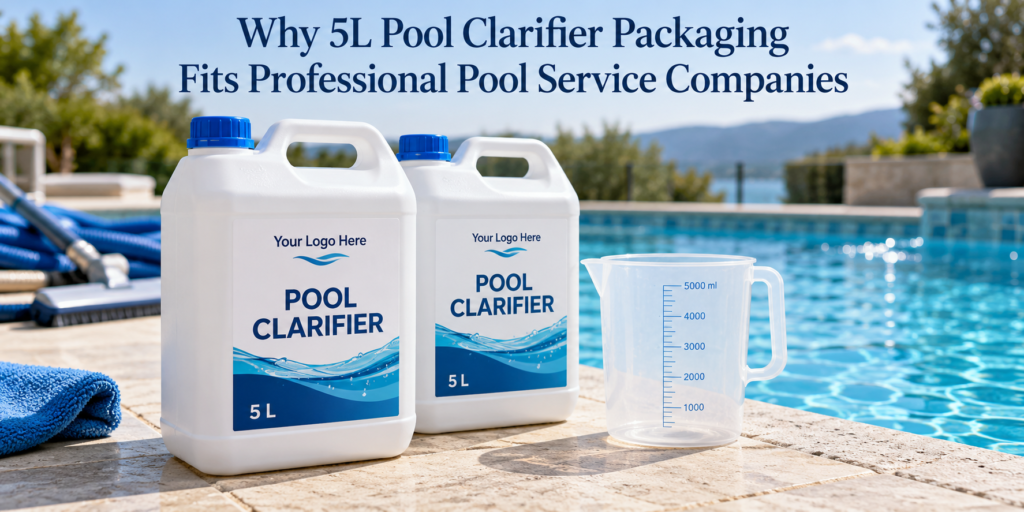
A pool service technician’s day runs on small decisions. Which pool needs extra brushing? Is the filter due for cleaning? How much product should go on the truck before the next round of visits?
Packaging sits quietly behind all of those tasks.
A bottle that’s too small may run out halfway through a busy route. A large container may hold plenty of product, yet be awkward to lift and pour. Somewhere between the two, a 5L jerrycan can offer a useful balance.
That’s why 5L pool clarifier packaging deserves a place on the buying list of professional pool service companies. It provides more working stock than a small retail bottle while remaining practical for many teams to carry, store, and use.
Still, the pack size alone doesn’t make a product suitable for professional work. The formula, approved directions, container design, and rate of use all matter.
Let’s look at where 5L packaging earns its place—and how to judge whether it fits your service business.
The Right Pack Size Starts with the Working Day
A homeowner may keep one bottle of clarifier on a shelf and use it only when needed. A service company has a different job.
Its team may care for several pools, each with its own water volume, filter system, and service history. Some sites need no clarifier during a visit. Others may need a measured treatment after the technician has checked the cause of poor clarity.
That makes daily product demand uneven.
A useful service pack needs to hold enough stock for the planned work without creating extra handling problems. It also needs to fit the way technicians move between their storage area, vehicle, and customer sites.
For many businesses, 5L is worth considering because it bridges that gap.
It holds a meaningful amount of liquid, yet it can still be assigned to one technician or one route. The team can track it as a working container rather than treat every visit as a trip back to a central bulk supply.
The key question is simple: Does this pack support the way your team actually works?
More Product on Hand, Fewer Small Bottles to Manage
Five liters equals the liquid volume of five 1L bottles. That’s straightforward arithmetic, but it has a practical effect.
When the same formulation is available in both sizes, one 5L jerrycan can replace several small containers in the working stock.
That may mean fewer bottles to count, open, close, and replace. It can also reduce the number of partly used bottles moving between the warehouse and service vehicles.
Picture a technician checking supplies before leaving. There’s one half-used bottle behind the test kit, another in a storage box, and an unopened bottle on the shelf. There may be enough product—but someone still has to check.
A larger working pack can make that task simpler.
Of course, fewer containers don’t automatically mean less total storage space. Jerrycan shape, carton size, and vehicle layout still affect how well the stock fits. A physical sample is often more useful than a product photo when assessing this point.
Easier Handling Than a Much Larger Working Container
Large packs have their place. A busy pool facility or a central blending operation may use enough product to justify them.
For a technician moving between sites, though, a much larger container can become cumbersome.
A 5L jerrycan generally carries less total weight than a 25L container holding the same liquid. That can make it easier to move from a shelf, place in a suitable vehicle storage area, and position for measured dispensing.
But “5L” describes volume, not weight. The filled weight depends on the liquid’s density and the packaging itself.
Handle design matters, too. A narrow grip can feel uncomfortable even when the load is manageable. A poorly placed handle may make the container tilt in an awkward way as it empties.
Before placing a large order, try the filled pack under realistic conditions:
- Can the technician grip it comfortably while wearing the required gloves?
- Is it easy to lift from the normal storage position?
- Can the opening be controlled during pouring?
- Does the container remain stable when set down?
Those details have more value than a bold “professional grade” claim on the label.
A Practical Supply Pack—With Proper Measuring Still Essential
A 5L container can hold the supply for several treatments, depending on the product directions and the needs of each pool. It should not become an excuse to estimate doses by eye.
The package holds the product. A suitable measuring tool determines the dose.
That distinction matters because the amount needed for one pool may be small compared with the size of the container. Pouring directly from a full jerrycan can make a small quantity hard to control.
A dedicated, clearly marked measuring vessel or compatible dispensing device can help. It should suit the dose range and be used according to the product instructions.
There’s also a reason to review the container opening. A wide neck may be useful for some tasks, yet it can release liquid faster than expected. A compatible pouring aid may improve control, but it needs to be assessed with the actual formulation.
Good packaging supports careful work. It doesn’t replace it.
Judge Value by Treatment Cost, Not the Size of the Can
A 5L pack may offer a lower purchase price per liter than a smaller pack of the same product. It may also reduce some packaging and filling costs per liter. Neither outcome should be assumed.
Ask for the actual prices, then compare them.
More importantly, pool service companies need to know what a suitable treatment costs. A low price per liter can be misleading when two products have different concentrations or application rates.
Start with a simple calculation:
Product cost per treatment = delivered cost per liter × liters used per treatment
For illustration, assume a product costs $8 per liter and its approved directions call for 100 mL in a particular situation:
$8 × 0.1L = $0.80 in product cost
These are example figures, not a price quotation or dosing recommendation.
That calculation gives a clearer basis for comparison than the container price alone. It also helps a service company understand its material cost for each job.
Then add the practical costs: delivery, storage, measuring equipment, damaged packs, and staff time. The cheapest can on the purchase order may not deliver the lowest working cost.
Match the Pack to Real Consumption
A 5L jerrycan is most useful when the business uses it at a sensible pace.
Buy too little and the team risks frequent replenishment. Buy too much and stock may sit longer than planned.
The answer starts with records.
Track how much clarifier is used over several representative weeks. Include both quiet periods and busy ones where possible. Note which routes use the product, why it was applied, and how much remained at the end of the period.
For example, a route using an average of 1L per week would take about five weeks to use a 5L pack. That is an inventory example, not a treatment schedule.
A route using very little may be better served by a smaller pack. A high-use site may justify a larger supply arrangement.
The useful measure is pack size compared with actual consumption, taking the labeled shelf life and storage conditions into account.
There’s no prize for buying the biggest container. The goal is to keep the right amount of usable stock close to the work.
Stock Control Becomes Clearer with a Standard Working Size
Standard packs can make purchasing and stock checks easier.
If several technicians use the same formulation in the same 5L container, the business can set a consistent way to issue stock and record returns.
For example, each route might have a working container and an agreed reserve level. The warehouse can then replenish against real use rather than wait for an urgent message from a technician.
A basic record can include:
- Product name and formulation reference
- Batch or lot number
- Date received
- Date opened, where useful
- Quantity issued
- Estimated quantity remaining
- Reorder point
The record doesn’t need to be elaborate. It needs to be clear enough that another staff member can understand it.
Stock rotation also becomes easier when batches remain identifiable. Use a system that respects the product’s expiry information and prevents older usable stock from being forgotten behind new deliveries.
Vehicle Storage Deserves a Real-World Check
A compact jerrycan may fit neatly into a service vehicle, but it still needs a suitable storage position.
Check its dimensions against the actual storage area. Include the height of the handle and cap, not just the body of the pack.
Also consider how the container will be secured and kept upright. A good fit on an empty shelf tells you little about how it will sit beside tools and other supplies on a working day.
Follow the product label and safety data sheet for storage and handling requirements. Product compatibility, temperature exposure, and spill control should be assessed for the specific chemical.
Avoid making the vehicle a long-term store simply because there’s room.
A practical pack should help the company carry the amount needed for the work. It should also make it easy to return unused stock to suitable storage when required.
This is where a short trial with the service team can reveal things a purchasing desk won’t see.
A Professional Container Needs More Than a Strong Handle
Pool service packaging faces repeated use. It may be opened many times, moved between locations, and handled with wet gloves.
A sound package therefore needs to work as a complete system.
The container material must suit the formulation. The cap, seal, and any liner must also be compatible. A strong bottle with an unreliable closure is still an unreliable pack.
Ask the supplier how the proposed package has been assessed with the actual product. Samples should be reviewed for leakage, controlled pouring, cap performance, and condition after normal handling.
Stacking needs separate attention. Some jerrycans are designed for stacking under stated conditions; others aren’t. The rectangular shape alone is not proof.
The same applies to transport. Confirm the packaging requirements for the specific product and shipment rather than assume every 5L chemical container is interchangeable.
These checks help turn an attractive packaging idea into a dependable working pack.
Clear Labels Help the Whole Team Work Consistently
A larger container may provide room for readable information, though the final label area depends on its shape.
Use that space well.
Technicians need to identify the product quickly, find the directions, and confirm they’re using the right instructions for the formula in the can.
A useful label should make essential information easy to locate, including the net contents, application directions, storage guidance, batch reference, and required safety details.
Avoid squeezing instructions into tiny type while giving most of the space to sales claims. The label is a working tool as well as a brand display.
Dose units need special care. Directions should make clear whether they refer to the supplied product or active ingredient and whether quantities are measured by mass or volume.
If the company supplies products to markets using different pool-volume units, well-prepared local instructions can reduce confusion.
A QR code may provide extra technical material. It should support the required label information rather than replace it.
Where 5L Fits Beside 1L and 25L Packs?
Different customers may need the same product in different sizes.
A small pool service business, a retail buyer, and a large facility operator do not necessarily share the same storage space or rate of use.
| Pack size | Where it may fit | Main point to assess |
|---|---|---|
| 1L | Low-use routes, smaller users, initial evaluation | Whether frequent replacement creates extra work |
| 5L | Regular service routes and moderate consumption | Whether the team can handle and use it efficiently |
| 25L | Higher-use sites or suitable central supply arrangements | Handling, dispensing, storage, and stock turnover |
These are possible uses, not fixed rules.
A concentrated product may last a long time even in a small pack. A less concentrated formulation may be consumed much faster. That’s why comparing pack sizes makes the most sense after the product and directions have been agreed.
For a distributor, offering several sizes can support different buyer needs. For a service company, using more than one size may make sense across different routes.
Private Label Packaging Can Support a Service Brand
Some service companies want a product line that carries their own name. A 5L pack can suit that aim when their customers include maintenance teams, property managers, or other regular users.
It creates a visible working product that staff may handle often.
But the value goes beyond placing a logo on a white can. A strong private label program brings the formulation, directions, packaging, and technical documents together.
If several pack sizes contain the same product, the presentation should help buyers recognize that relationship. If the formulas differ, the labels must make the difference clear.
Brand claims should also remain grounded. A blue liquid or a larger can does not establish greater performance.
Eautrix lists private label support and 5L jerrycans among the choices for its polymer pool clarifier. Buyers can review the Polymer Pool Clarifier product details when preparing a packaging brief.
The strongest service brand is built when the pack is easy to recognize and the product is dependable in its intended use.
Fewer Containers Can Help—But Check the Material Claim
Replacing five 1L bottles with one 5L jerrycan reduces the number of primary containers used for the same liquid volume.
That can mean fewer caps, labels, and individual items to manage.
However, it does not prove a specific reduction in plastic weight. The larger container may need thicker walls or a heavier closure. Carton design and protective packaging also affect the result.
If packaging reduction matters to your buyers, request actual component weights and compare the full packaging system per liter of product.
Keep disposal claims equally precise. Local recycling acceptance can vary, and chemical containers may require particular handling.
A measured statement such as “fewer individual containers for the same supplied volume” is easier to support than a broad environmental promise.
Professional buyers tend to appreciate that level of care. They need facts they can use in their own purchasing decisions.
Run a Small Trial Before Committing
A packaging trial doesn’t have to be complicated.
Choose a suitable route or working setting and let the team assess the proposed 5L pack under normal conditions. Keep the formulation and application instructions consistent so the feedback focuses on the packaging.
Ask technicians about grip, pouring control, closure performance, label readability, and storage fit.
Then compare their feedback with stock records. Did the pack last a sensible length of time? Was it easy to track? Did staff need an additional measuring aid?
Include the warehouse team, too. They will notice carton handling, shelf fit, and batch identification issues that may not appear at the poolside.
A short trial can prevent a large order of containers that look right but work poorly.
It also gives the supplier specific feedback. “The handle is uncomfortable with gloves” is much more useful than “We need better packaging.”
Choose the Pack That Helps Your Team Deliver
The appeal of 5L pool clarifier packaging is practical. It can provide useful working stock, reduce the number of small bottles to manage, and remain easier to move than a much larger container.
For a pool service company, those benefits matter when they make daily work more consistent.
The final choice should rest on actual consumption, treatment cost, container quality, and staff feedback. Confirm the formula and directions first, then assess the pack around them.
If you’re developing a branded service product, bring those requirements into the discussion early. Specify the intended users, expected use rate, label language, and storage conditions.
You can contact Eautrix to discuss 5L pool clarifier packaging and request details for your market.
A well-chosen container won’t do the technician’s job. It can make that job easier to organize, repeat, and manage.
Frequently Asked Questions
1. Is 5L pool clarifier packaging suitable for a small pool service company?
It can be, provided the company uses enough product within the stated shelf life and can store it correctly. Check consumption records before choosing between 1L, 5L, and larger packs.
2. Does a 5L pool clarifier container provide a lower cost per treatment?
It may when the same formulation has a lower delivered price per liter in the larger pack. Calculate treatment cost using the approved dose; container size alone doesn’t establish better value.
3. How many pools can a 5L pool clarifier pack treat?
There’s no fixed number. It depends on pool volume, the formulation, water conditions, and the labeled application rate. Divide 5,000 mL by the required amount per treatment to estimate the number of applications.
4. What should professional pool service buyers check in a 5L jerrycan?
Check formulation compatibility, handle comfort, pouring control, closure reliability, label readability, and storage fit. Confirm any stacking or transport requirements with the supplier.
5. Can professional pool service companies buy private label clarifier in 5L packs?
Yes, suppliers offering that service may provide branded labels and suitable containers. Confirm the formulation, minimum order quantity, packaging specification, technical documents, and destination-market labeling requirements before ordering.