
GET IN TOUCH
Ask For Sample?
What Causes Fine Suspended Particles in Swimming Pool Water?
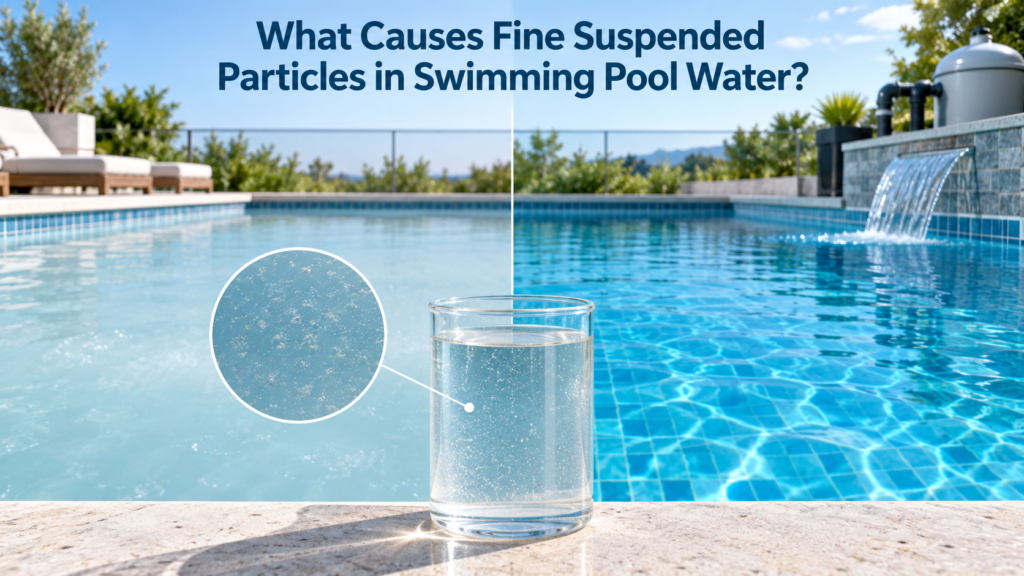
A swimming pool can look clean and still appear strangely dull. The floor is visible, the chlorine reading seems normal, and no leaves are floating on the surface. Yet when sunlight crosses the water, a pale haze appears. At night, the pool light reveals countless tiny specks drifting through the beam.
Those specks are fine suspended particles.
They are often too small to settle quickly and may be too small for the filter to catch efficiently on a single pass. Instead, they remain in the water, scatter light, and make an otherwise well-kept pool look cloudy or flat. The problem is more than cosmetic. Persistent particles can point to weak filtration, poor water balance, contamination, dead algae, or a treatment mistake.
So, where do these particles come from? Usually, there is no single culprit. Dust, swimmers, minerals, plant material, microbes, and pool chemicals can all contribute. Understanding the source is the first step toward choosing the right correction.
What Are Fine Suspended Particles?
Fine suspended particles are small solid or semi-solid materials that remain dispersed in pool water instead of floating to the surface or dropping rapidly to the floor. Many are measured in micrometres, or microns. For scale, one micron is one-thousandth of a millimetre.
Some particles are visible as pinpoints under strong light. Others cannot be seen individually at all. Pool users notice only their combined effect: hazy water, a whitish cast, poor sparkle, or reduced visibility toward the deep end.
Particle size is only part of the story. Surface charge matters too. Many fine particles carry similar electrical charges, so they repel one another. Think of two magnets held the wrong way around. Because the particles resist coming together, they stay as separate, filter-challenging fragments.
This is why a pool may run for hours without becoming clear. The filter is working, but the contaminants are small, stable, and slow to collect.
Dust, Soil, and Airborne Pollution—The Everyday Sources
Outdoor pools constantly collect material from the air. Wind carries soil, pollen, smoke residue, vehicle emissions, construction dust, and tiny bits of organic matter across surprising distances. Much of this material lands directly on the water.
Large debris is easy to spot and remove. Fine dust behaves differently. It can disperse through the entire pool before it settles. Swimmers, return jets, robotic cleaners, and brushing may lift settled dust back into circulation.
Local conditions strongly affect the load. A pool beside an unpaved road will face different pressure from one surrounded by lawn. Dry weather raises dust. Nearby building work may produce a sudden haze. Wildfire smoke can also leave extremely small ash particles, even when the fire is far away.
Pollen deserves a special mention. Some pollen floats and gathers along the waterline, while smaller grains or broken fragments remain suspended. When pollen combines with body oils or other contaminants, the resulting material can become harder to filter.
Swimmers Bring More Than Towels
Every swimmer adds a small contaminant load. Sunscreen, cosmetics, hair products, perspiration, skin cells, textile fibres, and traces of soil all enter the water. One person may contribute very little, but a busy pool can receive a substantial dose in a single afternoon.
These materials do not always remain in their original form. Chlorine may oxidize part of the organic matter and break it into smaller fragments. Oils may form tiny droplets. Skin cells and fibres may combine with dust. The water can therefore contain a mixed suspension rather than one easily identified substance.
High bather load also consumes sanitizer. If free chlorine falls behind demand, microorganisms may multiply and organic debris may build up faster than the circulation system can remove it. The pool can lose its sparkle before it turns obviously green.
This is why public, hotel, school, and community pools often need closer control of circulation and filtration than a lightly used residential pool. More swimmers mean more particles—simple as that.
Dead Algae Can Leave a Pool Cloudy
Killing algae and removing algae are two different jobs.
After an effective sanitation or algaecide treatment, dead algae cells may remain suspended in the water. These fragments are often too small to settle rapidly. The pool may change from green to blue but remain cloudy, which can puzzle pool owners who expected instant clarity.
The colour change is good news. It often means the algae are no longer actively growing. Still, the dead material must be filtered or otherwise removed. Brushing loosens residue from walls and steps, while continuous circulation moves it toward the filter. Cleaning or backwashing the filter at the right time prevents captured material from restricting flow.
If algae return soon after treatment, however, the issue is not merely leftover particles. Check sanitizer level, pH, circulation, hidden low-flow areas, and the accuracy of the pool-volume calculation. A clarifier can help collect fine debris, but it cannot replace algae control.
For pools with recurring algae pressure, a non-foaming Polyquat 60 Algaecide may be incorporated into an appropriate preventive maintenance program. Product use should always follow the finished-product label and local requirements.
Tiny Mineral Crystals May Form Inside the Water
Not every suspended particle enters from outside. Some are created in the pool when dissolved minerals become insoluble and form tiny crystals.
Calcium carbonate is a common example. The likelihood of precipitation rises when pH, total alkalinity, calcium hardness, and water temperature combine to make the water scale-forming. A rapid pH rise or a poorly managed chemical addition can trigger a whitish cloud.
This effect is sometimes seen after calcium hypochlorite is added, especially in hard water. It can also follow the addition of an alkalinity or pH increaser when the product is poured too quickly or allowed to form a concentrated pocket.
Fresh plaster pools may face added mineral pressure while the surface cures. Saltwater chlorine generators can create high-pH conditions near the cell, and heated water can encourage calcium carbonate to leave solution. The underlying chemistry varies, but the visible result may look much the same: pale, fine particles hanging in the water.
Before treating this as a simple filtration issue, test the water. Adding more chemicals without knowing the pH, alkalinity, and calcium hardness may make the cloud worse.
Chemical Incompatibility Can Create a Haze
Pool chemicals are designed to work in water, but that does not mean every product should be mixed directly with every other product.
Concentrated chemicals may react when they meet before being fully diluted. Some combinations form insoluble material. Others neutralize part of each other or produce a sticky suspension that loads the filter.
Anionic and cationic products are a classic concern. “Anionic” materials carry a negative charge, while “cationic” materials carry a positive charge. When concentrated products with opposite charges meet, they may bind rapidly and form visible haze, strings, gel-like residue, or precipitate.
The practical lesson is straightforward:
- Never mix concentrated pool chemicals together unless the product instructions clearly permit it.
- Add each chemical separately and allow suitable circulation time.
- Use clean measuring tools and do not return unused product to its original container.
- Follow the label sequence, dilution directions, and safety precautions.
More treatment is not always better. Sometimes the cloudy particles are the treatment products themselves—or the result of how they were added.
Poor Water Balance Can Keep Particles in Circulation
Water balance affects more than swimmer comfort and equipment protection. It also influences particle formation and treatment performance.
High pH can promote calcium carbonate clouding and can reduce the sanitizing power of free chlorine. Low sanitizer effectiveness gives biological and organic contaminants more time to accumulate. Very high total alkalinity may make pH harder to control, while unsuitable calcium hardness can contribute to scaling or corrosive conditions, depending on the overall water balance.
The key is to evaluate the whole picture. A single test result rarely explains everything.
Pool professionals often consider pH, total alkalinity, calcium hardness, temperature, and total dissolved solids together. The Langelier Saturation Index, or a pool-specific saturation index, can help indicate whether water tends to deposit calcium scale or dissolve calcium-containing surfaces. It is a guide rather than a substitute for observation, but it can reveal why fine mineral particles keep appearing.
Incomplete Dissolution of Pool Chemicals
Granular chemicals need time and the correct conditions to dissolve. If a product is added in a way that conflicts with its label, undissolved grains or small agglomerates may circulate through the pool.
Cold water often slows dissolution. Weak circulation makes matters worse. Adding a large amount in one place can create a concentrated cloud, and broadcasting a product that should first be dissolved may leave residue on the floor.
Even products that are normally soluble can contain small amounts of insoluble matter or can form particles when they meet highly mineralized water. That does not automatically mean the product is defective. Application method, water chemistry, storage history, and moisture exposure all deserve attention.
If cloudiness begins immediately after a chemical addition, record what was added, how much was used, where it entered the pool, and which products had been applied earlier. Timing is often the strongest clue.
Filter Media and Equipment Can Add to the Problem
A filter should remove particles, yet an unhealthy filtration system can allow them to persist—or even return them to the pool.
Common causes include:
- A torn cartridge or damaged filter element
- Cracked laterals in a sand filter
- Poorly seated components after maintenance
- Channeling through dirty or unsuitable filter media
- An incorrect multiport-valve position
- Excessive flow that reduces effective capture
- Insufficient daily circulation time
- Air entering the system and disturbing hydraulic performance
Filter media can also escape. Sand returning through pool inlets often points to a mechanical fault rather than ordinary dust. Diatomaceous earth, or DE, entering the pool may indicate a torn grid, damaged manifold, or assembly issue.
Take a close look at the material. Does it feel gritty? Does it appear mainly below the return jets? Did it begin after filter service? Those details can save hours of chemical guesswork.
Early Biological Growth May Look Like Ordinary Haze
Cloudiness can be the first visible sign of microbial growth. Bacteria and early-stage algae may be present before the water becomes green or surfaces feel slippery.
Warm water, sunlight, poor circulation, low sanitizer residual, high bather load, and accumulated nutrients all support biological activity. Tiny cells, organic by-products, and biofilm fragments then add to the suspended-particle burden.
This is why water clarity should never be judged by colour alone. Blue water is not automatically sanitary water. If clarity declines, check sanitizer and pH promptly, and follow the applicable operating rules for the pool.
For commercial pools, poor visibility is a safety concern. If the main drain or the deepest point cannot be seen clearly, bathers should not remain in the pool while the cause is investigated and corrected.
Rain and Storm Runoff Can Change Everything Overnight
Heavy rain does more than dilute pool chemicals. It can wash dust, soil, pollen, fertilizer residue, plant fragments, and other contaminants from the surrounding deck into the water. Wind may add even more debris before the storm ends.
Rainfall can also change pH, alkalinity, sanitizer concentration, and water level. If the pool overflows, normal skimming may weaken. If runoff enters directly, the contaminant load can rise sharply.
After a storm, remove large debris first, restore the correct water level, test the water, inspect circulation, and clean the filter as needed. Treat the actual problem instead of reaching automatically for the strongest chemical on the shelf.
Why Doesn’t the Filter Catch These Particles?
Filters do not trap every particle equally. Their performance depends on media type, media condition, flow rate, pressure, particle size, and how often the water passes through the system.
Very small particles may travel through spaces in the filter media. Those that are captured may later pass through if the media is damaged, the flow changes, or the filter is handled incorrectly. A dirty filter can sometimes capture finer material than a freshly cleaned one, but once it becomes overly loaded, flow falls and circulation suffers. There is a useful middle ground.
Turnover estimates can also be misleading. Pumping a volume equal to the pool’s capacity does not mean every litre has passed through the filter once. Pool water mixes unevenly, and some water may circulate repeatedly while low-flow zones receive little movement.
Run time alone, therefore, cannot guarantee clarity. Water must move through the whole pool, the filter must be in good condition, and the particles must be within a size range the system can retain.
How a Polymer Pool Clarifier Helps?
A pool clarifier does not make particles disappear. It helps small particles associate into larger groups that the filter can capture more readily.
Many fine contaminants remain stable because their surface charges keep them apart. A cationic polymer carries positive charges along its molecular chain. These charges can attach to negatively charged particles and reduce the repulsion between them. Long polymer chains may also connect several particles, a process often called bridging.
The resulting clusters are larger than the original particles. They can become easier for the filtration system to retain, allowing the water to regain brilliance over time.
A purpose-designed Polymer Pool Clarifier can support the removal of fine suspended matter when water chemistry, circulation, and filtration are already being managed. It is particularly useful for dull or hazy water caused by particles that are too small for efficient direct capture.
Still, dosage matters. Too little may produce a weak result. Too much can restabilize particles, create residue, or place an unnecessary load on the filter. Always base the dose on the pool volume and the finished-product instructions.
Clarifier or Flocculant—They Are Not Quite the Same
The terms “clarifier” and “flocculant” are sometimes used loosely, but their application goals often differ.
A clarifier generally forms filterable particle groups while the circulation system continues to operate. It suits gradual clarity improvement and routine maintenance.
A flocculant is often intended to create heavier flocs that settle to the pool floor for vacuuming to waste. This can remove a large contaminant load, but it may require the pump to be stopped during settling and may not be suitable for every filtration system.
Using one as though it were the other can create frustration. A product intended for filtration may not settle as expected. A strong flocculant sent directly into certain filters may block or damage them. Read the label, confirm the filter type, and understand the intended removal route before treatment.
How to Identify the Most Likely Cause?
Instead of adding products at random, work through the evidence.
First, note when the cloudiness began. Did it follow a storm, a crowded weekend, algae treatment, pH adjustment, filter cleaning, or a large chemical dose?
Next, test the water with a reliable kit or calibrated instrument. Check the parameters required for the pool, including sanitizer and pH. Review total alkalinity and calcium hardness when mineral clouding is possible.
Then inspect the physical system:
- Confirm that the pump primes and maintains normal flow.
- Check the pressure gauge against the clean-filter reading.
- Look for weak returns, closed valves, air bubbles, or blocked baskets.
- Examine the filter media or elements for wear and incorrect assembly.
- Brush steps, corners, ladders, and low-flow areas.
- Observe whether particles settle when circulation stops.
A simple jar test can also provide clues. Collect pool water in a clear container and leave it undisturbed. If particles settle, vacuum removal may be possible. If the sample remains evenly hazy, the particles may be extremely fine, colloidal, biological, or mineral in nature.
A jar test does not replace full water analysis, but it is a useful window into particle behaviour.
A Practical Order for Restoring Clear Water
When the water becomes cloudy, the order of action matters:
- Restrict swimming if visibility is poor or water-safety requirements are not met.
- Remove leaves and other large debris.
- Test and correct sanitizer and water balance according to the pool’s operating guidance.
- Treat active algae or microbial contamination before focusing on residual haze.
- Inspect the pump, circulation pattern, and filter condition.
- Brush surfaces so trapped material can reach the filtration system.
- Run the system for the required period and clean the filter when pressure indicates it is needed.
- If fine particles remain, use a compatible clarifier at the labelled dose.
- Retest the water and review the result before adding more product.
This sequence sounds less dramatic than pouring in a miracle cure. It is also far more dependable.
Preventing Fine Particles from Building Up Again
Clear water is easier to maintain than to recover. A steady routine reduces both contaminant load and sudden chemistry swings.
Encourage swimmers to rinse before entering. Keep the deck clean so rain and foot traffic carry less dirt into the water. Empty baskets, brush low-flow areas, and vacuum before debris breaks into finer fragments. Maintain a suitable sanitizer residual, check pH regularly, and give the circulation system enough time to serve the actual pool conditions.
Seasonal care matters too. When a pool will remain closed, water should be cleaned and balanced before the cover goes on. A suitable Winter Algaecide can support algae prevention during the off-season, but it works as part of a complete closing program—not as a substitute for cleaning, circulation planning, or correct water balance.
Keep treatment records. A short note about weather, bather load, test readings, chemical additions, filter pressure, and cleaning dates can reveal patterns that memory misses. If the same haze appears after every storm or every filter service, you have a valuable lead.
The Real Cause Is Often a Chain, Not a Single Event
Fine suspended particles rarely appear without context. A windy day adds dust. A busy afternoon contributes sunscreen and organic matter. Free chlorine falls. Early algae growth begins. The next chemical addition creates more fragments, while a loaded filter struggles to remove them.
Seen separately, each event seems minor. Together, they produce cloudy water.
That is the central point: treat the system, not merely the symptom. Identify what created the particles, correct water chemistry, restore circulation, confirm filter performance, and then use a clarifier when particle capture needs support.
Once the cause is understood, the haze stops being mysterious. It becomes a manageable water-treatment problem—and clear, sparkling water is much easier to recover.
Frequently Asked Questions
1. Why can I see tiny particles in my pool at night but not during the day?
A pool light sends a concentrated beam through the water, so fine particles scatter the light and become easier to see. Daylight is more diffuse, which can hide individual specks even when the pool looks slightly dull.
2. Will chlorine remove fine suspended particles from swimming pool water?
Chlorine can oxidize organic contaminants and control many microorganisms, but it does not physically filter particles from the water. Dead algae and oxidized residue still need to be captured by the filter, vacuumed out, or treated with a suitable clarifier.
3. How long does a pool clarifier take to clear fine particles?
The time depends on particle load, filter type, circulation, water balance, and product dosage. Improvement may appear within several hours, while heavily clouded water can require longer filtration. Follow the product label and avoid repeated dosing before evaluating the first treatment.
4. Can too much pool clarifier make water cloudy?
Yes. Overdosing can leave excess polymer in the water, create sticky residue, burden the filter, or interfere with effective particle grouping. Measure the pool volume carefully and use the labelled dose rather than assuming more will work faster.
5. Why does my pool stay cloudy even when the chemical readings look normal?
Normal test readings do not rule out fine dust, dead algae, damaged filter components, poor circulation, or particles below the filter’s efficient capture range. Inspect the equipment, review recent events, and consider a compatible polymer clarifier if the remaining haze is caused by fine suspended matter.