
GET IN TOUCH
Ask For Sample?
How Do Pool Clarifiers Help Restore Crystal-Clear Water?
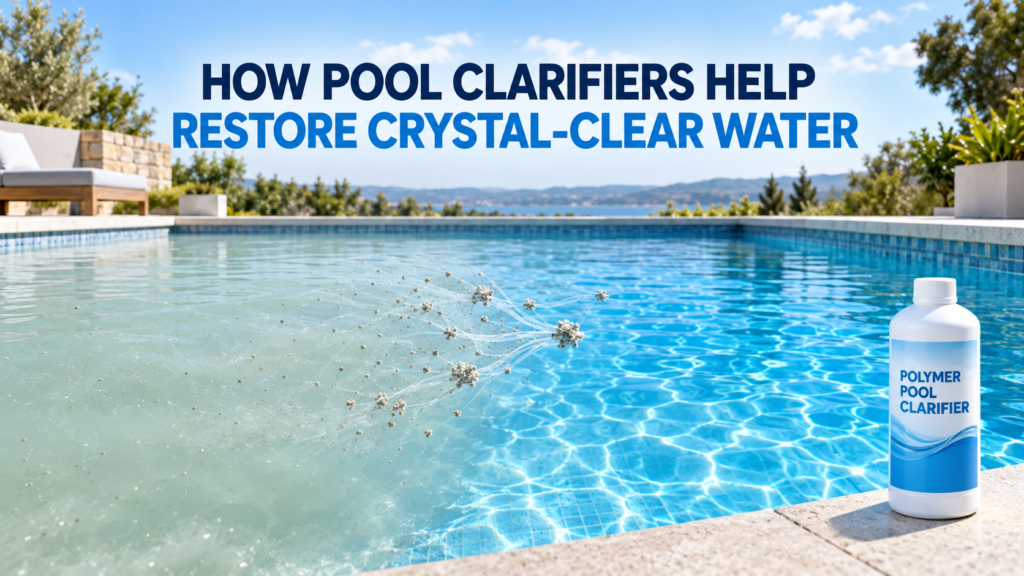
A swimming pool can lose its sparkle surprisingly fast. Yesterday, the water looked bright enough to reveal every tile on the floor. Today, it has a pale haze that seems to float everywhere. The sanitizer level may look normal. The pH may be close to target. The filter is running. Yet the water still refuses to clear.
That frustrating haze often comes from particles that are too small for the filter to catch efficiently. Dust, pollen, body oils, sunscreen residue, dead algae, mineral particles, and bits of organic matter can remain suspended in the water. Each particle may be nearly invisible on its own. Together, though, they scatter light and give the pool a dull, cloudy appearance.
This is where a pool clarifier can help.
A clarifier does not make dirt vanish, and it does not replace proper sanitation. Instead, it acts as a bridge between tiny suspended particles and the pool filter. It gathers difficult-to-filter matter into larger clusters, so the circulation and filtration system can remove it more readily.
Simple idea, clever chemistry.
Let’s look at what pool clarifiers really do, why they work, and how to use them without turning a small clarity problem into a bigger one.
Why Does Pool Water Look Cloudy in the First Place?
Clear water is not necessarily water with no particles in it. Even a well-maintained pool contains dissolved substances and very fine suspended matter. Water looks clear when those materials remain at low levels, stay properly dissolved, or are removed fast enough by filtration.
Cloudiness appears when suspended particles build up faster than the system can capture them. Common causes include:
- Windblown dust, sand, and pollen
- Swimmer waste, including perspiration, skin oils, cosmetics, and sunscreen
- Dead algae after an algaecide or sanitizer treatment
- Fine debris following heavy rain or a pool party
- Calcium carbonate precipitation caused by poor water balance
- Weak circulation or short pump run times
- A dirty, undersized, damaged, or poorly operated filter
- Excessive chemical additions or incompatible products
- Early algae growth
- High organic contamination combined with low sanitizer performance
The important point is that “cloudy water” describes an appearance, not a single cause. A clarifier may work beautifully when fine suspended solids are the main problem. It will be far less useful if the cloudiness comes from uncontrolled algae, severe calcium scale, or a failed filtration system.
Before reaching for any bottle, test the water and inspect the equipment. Check sanitizer, pH, total alkalinity, calcium hardness, and stabilizer where relevant. Confirm that return jets have good flow and that filter pressure is within its normal operating range. A five-minute check can prevent hours of guesswork.
So, What Is a Pool Clarifier?
A pool clarifier is a water-treatment product designed to condition small suspended particles so the filter can capture them more effectively. Many modern liquid clarifiers use water-soluble polymers. These polymers carry charged sites and have long molecular chains that can interact with particles dispersed through the water.
Eautrix’s Polymer Pool Clarifier, for example, is based on PolyDADMAC technology. PolyDADMAC is a cationic polymer, meaning that it carries a positive electrical charge along its chain. (Eautrix)
Why does that matter?
Many fine contaminants found in pool water develop a negative surface charge. Similar charges repel each other, so the particles remain separated—rather like two magnets refusing to meet at matching poles. Because they stay apart, they can pass through the filter or remain suspended for a long time.
A cationic clarifier helps reduce that repulsion. Once the particles become less stable, the polymer can bind or bridge them into larger groups. Water-treatment professionals often call these groups “flocs,” though the soft clusters created by a clarifier may be much smaller than the heavy flocs produced during a full flocculation treatment.
The filter now has something it can catch.
How Pool Clarifiers Restore Clear Water, Step by Step?
The result may look almost magical, but the process is practical and measurable. It usually follows four linked stages.
1. The Clarifier Disperses Through the Pool
After the measured dose is added, active circulation carries the liquid throughout the pool. Good distribution matters. If the product is poured into one dead corner while the pump is off, much of the water may receive little useful contact.
Some finished clarifiers are added directly around the pool perimeter. Others may have different label directions. Always follow the instructions for the specific formulation rather than assuming that every liquid polymer is applied in the same way.
2. The Polymer Interacts with Fine Particles
The cationic polymer is attracted to many negatively charged suspended particles. This interaction reduces the electrical forces that keep them apart.
Think of a crowded room where everyone insists on standing alone. The polymer acts like a friendly host, drawing small groups together. The particles are still present, but they no longer behave as countless isolated specks.
3. Small Particles Form Larger Clusters
The polymer’s long chains can attach to more than one particle. This creates bridges between them, forming clusters that are larger and easier to intercept.
Correct dosage is essential here. Too little clarifier may not destabilize enough particles. Too much can coat the particles so thoroughly that they become stable again, or it may create sticky material that burdens the filter. More product does not always mean clearer water. In polymer treatment, restraint often wins.
4. The Filter Removes the Conditioned Matter
Once the particle clusters circulate through the filtration system, the filter can retain more of them. Over several turnovers, the visible haze begins to fade. The water looks brighter, and details on the pool floor become sharper.
The clarifier has not “eaten” the cloudiness. The filter has removed it—with help.
That distinction explains why a clarifier cannot rescue a pool when the pump is not running, the filter medium is damaged, or the hydraulic system barely moves water.
Clarifier and Flocculant: Similar, but Not the Same
Pool owners often use the words “clarifier” and “flocculant” as if they were interchangeable. They are related, but the treatment methods are usually different.
A clarifier normally creates relatively small particle clusters that remain suspended and travel to the filter. The pump continues to operate, and clarity improves as the filter captures the conditioned particles.
A flocculant is generally intended to create larger, heavier flocs. These settle on the pool floor after circulation is stopped and must then be vacuumed to waste. That process can remove a heavy particle load quickly, but it needs careful handling and may not suit every filter or plumbing setup.
In practical terms:
- Use a clarifier for mild to moderate haze, routine water polishing, or fine particles that are slipping through an operating filter.
- Consider a label-approved flocculation treatment for severe cloudiness when settling and vacuuming to waste are possible.
- Do not add a clarifier and a flocculant together unless the product instructions specifically allow it.
For many residential and commercial pools, a well-formulated liquid clarifier is the gentler and more convenient first step. It works with normal circulation rather than requiring the pool to be shut down for settling.
What Types of Cloudiness Can a Clarifier Help?
A polymer clarifier can be especially useful when the haze comes from fine suspended matter such as:
- Dust and airborne debris
- Pollen
- Small organic particles
- Residue from heavy swimmer use
- Fine material that remains after vacuuming
- Dead algae after the algae has been controlled
- Mild dullness following rain or routine maintenance
- Particles too small for the filter to trap efficiently
It may also help “polish” water that is technically acceptable but lacks that crisp, glass-like finish expected in hotels, clubs, wellness facilities, and carefully maintained residential pools. Guests may not understand turbidity measurements, but they notice whether lane markings and floor drains look sharp. Appearance shapes confidence.
Still, clarity should never be treated as proof of sanitation. Water can look beautiful and still contain harmful microorganisms. A clarifier improves physical particle removal; it is not a primary disinfectant.
When a Pool Clarifier Will Not Fix the Real Problem?
This is the part many product labels cannot explain in one short paragraph: not every cloudy pool needs a clarifier.
If the water is green and slippery surfaces are developing, active algae may be present. The pool needs a complete algae-control response, including testing, circulation, brushing, filtration, and an appropriate sanitizer or algaecide program. Eautrix Polyquat 60 Algaecide is designed for algae control; a dedicated clarifier serves a different primary purpose. (Eautrix)
If calcium hardness and pH are too high, the haze may be precipitated calcium carbonate. Adding more polymer without correcting the water balance will not remove the cause.
If filter pressure is unusually low, water may be bypassing the filter or flow may be restricted before it reaches the pump. If pressure is unusually high, the filter may already be loaded with debris. In either case, equipment attention comes first.
A clarifier also cannot compensate for:
- Inadequate sanitizer residual
- Incorrect pH
- Poor circulation in steps, corners, or benches
- Broken filter laterals or damaged cartridge elements
- Channeling in a sand filter
- A filter that is too small for the pool
- Excessive bather load without enough treatment capacity
- Repeated chemical overdosing
Here’s a useful rule: diagnose first, clarify second.
How Long Does a Pool Clarifier Take to Work?
Some pools show visible improvement within several hours. Others need one or two days of circulation and filtration. The timing depends on particle type, contamination level, dose, pool turnover rate, filter condition, and the chemistry of the finished product.
A lightly hazy residential pool with a clean filter may brighten after a few filtration cycles. A large commercial pool recovering from heavy use may take longer because new contamination continues to enter the water. A pool full of dead algae may also need brushing, vacuuming, and repeated filter cleaning before it becomes truly clear.
Patience matters. Adding a second dose too soon can produce an overdose just as the first treatment begins to work.
Watch the filter during the process. As it captures more material, pressure may rise. Clean or backwash the filter according to the equipment manufacturer’s instructions and the facility’s operating procedure. Do not backwash too early without reason, since a slightly seasoned filter bed may capture fine particles better than a freshly backwashed one. On the other hand, do not allow pressure to climb beyond the recommended limit.
How to Use a Polymer Pool Clarifier Correctly?
The exact method must come from the finished product label, but a sound treatment sequence generally looks like this.
Test and Balance the Water
Measure the key parameters before treatment. Correct sanitizer and pH problems that could be driving the cloudiness. If a major calcium imbalance is present, address it before expecting a clarifier to create lasting results.
Remove Large Debris
Skim leaves, empty baskets, brush surfaces, and vacuum material that can be removed mechanically. There is little sense asking a fine-particle treatment to deal with debris that a net can collect in seconds.
Inspect the Filter and Circulation System
Confirm that the pump is primed, return flow is strong, valves are correctly positioned, and the filter is operational. Record the normal clean-filter pressure if it is known.
Calculate the Pool Volume
An inaccurate pool volume leads directly to inaccurate dosing. For a rectangular pool, multiply average length, width, and average depth, then convert the result to liters, cubic meters, or gallons. Irregular pools may need to be divided into simpler shapes.
Measure—Do Not Guess
Use a clean measuring container and follow the product label. Clarifier dosage may be expressed in milliliters per cubic meter, fluid ounces per gallon range, or parts per million. Check the units twice. A capful is not a dependable unit unless the cap is specifically marked for dosing.
Add the Product with Circulation Running
Distribute the product as directed. Keep the pump operating for the label-specified period so the polymer contacts the suspended matter and carries the conditioned particles toward the filter.
Monitor Clarity and Filter Pressure
Give the treatment time. Check the water from different angles and under daylight when possible. Clean the filter when its pressure rise or operating instructions indicate that cleaning is needed.
Repeat Only When the Label Permits It
If the water remains cloudy, do not automatically add more. Retest the chemistry, inspect the filter, and reconsider the cause. The original diagnosis may have been incomplete.
Why Overdosing Can Make Water Look Worse?
The most common clarifier mistake is wonderfully human: if a little helps, a lot must help faster.
Sadly, polymers do not follow that logic.
At the correct dose, polymer chains help particles join together. At an excessive dose, the polymer may cover particle surfaces and give them enough charge or steric protection to separate again. The water can remain hazy or even become more turbid. Sticky deposits may form on filter media, and cartridges may need extra cleaning.
Overdosing can also occur when several products contain cationic polymers. An operator might add an algaecide, a multipurpose treatment, and a separate clarifier without realizing that all three contribute polymer to the water.
Read active-ingredient information and product directions. When combining treatments, check compatibility and spacing requirements. If two cationic polymer products are used within the same maintenance program, the total polymer load deserves attention.
Does Filter Type Change Clarifier Performance?
Yes. The clarifier works with the filter, so filter design and condition affect the result.
Sand Filters
Sand filters are robust and widely used, but very fine particles can pass through the spaces between sand grains. A clarifier can enlarge those particles enough to improve capture. Correct backwashing remains important; too frequent or too late can both reduce performance.
Cartridge Filters
Cartridge elements can capture relatively fine matter and often respond well to a suitable clarifier dose. However, excess polymer can coat the pleats and reduce flow. Clean the cartridge properly rather than merely spraying the visible surface for a few seconds.
Diatomaceous Earth Filters
DE filters offer fine filtration and may clear conditioned particles quickly. Their pressure should be watched closely because captured solids can load the filter. Follow the equipment manufacturer’s procedure for cleaning and recharging the DE medium.
No clarifier can repair torn fabric, cracked laterals, poor sealing, or water bypass. Chemistry and equipment have to cooperate.
Clarifiers in Residential and Commercial Pools
The underlying chemistry is similar, but the operating context can be very different.
In a residential pool, a clarifier may be used after a storm, a family gathering, spring opening, or treatment of a minor algae incident. The owner can often allow the filter to run overnight and inspect the result the next morning.
Commercial pools face heavier and less predictable loads. Hotels, schools, fitness centers, water parks, and public facilities must manage sunscreen, cosmetics, organic matter, and frequent swimmer entry. A clarifier may support routine water polishing, but dosing should fit the site’s approved operating procedure. Operators must also comply with local rules for water quality, chemical use, records, and pool reopening.
For private-label brands and distributors, this difference affects product positioning. A retail product needs clear household directions and convenient packaging. A commercial formulation may be supplied in larger packs and supported by technical guidance for automated or controlled manual dosing.
Eautrix offers polymer clarifier packaging in 1 L, 5 L, and 25 L formats, with formulation, color, and private-label options for different markets. A blue-dyed product can create a familiar retail appearance, while an undyed formulation may suit buyers who prefer a simple original liquid. Color, of course, is a presentation choice—not evidence of stronger clarification. (Eautrix)
Can a Clarifier Be Used with an Algaecide?
Often, yes, but the products must have compatible labels and a sensible treatment sequence.
An algaecide is used to prevent or control algae. A clarifier conditions fine suspended material for filtration. After algae are controlled, dead cells may remain in the water and create a gray, greenish, or whitish haze. A clarifier can then help the filter collect that material.
However, not every product should be poured into the pool at the same moment. Some algaecides and clarifiers are both cationic polymers, and excessive combined dosing may increase filter loading or cloudiness. Strong sanitizer treatments may also require a waiting period before another product is added.
Follow each label, keep records, and avoid improvised chemical cocktails. For seasonal closing programs that combine algae prevention with clarity support, a purpose-designed Winter Algaecide may be more convenient than stacking several unrelated products. (eautrix.com)
Clear Water Starts with a Complete System
A good pool clarifier is a supporting player, not a one-bottle maintenance program.
Crystal-clear water depends on several parts working together:
- Accurate water testing
- Effective sanitation
- Stable pH and water balance
- Strong circulation
- Clean, correctly sized filtration
- Regular brushing and vacuuming
- Sensible swimmer-load management
- Targeted chemical treatment
When those foundations are in place, a polymer clarifier can solve one stubborn problem remarkably well: particles that remain suspended because they are too small or too stable for the filter to remove efficiently.
It gathers the invisible troublemakers, guides them toward the filter, and lets the equipment finish the job. No drama. Just better particle control—and the bright, crisp water everyone hoped to see.
Frequently Asked Questions About Pool Clarifiers
1. Can I swim after adding a polymer pool clarifier?
Follow the finished product label and local pool rules. Many liquid clarifiers permit swimming after proper dispersion and when all water-quality readings are within the required range, but waiting instructions vary by formulation. Never assume that one brand’s directions apply to another.
2. Will a pool clarifier remove green algae?
A clarifier is not a substitute for an algaecide or sanitizer. It may help the filter remove dead algae after an effective algae treatment, but active algae growth must first be controlled through an appropriate pool-care program.
3. How often should I add clarifier to a swimming pool?
Use it only as often as the product label recommends and the water condition requires. Some pools need occasional corrective treatment; others may use a low maintenance dose. Repeated dosing without diagnosing the cause of cloudiness can lead to polymer buildup and poor filtration.
4. Why is my pool still cloudy after using clarifier?
Possible reasons include incorrect dosage, insufficient circulation, a dirty or damaged filter, poor water balance, active algae, calcium precipitation, or inadequate treatment time. Retest the water and inspect the filtration system before adding another dose.
5. Is a cationic polymer pool clarifier suitable for saltwater pools?
Many cationic polymer clarifiers can be used in saltwater pools when the finished product label permits it. The salt system still needs correct chlorine production, circulation, and water balance. Check compatibility with the specific chlorinator and other treatment products before use.