
GET IN TOUCH
Ask For Sample?
Pool Clarifier Explained: A Beginner’s Guide to Clearer Pool Water
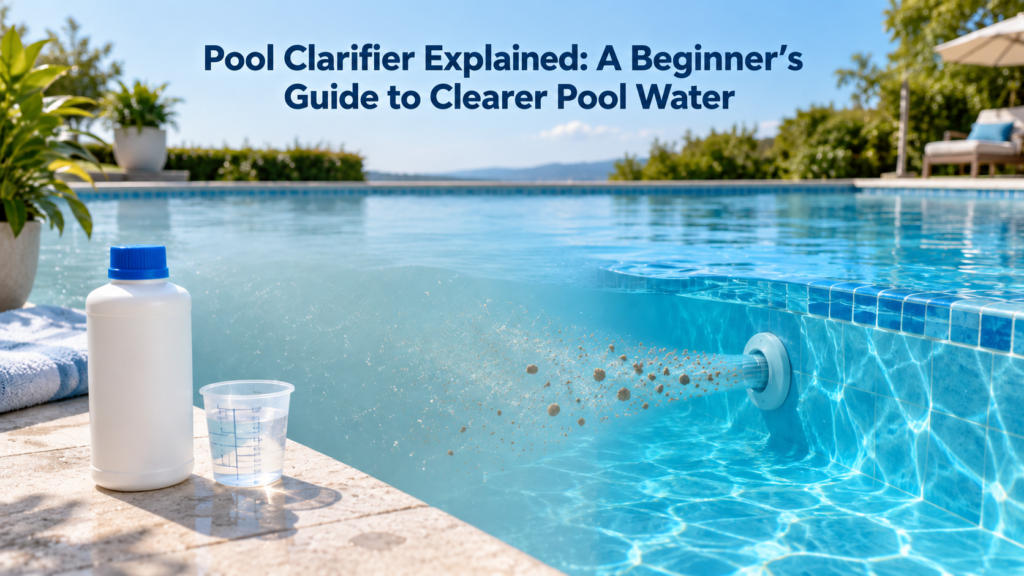
You walk outside, glance at the pool, and something feels off. The water is not green. It does not smell strange. The pump is running. Yet the deep end looks slightly hazy, the floor has lost its sharp outline, and the water no longer has that clean, glass-like sparkle.
This is exactly the sort of situation that makes many new pool owners reach for a pool clarifier.
A clarifier can be very useful when tiny suspended particles are causing dull or cloudy water. It helps the filter capture material that might otherwise pass through again and again. But it is not a cure for every pool problem, and adding more than the label recommends can make matters worse.
So, what does a pool clarifier really do? When should you use one? And how can you tell whether your pool needs clarification, better filtration, corrected water balance, or algae treatment instead?
Let’s clear up the confusion—quite literally.
What Is a Pool Clarifier?
A pool clarifier is a water-treatment product designed to help remove very small suspended particles from swimming pool water.
These particles may include:
- Dust and fine soil
- Pollen
- Cosmetic residues
- Body oils
- Tiny pieces of organic debris
- Dead algae after successful algae treatment
- Fine matter that is too small for the filter to catch easily
Many of these particles are invisible on their own. Together, however, they scatter light as it passes through the water. That light scattering creates the familiar milky, dull, or hazy appearance.
A clarifier does not simply “erase” the particles. It conditions them so they can gather into larger groups. The pool filter can then capture those groups more effectively.
Think of it like sweeping flour from a kitchen counter. Trying to pick up each speck with your fingers would be hopeless. If the specks gather into a small pile, removing them becomes much easier. A clarifier helps suspended material behave in a similar way.
How Does a Pool Clarifier Work?
Many modern liquid pool clarifiers are based on water-soluble polymers. A polymer is a large molecule made from repeating chemical units. That may sound rather technical, but the practical idea is simple: the polymer can interact with many tiny particles at once.
Suspended particles often carry electrical charges on their surfaces. Those charges can help keep the particles apart, allowing them to remain dispersed in the water. Certain clarifier polymers carry an opposite charge. When properly dosed, they reduce the forces keeping those particles separate.
The particles begin to gather into larger, loosely bound clusters. Water professionals often call this process coagulation or floc formation, although the exact behavior depends on the polymer, the dose, and the water conditions.
Once those clusters grow large enough, the filter has a better chance of trapping them. The particles have not vanished; the circulation and filtration system has simply gained a fairer fight.
This is why a clarifier works best when the pump and filter are functioning correctly. The chemical prepares the particles for removal, while the filter does the actual removal.
Is Pool Clarifier the Same as Pool Flocculant?
No. The terms are sometimes used loosely, but pool clarifier and pool flocculant usually support different cleaning methods.
A clarifier forms relatively small particle clusters that remain suspended long enough to travel through the circulation system and enter the filter. It is often used for mild cloudiness, routine water polishing, or slow improvement while the pool continues operating.
A flocculant is generally intended to create larger, heavier clumps that settle on the pool floor. Those settled solids are then vacuumed to waste rather than sent through the filter. Flocculation can be useful for severe cloudiness, but it normally requires more work, more water loss, and a system that allows vacuuming directly to waste.
Here is the beginner-friendly distinction:
- Clarifier: gathers fine particles so the filter can catch them.
- Flocculant: gathers particles into heavier material that settles and must be vacuumed out.
They are not automatically interchangeable. Always follow the finished product label and check whether the treatment suits your filter and plumbing setup.
When Should You Use a Pool Clarifier?
A clarifier makes sense when fine suspended matter appears to be the main reason the pool looks dull or slightly cloudy.
Common examples include:
- The water is chemically balanced but still lacks sparkle.
- Fine dust entered the pool after windy weather or nearby construction.
- Pollen has created a faint haze during spring.
- Dead algae remains suspended after the algae itself has been controlled.
- The pool has been busy, and swimmer-related residues have increased.
- A sand filter is struggling to capture the finest material.
- The pool needs a gentle clarity boost before an event or seasonal opening.
Notice the phrase “slightly cloudy.” A clarifier is often at its best as a polishing aid, not as an emergency answer to a pool that has turned opaque overnight.
If you cannot see the bottom, treat that as a safety concern. Keep swimmers out while you identify the cause and restore visibility. Do not assume that one extra dose of clarifier will make the pool safe.
When a Pool Clarifier Is the Wrong First Step
Cloudiness is a symptom, not a diagnosis. Several very different problems can make water look cloudy, and a clarifier cannot correct all of them.
Before adding one, check the following.
Poor Sanitizer Control
If the sanitizer level is too low, microorganisms and algae may begin growing. A clarifier does not replace chlorine, bromine, or another approved primary sanitizer. Correct the sanitation problem according to the pool’s treatment program and local requirements.
Incorrect pH or Alkalinity
Poor water balance can affect sanitizer performance, swimmer comfort, and mineral behavior. Test the water with a reliable kit or meter before reaching for another bottle.
High Calcium Hardness or Scale Formation
Calcium can come out of solution and create cloudy water when the balance of pH, alkalinity, calcium hardness, and temperature favors precipitation.
A clarifier may gather some suspended mineral matter, but it does not remove the underlying reason that calcium is forming.
A Dirty or Poorly Operating Filter
A blocked skimmer basket, low flow, channeling in a sand filter, damaged filter media, or a clogged cartridge can all reduce particle removal.
Adding clarifier to a filtration system that is barely moving water is a little like handing someone a broom while the door to the room remains locked.
Live Algae
Early algae growth may appear as dullness before the pool becomes obviously green. Brush the surfaces. If a slimy film, colored dust, or rapid sanitizer loss appears, investigate algae rather than treating the water as a simple particle problem.
For algae prevention and control, use an appropriately registered product according to its label. A non-foaming polymeric product such as Polyquat 60 Algaecide serves a different primary purpose from a dedicated clarifier. Related polymer chemistry does not make the two products interchangeable.
How to Use Pool Clarifier: A Simple Step-by-Step Approach
Product directions vary, so the label always comes first. Still, the following process will help a beginner avoid the most common mistakes.
1. Inspect the Pool Before Treating It
Remove leaves and large debris. Empty the skimmer and pump baskets. Make sure the water level is correct and confirm that the circulation system is operating normally.
Look closely at the water and surfaces. Is the problem just a light haze, or are there signs of algae, scale, or poor circulation?
2. Test and Correct the Water Balance
Measure the sanitizer, pH, total alkalinity, and other parameters required for your pool. Correct major problems before using the clarifier, following the chemical labels and the instructions for your pool system.
Why does this matter? Because a clarifier performs within a treatment program. It cannot compensate for badly unbalanced water or an ineffective sanitizer residual.
3. Check the Filter
Record the filter pressure when the system is clean. Clean or backwash the filter if required by the manufacturer’s instructions. A filter that is already overloaded has limited space for the extra material the clarifier may help it capture.
Do not backwash immediately after adding the clarifier unless the product directions tell you to do so. The treatment needs time to circulate and carry conditioned particles toward the filter.
4. Calculate the Pool Volume
Accurate dosing begins with an accurate water volume. Guessing can lead to underdosing, overdosing, or repeated additions that make the situation harder to understand.
For a rectangular pool, a basic volume calculation uses length, width, average depth, and the correct conversion factor for your chosen units. Irregular pools may require separate section calculations or information from the builder.
5. Measure the Product Carefully
Use a clean measuring cup or chemical-resistant dosing tool reserved for pool products. Never use kitchen utensils that will return to food preparation.
Add only the label dose for the stated pool volume and water condition. A maintenance dose, a routine clarification dose, and a corrective dose may be very different.
If the product is a concentrated raw material intended for professional formulation, do not apply it as though it were a ready-to-use consumer product.
6. Distribute It as Directed
Some liquid clarifiers are added slowly around the perimeter while the circulation system is running. Others may have different instructions. Follow the product label for the application point, circulation time, and any dilution requirement.
Never mix concentrated pool chemicals together in the same container. Add each product separately and follow the stated waiting periods.
7. Let Circulation and Filtration Do Their Work
Run the system for the period recommended on the label. Improvement may be gradual. As the filter captures more material, its pressure may rise. Inspect it and clean or backwash when required.
Patience matters here. Adding another dose before the first treatment has had time to work can turn a manageable haze into a stubborn mess.
Why More Clarifier Can Make Water Cloudier
The “more product, faster result” instinct is understandable—and often wrong.
Polymers work within a useful dose range. Too little product may not condition enough particles. Too much can coat particles and filter media, interfere with cluster formation, or leave excess polymer dispersed in the water.
Depending on the formula and conditions, the result may be persistent haze, sticky residue, or faster filter loading.
Overdosing can also make troubleshooting confusing. Was the original cloudiness caused by dust, dead algae, mineral precipitation, or the extra clarifier? Once several chemicals have been added in quick succession, the answer becomes harder to see.
If you suspect an overdose, stop adding product. Maintain proper circulation, monitor the filter, test the water, and follow the manufacturer’s guidance.
Severe cases may require filter cleaning or partial water replacement, but the correct response depends on the product and pool conditions.
How Long Does Pool Clarifier Take to Work?
There is no universal clock. Some pools show visible improvement within several hours, while others may need one or two days of circulation and filtration.
The result depends on:
- The type and concentration of suspended particles
- The severity of the haze
- The clarifier chemistry and dose
- Pool volume and turnover rate
- Filter type and condition
- Circulation patterns
- Water balance
- Whether algae or minerals are involved
If nothing improves after the label’s expected treatment period, do not simply repeat the dose. Recheck the diagnosis. Test the water again, inspect the filter, and consider whether the cloudiness has a cause that clarification alone cannot solve.
Does Filter Type Affect Clarifier Performance?
Yes. The clarifier and filter work as a team, so filter condition and design matter.
Sand Filters
Sand filters are durable and easy to operate, but very fine particles may pass through them. A compatible clarifier can help create larger particle groups that the sand bed can retain.
Watch the pressure and backwash when required rather than following an arbitrary schedule.
Cartridge Filters
Cartridge filters can capture fine material well, but they may load quickly after clarification. Inspect and rinse the cartridge according to the manufacturer’s directions.
Excessive clarifier use may coat the media, so careful dosing is particularly important.
Diatomaceous Earth Filters
DE filters capture very fine particles and can polish water effectively. They may also experience a rapid pressure increase when a large particle load reaches the filter.
Follow the equipment instructions for cleaning and restoring the DE coating.
Whatever the filter type, damaged media cannot be repaired by adding chemicals. If dirt returns through the pool inlets, inspect the equipment.
Pool Clarifier, Algaecide, and Sanitizer: Three Different Jobs
Beginners often see these products standing together on a shelf and assume they are different strengths of the same thing. They are not.
- A sanitizer controls harmful microorganisms and maintains a protective residual when used correctly.
- An algaecide helps prevent or control algae according to its approved label.
- A clarifier helps the filtration system remove fine suspended particles.
One pool may need all three functions at different moments, but each product must keep its own job description.
For example, after algae has been treated and killed, the water may remain cloudy because dead biological material is still suspended. A Polymer Pool Clarifier may then help the filter remove that fine residue.
The clarifier did not kill the algae; it supported the cleanup that followed.
During seasonal closing, algae prevention is another distinct task. A purpose-designed Winter Algaecide may form part of the off-season program, while clarification may be considered separately if suspended matter is present.
Can You Swim After Adding Pool Clarifier?
Follow the product label. Waiting times and use conditions vary among formulations, and local rules may differ for residential and commercial pools.
Even when a product permits swimming after a stated circulation period, do not allow swimming if the water is so cloudy that the pool floor or main drain cannot be seen clearly. Visibility is a safety issue, not merely a cosmetic one.
Also confirm that the sanitizer and pH are within the required range. Clear-looking water is not proof that the water is properly sanitized.
Common Pool Clarifier Mistakes
Most clarifier problems come from a handful of habits.
Treating Every Cloudy Pool the Same Way
Cloudiness can come from particles, algae, mineral imbalance, filtration failure, or several causes at once. Diagnose before dosing.
Pouring Without Measuring
The side of a bottle is not a measuring tool. Calculate the water volume and use the labeled dose.
Adding Repeated Doses Too Quickly
Give the first dose and filtration system time to work. Repeated additions may create an overdose.
Ignoring the Filter
A clarifier supports filtration; it does not replace filtration. Check flow, pressure, baskets, media, and run time.
Confusing Clarifier With Algaecide
A clearer pool is not necessarily an algae-free or sanitized pool. Use each treatment for its intended purpose.
Mixing Concentrates
Never combine pool chemicals in a dosing cup, bucket, feeder, or storage area unless a qualified formulation process specifically requires it.
Consumer pool products should be added separately according to their labels.
Choosing a Pool Clarifier Product
For pool owners, the label should clearly identify the product’s purpose, dose, application method, safety precautions, storage conditions, and suitability for the pool’s filter type.
For distributors, service companies, and private-label brands, product evaluation goes further. Useful questions include:
- What is the active polymer?
- What is its concentration?
- Is the product ready to use or intended for further formulation?
- Is it non-foaming at the recommended dose?
- What are the appearance, pH, density, and viscosity specifications?
- Are the batch COA, SDS, and TDS available?
- Has compatibility been checked for the intended packaging?
- Can the supplier support 1 L, 5 L, or 25 L private-label formats?
- What testing supports the proposed dose and shelf life?
Eautrix Polymer Pool Clarifier is based on PolyDADMAC technology and can be supplied as a liquid pool-clarification solution for bulk, customized, and private-label requirements.
Finished formulations and label directions should be developed for the intended market, local rules, pool conditions, and packaging format.
Clear Water Starts With the Right Diagnosis
A pool clarifier is not magic in a bottle. In a way, that is good news. Its job is specific and understandable: help fine suspended particles gather so the filter can remove them more efficiently.
Used at the right time and at the right dose, it can restore the crisp, bright look that makes a well-maintained pool so inviting. Used without testing or poured in repeatedly, it may add another layer to the problem.
The sensible order is simple: inspect, test, diagnose, treat, circulate, and filter. Keep those steps together and a clarifier becomes a useful tool rather than a hopeful guess.
Clear water is rarely the result of one dramatic chemical addition. More often, it comes from small things done correctly—the right sanitizer level, balanced water, steady circulation, a clean filter, and, when fine particles refuse to leave, a carefully measured clarifier.
Frequently Asked Questions About Pool Clarifiers
1. What Does a Pool Clarifier Do to Cloudy Swimming Pool Water?
A pool clarifier helps tiny suspended particles gather into larger groups that the filtration system can capture more easily. It works best when fine debris—not live algae, mineral imbalance, or equipment failure—is the main cause of cloudiness.
2. Can I Use Pool Clarifier and Chlorine at the Same Time?
Compatibility and timing depend on the finished products. Maintain the required sanitizer residual, but follow both labels and never mix concentrated chemicals together. If either label specifies a waiting period or separate addition, follow it.
3. How Much Polymer Pool Clarifier Should I Add?
Use the exact dose printed on the finished product label for your calculated pool volume and water condition. Concentrations differ, so a dose from another brand or a raw-material specification should not be copied.
4. Why Is My Pool Still Cloudy After Adding Clarifier?
The dose may need more filtration time, the filter may be dirty, or the cloudiness may come from algae, calcium precipitation, poor water balance, or equipment trouble. Recheck the diagnosis before adding more clarifier.
5. Is Pool Clarifier Safe for Sand, Cartridge, and DE Filters?
Many clarifiers are suitable for common pool filters when used as directed, but compatibility varies by formulation. Check the label and equipment instructions. Monitor filter pressure because captured material may increase the cleaning or backwashing requirement.