
GET IN TOUCH
Ask For Sample?
A Complete Introduction to Professional Pool Algaecides
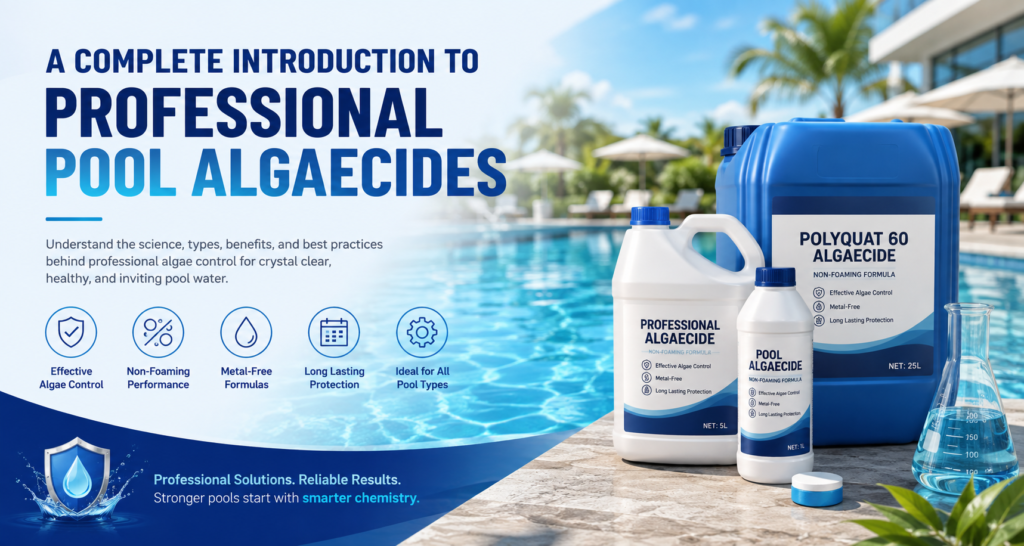
A swimming pool can look perfectly clear on Monday and start showing a faint green tint by Thursday. Anyone who has managed pools for long enough knows how quickly that change can happen.
Algae are part of the reason.
Warm water, sunlight, swimmers, rain, dust, leaves, changing sanitizer levels, and weak circulation can create conditions where algae gain a foothold. Chlorine remains the main sanitizer in many pools, of course, but professional pool care rarely depends on one chemical alone. Algaecides can provide another layer of control, especially when pools face heavy use, seasonal changes, or recurring algae problems.
That sounds simple enough. Add an algaecide and keep the water clear, right?
Not quite.
Professional pool algaecides include several different chemical families. They behave differently in water, interact differently with pool chemistry, and may bring very different advantages—or unwanted side effects.
For pool service companies, chemical distributors, private-label brands, hotels, resorts, and commercial pool operators, understanding these differences matters. Choosing an algaecide isn’t simply about finding something that kills algae. The better question is: what kind of algae control fits the whole pool maintenance program?
This guide explains the fundamentals.
What Exactly Is a Professional Pool Algaecide?
A pool algaecide is a chemical product designed to control algae in swimming pool water.
The word control is important.
Some algaecides are primarily used to prevent algae from becoming established. Others can help control existing algae as part of a broader treatment program. Certain products are suited to routine maintenance, while concentrated formulations may be used when stronger or longer-lasting support is required.
Professional products are usually selected with more than immediate algae control in mind.
Pool operators may also consider:
- compatibility with chlorine and other treatment chemicals
- foaming tendency
- potential staining or discoloration
- persistence in treated water
- ease of dosing
- storage stability
- compatibility with filtration systems
- suitability for commercial maintenance schedules
That last point often gets overlooked.
A homeowner maintaining one backyard pool can inspect the water whenever necessary. A pool service company responsible for dozens—or hundreds—of pools works differently. Technicians follow routes, dosing schedules, and service intervals. A hotel may need the pool looking inviting every morning, not merely after someone notices green water.
So professional algae control is as much about reliability and prevention as it is about fixing visible problems.
If Chlorine Kills Algae, Why Use an Algaecide?
It’s a fair question.
Chlorine is a powerful oxidizing sanitizer and plays the central role in controlling microorganisms in many swimming pools. Under properly maintained conditions, adequate free chlorine can strongly suppress algae growth.
Yet real pools aren’t laboratory beakers.
They get sunlight.
They get rain.
They get sunscreen, body oils, dust, pollen, leaves, and organic debris. Swimmer loads suddenly jump on hot weekends. Pumps don’t always run under ideal conditions. Circulation may be weaker in steps, corners, ladders, decorative features, or other low-flow areas.
And sanitizer levels fluctuate.
This is where an algaecide can become useful—not necessarily as a replacement for chlorine, but as a supporting part of the maintenance program.
Think of chlorine as the main defense and an algaecide as another layer behind it. You still need the first layer. The second one simply makes the system less dependent on everything going perfectly every single day.
Professional operators tend to appreciate that margin.
How Do Pool Algaecides Work?
Different algaecide chemistries work through different mechanisms, so there isn’t one universal answer.
Many common organic algaecides contain cationic, or positively charged, compounds. Algal cell surfaces typically carry negatively charged sites. The interaction between these surfaces and cationic molecules can interfere with cell membrane function and contribute to loss of cell integrity.
Sounds rather technical, doesn’t it?
The practical idea is simpler: the chemical interacts with the algae in a way that makes normal cellular function difficult to maintain.
Some metal-based products work differently. Copper ions, for example, can interfere with essential biological processes in algae.
The chemistry matters because it influences more than algae control. It can also affect foaming, staining risk, compatibility, persistence, and how the product behaves alongside other pool chemicals.
That’s why two bottles labeled “algaecide” may perform quite differently.
The Main Types of Professional Pool Algaecides
Several chemical families appear in pool algae-control products. Three groups deserve particular attention.
Quaternary Ammonium Algaecides
Traditional quaternary ammonium compounds—often simply called quats—have been used for algae control for many years.
They are cationic surfactant-like materials that can interact with algal cell membranes.
Their appeal isn’t difficult to understand. They can provide effective algae control and can be formulated into convenient liquid products.
But traditional quats have one rather famous drawback: foam.
In pools with strong circulation, waterfalls, spas, fountains, or other aerated features, excessive foaming can become highly visible. A chemically treated pool that suddenly looks like someone added dish soap isn’t exactly the image a hotel or pool service company wants to present.
This limitation encouraged the development and wider use of polymeric alternatives.
Polymeric Quaternary Ammonium Compounds
Polymeric quaternary ammonium compounds, commonly called polyquats, contain multiple cationic sites along a polymer chain.
Their polymeric structure gives them properties that differ from many small-molecule quaternary ammonium compounds.
One of the most familiar examples in pool care is Polyquat 60.
Polyquat-type algaecides have become popular because they can combine effective algae-control support with low-foaming or non-foaming performance. That combination is particularly attractive in professional and commercial pools.
More on that in a moment.
Copper-Based Algaecides
Copper compounds have also been widely used for algae control.
Copper ions can be effective against various algae, and properly formulated copper products can have useful applications. However, metal-containing treatments introduce another set of considerations.
Under unfavorable water conditions, metals can contribute to staining or discoloration of pool surfaces. Copper may also be associated with unwanted coloration of hair in certain circumstances.
This doesn’t mean every copper algaecide will automatically stain a pool. Chemistry is rarely that dramatic. Product formulation, concentration, pH, existing metal levels, and overall water balance all matter.
Still, many professional maintenance programs increasingly pay close attention to metal-free algae-control options, especially where appearance and surface protection are priorities.
So, What Makes Polyquat 60 Interesting?
Polyquat 60 has become a familiar name in professional pool treatment because it addresses several practical concerns at once.
Rather than being a conventional small-molecule quat, it is a polymeric cationic algaecide.
Its main advantages can include:
- strong algae-control support
- non-foaming or very low-foaming behavior
- no added copper from the algaecide itself
- suitability for preventive maintenance programs
- compatibility with many conventional pool-treatment routines when used correctly
- usefulness in seasonal and winterizing programs
For pool chemical distributors, service companies, and private-label brands looking for a concentrated polymeric option, Polyquat 60 Algaecide provides a practical starting point for developing non-foaming, metal-free algae-control programs. Its concentrated format also gives formulators flexibility when creating professional-strength or maintenance-level pool products.
The absence of the classic quat foaming problem is especially valuable.
Imagine a resort pool with powerful return jets and decorative waterfalls. Even moderate foaming becomes conspicuous. Guests don’t see the chemistry behind it; they simply see water that looks wrong.
Appearance matters.
A lot.
For professional pool operators, water quality isn’t judged only through test strips and chemical readings. It’s also judged by the person standing beside the pool thinking, Would I swim in that?
Professional Algaecides Are Often About Prevention
People naturally notice algae once the pool turns green.
Professionals would rather deal with it before that point.
Preventive algae treatment aims to maintain conditions that make algae establishment difficult. This may involve routine algaecide dosing alongside appropriate sanitizer residuals, filtration, circulation, brushing, and water-balance control.
Reactive treatment starts after algae have already become visible or strongly established.
The difference is similar to maintaining a car versus waiting until smoke comes out from under the hood. Both situations involve the same machine, but one tends to be considerably less stressful.
Once heavy algae growth develops, treatment may require several actions rather than simply pouring in more algaecide.
These can include brushing affected surfaces, correcting water balance, restoring sanitizer levels, improving circulation, cleaning or backwashing filters, removing debris, and using an appropriate algae-control treatment.
Algaecide isn’t magic in a bottle. Professional treatment works as a system.
Why Non-Foaming Performance Matters More Than It Sounds
Foam doesn’t necessarily mean a pool is unsafe, but visually it can be disastrous.
This is particularly relevant for:
- hotel pools
- resort pools
- spas and water features
- public swimming facilities
- fountains connected to treated systems
- pools with strong return jets
- high-circulation commercial pools
Traditional surfactant-type quaternary ammonium compounds can encourage foam because of their molecular behavior at air-water interfaces.
Polymeric quaternary compounds generally behave differently.
That difference helps explain why non-foaming polyquat formulations have become important in professional pool care.
For a residential owner, a little temporary foam may be annoying. For a resort manager preparing the pool deck before breakfast service, it can become a customer-experience problem.
Same chemistry. Very different business consequence.
Metal-Free Doesn’t Mean Chemistry-Free
“Metal-free” has become an attractive description in pool algae-control products, but the term should be understood properly.
It generally means the algaecide does not depend on metals such as copper for its primary algae-control action.
It doesn’t mean the product somehow works without active chemistry.
Polyquat algaecides rely on organic cationic polymer chemistry instead.
Why might that matter?
Removing intentionally added copper from an algae-control formulation can reduce one source of metal-related concerns. That can be appealing for pools with sensitive finishes, known metal issues, or operators who simply prefer a non-metal maintenance strategy.
However, switching algaecides doesn’t remove metals that are already present in source water or the pool.
Again, the whole water system matters.
Water Chemistry Still Runs the Show
This point deserves repetition: an algaecide cannot compensate indefinitely for poorly maintained pool water.
Professional algae control starts with the basics.
Sanitizer Level
Adequate sanitizer residual must be maintained according to the pool’s treatment program and applicable local requirements.
An algaecide should not be treated as permission to ignore sanitizer control.
pH
Pool pH influences swimmer comfort, equipment, surface conditions, and the behavior of other treatment chemicals.
Poor pH control can make an otherwise sensible chemical program much less effective.
Circulation
Here’s a simple truth that chemistry suppliers sometimes forget: a chemical cannot work effectively where it isn’t distributed properly.
Dead zones can occur around steps, corners, behind ladders, near decorative structures, or wherever water movement is weak.
Good circulation helps distribute sanitizer and supplementary treatment chemicals throughout the pool.
Filtration
Algae control and filtration work together.
When treatment damages or removes algae, suspended material still needs somewhere to go. Effective filtration helps remove particles and keeps the water visually clear.
Physical Cleaning
Yes, brushing still matters.
Chemical treatment becomes more effective when algae films and deposits are physically disturbed. Pool walls, floors, steps, corners, and other vulnerable areas should receive attention.
Sometimes the humble pool brush does more useful work than another dramatic chemical dose.
Algaecide and Clarifier: Different Jobs, Useful Partnership
This distinction is worth understanding.
An algaecide primarily helps control algae.
A pool clarifier helps gather or condition fine suspended particles so that filtration can remove them more effectively.
These are different functions.
This is why algae control and clarification are often treated as complementary parts of a professional pool-care program. Once biological growth has been brought under control, a Polymer Water Clarifier can help condition fine suspended particles for more effective removal by the filtration system, supporting faster recovery of bright, visually clear water.
After an algae event, water may remain cloudy even when active growth has been controlled. Fine particles, dead algae, organic debris, and other suspended material can affect clarity.
A properly designed maintenance program may therefore use algae control and clarification as complementary steps.
One addresses biological growth; the other helps with physical water clarity.
It’s a bit like cleaning a room. Stopping someone from throwing more dust around doesn’t automatically remove the dust already floating in the air.
Where Professional Algaecides Are Commonly Used
Professional algae-control products can serve very different pool environments.
Residential Pool Service
Pool maintenance companies need products that work reliably across many customer sites.
Technicians may visit a property weekly rather than daily, so persistent preventive support can be valuable.
Hotels and Resorts
Here, appearance carries unusual weight.
A faint green wall, cloudy water, surface staining, or visible foam can quickly become a guest complaint—and potentially a photo shared online.
Professional algae control helps operators protect both water quality and the visual experience surrounding the pool.
Public and Commercial Pools
High swimmer loads can place substantial pressure on water-treatment systems.
These pools require careful sanitizer management, circulation, filtration, cleaning, and regulatory compliance. Algaecides may serve as supplementary tools within that broader program.
Seasonal Pools
Pools that operate only during warmer months face their own challenges.
Opening and closing periods can create opportunities for algae growth, particularly when sanitizer levels decline during extended shutdown periods.
This is one reason winter algaecides and longer-lasting algae-control formulations have a distinct role in seasonal pool maintenance.
What Is a Winter Algaecide?
A winter algaecide is intended to help suppress algae during extended periods when a pool is closed or receives limited maintenance.
Winter is a slightly misleading word, by the way.
The real issue isn’t snow.
It’s time.
A closed pool may go weeks or months without normal circulation, brushing, sanitizer adjustment, and filtration. Depending on climate and water temperature, algae may take advantage of those conditions.
A suitable winterizing product can provide additional algae-control support during that dormant period.
For pool service companies, this can also make spring opening easier. Nobody enjoys removing a cover and discovering what looks like a small green pond underneath.
For seasonal pools that may remain closed for weeks or months, a dedicated Winter Algaecide can provide longer-lasting algae-control support during periods of reduced circulation and maintenance. This type of formulation is particularly useful for pool service companies and private-label brands building complete closing and winterization programs.
Concentration Isn’t the Whole Story
Professional buyers frequently compare products by active concentration.
That’s reasonable—but concentration alone doesn’t tell the whole story.
A more concentrated product may reduce shipping volume or allow greater formulation flexibility. Yet professionals should also evaluate the active chemistry itself, recommended dose, stability, viscosity, handling characteristics, compatibility, and intended application.
Two products at similar concentrations aren’t necessarily equivalent.
Even products belonging to the same broad chemical family can differ in polymer structure, molecular characteristics, formulation components, or specifications.
Technical data sheets and safety data sheets therefore matter.
So does supplier consistency.
For private-label pool chemical companies, batch-to-batch consistency can be every bit as important as the number printed on the front label.
How Professional Buyers Evaluate an Algaecide?
Price matters. Of course it does.
But experienced buyers usually look beyond price per kilogram or price per liter.
They may consider:
- active ingredient and concentration
- chemical identity
- appearance and viscosity
- pH and density
- foaming tendency
- metal content
- recommended application rate
- storage stability
- packaging options
- regulatory status in the target market
- manufacturing consistency
- documentation
- private-label possibilities
- formulation support
The cheapest concentrate isn’t always the cheapest product to use.
If a formulation requires a higher treatment rate, causes foam complaints, contributes to staining concerns, or creates inconsistent results between batches, the initial saving can disappear rather quickly.
Professional purchasing is really about cost per successful treatment, not merely cost per drum.
More Algaecide Is Not Automatically Better
This is one of the easiest mistakes to make.
If the recommended amount works, twice as much should work twice as well—right?
Chemistry doesn’t usually cooperate with that logic.
Overdosing can waste product and may increase the chance of undesirable interactions or side effects, depending on the formulation.
Professional dosing should therefore follow the product label, technical instructions, and applicable regulations.
The same principle applies when combining chemicals.
Pool operators shouldn’t casually mix concentrated treatment products together. Chemicals that coexist safely after proper dilution in a large pool can behave very differently when mixed directly in a container.
That distinction matters for safety.
Algaecides Can’t Fix Poor Circulation
Suppose algae repeatedly appear in exactly the same corner of a pool.
Adding increasingly large doses of chemicals might seem logical. But the recurring location is giving you a clue.
Check the hydraulics.
Poor circulation can create local areas where sanitizer concentration and chemical distribution aren’t as consistent as elsewhere in the pool.
Return jets may need adjustment. Filters may need attention. Pump operating time may be insufficient. Physical design may simply create stubborn low-flow zones.
This is where experienced pool professionals earn their keep. They don’t just treat the symptom—they read what the pool is telling them.
Green steps every week?
That’s data.
The Role of Algaecides in Low-Maintenance Pool Programs
“Low maintenance” never means “no maintenance.”
Still, many pool owners want fewer surprises and more stable water between service visits.
Long-lasting algae-control support can help here.
A professional program may combine:
- stable sanitizer management
- balanced water chemistry
- reliable filtration
- good circulation
- routine brushing
- preventive algaecide treatment
- periodic clarification when needed
Each part reduces pressure on the others.
This is particularly useful for pool service businesses. When technicians manage large service routes, preventing a problem is far more efficient than returning for an emergency green-pool treatment.
Preventive chemistry can therefore have an operational value that doesn’t immediately appear on a product specification sheet.
What About Green Water?
Green water often suggests algae—but not always.
Metals can also affect water color.
That’s why professionals diagnose before treating.
If the pool is green because of active algae growth, the response may involve sanitizer correction, brushing, filtration, and suitable algae treatment.
If dissolved metals are responsible for the color, simply adding more algaecide may not address the underlying cause and could complicate matters depending on the product chemistry.
Observation, testing, and treatment history all help distinguish the possibilities.
The green color is a symptom. The cause still needs to be identified.
Why Pool Brands Are Paying More Attention to Formulation
Pool chemical brands increasingly compete on more than basic efficacy.
Customers notice whether a product foams.
They notice stains.
They notice whether water stays clear between maintenance visits. They notice packaging, dosing convenience, odor, and how easily instructions can be understood.
Commercial buyers notice even more.
As a result, the algaecide active ingredient becomes part of a larger formulation decision.
A private-label brand might start with a concentrated polymeric active and develop different finished products around it: a concentrated professional algaecide, a lower-active maintenance product, a seasonal treatment, or a combined maintenance concept.
This flexibility helps explain the continued interest in polymeric cationic chemistry within pool treatment.
Professional Pool Care Is Becoming More Preventive
The old image of pool treatment is fairly dramatic: green water appears, someone throws chemicals into it, and eventually the pool turns blue again.
Professional maintenance aims for something much less exciting.
Nothing happens.
The water stays clear.
The walls don’t turn green.
Guests don’t complain.
The maintenance technician finishes the scheduled visit without discovering a miniature ecosystem behind the ladder.
That’s the quiet value of preventive treatment.
Modern pool management increasingly focuses on maintaining stable conditions rather than repeatedly correcting major failures. Algaecides fit naturally into that approach when they are selected and used appropriately.
Choosing the Right Professional Algaecide
There isn’t one universal algaecide for every pool.
The right chemistry depends on the maintenance objective.
If foaming is a major concern, a polymeric non-foaming algaecide may be preferable to a conventional quat.
If operators want to avoid introducing additional metals, a metal-free organic formulation may make more sense than a copper-based product.
If the pool will remain closed for months, persistence during seasonal storage may matter more than the requirements of weekly summer maintenance.
If a company is developing a private-label product, concentration, viscosity, formulation compatibility, packaging, documentation, and regulatory requirements become equally important.
So rather than asking, “Which algaecide is strongest?”, professional buyers may get a better answer by asking:
“Which algaecide fits the way this pool is actually maintained?”
That’s a much more useful question.
The Bigger Picture: Algae Control Is a Program, Not a Bottle
Professional pool maintenance rarely succeeds because of one miracle chemical.
Clear water comes from several systems working together: sanitation, circulation, filtration, water balance, physical cleaning, algae prevention, and consistent monitoring.
Algaecides occupy one specific place within that system.
Used properly, they can provide an additional barrier against algae, help reduce recurring growth, support seasonal maintenance, and give pool operators more control when operating conditions aren’t perfect.
Polymeric algaecides such as Polyquat 60 are particularly interesting because they address several practical concerns associated with traditional algae-control products—especially foaming and intentionally added metals.
But even a high-quality algaecide still needs good pool management around it.
That’s perhaps the most useful lesson.
Professional algae control isn’t about pouring more chemicals into water. It’s about understanding why algae appear, where the maintenance system is vulnerable, and which chemistry provides the right support without creating another problem somewhere else.
When those pieces fit together, pool maintenance becomes far less dramatic.
And that’s exactly what professionals want.
Frequently Asked Questions
1. What is the best professional algaecide for swimming pools?
There is no single best professional pool algaecide for every application. The choice depends on factors such as foaming tolerance, pool type, water chemistry, seasonal conditions, metal concerns, maintenance frequency, and the intended treatment program. Polymeric quaternary ammonium algaecides are commonly considered when non-foaming, metal-free algae control is desired.
2. What is the difference between Polyquat 60 and regular pool algaecide?
Polyquat 60 is a polymeric quaternary ammonium algaecide. Traditional quat algaecides are generally smaller surfactant-like molecules and can produce noticeable foam under strong circulation. Polymeric products are widely used where low-foaming or non-foaming performance is important.
3. Can professional pool algaecide replace chlorine?
No. Algaecides are generally used as supplementary algae-control products rather than replacements for the primary pool sanitizer. Proper sanitizer residual, pH, circulation, filtration, and physical cleaning remain essential parts of pool maintenance.
4. Why do commercial pools use non-foaming algaecides?
Commercial pools often have powerful circulation systems, water features, and high visibility to guests. Foam can create an undesirable appearance and operational complaints. A non-foaming professional pool algaecide can therefore be particularly useful for hotels, resorts, public pools, and pool service companies.
5. Is a metal-free pool algaecide better than a copper algaecide?
Neither category is automatically better for every application. Metal-free polymeric algaecides avoid intentionally adding copper through the algae-control product, which can be useful where operators are concerned about metal accumulation, staining, or discoloration. Copper-based products can also provide effective algae control when correctly formulated and managed. The better choice depends on the pool, water chemistry, treatment objectives, and local product requirements.