
GET IN TOUCH
Ask For Sample?
Why Pool Filters Cannot Always Remove Very Fine Particles?
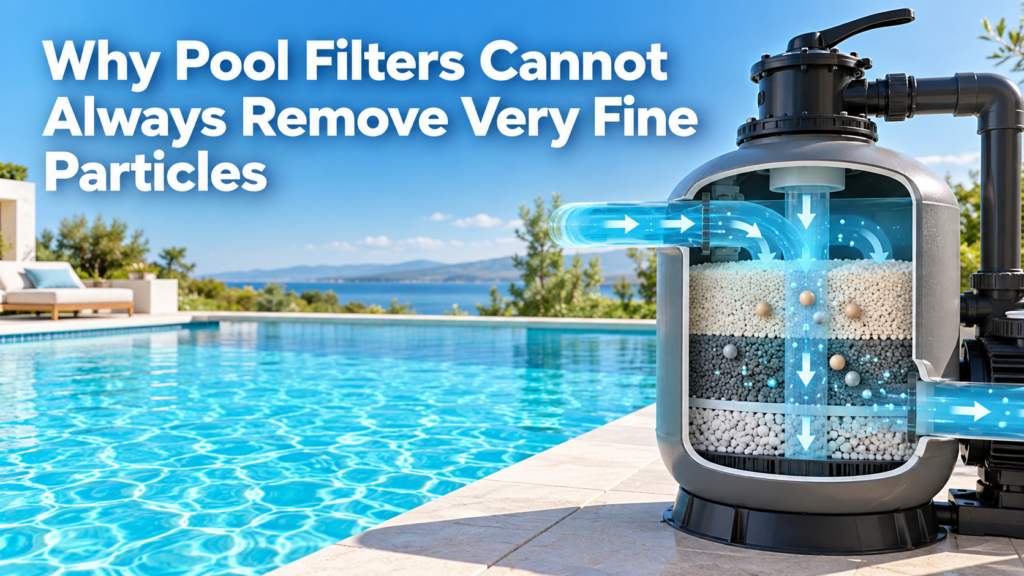
Your pool pump is running. The pressure gauge looks normal. The filter has been cleaned. Yet when sunlight cuts across the water, a faint haze still hangs beneath the surface.
It is frustrating, isn’t it? The filtration system appears to be doing its job, but the pool refuses to develop that sharp, glass-like clarity everyone expects.
The reason is usually not that the filter has stopped working. More often, the particles causing the haze are simply difficult for the filter to capture. They may be too small, too well dispersed, electrically resistant to aggregation, or moving through the system under conditions that reduce filtration efficiency.
A pool filter is powerful, but it is not magic. It removes contaminants only when water carries those contaminants into the filter and the filter media can retain them. Very fine suspended particles can slip through that process again and again.
Let’s look at why this happens—and what can be done without turning routine pool care into a guessing game.
A Working Filter Does Not Guarantee Perfectly Clear Water
Pool filtration is often described as if it were a simple kitchen strainer: water passes through holes, dirt stays behind, and clean water returns to the pool.
That picture is useful, but incomplete.
Many pool filters—especially sand filters—work through depth filtration. Water follows winding paths through a bed of media. Particles may be removed by straining, settling within small spaces, contacting media surfaces, or attaching to material already held in the filter bed.
For any of that to happen, however, the particle must come close enough to a surface and remain there. A particle that follows the water around the grains without making effective contact can leave the filter with the return flow.
This is why a filter can collect leaves, insects, hair, and visible debris while failing to remove the faint dust-like material responsible for cloudy water. The filter is working. It is just being asked to catch something that behaves very differently from ordinary dirt.
Fine Particles Are Smaller Than They Look—Much Smaller
A micrometre, usually written as µm or micron, is one millionth of a metre. A human hair is commonly tens of microns wide, while many haze-forming particles may be only a few microns—or smaller.
These particles can come from many sources:
- Windblown clay and dust
- Dead algae after treatment
- Pollen fragments
- Body oils and cosmetic residues
- Precipitated calcium compounds
- Organic matter brought in by swimmers
- Fine corrosion or construction debris
- Poorly dissolved pool chemicals
Individually, such particles may be invisible. In large numbers, though, they scatter light. That scattered light creates the milky, dull, or slightly smoky appearance we call turbidity.
This explains a familiar pool-care puzzle: you may not see any “dirt” when you collect a glass of water, yet the deep end looks hazy from across the deck. The problem is not one large contaminant. It is an enormous population of tiny ones.
Filter Ratings Are Not a Universal Promise
Pool filter discussions often include neat claims about how many microns a sand, cartridge, or diatomaceous earth filter can remove. Those figures can be useful for general comparison, but they should not be treated as guaranteed cut-off points.
Real filtration performance depends on more than the name of the filter.
Media grade, bed depth, cartridge condition, flow rate, hydraulic design, maintenance, particle shape, particle chemistry, and the amount of material already deposited all matter. Even the meaning of a quoted micron rating may differ. A nominal rating generally describes a level of removal under stated conditions; it does not mean every particle above that size will be captured. An absolute rating is more restrictive, but it still depends on a defined test method.
The practical lesson is simple: “filters down to X microns” should not be read as “nothing larger than X microns can ever pass.” Pool water is a dynamic mixture, not a perfectly controlled laboratory sample.
The CDC’s Model Aquatic Health Code also treats filter performance as a combination of filter type, particle entrapment, flow, recirculation, and operational condition—not as one isolated micron number. That broader view is much closer to what operators see beside a real pool.
Tiny Particles Follow the Water Around the Filter Media
Imagine throwing a tennis ball through a dense row of tree branches. It is likely to strike something. Now imagine releasing a speck of dust into a gentle stream flowing around smooth pebbles. The speck may simply travel with the streamlines.
Very fine pool particles behave more like the dust speck.
Their small mass gives them little inertia. Instead of continuing in a straight line and colliding with a sand grain or filter fibre, they can curve with the moving water. If they do not touch the filter surface, they cannot attach to it.
Some very small particles also experience Brownian motion—a constant, irregular movement caused by collisions with surrounding water molecules. This motion can sometimes increase contact with a surface, but it also illustrates why fine-particle removal cannot be explained by gravity and sieving alone. At this scale, familiar everyday rules begin to feel a little less dependable.
Surface Charge Keeps Many Particles Apart
Size is only half the story. Chemistry matters too.
Many suspended particles in pool water carry a negative surface charge. When particles have similar charges, they repel one another. The force may be small, but at microscopic distances it can be strong enough to keep particles separate.
That stable dispersion is bad news for filtration. Instead of colliding and forming larger clusters, the particles remain as tiny individual units. They may pass through the filter bed repeatedly while continuing to scatter light in the pool.
Think of it as a room full of people who all insist on keeping personal space. If no one forms a group, they can file through narrow exits one by one. Bring them together into larger clusters, and their movement changes completely.
This is where a well-formulated clarifier can help. A cationic, or positively charged, polymer can interact with negatively charged suspended matter. Depending on the polymer and treatment conditions, it may reduce charge repulsion and bridge several particles together. The resulting aggregates are easier for the filter to retain.
If fine suspended matter is the confirmed cause of dull water, a Polymer Pool Clarifier can support the existing filtration system by changing particle behaviour before the water reaches the filter.
The clarifier does not replace the filter. It makes the filter’s target easier to catch.
Flow Rate Can Help—or Quietly Work Against You
It is tempting to assume that faster flow always means faster cleaning. More water through the filter should remove more dirt, right?
Not necessarily.
When flow is too high for the filter design, water moves through the media with greater velocity. Fine particles have less time to contact and attach to the filter surface. In a granular bed, high flow may also encourage preferential paths—small channels through which part of the water travels with less resistance.
Water, like most of us on a busy Monday morning, takes the easiest route available.
If much of the flow follows those easier paths, some sections of the media do less work. The system may show strong circulation at the return jets while producing disappointing clarity.
Excessive flow can create other problems as well. Previously captured material may migrate deeper into the bed or, under unfavorable conditions, break free and return to the pool. A pump and filter must therefore be matched as a hydraulic system. Bigger and faster are not automatically better.
Channeling, Bypass, and Poor Sealing Let Particles Escape
Sometimes the limitation is not the microscopic particle at all. It is the route the water takes.
In a sand filter, channeling may develop when water repeatedly follows narrow pathways instead of spreading evenly through the bed. Incorrect backwashing, media that has clumped, poor internal distribution, or long-term neglect can contribute to uneven flow.
In a cartridge filter, a damaged element, poor seating, a cracked end cap, or a failed seal may allow water to move around the filtration surface. In a diatomaceous earth filter, tears in grids, damaged manifolds, or an inadequate coating can create similar escape routes.
Multiport valves and internal components deserve attention too. A worn gasket or incorrect valve position can allow a portion of the circulation to bypass effective filtration.
These faults matter because a tiny bypass stream can carry a great deal of fine material over many hours. If cloudy water returns soon after cleaning, or debris appears at the return jets, inspect the system rather than reaching immediately for another chemical.
The Filter May Need Time to See the Whole Pool
A filter can only treat water that reaches it.
Poor circulation leaves dead zones behind steps, ladders, benches, corners, and deep-end transitions. Fine particles may remain suspended in these areas, then drift back into view when swimmers enter or the wind changes.
Turnover time is often misunderstood here. A theoretical turnover does not mean every drop of water has passed through the filter once. Pool water mixes continuously, so some water may pass through the circulation system several times while another portion reaches the intake more slowly.
Return-jet direction, skimmer performance, water level, pump run time, and pool shape all affect how quickly suspended matter reaches the filter. Brushing walls and the floor can move settled dust back into circulation, where the filter has a chance to capture it. Vacuuming may be more suitable when a substantial layer has already settled.
Patience matters. A properly treated pool with good circulation may still require several filtration cycles before clarity improves.
A Dirty Filter Can Become Better—Then Suddenly Worse
There is a mildly contradictory truth in filtration: a small amount of collected material can sometimes improve fine-particle removal.
As particles accumulate, they narrow some of the flow spaces and form a filter cake or conditioned surface. This can help trap finer matter that might pass through a freshly cleaned medium.
But there is a limit.
As loading continues, resistance rises. The pressure differential increases, flow falls, and channeling or breakthrough may occur. A heavily loaded filter can no longer operate as intended. Cleaning too often may prevent useful conditioning; cleaning too late may release contaminants or place unnecessary strain on the circulation system.
The pressure gauge offers useful guidance when it works correctly. Operators commonly compare the reading with the clean-filter baseline and follow the equipment manufacturer’s stated cleaning threshold. A gauge that is stuck, damaged, or never recorded leaves the operator working half-blind.
Water Chemistry Can Create New Fine Particles Faster Than Filtration Removes Them
Suppose the filter is capturing suspended material, but the pool keeps producing more. The water may remain cloudy no matter how long the pump runs.
High pH, elevated calcium hardness, high total alkalinity, and temperature can contribute to calcium carbonate precipitation. The water may develop a white or grey haze that resembles ordinary dust. Adding certain chemicals too quickly, mixing incompatible products, or applying concentrated products in the same area can also create localized reactions and fine precipitates.
Algae treatment presents another example. After algae have been killed, millions of damaged cells and fragments may remain suspended. Sanitizer has addressed the living growth, but the filter still has a physical removal job to perform.
The reverse problem occurs when active algae continue multiplying. A clarifier cannot correct inadequate sanitation, poor circulation, or an untreated algae bloom. The source must be controlled first.
This is why water testing comes before diagnosis by appearance. Cloudy water is a symptom, not a single disease.
Some “Particles” Are Not Filterable Particles
Not every clarity problem comes from suspended solids.
Very small air bubbles can give water a milky appearance, especially near return fittings. Fill a clear glass with pool water and let it stand. If the cloudiness clears from the bottom upward as bubbles rise, air may be entering the circulation system. A suction-side leak, low water level, blocked skimmer, or pump issue may be responsible.
Dissolved substances create another distinction. Material that is truly dissolved at the molecular or ionic level does not behave like a suspended particle. A standard pool filter cannot strain dissolved salt, hardness ions, or many dissolved metals from the water. Treatment may require chemical adjustment, sequestration, dilution, or another purpose-specific process.
And then there is color. Clear but tinted water may point toward dissolved metals or other chemistry rather than fine particulate haze.
Before adding a clarifier, ask a basic question: is there actually something suspended for the polymer and filter to remove?
How Polymer Clarifiers Make Fine Particles Easier to Capture?
A polymer pool clarifier does not make filter pores smaller. It changes the condition of the particles.
Many purpose-designed clarifiers use water-soluble polymers with charged sites along their molecular chains. These chains can adsorb onto particle surfaces. One chain may connect several particles, creating a larger aggregate. Charge neutralization may also reduce the repulsion that keeps particles apart.
The process is often called coagulation or flocculation in water treatment, although pool products vary in chemistry and in the size and strength of the aggregates they form. A filter-aid clarifier usually aims to create particles large and durable enough for filtration without producing heavy floc that must settle and be vacuumed.
The dose matters—a lot.
Too little product may not create enough contact or bridging. Too much may coat particle surfaces, restabilize the suspension, load the filter rapidly, or leave the water looking worse. More chemical is not the shortcut it appears to be.
Always follow the product label, base the dose on the actual pool volume, distribute the product as directed, and maintain suitable circulation. Commercial formulators and private-label buyers should also evaluate the product with the filter types, source water, and treatment programs used in their target market.
For businesses developing a broader pool-care range, the Specialty Pool Chemicals category shows how dedicated clarification and algae-control products can serve different jobs within one maintenance program.
Clarifier, Flocculant, and Algaecide Are Not the Same Thing
These product categories are sometimes treated as interchangeable, but their primary functions differ.
A clarifier generally conditions fine suspended particles so the operating filter can capture them more effectively. A flocculant is commonly used to create heavier floc that settles, followed by careful vacuuming—often to waste, depending on the system and label. An algaecide is intended to control or prevent algae growth.
One formulation may provide secondary benefits, but the label claim and chemistry still matter. For example, Polyquat 60 Algaecide is primarily positioned for non-foaming algae control. It should not automatically be substituted for a dedicated clarifier when fine suspended particles are the main problem.
Matching the product to the cause prevents wasted chemical, overloaded filters, and that sinking feeling when the water looks even cloudier the next morning.
A Practical Troubleshooting Sequence for Persistent Haze
When very fine particles remain in the pool, work through the system in a logical order.
- Confirm swimmer safety first. If the main drain or other critical features cannot be seen clearly, restrict use according to local rules and facility procedures.
- Test the water. Check sanitizer, pH, total alkalinity, calcium hardness, stabilizer where relevant, and any other parameters required by the treatment program.
- Identify the likely source. Consider recent algae treatment, heavy bathing, dust, storms, chemical additions, scale formation, or construction nearby.
- Rule out air bubbles. Use the standing-glass check and inspect for circulation leaks if the haze behaves like entrained air.
- Inspect circulation. Check skimmers, baskets, valves, water level, pump performance, and return-jet direction.
- Inspect the filter. Look for damaged elements, poor seals, channeling, incorrect media condition, valve faults, or return-line debris.
- Compare filter pressure. Use the clean-filter baseline and the equipment manufacturer’s instructions rather than cleaning on an arbitrary calendar.
- Brush and circulate. Move fine matter from low-flow surfaces into the water so it can reach the filter.
- Use a suitable clarifier only when indicated. Apply the correct dose and allow adequate filtration time.
- Reassess before adding more. If clarity does not improve, investigate the diagnosis, hydraulic condition, and product compatibility instead of stacking repeated doses.
This sequence is less dramatic than pouring in another bottle, but it is far more dependable.
Better Clarity Comes From a System, Not One Piece of Equipment
Crystal-clear pool water is produced by cooperation between sanitation, chemical balance, circulation, filtration, cleaning, and—when needed—particle conditioning.
The filter remains central to that system. It removes material that would otherwise remain in the water. Still, very fine particles can evade capture because they are small, stable, electrically repulsive, poorly transported, or carried through an imperfect filter path.
Once you understand that, persistent haze becomes less mysterious. The question changes from “Why is my filter failing?” to “What is preventing these particles from reaching, contacting, and staying in the filter?”
That is a much better question. It leads to better testing, fewer unnecessary chemicals, and clearer water with less trial and error.
Frequently Asked Questions
1. Why does my pool remain cloudy even though the filter runs all day?
The water may contain particles too fine or too stable for efficient capture. Poor circulation, high flow, damaged filter components, active algae, imbalanced chemistry, or air bubbles can create a similar appearance. Test the water and inspect the circulation and filtration system before adding treatment products.
2. Can a sand filter remove very fine suspended particles from pool water?
A sand filter can remove a wide range of suspended matter, but performance depends on media condition, bed depth, flow rate, particle properties, and maintenance. Very fine, well-dispersed particles may pass through until they aggregate or the filter bed becomes suitably conditioned.
3. Will a polymer pool clarifier improve sand filter performance?
It can help when stable fine particles are causing haze. The polymer encourages small particles to form larger aggregates that a sand filter can retain more readily. Correct dosage, good circulation, and a functioning filter are essential.
4. Can too much pool clarifier make the water cloudy?
Yes. Overdosing may restabilize particles, create excess polymer residue, or load the filter too quickly. Calculate the actual pool volume, follow the label, and allow the recommended filtration time before considering another dose.
5. How long should a pool filter run after adding clarifier?
Run time depends on the product label, pool volume, circulation pattern, filter type, and severity of the haze. Many treatments require extended circulation and filtration, but the label and equipment instructions should govern. Check pressure and clean the filter only when the recommended threshold is reached.