GET IN TOUCH
Ask For Sample?
OEM & Private Label Options for Polixetonium Chloride
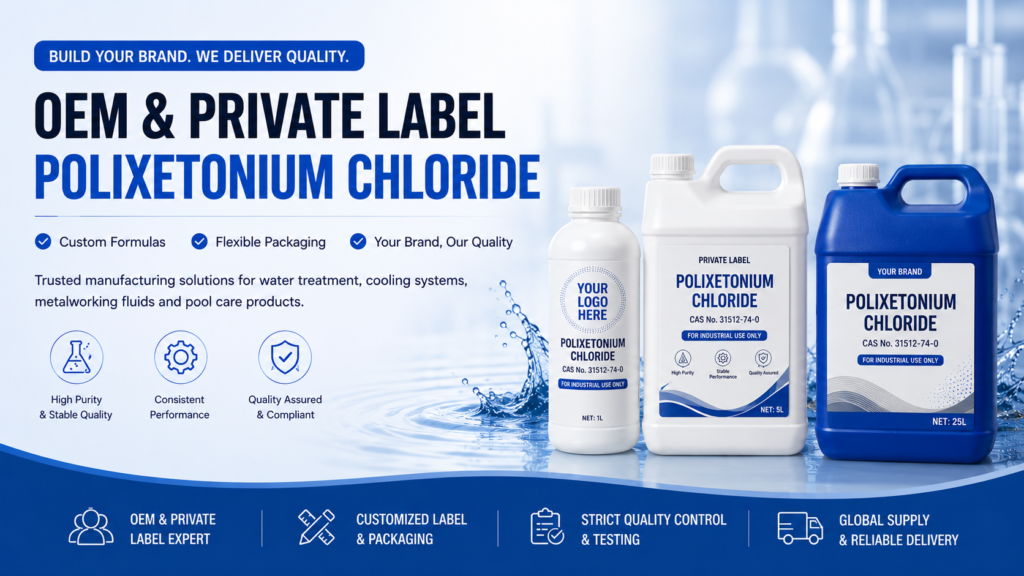
Private label chemical manufacturing has become one of the fastest ways for distributors, water treatment companies, and pool chemical brands to expand their product lines without investing in their own production facilities.
For companies selling Polixetonium Chloride (CAS No. 31512-74-0), OEM and private label services provide a practical way to launch branded products while relying on an experienced manufacturer for production, quality control, packaging, and documentation.
Whether you sell industrial water treatment chemicals, cooling water biocides, metalworking fluid preservatives, or swimming pool chemicals, choosing the right OEM supplier can significantly shorten your time to market while reducing operational risk.
This guide explains the most common OEM options available, what can be customized, and what buyers should look for before selecting a manufacturing partner.
What Do OEM and Private Label Actually Mean?
These two terms are often used interchangeably, but they are slightly different.
OEM (Original Equipment Manufacturer) generally refers to products manufactured according to a customer’s specific requirements. This may include customized formulations, packaging, specifications, or documentation.
Private Label usually means the manufacturer supplies an existing, proven formulation while the customer sells it under their own brand.
In reality, many Polixetonium Chloride projects combine both approaches.
For example:
- Standard 60% formulation
- Customer’s own logo
- Customized labels
- Different package sizes
- Market-specific documentation
The final product looks and feels like the customer’s own brand while production remains with the manufacturer.
Which Products Can Be Customized?
OEM services extend far beyond simply printing a different label.
Depending on your market, a supplier may customize:
- Active content
- Product viscosity
- Appearance specification
- Packaging size
- Bottle color
- Drum design
- Label artwork
- Carton printing
- Pallet configuration
- Shipping marks
- Documentation
For swimming pool brands, private labeling usually focuses on ready-to-sell retail packaging.
For industrial customers, customization often emphasizes technical specifications and bulk packaging.
Packaging Options for Different Markets
Packaging is one of the most visible parts of a private label program.
Different customers require different solutions depending on their sales channels.
Typical options include:
| Market | Common Packaging |
|---|---|
| Retail pool chemicals | 1L white plastic bottle |
| Professional service companies | 5L plastic jerrycan |
| Chemical distributors | 25L plastic drum |
| Industrial users | 200L blue plastic drum |
| Large manufacturers | 1000L IBC Tote |
Many suppliers can also provide:
- Custom bottle colors
- Tamper-evident caps
- Induction seals
- UV-resistant labels
- Export cartons
- Pallet wrapping
- Customized pallet labels
These details improve product presentation while protecting the shipment during international transportation.
Branding and Label Design
A professional label does much more than display a company logo.
Good private label packaging should clearly communicate:
- Product name
- CAS No. 31512-74-0
- Active content
- Net weight
- Batch number
- Manufacturing date
- Storage conditions
- Safety information
- Company information
Some suppliers also assist customers with:
- Label layout
- Multi-language labels
- Barcode generation
- QR codes
- Carton artwork
This is particularly helpful for new distributors launching their first product line.
Formula Customization
Not every customer requires exactly the same formulation.
Although the standard Polixetonium Chloride 60% grade meets the needs of most markets, OEM suppliers may offer additional customization depending on the application.
Possible adjustments include:
Cooling Water
- Optimized viscosity
- Customer-required active content
- Compatibility with existing treatment programs
Metalworking Fluids
- Specification adjustments for preservative formulations
- Consistent quality between production batches
Swimming Pool Chemicals
- Private label algaecide products
- Retail-ready packaging
- Customized instructions for local markets
It is important to remember that formulation changes should always be validated through laboratory testing before commercial production begins.
Quality Control Makes the Difference
A reliable OEM supplier should offer far more than production capacity.
Strong quality management typically includes:
- Incoming raw material inspection
- Batch production records
- Routine laboratory testing
- Third-party verification when required
- Retained production samples
- Product traceability
Professional suppliers generally provide documents such as:
- COA
- SDS (MSDS)
- TDS
Some customers may also request additional testing reports depending on their market requirements.
The more transparent the supplier’s quality system is, the easier future cooperation becomes.
Typical OEM Production Process
Although every manufacturer has its own procedures, most OEM projects follow a similar workflow.
Step 1 — Technical Discussion
The customer explains:
- Target application
- Required specification
- Packaging
- Label requirements
- Estimated annual demand
Step 2 — Sample Evaluation
Laboratory samples are prepared for testing.
Customers verify product performance before approving commercial production.
Step 3 — Artwork Confirmation
Both parties approve:
- Label design
- Carton printing
- Package dimensions
- Regulatory information
Step 4 — Production
After approval, manufacturing begins according to the agreed specifications.
Step 5 — Final Inspection
Finished products undergo quality inspection before shipment.
Inspection records are normally included with shipping documents.
How to Choose the Right OEM Supplier ?
Price is important—but it should never be the only deciding factor.
A dependable supplier should demonstrate strengths in several areas.
Manufacturing Experience
Look for companies with proven experience producing cationic polymer biocides rather than general chemical trading alone.
Stable Product Quality
Consistency between production batches often matters more than achieving the absolute lowest price.
Flexible Customization
Every market has different packaging and branding requirements.
A supplier willing to adapt usually creates better long-term partnerships.
Communication
Quick responses, clear technical explanations, and transparent documentation often indicate how future cooperation will proceed.
Long-Term Support
The best OEM suppliers continue supporting customers after delivery by providing technical advice, updated documentation, and assistance with new projects.
Why Many Buyers Choose Private Label ?
Launching a branded chemical product from scratch can require substantial investment.
Private labeling offers several practical advantages:
- Faster market entry
- Lower development costs
- Reduced production risk
- Professional appearance
- Flexible order quantities
- Established manufacturing experience
- Better focus on sales and customer service
For many distributors, this approach allows them to build their own brand while relying on an experienced manufacturing partner for production.
Final Thoughts
OEM and private label services allow companies to create professional Polixetonium Chloride products without building their own manufacturing facilities.
The most successful partnerships are based on more than competitive pricing. Consistent quality, responsive communication, flexible customization, and dependable technical support often determine whether a supplier becomes a long-term partner.
If you are planning to introduce your own branded Polixetonium Chloride products, taking time to evaluate a supplier’s manufacturing capabilities, quality system, packaging flexibility, and OEM experience can help ensure a smoother launch and stronger customer confidence.
FAQs
1. What is the difference between OEM and private label Polixetonium Chloride?
OEM usually involves manufacturing according to customer-specific requirements, while private label typically uses an existing formulation sold under the customer’s own brand.
2. Can I customize the packaging size?
Yes. Common options include 1L bottles, 5L jerrycans, 25L drums, 200L plastic drums, and 1000L IBC totes. Custom packaging may also be available depending on order quantity.
3. Can the product label include my company logo?
Absolutely. Most OEM suppliers can produce customized labels featuring your logo, product information, barcodes, QR codes, and market-specific regulatory content.
4. What documents are normally provided with OEM orders?
Most manufacturers supply a Certificate of Analysis (COA), Safety Data Sheet (SDS/MSDS), and Technical Data Sheet (TDS). Additional testing reports may be available upon request.
5. How long does a private label project usually take?
For a standard OEM project, sample approval, artwork confirmation, production, and packaging typically take several weeks, depending on customization requirements, packaging materials, and production scheduling.