
GET IN TOUCH
Ask For Sample?
MOQ, Packaging & Shipping for Polixetonium Chloride
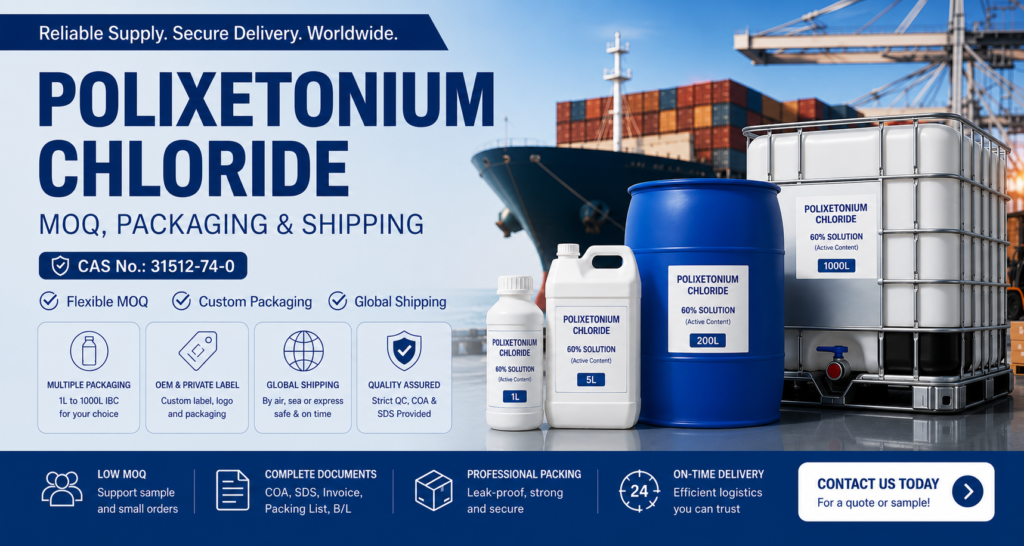
When sourcing Polixetonium Chloride (CAS No. 31512-74-0) from China, buyers often focus on product quality, pricing, and technical performance. Those are certainly important—but they’re only part of the picture.
The practical side of purchasing can have just as much impact on your project. Questions like “What’s the minimum order quantity?”, “Which packaging should I choose?”, or “Can this product be shipped safely to my country?” often determine whether a transaction goes smoothly or becomes an expensive headache.
The good news? Polixetonium Chloride is a relatively straightforward product to export when it’s packed correctly and supported by complete documentation.
This guide explains what international buyers should know about MOQ, packaging options, shipping methods, and logistics before placing an order.
Why MOQ, Packaging, and Shipping Matter More Than You Think
Imagine finding the perfect supplier with competitive pricing, only to discover that their minimum order is much larger than you need—or that your preferred packaging isn’t available.
It happens more often than you might think.
The right purchasing strategy isn’t simply buying the lowest-priced product. It’s choosing an order size and packaging format that minimizes your overall cost while ensuring the product arrives safely and performs exactly as expected.
A reliable supplier should be able to help you balance all three factors:
- Purchase cost
- Transportation cost
- Storage convenience
Finding that balance usually saves far more money than negotiating another dollar off the product price.
What Is the Typical MOQ for Polixetonium Chloride?
There isn’t a universal MOQ for Polixetonium Chloride. It depends largely on whether you’re purchasing a standard product or requesting customized services.
Typical minimum order quantities are:
| Purchase Type | Typical MOQ |
|---|---|
| Sample | 100–500 mL |
| Laboratory evaluation | 1–5 L |
| Standard industrial order | 1 pallet / IBC |
| OEM / Private Label | 500–1,000 kg or higher |
| Full container order | 16–20 MT (depending on packaging) |
For most manufacturers, 1 pallet or 1 IBC is the practical minimum for commercial orders because it matches one standard drum or pail.
If you’re evaluating a supplier for the first time, requesting a sample before placing a larger order is always a smart approach.
Factors That Affect Minimum Order Quantity
MOQ isn’t simply a number chosen by the supplier. Several practical factors influence it.
Packaging Type
Standard packaging is easier to prepare.
Customized bottles, printed labels, or branded cartons require additional setup, which naturally increases the minimum order.
Private Label Requirements
OEM production often involves:
- Label design
- Printing plates
- Carton customization
- Production scheduling
Because of these setup costs, suppliers generally require larger order quantities.
Production Schedule
If the product is already in stock, small orders can usually be supplied quickly.
If production must be arranged specifically for your order, the MOQ may increase.
Export Destination
Some destinations require additional certifications or documentation.
Preparing these documents adds cost, which may also influence the minimum order requirement.
Standard Packaging Options Available
Most suppliers offer several packaging choices to suit different customers.
Typical options include:
- 1 L plastic bottle
- 5 L plastic jerrycan
- 25 L stacktable plastic jerrycan
- 200 L plastic drum
- 1000 L IBC Tote
Small containers are ideal for distributors and laboratory testing.
Industrial users generally prefer larger containers because they reduce packaging costs per kilogram.
For bulk purchases, IBC totes usually provide the best balance between transportation efficiency and handling convenience.
Can You Request OEM or Private Label Packaging?
Absolutely.
Many manufacturers provide complete OEM and private label services.
These may include:
- Custom product labels
- Company logo printing
- Customized bottle colors
- Retail-ready packaging
- Instruction labels
- Carton printing
- Barcode printing
- Multilingual labels
Private labeling allows distributors to build their own brand without investing in manufacturing facilities.
If you’re planning long-term cooperation, OEM packaging can significantly strengthen your market presence.
Packaging Recommendations for Different Buyer Types
Not every customer needs the same packaging.
Here are some common recommendations.
Laboratory Customers
Recommended package:
- 100 mL sample
- 500 mL bottle
- 1 L bottle
Small packages reduce waste while making laboratory evaluation easier.
Distributors
Recommended package:
- 5 L
- 25 L
These sizes are easy to resell while keeping inventory manageable.
Industrial End Users
Recommended package:
- 200 L drums
- 1000 L IBC totes
Larger packaging lowers packaging costs and improves unloading efficiency.
OEM Brands
Recommended package:
Customized retail packaging with private labels.
Although the MOQ is higher, branding creates greater long-term value than selling generic products.
How Polixetonium Chloride Is Shipped Internationally
Shipping method depends mainly on order size.
Express Courier
Suitable for:
- Samples
- Small quantities
Common carriers like Fedex or DHL can treat those liquid by air according to regulations concerned.
Delivery usually takes 3–7 days.
Air Freight
Best for:
- Urgent orders
- Medium quantities
Although more expensive than sea freight, it significantly shortens delivery time.
Sea Freight
The most economical option for commercial orders.
Typical container options include:
- LCL (Less than Container Load)
- 20-foot container
- 40-foot container
For large-volume buyers, sea freight offers the lowest transportation cost per kilogram.
Is Polixetonium Chloride Classified as a Dangerous Good?
The transport classification of Polixetonium Chloride (CAS No. 31512-74-0) depends on the product formulation, concentration, and the applicable transport regulations.
Many commercial grades are transported as Class 9 (Miscellaneous Dangerous Goods) under international transport regulations because they may be classified as environmentally hazardous substances. However, the final classification should always be confirmed based on the supplier’s latest Safety Data Sheet (SDS) and transport assessment for the specific product being shipped.
Before shipment, a professional supplier should provide the necessary transport documentation and confirm the appropriate shipping classification, including any applicable UN number, packing group, or special handling requirements.
This helps ensure compliance with the regulations of the destination country while avoiding unnecessary customs or shipping delays.
If you are unsure about the shipping requirements in your market, our logistics team can help verify the applicable transport classification and recommend the most suitable shipping solution for your destination.
How to Reduce Shipping Costs Without Sacrificing Quality
Shipping costs have become a significant part of international purchasing.
Fortunately, there are several ways to reduce them.
Consolidate Orders
Combining multiple products into one shipment often reduces freight costs.
Choose Appropriate Packaging
IBC totes generally lower packaging costs compared with multiple small drums.
Documentation Required for International Shipping
Professional suppliers typically provide:
- Commercial Invoice
- Packing List
- Certificate of Analysis (COA)
- Safety Data Sheet (SDS/MSDS)
- Bill of Lading
- Certificate of Origin (when requested)
- Insurance documents (if applicable)
Some countries may require additional documentation depending on local import regulations.
Discuss these requirements with your supplier before production begins to avoid unnecessary customs delays.
Common Shipping Mistakes Buyers Should Avoid
Even experienced buyers occasionally overlook logistics details.
Some common mistakes include:
- Ordering the wrong packaging size
- Ignoring local import requirements
- Requesting customized labels too late
- Underestimating sea freight transit time
- Choosing price over export experience
- Failing to confirm pallet requirements
- Not requesting photos before shipment
A little preparation before shipment can prevent costly surprises after the goods arrive.
How to Choose the Right Supplier for Reliable Delivery
A dependable supplier offers more than competitive pricing.
Look for a partner that can provide:
- Consistent product quality
- Flexible packaging options
- OEM and private label services
- Complete export documentation
- Responsive technical support
- Professional loading and shipping experience
- Stable production capacity
- Clear communication throughout the order process
Reliable delivery begins long before the shipment leaves the factory.
Working with an experienced exporter can save both time and money over the long run.
Conclusion
Buying Polixetonium Chloride isn’t just about selecting the right chemical—it’s also about choosing the right packaging, ordering an appropriate quantity, and working with a supplier who understands international logistics.
Whether you’re purchasing samples for laboratory testing, sourcing bulk material for industrial production, or building your own private-label brand, careful planning makes the entire process smoother and more cost-effective.
A trustworthy supplier should be able to guide you through every stage, from MOQ selection and packaging recommendations to export documentation and worldwide shipping, helping you receive the right product, in the right package, at the right time.
Frequently Asked Questions
1. What is the standard MOQ for Polixetonium Chloride?
For standard commercial orders, the MOQ is 1 pallet or 1 IBC, while smaller samples (typically 100–500 mL) are often available for product evaluation.
2. Can I order Polixetonium Chloride with my own private label?
Yes. Many manufacturers offer OEM and private label services, including custom labels, branded packaging, multilingual artwork, and customized cartons. The MOQ for these services is usually higher than for standard products.
3. Which packaging option is best for large-volume buyers?
For industrial users, 1000 L IBC totes generally provide the most economical solution by reducing packaging waste, improving handling efficiency, and lowering shipping costs per kilogram.
4. What shipping documents are normally provided?
A complete shipment typically includes a Commercial Invoice, Packing List, COA, SDS/MSDS, Bill of Lading, and, when requested, a Certificate of Origin or other destination-specific documents.
5. How can I reduce the total landed cost when importing Polixetonium Chloride?
The most effective strategies include consolidating shipments, selecting the appropriate packaging size, planning orders in advance to use sea freight, and working with an experienced exporter who can optimize container loading and prepare accurate shipping documentation.