
GET IN TOUCH
Ask For Sample?
How Water Temperature Affects Polyquat 60 Performance?
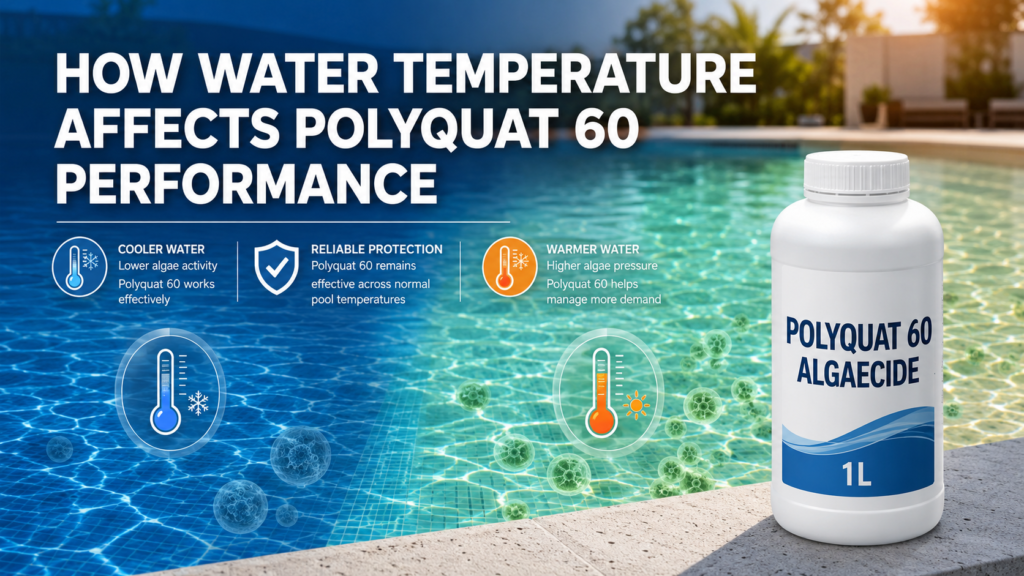
A swimming pool can look perfectly balanced on a mild morning and begin losing its sparkle after several hot afternoons. The Polyquat 60 dose has not changed. The circulation schedule may be the same. Yet algae pressure suddenly feels harder to control.
Water temperature is often part of the explanation—but not because Polyquat 60 simply “stops working” in warm water.
Within normal swimming pool temperatures, Polyquat 60 remains a useful non-oxidizing algaecide. Warmer water can even support faster dispersion and contact between the polymer and algae cells. The bigger issue is what happens around the algaecide: algae grow faster, chlorine residuals can become harder to maintain, swimmers add more organic material, and warm dead zones become increasingly hospitable to algae.
Cold water brings a different set of challenges. Algae activity slows, but the concentrated product becomes more viscous and circulation may be reduced during winter. That can delay uniform distribution.
So, does temperature matter? Absolutely. It changes the operating conditions under which Polyquat 60 must perform.
First, What Is Polyquat 60?
Polyquat 60 is a common pool-industry name for a concentrated polymeric quaternary ammonium algaecide. Many commercial formulations are based on polixetonium chloride, also called Polyquaternium-42, with CAS No. 31512-74-0. The number “60” normally indicates an active ingredient concentration of approximately 60%.
Unlike chlorine, Polyquat 60 does not control algae through oxidation. It uses permanently positively charged sites distributed along a polymer chain.
Many algae cell surfaces carry a net negative charge. The cationic polymer is therefore attracted to them. After adsorption onto the cell surface, it can interfere with normal membrane functions, nutrient transport, and cellular stability.
This mechanism gives properly formulated Polyquat 60 Algaecide several useful characteristics:
- It is non-oxidizing.
- It does not introduce copper or other metals.
- It presents little risk of metal-related surface staining.
- It is generally non-foaming at the recommended dose.
- It is water-soluble and suitable for normal pool circulation systems.
- It can supplement chlorine or bromine sanitation.
- It is especially valuable as a preventive treatment.
That last point is worth emphasizing. Polyquat 60 is usually easier to use before an algae bloom becomes established. Once pool walls are covered with mature colonies, brushing, filtration, sanitizer correction, and sometimes shock treatment become essential.
Polyquat 60 is an algaecide—not a replacement for the pool sanitizer.
Does Warm Water Directly Weaken Polyquat 60?
Under normal swimming pool conditions, a moderate increase in water temperature does not suddenly deactivate Polyquat 60.
Polixetonium chloride is a polymeric quaternary ammonium compound. Its positive charge is part of the molecular structure and does not depend on the same pH-controlled equilibrium that determines the relative proportions of hypochlorous acid and hypochlorite in chlorinated water.
That makes Polyquat 60 rather different from chlorine.
A pool changing from 24°C to 30°C, or from 75°F to 86°F, does not remove the polymer’s cationic character. The polymer can still disperse through the water and interact with negatively charged algae surfaces.
Some registered polymeric algaecide labels even state that their algae-fighting performance increases as pool water temperature rises. That wording should be interpreted carefully. It does not mean every formulation becomes proportionally stronger with every degree of temperature increase. Product concentration, polymer composition, dosage, circulation, and label directions still matter.
A more reliable conclusion is this:
Normal warm pool water generally does not destroy Polyquat 60, but warm conditions increase the amount of biological and operational pressure that the treatment must overcome.
The swimming pool itself becomes harder to manage, even if the active polymer remains functional.
Warmer Water Helps the Chemistry Move—But It Also Helps Algae
Temperature affects molecular movement. In warmer water, dissolved substances generally move and disperse more readily than they do in very cold water. A liquid Polyquat 60 treatment may therefore mix relatively easily when circulation is strong.
Interactions between the cationic polymer and biological surfaces can also occur more readily when both the chemical and target organisms are well dispersed.
That sounds like good news. It is—but only half the story.
Algae are living organisms, and many common pool algae grow more aggressively as water becomes warm, provided that light, carbon, nitrogen, phosphorus, and other nutrients are available. Older CDC pool guidance notes that keeping water below approximately 80°F, or 27°C, can help minimize algae problems. This is not a hard biological boundary, but it illustrates the general relationship between warmer pool water and greater algae risk.
Once water temperatures move into the upper 20s Celsius, several conditions may appear together:
- Algae reproduce more rapidly.
- Biofilms develop more readily in poorly brushed areas.
- Swimmer activity rises.
- Sunscreen, perspiration, skin oils, and other organic material enter the water.
- Chlorine demand becomes less predictable.
- Sun exposure may increase because hot weather and strong sunlight often occur together.
- Warm steps, ladders, corners, and shallow areas can become local algae habitats.
Here is the little contradiction: warm water may help Polyquat 60 disperse, yet it also gives algae better growing conditions.
In practice, the second effect is usually more important. Pool operators may need closer testing, stronger circulation, and more disciplined preventive treatment during hot weather—not because the algaecide has failed, but because the algae challenge has intensified.
Temperature Range and Practical Performance
The following ranges are practical maintenance categories rather than universal dose limits. Always follow the registered product label and local pool regulations.
| Water temperature | Typical algae pressure | Polyquat 60 considerations |
|---|---|---|
| Below 15°C / 59°F | Usually low, though algae can survive | Product may be more viscous; reduced circulation can delay distribution |
| 15–24°C / 59–75°F | Low to moderate | Routine preventive treatment is usually straightforward |
| 24–28°C / 75–82°F | Moderate and rising | Watch sanitizer residual, sunlight exposure, and shaded surfaces |
| 28–32°C / 82–90°F | High under sunny or nutrient-rich conditions | Maintain circulation, test more often, and avoid missed maintenance doses |
| Above 32°C / 90°F | Potentially severe, especially with heavy use | Treat the whole water-management program as high demand; do not rely on algaecide alone |
These ranges cannot predict every pool. A shaded, lightly used pool at 30°C may remain more stable than a sunny pool at 26°C with weak circulation and a large swimmer load.
Temperature is one variable, not the entire diagnosis.
The Bigger Temperature Effect May Be on Chlorine
When someone says, “Polyquat 60 seems weaker during hot weather,” the real problem may be a falling sanitizer residual.
Chlorine and Polyquat 60 have different jobs:
- Chlorine is the primary sanitizer and oxidizer.
- Polyquat 60 is a supplemental, non-oxidizing algaecide.
- Filtration removes suspended material.
- Brushing breaks up attached growth and exposes hidden surfaces.
- Circulation carries treatment chemicals into corners and plumbing.
Warm weather can increase sanitizer demand indirectly. More people use the pool, bringing perspiration, cosmetics, sunscreen, dust, and other contaminants into the water. Algae and microorganisms also become more biologically active. Meanwhile, intense sunlight can accelerate the loss of unstabilized chlorine.
The result? Polyquat 60 may still be present, but it is being asked to compensate for an incomplete sanitation program.
That is not its intended role.
The CDC continues to stress the importance of maintaining appropriate free chlorine and pH in treated pools. Polyquat 60 should never be used to justify a low sanitizer residual, especially because an algaecide is not a complete defense against disease-causing microorganisms.
During hot weather, check:
- Free chlorine or bromine
- pH
- Total alkalinity
- Circulation time
- Filter condition
- Swimmer load
- Debris and organic contamination
- Shaded or poorly circulated surfaces
If chlorine disappears unusually quickly, simply pouring in more algaecide may hide the real maintenance problem for a short time. It will not correct it.
Hot Water Does Not Mean “Add More” Automatically
It is tempting to create a simple rule: hotter pool, larger Polyquat 60 dose.
Real maintenance is not quite that tidy.
The recommended dose is determined by the product’s active concentration, registered label, pool volume, and intended treatment. Water temperature may justify closer monitoring or a shorter maintenance interval, but it does not give the user permission to exceed label directions.
Overdosing can create unnecessary cost and may contribute to:
- Temporary cloudiness
- Increased filter loading
- Interactions with suspended particles
- Unwanted chemical demand
- Residue or water-quality complications
- Poor results from combining several treatments without a plan
Because Polyquat 60 is a cationic polymer, it can also interact with negatively charged particles and some anionic products. More chemical does not always mean more algae control. Sometimes it means more material collecting in the filter.
A better hot-weather response is to examine the full system:
- Confirm the pool volume and product concentration.
- Test and correct the sanitizer residual.
- Keep pH within the range required by the sanitizer and product label.
- Brush walls, steps, corners, and fittings.
- Clean or backwash the filter when needed.
- Run the circulation system long enough to distribute the treatment.
- Apply the labeled preventive dose consistently.
Prevention during the first warm spell is usually easier than recovery after the pool turns green. Algae rarely sends a polite warning email.
Why Circulation Matters More as Temperature Rises
A pool thermometer shows one number, but the entire pool may not be at that exact temperature.
Shallow areas can warm quickly in direct sunlight. Deep water may remain cooler. Steps, tanning ledges, corners behind ladders, and spaces around fixtures may have different flow and temperature conditions.
These microenvironments matter.
Imagine adding Polyquat 60 near a return inlet while the pump runs for only a short period. The main body of water may receive the treatment, yet a warm corner with poor circulation can remain under-treated. Algae gains a foothold there and later spreads.
For good distribution:
- Add the product according to its label, commonly around the pool perimeter or in several locations.
- Keep the pump operating during and after application for the labeled circulation period.
- Confirm that return jets reach steps, corners, and low-flow areas.
- Brush surfaces so attached algae and debris enter the moving water.
- Inspect areas behind ladders and beneath floating covers.
Warm water makes these circulation gaps less forgiving because algae can respond faster once conditions become favorable.
How Cool Water Changes Polyquat 60 Performance
Cool water usually slows algae growth. That is why colder months often feel easier from a biological standpoint. Still, cold water creates its own practical issues.
The concentrate becomes more viscous
Polyquat 60 is already a relatively viscous concentrated liquid. As its temperature falls, it may pour more slowly and take longer to disperse.
This does not necessarily indicate damaged material. It is often a reversible physical change: cold liquids tend to flow less easily.
If a container has been stored in a cold warehouse, allow it to return gradually to an appropriate handling temperature specified by the supplier. Do not place it next to a heater, flame, or improvised heat source. Gentle warming through normal indoor storage is safer than sudden heating.
Mixing can take longer
Cold, dense water combined with a viscous product and a short pump cycle can create uneven distribution. The algaecide cannot protect a section of water it has not reached.
For cold-water application:
- Make sure the circulation system is operating.
- Add the product slowly and evenly as directed.
- Avoid pouring the entire dose into one quiet corner.
- Allow adequate circulation after application.
- Brush the pool when practical.
- Check that cold-weather plumbing arrangements still permit full circulation.
Algae may slow down without disappearing
Cold water does not sterilize a pool. Some algae remain dormant or metabolically slow, then recover when the water warms.
That is why an apparently clear winter pool can develop a bloom soon after spring temperatures rise. The algae problem may have been waiting quietly beneath the cover, along the waterline, or inside a low-flow zone.
A suitable Winter Algaecide can provide preventive support during the closed season, but it should be applied as part of a complete winterization procedure. Water balance, debris removal, circulation during treatment, correct sanitizer management, and a secure cover still matter.
The Spring Warming Period Deserves Special Attention
One of the riskiest times is not the hottest part of summer. It is the period when cold water begins warming.
Why?
Maintenance may still follow a winter schedule while algae metabolism is already accelerating. The pool may remain covered, circulation may be limited, and sanitizer testing may be infrequent. Meanwhile, sunlight and rising temperature are quietly changing the water.
The answer is not necessarily a dramatic chemical treatment. Early inspection often prevents one.
As the water warms:
- Remove accumulated debris.
- Test sanitizer and pH.
- Inspect the water beneath the cover.
- Restore adequate circulation.
- Brush walls and steps.
- Apply the appropriate labeled preventive treatment.
- Clean the filter if winter debris has increased the pressure.
A modest amount of maintenance at the right time can save hours of brushing and filtration later.
Temperature, Viscosity, and Product Measurement
Temperature can also affect dosing accuracy before Polyquat 60 reaches the pool.
A cold product pours slowly and may cling to measuring equipment. A warm product flows more easily. If an operator estimates the dose by pouring for a certain number of seconds, the actual amount can change with product temperature.
Use volume or weight measurement suitable for the formulation. Do not depend on pouring speed.
For commercial filling and private-label production, manufacturers should also consider:
- Product temperature during viscosity testing
- The test method and spindle conditions
- Filling-line temperature
- Pump and hose selection
- Container drainage behavior
- Whether specification values are reported at a defined temperature
Viscosity results are meaningless without consistent test conditions. A sample tested at 10°C may appear much thicker than the same material tested at 25°C, even though its chemical composition has not changed.
This distinction matters when comparing batches. A temperature-related viscosity change should not be mistaken for a concentration failure.
Does Polyquat 60 Work in Heated Pools and Spas?
Polyquat 60 may be suitable for heated water when the specific product label permits that application. However, spas and hot tubs are not simply small swimming pools.
They commonly have:
- Higher water temperatures
- Lower total water volume
- Strong aeration
- Heavy sanitizer demand
- More concentrated bather waste
- Shorter turnover cycles
- Greater risk from a dosing error
The CDC’s Model Aquatic Health Code sets 104°F, or 40°C, as the upper water-temperature limit for hot tubs and spas because of human health concerns. Chemical management at these temperatures also demands close attention.
Never transfer a swimming-pool dose directly to a spa without recalculating the true volume and checking the label. A small measurement error in 1,500 liters of spa water has a much greater effect than the same error in a 60,000-liter pool.
Polyquat 60 can supplement algae control where permitted, but sanitizer management remains central.
What About Polyquat 60 During a Heat Wave?
During a heat wave, treatment should become more observant rather than merely more aggressive.
A practical hot-weather routine may include:
- Testing free sanitizer more frequently
- Checking pH after heavy use or chemical additions
- Extending circulation when necessary
- Removing leaves, pollen, and insects promptly
- Brushing warm, shaded, and low-flow surfaces
- Cleaning the filter before pressure becomes excessive
- Maintaining the labeled preventive Polyquat 60 schedule
- Inspecting the pool after storms or large gatherings
Rain can add nutrients and debris. A party can add a large organic load. Strong sunlight can reduce chlorine residual. Each event may matter as much as the thermometer itself.
If the water is already green, identify whether the problem is suspended green algae, attached mustard algae, black algae colonies, metal discoloration, pollen, or cloudy particulate matter. These conditions do not all require the same response.
A concentrated algaecide cannot replace diagnosis.
Polyquat 60 and Water Clarity at Different Temperatures
Polyquat 60’s cationic polymer structure may also interact with fine suspended particles. In some situations, this can support their aggregation and removal by the filter.
Temperature can influence that process indirectly through:
- Product viscosity
- Mixing energy
- Water circulation
- Particle concentration
- Filter operation
- The amount of organic matter present
Still, Polyquat 60 should not automatically be treated as a full replacement for a dedicated Polymer Pool Clarifier. The correct product depends on whether the main problem is active algae, dead algae, fine suspended debris, or a filtration limitation.
If the water becomes cloudy after treatment, check the filter and water balance before adding several more products. Stacking chemicals can make troubleshooting surprisingly messy.
Pool Water Temperature Is Not the Same as Storage Temperature
This distinction is easy to miss.
Pool water temperature concerns the conditions after the product has been diluted into thousands of liters of water.
Storage temperature concerns the concentrated formulation inside its original container.
The concentrate is far more sensitive to poor handling because it contains much less water and has a much higher viscosity. Excessive heat, freezing, repeated temperature cycling, contamination, or prolonged exposure to sunlight may change its physical appearance or handling properties.
Follow the supplier’s safety data sheet and technical data sheet. As a general handling principle:
- Keep the container tightly closed.
- Store it in a dry, ventilated location.
- Protect it from excessive heat and direct sunlight.
- Prevent freezing unless the supplier confirms freeze–thaw stability.
- Keep it away from incompatible chemicals.
- Use clean, compatible transfer equipment.
- Inspect material that has separated, frozen, or changed unexpectedly before use.
Do not assume that a product suitable for 30°C pool water should be stored indefinitely in a 40°C warehouse. Diluted application conditions and concentrated storage conditions are chemically and physically different.
A Simple Temperature-Based Maintenance Strategy
Temperature should guide attention, not encourage improvised dosing.
When the water is cool
Focus on distribution and seasonal prevention. Make sure the more viscous product is measured accurately and circulated well. Do not assume low temperature eliminates algae.
As the water begins warming
Increase inspection frequency. Restore normal circulation before algae activity overtakes the winter maintenance schedule.
During normal swimming conditions
Maintain consistent preventive dosing, balanced water, adequate sanitizer, filtration, and brushing. This is where Polyquat 60 is easiest to manage.
During hot weather
Watch the complete system. Higher algae pressure, intense sunlight, heavier swimmer use, and faster sanitizer demand can arrive together. Correct these conditions before blaming the algaecide.
When the pool is already green
Treat the outbreak as a remediation job. Test the water, identify the cause, restore sanitizer, brush affected surfaces, filter continuously when appropriate, and use Polyquat 60 according to its labeled role.
Final Thoughts
Water temperature affects Polyquat 60 performance, but the relationship is not as simple as “warm is good” or “cold is bad.”
Warm water can improve the flow and dispersion of a liquid polymer. Yet it also accelerates algae activity and often coincides with stronger sunlight, heavier pool use, and higher sanitizer demand. The Polyquat 60 may still be working; it simply faces a more difficult environment.
Cool water suppresses algae growth, but it can increase product viscosity and slow distribution. During winter, reduced circulation and neglected surfaces may allow algae to survive until spring.
The practical lesson is clear: use temperature as an early warning signal. When water warms, strengthen monitoring and circulation. When it cools, pay attention to mixing and long-term prevention. In every season, keep sanitizer, pH, filtration, and brushing under control.
Polyquat 60 performs best as part of that complete program. It is a valuable layer of algae protection—but, like every pool chemical, it works far better when the rest of the system is doing its share.
Frequently Asked Questions
1. Does Polyquat 60 stop working in hot pool water?
No. Normal warm swimming pool water does not suddenly deactivate Polyquat 60. However, higher temperatures can increase algae growth, swimmer activity, and sanitizer demand, making algae control more challenging.
2. Should I add more Polyquat 60 when the pool temperature rises?
Not automatically. Follow the product label. During hot weather, test sanitizer more often, improve circulation, brush low-flow areas, and maintain the labeled preventive dose rather than exceeding it without justification.
3. What is the best water temperature for Polyquat 60 algaecide?
Polyquat 60 can perform across normal swimming pool temperatures. There is no single perfect temperature. Consistent dosing, good circulation, balanced pH, adequate sanitizer, and early algae prevention have a greater practical effect.
4. Can Polyquat 60 be added to cold water during pool winterization?
Yes, when the product label permits winter closing use. Cold concentrate may be more viscous, so measure it carefully, distribute it evenly, and circulate the pool long enough before completing the closing process.
5. Why does algae appear faster when pool water exceeds 80°F?
Warmer water can support faster algae metabolism and reproduction. Hot weather also tends to bring stronger sunlight, heavier pool use, more organic contamination, and greater sanitizer demand—all of which can increase the risk of an algae bloom.