
GET IN TOUCH
Ask For Sample?
Using Polyquat 60 in Commercial Swimming Pools
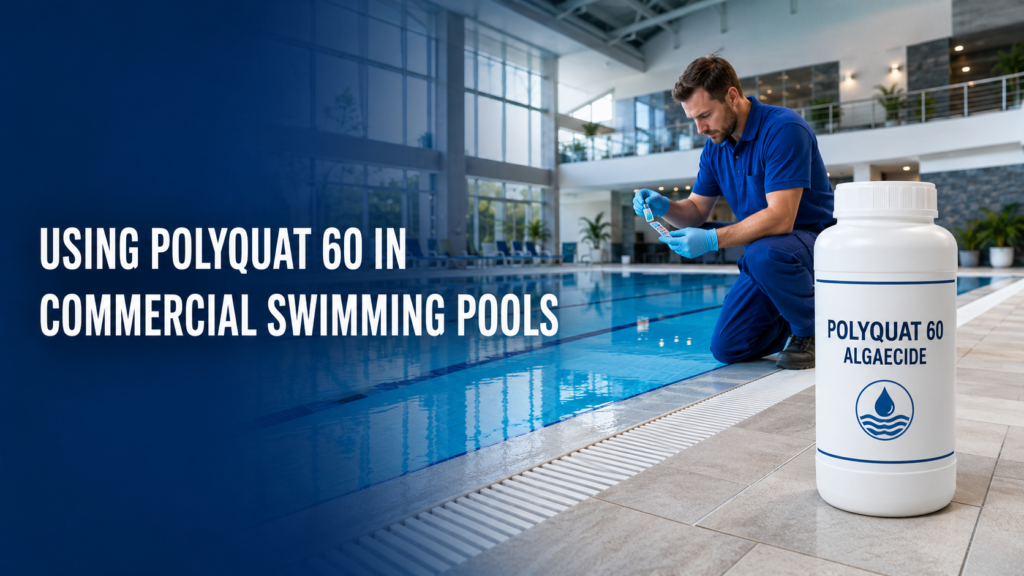
Commercial swimming pools rarely get an easy day.
A hotel pool may welcome families from early morning until late evening. A fitness center pool deals with steady swimmer traffic, while a resort pool must stay visually perfect even when sunscreen, body oils, dust, pollen, and sudden rain keep entering the water. Then there are school pools, municipal aquatic centers, apartment complexes, and water parks—each with its own operating pressures.
Under these conditions, algae prevention is not simply about keeping the water blue. It affects swimmer confidence, filtration efficiency, chemical consumption, maintenance labor, and whether a facility can remain open.
Polyquat 60 can provide another layer of algae protection within a properly managed commercial pool program. It is non-oxidizing, generally non-foaming, and does not depend on copper for its activity. Those features make it particularly useful in pools where water appearance, surface protection, and reliable daily operation matter.
Still, Polyquat 60 is not a replacement for chlorine, filtration, brushing, or good water balance. Think of it as a supporting player—an important one, certainly, but not the entire team.
Why Commercial Pools Face Greater Algae Pressure
A private pool may sit unused for several days. Commercial pools usually do not have that luxury.
Every swimmer brings material into the water:
- Perspiration
- Skin oils
- Cosmetics
- Sunscreen
- Hair products
- Dirt and dust
- Small amounts of organic debris
These contaminants increase the workload placed on the sanitizer and filtration system. If sanitizer residual falls, circulation becomes uneven, or filtration cannot keep pace, algae may gain a foothold.
Outdoor commercial pools face added pressure from windblown soil, pollen, leaves, insects, sunlight, and rain. Warm weather accelerates biological activity, while sunlight can reduce available chlorine—especially when the pool’s stabilizer level is not correctly managed.
Indoor pools have different challenges. They may receive less sunlight, but warm water, continuous traffic, high humidity, decorative water features, and difficult-to-reach surfaces can still create favorable conditions for growth.
And algae do not always announce themselves with bright green water. The first warning may be much less dramatic:
- A slippery step
- A faint film near the waterline
- Dull-looking walls
- Dark marks in grout lines
- Cloudiness that returns after filtration
- Higher-than-normal sanitizer demand
By the time the entire pool turns green, the problem has usually been developing for a while.
What Is Polyquat 60?
Polyquat 60 is a concentrated aqueous formulation based on a polymeric quaternary ammonium compound. Many commercial formulations use Polixetonium Chloride, associated with CAS No. 31512-74-0 and the name Polyquaternium-42.
The “60” normally refers to an active-polymer concentration of approximately 60% by weight. It does not refer to a 60 ppm treatment rate, 60 repeating units, or a fixed molecular weight.
Because “Polyquat 60” is a commercial description rather than one universal chemical specification, pool operators and purchasing teams should verify the actual active ingredient and concentration through the product label, Technical Data Sheet, Safety Data Sheet, and Certificate of Analysis.
The active polymer contains many permanent positive charges along its molecular chain. Algae cell surfaces and various suspended biological materials tend to carry negative charges under normal pool-water conditions. This difference in charge encourages the polymer to associate with the cell surface.
That interaction may disrupt membrane behavior, nutrient transport, and normal cell function. Growth becomes more difficult, and established algae become easier to control as part of a complete treatment program.
For more information about the product’s chemistry and commercial supply formats, visit Polyquat 60 Algaecide.
Why Polyquat 60 Fits Commercial Pool Operations
Commercial pool operators often need more than basic algae control. The product must also fit around swimmer schedules, circulation systems, surface materials, and existing chemical programs.
Polyquat 60 offers several practical advantages.
First, it is generally described as non-foaming or low-foaming when correctly formulated and applied at the labeled dose. This matters in pools with strong return jets, fountains, waterfalls, spa sections, or interactive water features. A foamy surface can look unhygienic even when the water is microbiologically acceptable. Guests judge with their eyes first—fair or not.
Second, Polyquat 60 does not need copper or silver to control algae. A metal-free formulation avoids adding copper through the algaecide itself. This is useful for pools with light plaster, decorative tile, white grout, or finishes that could reveal staining quickly.
Third, it is non-oxidizing. It controls algae through cationic polymer activity rather than strong oxidation. That gives it a different role from chlorine and allows it to support a sanitizer-based program without pretending to replace one.
Fourth, the polymer may also help gather some fine suspended material. This secondary effect can support filtration and water appearance. It should not, however, be treated as a substitute for a dedicated clarifier when persistent fine particles are the real problem.
Polyquat 60 Supports Chlorine—It Does Not Replace It
This distinction is essential in a public or commercial swimming facility.
Chlorine or another locally approved sanitizer remains responsible for controlling pathogens and maintaining sanitary water. Polyquat 60 is primarily an algaecide. It does not provide the same rapid, broad disinfection expected from an approved primary sanitizer.
A useful comparison is to think of chlorine as the main engine and Polyquat 60 as traction control. The second system can help the vehicle handle difficult conditions, but it cannot make the engine unnecessary.
Commercial facilities should continue to maintain:
- The sanitizer residual required by the local pool code
- The approved pH range
- Suitable total alkalinity
- Proper filtration and turnover
- Accurate automated or manual testing
- Routine cleaning, brushing, and vacuuming
- Required operating records
The CDC’s Model Aquatic Health Code is guidance for public pools and other aquatic venues, but local authorities determine the enforceable requirements for each facility. The current CDC edition was posted in 2024, and operators should compare it with applicable state, provincial, municipal, or national rules.
An algaecide label cannot overrule a local health code. Likewise, a local operating target should not be guessed from residential pool advice found online.
Prevention Is Usually Cheaper Than Recovery
A preventive Polyquat 60 program is often more suitable for commercial facilities than waiting for a visible bloom.
Once algae have spread across walls and floors, treatment becomes more disruptive. The facility may require brushing, vacuuming, filter cleaning, oxidizing treatment, closure time, repeated testing, and a larger corrective dose of algaecide. Dead algae then need to be removed from the water.
That costs money. It also creates an awkward question at the reception desk: “Why is the pool closed?”
Preventive treatment aims to reduce the chance that algae will become established. It may be considered when:
- The pool experiences consistently heavy swimmer traffic
- Warm weather is increasing biological activity
- An outdoor pool receives frequent rain or windblown debris
- The facility has known low-circulation areas
- The pool is reopening after a shutdown
- Sanitizer demand has recently increased
- Maintenance access will be limited during a holiday period
- A recurring algae history has been documented
A routine program still needs adjustment. A quiet hotel pool in early spring does not face the same load as a resort pool during a hot holiday weekend.
When Corrective Treatment May Be Needed
Polyquat 60 may also be included in a corrective program when algae are already visible. However, pouring algaecide into green water and walking away is rarely enough.
A stronger recovery procedure may include:
- Confirming the pool volume.
- Closing the pool if water quality does not meet local operating requirements.
- Testing sanitizer, pH, total alkalinity, and other relevant parameters.
- Removing leaves and loose debris.
- Brushing algae from walls, steps, ladders, corners, and fittings.
- Applying the required sanitizer or oxidizing treatment.
- Adding Polyquat 60 only as permitted by its label.
- Running circulation and filtration.
- Vacuuming settled material.
- Cleaning or backwashing the filter.
- Retesting before reopening.
Timing matters. A very high oxidizer concentration may degrade some polymeric algaecide, while adding concentrated products too close together may cause undesirable interactions. Follow the finished-product label regarding treatment order and waiting periods.
Never combine concentrated chlorine and concentrated Polyquat 60 in the same bucket, feeder, measuring container, or chemical line.
How Much Polyquat 60 Should a Commercial Pool Use?
There is no responsible universal dose for every product and every commercial pool.
Finished Polyquat 60 formulations differ in active content, approved uses, local registration, label directions, and supporting ingredients. The product label must remain the primary dosing authority.
Still, the calculation method is straightforward once the label provides a volume-based dosage.
Suppose a label calls for X liters per 100,000 liters of pool water:
For example, if a pool contains 500,000 liters and the labeled rate is 1 liter per 100,000 liters:
That example explains the calculation only. It is not a general dose recommendation.
For irregularly shaped pools, volume errors are common. A 10% error in estimated volume creates a 10% dosing error before the product even leaves the chemical room.
Operators should verify:
- Pool length, width, depth, and shape
- Balance tank or surge tank volume, where relevant
- Whether the label rate is based on total system volume
- Product concentration
- Whether the dose is initial, corrective, maintenance, or closing treatment
A 60% raw-material concentrate is also not automatically equivalent to a finished registered pool product. Industrial concentrate may require formulation, dilution, labeling, registration, and documented quality controls before use or resale.
The Right Way to Add Polyquat 60
Application should take place when the facility is closed to swimmers and the circulation system can operate long enough to distribute the product.
Before dosing, confirm that:
- The actual pool volume is known
- Water chemistry has been tested
- The filtration system is operating correctly
- Skimmer baskets and strainers are clear
- The product is approved for the intended application
- Staff have reviewed the label and SDS
- Suitable personal protective equipment is available
- Other chemical additions have been separated as directed
If the label permits direct addition, measure the required quantity with a clean, compatible container. Distribute it around the pool perimeter or through the designated dosing point while circulation is operating.
Some formulations may allow pre-dilution. If so, follow the specified method. Add the chemical slowly to the larger amount of water—never pour water into a container of concentrated chemical.
Do not use the same measuring equipment for chlorine, acid, algaecide, and clarifier. Cross-contamination in a chemical room can cause reactions long before the product reaches the pool.
After dosing, allow thorough circulation. Pay attention to stairs, beach-entry sections, recessed benches, disabled-access ramps, decorative features, and areas behind ladders. These quiet corners often reveal circulation problems before the main body of water does.
Water Balance Still Controls the Bigger Picture
Polyquat 60 retains its permanent positive charge across the normal swimming-pool pH range. That does not mean water chemistry can be ignored.
Poor pH control can reduce sanitizer performance, affect swimmer comfort, encourage scale, increase corrosion risk, and complicate algae treatment. Total alkalinity influences pH stability, while calcium hardness and overall water balance affect pool surfaces and equipment.
Operators should also review:
- Sanitizer residual and demand
- Combined chlorine, where applicable
- Cyanuric acid
- Water temperature
- Filtration pressure
- Turnover and circulation
- Organic contamination
- Source-water quality
- Phosphate levels when repeated growth remains unexplained
- Weather conditions for outdoor facilities
An algaecide dose may appear ineffective when the real problem is a blocked return, dirty filter, incorrect volume calculation, or sanitizer controller that needs calibration.
Adding more product without checking the system is like turning up the music because the pump is making a strange noise. The noise may be harder to hear, but the fault is still there.
Heavy Bather Load Changes the Treatment Strategy
A busy commercial pool can move from stable to stressed within hours.
Swimmers introduce nitrogen-containing compounds and organic material. These substances consume sanitizer and contribute to combined chlorine formation. Sunscreen and body oils may collect at the waterline, while fine particles remain suspended until the filter captures them.
Polyquat 60 can support algae prevention during these periods, but increasing the algaecide dose should not be the first reaction to every rise in attendance.
A better heavy-load procedure includes:
- Testing more frequently
- Confirming chemical-controller calibration
- Maintaining the required sanitizer residual
- Checking circulation and turnover
- Cleaning baskets and strainers
- Monitoring filter pressure
- Brushing known trouble spots
- Removing surface contamination
- Applying the scheduled Polyquat 60 dose according to the label
- Recording unusual weather or attendance
Records make patterns visible. If algae appear every Monday after busy weekends, the facility may need to adjust its weekend testing, cleaning, circulation, or treatment schedule.
Can Polyquat 60 Improve Water Clarity?
Sometimes—but this benefit needs careful wording.
As a cationic polymer, Polyquat 60 may associate with negatively charged fine particles and biological debris. This can help form material that is easier for the filter to capture. Water may appear brighter after several filtration cycles.
Yet Polyquat 60 is primarily an algaecide.
If the pool remains cloudy after algae treatment, the suspended material may include dead algae, scale, dust, organic contamination, or particles too fine for the filter to remove efficiently. The operator should diagnose the cause before adding more polymer.
Where the treatment program calls for dedicated clarification, Polymer Pool Clarifier can be considered separately. Always check compatibility and application intervals before using two cationic polymer products within the same program.
Excessive polymer dosing can itself contribute to haze or increase the load on the filter. More is not always better. With pool chemicals, “a little extra for luck” is not a sound operating method.
Common Mistakes in Commercial Polyquat 60 Programs
Several mistakes appear repeatedly.
Treating it as a sanitizer: Polyquat 60 does not replace the approved primary disinfectant.
Guessing the pool volume: Incorrect volume leads directly to underdosing or overdosing.
Ignoring the active concentration: Products sold under similar names may contain different active levels.
Mixing concentrates: Concentrated algaecide should not be mixed directly with chlorine, acids, alkalis, oxidizers, clarifiers, or other pool chemicals.
Adding several products at once: Even individually compatible products may interact when concentrated or added without enough circulation time.
Dosing into stagnant water: The polymer needs circulation to reach the entire pool.
Skipping physical cleaning: Brushing breaks up attached growth and exposes hidden algae to treatment.
Blaming every cloudy pool on algae: Cloudiness may come from filtration, scale, source water, dead algae, or chemical incompatibility.
Continuing to dose without investigating recurrence: Repeated algae often indicate a wider operational weakness.
Storage and Chemical-Room Safety
Commercial facilities should treat Polyquat 60 as a chemical product, even though it is non-oxidizing and generally easy to handle as a liquid.
Store it:
- In the original labeled container
- With the cap securely closed
- In a cool, dry, ventilated area
- Away from incompatible chemicals
- Away from direct sunlight and extreme temperatures
- Inside suitable secondary containment
- Where unauthorized staff cannot access it
The SDS should remain available to operators and emergency personnel. Staff should receive training covering handling, spill response, personal protective equipment, first aid, and chemical separation.
Transfer pumps, tubing, and measuring containers should be compatible with the formulation and clearly identified. A dedicated color-coding system can help prevent staff from confusing algaecide equipment with chlorine or acid equipment.
Recordkeeping Turns Treatment into a System
Commercial pool care should not depend on one experienced operator remembering everything.
Each Polyquat 60 application record should include:
- Date and time
- Pool or water-feature identification
- Calculated water volume
- Product name
- Lot or batch number
- Active concentration
- Quantity added
- Reason for treatment
- Sanitizer reading
- pH reading
- Water temperature
- Filter pressure
- Circulation status
- Weather or bather-load notes
- Name of the operator
These records help supervisors investigate recurring algae, compare chemical use across sites, evaluate supplier consistency, and respond to questions from inspectors.
They also prevent accidental repeat dosing during shift changes. That alone can save a facility from a surprisingly common problem.
Choosing a Commercial Polyquat 60 Product
Purchasing teams should look beyond the words “Polyquat 60” on the front label.
Ask the supplier to provide:
- Exact active-ingredient identity
- CAS number
- Active-content range
- Appearance specification
- pH specification
- Density
- Viscosity
- SDS
- TDS
- COA
- Shelf-life information
- Storage requirements
- Packaging options
- Regulatory and labeling status for the target market
- Directions for commercial pool use
- Batch traceability
- Information about formulation compatibility
Viscosity deserves attention because concentrated Polyquat 60 may be noticeably thicker than water. Pump selection, low-temperature handling, transfer speed, and packaging design can all affect day-to-day use.
Product consistency also matters. A commercial facility or pool-service company needs predictable active content, viscosity, and handling from one shipment to the next. A lower purchase price offers little comfort if inconsistent material creates dosing trouble across several pools.
Seasonal and Temporary Closures Need a Separate Plan
Commercial pools may close for winter, renovation, maintenance, or low-demand periods. During these closures, sanitizer monitoring, brushing, circulation, and filtration may be reduced.
A higher closing dose is sometimes specified, but it should not be improvised from the normal maintenance rate. Pool-closing formulations vary, and some combine polyquat chemistry with clarification support.
Before an extended closure:
- Clean and brush the pool
- Remove leaves and debris
- Balance the water
- Complete the required sanitizer treatment
- Allow an excessive sanitizer level to return to the range permitted by the algaecide label
- Add the labeled amount of closing algaecide
- Circulate thoroughly
- Protect equipment as required
- Install and secure the cover
- Schedule off-season inspections where practical
Facilities needing a dedicated off-season formulation can review Winter Algaecide.
A winter product cannot make a dirty pool maintain itself for several months. Starting clean remains the quiet secret behind an easier reopening.
Polyquat 60 Works Best as Part of Good Pool Management
Polyquat 60 can be a valuable treatment for hotels, resorts, schools, fitness centers, apartment complexes, municipal pools, and other commercial aquatic facilities.
Its polymeric structure supports algae control without relying on copper. Its low-foaming character suits highly visible pools and water features. It can complement chlorine-based sanitation and may provide some support for fine-particle removal.
But its greatest value appears when the rest of the operation is already disciplined.
Correct sanitizer residual, balanced water, reliable circulation, effective filtration, regular brushing, accurate dosing, trained staff, and good records create the conditions in which Polyquat 60 can perform properly.
That may sound less exciting than finding one miraculous chemical. It is also far more dependable.
Frequently Asked Questions
1. Can Polyquat 60 replace chlorine in a commercial swimming pool?
No. Polyquat 60 is a supplementary non-oxidizing algaecide, not an approved replacement for chlorine or another required primary sanitizer. Commercial pools must maintain the disinfectant residual specified by the local authority and product label.
2. How often should Polyquat 60 be added to a commercial pool?
Application frequency depends on the finished-product label, active concentration, pool volume, water temperature, bather load, weather, and algae history. Some products are used on a scheduled maintenance basis, while corrective and closing treatments may require different rates.
3. Is Polyquat 60 suitable for hotel and resort swimming pools?
It may be well suited to hotel and resort pools because it is generally non-foaming and metal-free when properly formulated. The product must still be approved for the intended market and used within the facility’s sanitation, filtration, and water-balance program.
4. Can Polyquat 60 cause cloudy water after treatment?
An excessive dose may contribute to temporary haze or increase the amount of material the filter must remove. Cloudiness may also consist of dead algae. Keep the filtration system operating, check filter pressure and water chemistry, and avoid adding another large dose before identifying the cause.
5. Can Polyquat 60 be used with chlorine in a public pool?
Yes, many Polyquat 60 products are designed to complement chlorinated pool programs. However, concentrated products must never be mixed together. Add them separately, follow label intervals, maintain circulation, and comply with local public-pool regulations.