GET IN TOUCH
Ask For Sample?
How Does pH Influence Polyquat 60 Effectiveness?
A swimming pool can have the right Polyquat 60 dosage and still develop algae. Frustrating, isn’t it?
The algaecide may not be the problem. The trouble could be the water surrounding it.
Pool pH affects chlorine activity, mineral balance, swimmer comfort, water clarity, and the conditions in which algae grow. Yet Polyquat 60 responds to pH differently from chlorine and many other treatment chemicals. Its active polymer remains positively charged across a broad pH range, so moderate pH changes do not simply switch its algaecidal action on or off.
That does not mean pH can be ignored. Far from it.
The more accurate explanation is this: Polyquat 60 itself has broad pH tolerance, but the overall algae-control program performs better when pool pH is properly managed.
First, What Does pH Actually Measure?
pH describes how acidic or alkaline water is. The scale normally runs from 0 to 14:
- A pH below 7 is acidic.
- A pH of 7 is neutral.
- A pH above 7 is alkaline.
The scale is logarithmic. That sounds rather academic, but the practical meaning is simple: a change of one pH unit represents a tenfold change in hydrogen-ion activity. Water at pH 6 is not just slightly more acidic than water at pH 7. Chemically, the difference is considerable.
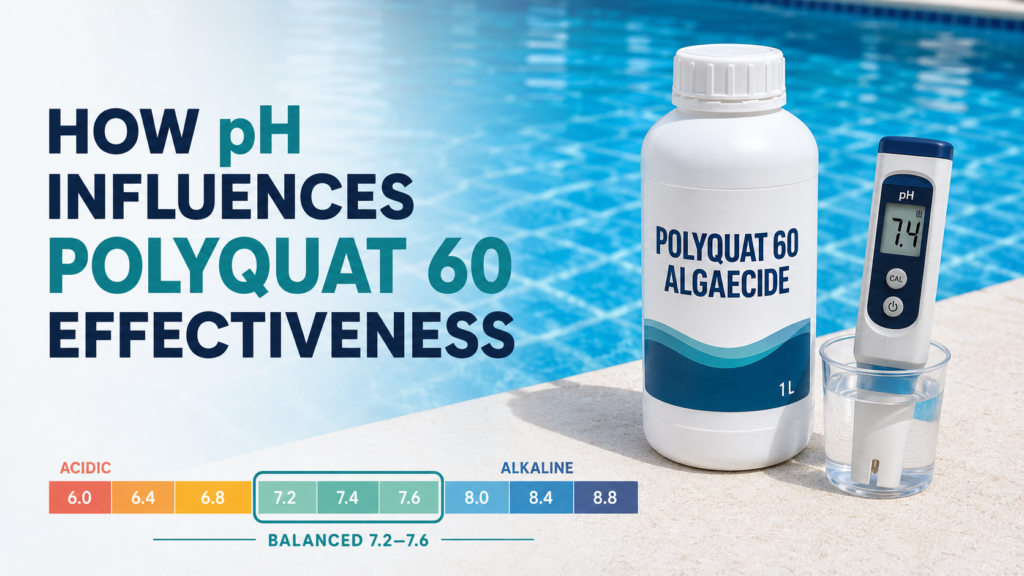
Swimming pools are usually kept in a mildly alkaline range. A working target of approximately pH 7.2 to 7.6 is common, although the permitted range on local regulations, operating standards, and individual product labels may be broader.
Why stay near that range?
Because it creates a sensible compromise among:
- Chlorine performance
- Swimmer comfort
- Equipment protection
- Mineral stability
- Water clarity
- Algae-control support
Pool chemistry is a team effort. If pH moves too far in either direction, several members of that team begin behaving badly.
What Is Polyquat 60?
Polyquat 60 is a concentrated, polymeric quaternary ammonium algaecide. The active ingredient commonly associated with this name is Polixetonium Chloride, identified by CAS No. 31512-74-0.
Its full chemical name is:
Poly[oxyethylene(dimethyliminio)ethylene(dimethyliminio)ethylene dichloride]
Quite a mouthful, admittedly. “Polyquat 60” is much easier to say.
The number 60 generally refers to a product containing approximately 60% active ingredient by weight. Buyers should still check the product specification because commercial naming conventions and finished formulations can vary.
Unlike copper-based algaecides, Polyquat 60 controls algae without introducing copper ions into the water. It is also generally described as non-foaming when correctly formulated and applied.
For a more detailed introduction to its chemistry and commercial form, see Polyquat 60 Algaecide.
How Does Polyquat 60 Control Algae?
Polyquat 60 is a cationic polymer. In plain language, its polymer chain carries multiple positive electrical charges.
Algae cell surfaces and many suspended organic particles tend to carry negative charges. The positively charged polymer is therefore attracted to them—rather like opposite poles of two magnets.
This interaction can:
- Disturb the integrity of algae cell surfaces
- Interfere with normal cell functions
- Reduce the ability of algae to survive and reproduce
- Help associate small negatively charged particles into larger filterable groups
The mechanism is non-oxidizing. Polyquat 60 does not attack contaminants through oxidation in the same way chlorine does.
That distinction becomes important when discussing pH.
Why Polyquat 60 Is Less pH-Sensitive Than Chlorine
Many chemicals gain or lose their electrical charge as pH changes. Polyquat 60 behaves differently because it contains quaternary ammonium groups.
These groups carry a permanent positive charge under normal pool conditions. They do not need to collect a hydrogen ion from acidic water before becoming cationic. Nor do they readily lose their charge when the water becomes moderately alkaline.
Consequently, Polyquat 60 remains cationic across a broad working pH range.
This permanent charge helps preserve the electrostatic attraction between the polymer and negatively charged algae surfaces. It explains why registered product labeling for this active ingredient may describe the algaecide as effective under both acidic and alkaline conditions. An EPA-approved label, for example, states that a polixetonium-chloride algaecide is effective at both acid and alkaline pH.
So, does pH have no effect on Polyquat 60?
Not quite. Chemistry rarely offers such a convenient shortcut.
Direct Effect Versus Indirect Effect—The Crucial Difference
When people ask how pH influences Polyquat 60 effectiveness, they may be combining two separate questions:
- Does pH directly change the electrical form of the active polymer?
- Does pH change the surrounding pool conditions in ways that affect the final algae-control result?
For normal pool maintenance, the first effect is relatively limited. The second can be substantial.
| pH-related factor | Direct effect on Polyquat 60 | Effect on the pool program |
|---|---|---|
| Permanent polymer charge | Usually limited within normal pool pH | Helps retain broad-range activity |
| Chlorine speciation | Not a direct Polyquat reaction | Can strongly affect sanitation |
| Mineral precipitation | May remove or obstruct some treatment activity | Can cause scale and cloudy water |
| Algae-growing conditions | Does not change the polymer identity | Can increase treatment demand |
| Water clarity | Not necessarily loss of algaecidal action | Can make results appear poorer |
| Surface condition | May change polymer contact and distribution | Can shelter attached algae |
In other words, pH may not deactivate the polymer, but it can change nearly everything happening around it.
What Happens When Pool pH Is Too Low?
Water below the recommended operating range becomes increasingly acidic.
Polyquat 60 can remain positively charged in this environment. That is the good news. Yet low-pH water may create other problems that undermine a sound maintenance program.
Possible consequences include:
- Corrosion of metal equipment
- Etching of cementitious pool surfaces
- Damage to grout or plaster
- Eye and skin discomfort
- Faster loss of alkalinity
- Unstable water balance
- Greater difficulty maintaining a consistent sanitizer residual
Low pH also changes chlorine chemistry. A larger portion of free chlorine exists as hypochlorous acid, the more active disinfecting form. That might sound useful, but aggressively acidic water is not a smart way to improve sanitation. The risks to surfaces, equipment, and swimmers outweigh any narrow chemical advantage.
An unstable pool can also experience rapid chemical corrections. Operators may add alkali, sanitizer, and algaecide within a short period. If concentrated products meet before they disperse, local reactions or incompatibilities become more likely.
The practical lesson is straightforward: do not use Polyquat 60 as a reason to leave acidic pool water uncorrected.
What Happens Around pH 7.2 to 7.6?
This is the comfortable middle ground for many swimming pools.
Within this range:
- Polyquat 60 retains its cationic character.
- Chlorine remains useful for routine sanitation and oxidation.
- Swimmer comfort is generally supported.
- Mineral balance is easier to control.
- Many surfaces and equipment components face less chemical stress.
- Test results are easier to interpret.
- Treatment programs become more predictable.
Notice the word “predictable.” That matters.
Polyquat 60 may function outside this range, but a balanced pool gives the product a cleaner working environment. Circulation, filtration, brushing, chlorine, and algaecide can each perform their intended job without constantly compensating for another water-balance problem.
A pH reading of 7.4 is not a magical switch. Algae do not look at the test result and surrender. Still, this range helps remove avoidable complications.
What Happens When Pool pH Is Too High?
High pH often creates more visible operational problems.
The Polyquat 60 polymer does not suddenly lose its permanent positive charge at pH 7.8 or 8.0. Nevertheless, alkaline water can weaken the larger algae-control system.
The most important effect involves chlorine.
Free chlorine exists mainly as hypochlorous acid and hypochlorite ion. As pH rises, the balance shifts toward hypochlorite ion, which is generally less effective as a disinfecting form under comparable conditions.
That means the measured free-chlorine level may look acceptable while its immediate sanitizing action is less favorable than expected.
Meanwhile, warm water, sunlight, heavy swimmer use, organic contamination, and poor circulation continue placing pressure on the pool. Algae may gain a foothold. Polyquat 60 then has to support a system in which the primary sanitizer is not working under ideal conditions.
High pH can also encourage calcium carbonate precipitation when calcium hardness, temperature, and total alkalinity support it. The consequences may include:
- Cloudy or dull water
- Rough scale on surfaces
- Deposits inside heaters and circulation equipment
- Reduced visual quality
- Greater difficulty distinguishing scale, debris, and early algae
- Less efficient filtration or circulation in severe cases
A pool may therefore look as if the algaecide has “failed” when the true problem is a combination of weaker sanitizer performance, mineral precipitation, and poor water movement.
Does High pH Neutralize Polyquat 60?
Under normal swimming-pool conditions, high pH does not neutralize Polyquat 60 in the same way it reduces the proportion of hypochlorous acid in a chlorinated pool.
Polyquat 60’s quaternary ammonium sites remain positively charged. That is one of the chemistry’s practical strengths.
However, several qualifications matter:
- Extremely high or low pH falls outside normal pool operation.
- Finished formulations can contain ingredients other than the active polymer.
- Product stability and performance should be evaluated according to the supplier’s specification.
- Concentrated products should not be mixed together.
- Deposits, suspended solids, and organic contamination can consume or redirect cationic-polymer activity.
- Label directions take priority over general advice.
“Broad pH effectiveness” should therefore be read as operational tolerance, not immunity to every possible water condition.
pH Influences Chlorine More Strongly Than Polyquat 60
This is probably the single most useful point to remember.
Polyquat 60 and chlorine have different jobs:
- Chlorine provides routine sanitation and oxidation.
- Polyquat 60 supplies non-oxidizing algae-control support.
- Filtration removes suspended material.
- Brushing breaks up attached growth and exposes hidden areas.
- Circulation distributes treatment chemicals.
- Water balance keeps the entire program manageable.
Polyquat 60 should not be treated as a replacement for an approved sanitizer.
When high pH reduces the more active portion of free chlorine, organic material may accumulate more quickly. Algae pressure rises, and the pool may demand more brushing, filtration, sanitizer correction, and algaecide support.
Adding extra Polyquat 60 without correcting pH misses the real cause. It is a little like turning up the car radio because the engine is making an odd noise. The noise may be less noticeable, but the engine still needs attention.
Can Algae Themselves Change Pool pH?
Yes—especially where algae growth is already substantial.
During daylight, algae consume carbon dioxide through photosynthesis. Removing dissolved carbon dioxide can push pH upward. At night, respiration and other biological processes may reverse part of that movement.
A pool with active algae can therefore show changing pH readings across the day. If you test only once, you may not see the full pattern.
This creates a feedback loop:
- Algae grow.
- Biological activity contributes to pH movement.
- High pH makes chlorine management less favorable.
- Weaker sanitation allows more biological pressure.
- The treatment program becomes harder to stabilize.
Polyquat 60 can help interrupt algae growth, but pH, sanitizer residual, circulation, and filtration still need correction.
pH Also Influences What You See
Water appearance is not a direct measurement of Polyquat 60 performance.
High pH may produce mineral haze. Dead algae can remain suspended after treatment. Fine debris may pass through the filter repeatedly. A pool can therefore look cloudy even when algae are being controlled.
Likewise, clear water is not proof that sanitation is adequate.
When fine suspended material—not active algae—is responsible for dull water, adding more algaecide may accomplish very little. A purpose-designed Polymer Pool Clarifier may be more suitable when its label and the existing treatment program permit its use.
These products should not be treated as interchangeable merely because both may involve cationic-polymer chemistry.
How Total Alkalinity Fits Into the Picture
pH tells you the water’s current acid–base condition. Total alkalinity describes, in part, its ability to resist sudden pH change.
Think of alkalinity as a shock absorber for pH.
If total alkalinity is too low, pH may swing sharply after rain, chemical addition, aeration, or heavy swimming. If it is too high, pH may resist correction and repeatedly drift upward under some operating conditions.
Polyquat 60 does not correct either problem.
A pool with unstable alkalinity may move in and out of its target pH range. The algaecide can still retain broad activity, but the surrounding sanitizer and mineral conditions become inconsistent. Consistency matters far more than chasing one perfect test result.
Should pH Be Adjusted Before Adding Polyquat 60?
If pH is outside the recommended range, correcting it before routine Polyquat 60 treatment is usually sensible—provided the product label and pool-operating procedure are followed.
A practical sequence may look like this:
- Test pH, free chlorine, total alkalinity, and other relevant balance factors.
- Confirm the pool volume.
- Adjust pH with an appropriate pool chemical if needed.
- Allow the chemical to disperse according to its instructions.
- Retest the water.
- Add Polyquat 60 separately at the labeled dosage.
- Maintain circulation for the required period.
- Brush surfaces and clean or backwash the filter when necessary.
Never pour concentrated Polyquat 60 directly onto another concentrated pool chemical. EPA labels for this active ingredient specifically warn against mixing the algaecide with concentrated dry or liquid chlorine products. Add each chemical separately and follow its label. U.S. EPA product label
Does Polyquat 60 Change Pool pH?
A correctly formulated and properly dosed Polyquat 60 product usually does not cause a large change in the pH of an entire pool.
The reason is dilution. Even an initial treatment dose represents a small volume compared with the total water volume. Pool alkalinity also provides buffering.
However, not every commercial product is identical. Differences can exist in:
- Active concentration
- Product pH
- Carrier composition
- Processing aids
- Additional functional ingredients
- Recommended dose
PubChem reports a pH of approximately 6.9–7.3 for a referenced 60% polixetonium chloride product, but buyers should rely on the specification and test method for the particular material being purchased. NIH PubChem
For B2B sourcing, it is worth confirming whether the supplier reports pH for the product as supplied or for a diluted solution. Those two figures are not automatically comparable.
Can pH Affect the Polymer’s Secondary Clarification Behavior?
Potentially, yes—but the answer is more complicated than a simple pH chart.
Cationic polymers may associate with negatively charged suspended particles. The strength of that interaction can depend on:
- Particle type
- Surface charge
- pH
- Ionic strength
- Organic load
- Polymer dosage
- Mixing conditions
- Contact time
Changes in pH can alter the surface charge of minerals, organic matter, and biological debris. This may affect how the polymer interacts with those materials.
Yet Polyquat 60 is primarily selected as an algaecide. Any clarification benefit should be considered secondary and formulation-dependent. It should not be used as an excuse to overdose the pool.
Too much cationic polymer may coat particles or interfere with the aggregation process. More product does not always mean clearer water. Sometimes it merely means more product.
Why Overdosing Will Not Fix a pH Problem
When algae remain visible, it is tempting to add another large dose of algaecide. That response feels decisive, but it may overlook the actual cause.
Persistent algae can be associated with:
- Incorrect pool-volume calculations
- Poor circulation
- Dead zones behind steps or ladders
- Dirty or undersized filters
- Inadequate brushing
- High phosphate or nutrient pressure
- Low sanitizer residual
- Excessive stabilizer affecting chlorine management
- High organic contamination
- Poorly controlled pH
- Failure to follow the treatment label
- Misidentification of stains or scale as algae
An algaecide cannot repair a circulation pump, remove mineral scale, or correct a badly unbalanced sanitizer program.
Before increasing the dose, test the water and inspect the system. The answer is often hiding in plain sight.
A Practical pH Guide for Polyquat 60 Use
| Pool pH condition | Likely situation | Polyquat 60 consideration | Recommended response |
|---|---|---|---|
| Below 7.0 | Acidic and potentially corrosive | Polymer may remain cationic, but the pool is unbalanced | Correct pH carefully and inspect alkalinity |
| 7.0–7.2 | Slightly below a common target | Broad algaecide activity may remain | Follow local standards and product directions |
| 7.2–7.6 | Common preferred operating zone | Predictable conditions for a combined treatment program | Maintain and monitor |
| 7.6–7.8 | Mildly elevated | Polyquat may remain active, while chlorine chemistry begins becoming less favorable | Check sanitizer and correct developing drift |
| Above 7.8 | High-pH problems become more likely | Do not assume more algaecide will solve the pool condition | Correct pH; inspect scale, clarity, and circulation |
| Extreme pH | Outside normal pool operation | Product behavior and surface safety become less predictable | Stop routine dosing and restore water balance |
These ranges are general guidance, not a substitute for the product label or local public-pool requirements.
How Pool Professionals Can Get More Consistent Results
Reliable algae prevention usually looks rather ordinary. That is precisely why it works.
Test at consistent times. Keep records. Correct gradual pH drift before it becomes a large excursion. Maintain the sanitizer residual. Brush the places that moving water barely reaches. Check the filter rather than assuming it is working perfectly.
For Polyquat 60 itself:
- Verify the active concentration.
- Calculate the actual pool volume.
- Measure the dose rather than estimating it.
- Distribute the product with adequate circulation.
- Keep concentrated chemicals separate.
- Follow the initial and maintenance dosage on the registered product label.
- Do not use the product as a substitute for sanitation.
- Retest after storms, heavy bathing, heat waves, or major chemical adjustments.
Polyquat 60 is often valued because it makes algae prevention more forgiving. It does not make pool chemistry optional.
What This Means for Product Formulators and Buyers
The pH question is also important before Polyquat 60 ever reaches a swimming pool.
Manufacturers and private-label buyers should distinguish among:
- The pH of the concentrated raw material
- The pH of a diluted laboratory test solution
- The pH of the finished algaecide
- The recommended pH of treated pool water
- The pH range used in efficacy or stability testing
They are related, but they are not the same specification.
A strong technical discussion should also cover active content, viscosity, density, appearance, storage stability, packaging compatibility, and intended dosage. If a supplier says only that the product is “pH stable,” ask what that phrase means and how it was evaluated.
For seasonal formulations, pH is only one part of a broader package. Long idle periods, falling temperatures, debris accumulation, and reduced circulation also affect winter algae prevention. A purpose-built Winter Algaecide may combine algae-control chemistry with a dosage and formulation suited to pool closing programs.
The Bottom Line
Polyquat 60 works across a broader pH range than many pool operators expect because its quaternary ammonium groups remain permanently positively charged under normal pool conditions.
That is the direct chemical answer.
The practical answer is broader: pH still influences chlorine activity, mineral precipitation, water clarity, surface condition, biological pressure, and the stability of the complete maintenance program.
Keep the distinction clear:
Balanced pH does not “activate” Polyquat 60. It creates better conditions for Polyquat 60, chlorine, filtration, and circulation to work together.
That may sound like a small difference in wording. Around a real swimming pool, it is the difference between treating one symptom and managing the whole system.
Frequently Asked Questions
1. What is the best pool pH for Polyquat 60 effectiveness?
Polyquat 60 remains active across a broad pH range, but approximately 7.2–7.6 commonly provides predictable conditions for chlorine performance, swimmer comfort, mineral control, and overall algae prevention. Always follow the product label and applicable pool regulations.
2. Does high pH make Polyquat 60 ineffective?
Moderately high pool pH does not normally remove the polymer’s permanent positive charge. However, it can reduce favorable chlorine activity, encourage scale, and create conditions that make algae control more difficult.
3. Can I add Polyquat 60 before adjusting pool pH?
If pH is significantly outside the recommended range, adjust it first, allow the correction chemical to circulate, and retest. Add Polyquat 60 separately according to its label. Never mix concentrated algaecide with concentrated chlorine.
4. Will Polyquat 60 lower or raise swimming-pool pH?
A correctly dosed Polyquat 60 product usually causes little change in total pool pH because the treatment volume is small relative to the pool. Finished formulations vary, so check the supplier’s technical data.
5. Why is algae still growing when pH and Polyquat 60 dosage are correct?
Check sanitizer residual, circulation, filtration, brushing, pool-volume calculations, organic contamination, hidden dead zones, and product application timing. A correct pH and algaecide dose cannot compensate for every maintenance problem.