GET IN TOUCH
Ask For Sample?
Compatibility of Polixetonium Chloride with Other Chemicals
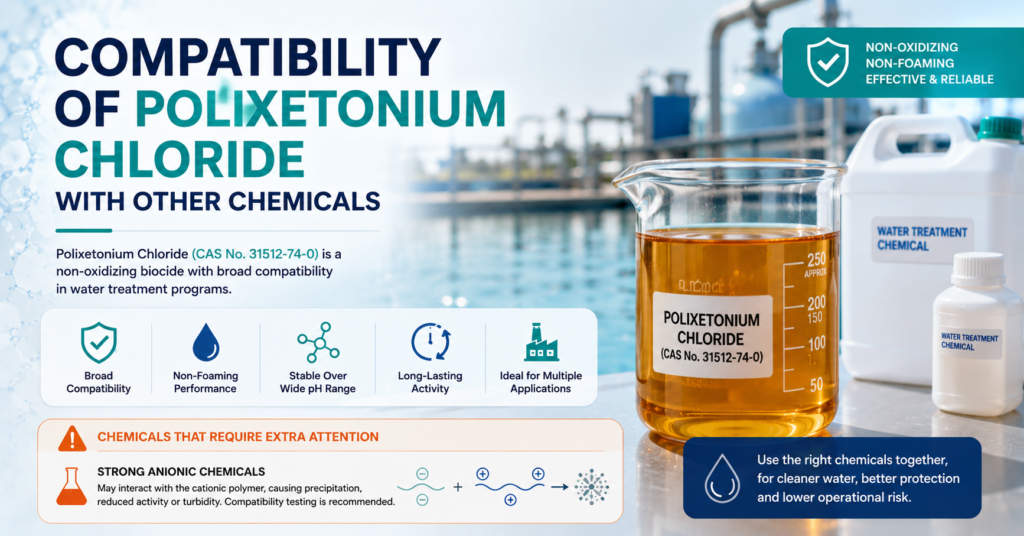
Polixetonium Chloride (CAS No. 31512-74-0) has become a popular non-oxidizing biocide for industrial water treatment, cooling water systems, swimming pools, decorative fountains, and various recirculating water applications. Its broad-spectrum antimicrobial activity, non-foaming performance, and excellent stability make it a reliable choice for many water treatment professionals.
But here’s a question that often comes up:
Can Polixetonium Chloride be used together with other chemicals?
The short answer is yes—most of the time. In fact, it is commonly incorporated into multi-component water treatment programs. However, compatibility depends on the type of chemical involved, the dosage, the mixing sequence, water quality, and system conditions.
Understanding which chemicals work well together—and which combinations deserve extra attention—can improve treatment performance while avoiding unnecessary problems.
Let’s explain.
Why Chemical Compatibility Matters More Than Many People Realize
No single chemical can solve every water treatment challenge.
A typical industrial cooling water system may require several treatment products simultaneously, including:
- Biocides
- Corrosion inhibitors
- Scale inhibitors
- Dispersants
- Flocculants
- pH adjusters
- Oxidizing disinfectants
Swimming pools are similar. Besides an algaecide, operators may also use chlorine, clarifiers, pH regulators, calcium hardness adjusters, and cyanuric acid.
If these chemicals are incompatible, several problems may occur:
- Reduced antimicrobial performance
- Product decomposition
- Precipitation or cloudiness
- Increased operating costs
- Equipment fouling
- Unexpected maintenance issues
Fortunately, Polixetonium Chloride is known for its relatively broad compatibility compared with many conventional biocides.
What Makes Polixetonium Chloride Compatible with So Many Water Treatment Programs
Unlike oxidizing biocides, Polixetonium Chloride works through a different mechanism.
Its polymeric quaternary ammonium structure adsorbs onto negatively charged microbial cell surfaces, disrupts cell membrane integrity, and causes leakage of cellular contents, ultimately leading to cell death.
Because it does not rely on oxidation, it generally does not react aggressively with many common water treatment chemicals.
Additional characteristics also contribute to its compatibility:
- Stable over a wide pH range
- Non-oxidizing chemistry
- Non-foaming during circulation
- Low volatility
- Good thermal stability
- Effective over relatively long contact periods
These properties make it suitable for continuous or periodic dosing in many industrial water systems.
Chemicals That Work Well with Polixetonium Chloride
Chlorine and Bromine Programs
One of the most common questions concerns chlorine compatibility.
In swimming pool applications, Polixetonium Chloride is frequently used alongside chlorine or bromine sanitizing programs.
Rather than replacing chlorine, it provides an additional layer of algae control, helping reduce the likelihood of algae outbreaks while maintaining a clean appearance.
When dosed correctly, the two treatment methods complement each other instead of competing.
Corrosion Inhibitors
Most commonly used corrosion inhibitors show good compatibility, including systems based on:
- Phosphonates
- Molybdates
- Silicates
- Zinc salts (when properly formulated)
Routine industrial water treatment programs often combine these products successfully.
Scale Inhibitors
Scale inhibitors generally do not interfere with the activity of Polixetonium Chloride.
Examples include:
- Organophosphonates
- Polycarboxylates
- Polymer dispersants
These products target mineral deposits, while Polixetonium Chloride targets microorganisms, so their functions are complementary.
Nonionic Surfactants
Most nonionic surfactants exhibit good compatibility.
Because they carry no electrical charge, they usually do not interact strongly with the cationic polymer structure.
Cooling Water Treatment Formulations
Many commercial cooling water treatment packages successfully combine Polixetonium Chloride with:
- Corrosion inhibitors
- Scale inhibitors
- Dispersants
- Antifoams
- Oxygen scavengers
The final formulation, however, should always be validated through compatibility testing.
Chemicals That Require Extra Attention
Although Polixetonium Chloride is broadly compatible, not every chemical combination is equally suitable.
Strong Anionic Chemicals
This is perhaps the most important compatibility consideration.
Because Polixetonium Chloride is a strongly cationic polymer, it may react with strongly anionic materials.
Examples include certain:
- Anionic surfactants
- Anionic dispersants
- Sulfonated polymers
- Sulfated detergents
Direct mixing may result in:
- Reduced activity
- Floc formation
- Increased turbidity
- Precipitation
Whenever strong anionic products are present, laboratory compatibility testing is strongly recommended before full-scale application.
Common Compatibility Mistakes to Avoid
Even compatible chemicals can produce disappointing results if handled improperly.
Some common mistakes include:
- Mixing concentrated products before dilution
- Ignoring dosing sequence
- Assuming every commercial formulation behaves the same
- Skipping jar tests for new formulations
- Using contaminated storage tanks
- Combining incompatible surfactants without testing
These simple oversights can significantly reduce treatment efficiency.
ractical Mixing and Dosing Recommendations
The following practices help maximize compatibility.
Add Chemicals Separately
Whenever possible, inject each product individually into flowing water.
Avoid premixing concentrated chemicals unless the formulation has been specifically validated.
Maintain Good Circulation
Adequate circulation helps distribute each chemical evenly and reduces localized high concentrations.
Follow Manufacturer Recommendations
Commercial formulations often contain proprietary additives that may affect compatibility.
Always review the supplier’s technical guidance before combining products.
Monitor Water Quality
Regular monitoring helps verify that the treatment program remains effective.
Key parameters include:
- pH
- Conductivity
- Chlorine residual (where applicable)
- Microbial counts
- Turbidity
- Biofilm formation
How to Test Compatibility Before Large-Scale Use
Whenever introducing a new chemical combination, performing a simple compatibility evaluation is a smart precaution.
A typical laboratory assessment includes:
- Prepare representative water samples.
- Add chemicals at their intended application concentrations.
- Observe for precipitation, cloudiness, color changes, or excessive viscosity.
- Allow the mixture to stand for 24 hours.
- Recheck appearance and stability.
- If necessary, perform microbial efficacy testing under simulated operating conditions.
This straightforward procedure can help identify potential issues before implementation in a full-scale system.
Compatibility in Different Applications
Industrial Cooling Water
Polixetonium Chloride is commonly used together with:
- Scale inhibitors
- Corrosion inhibitors
- Oxidizing biocide programs
- Dispersants
Its non-foaming nature makes it particularly suitable for systems with high circulation rates.
Swimming Pools
In swimming pools, it is commonly compatible with:
- Chlorine
- Bromine
- pH adjusters
- Calcium hardness increasers
- Cyanuric acid
Direct mixing with concentrated sanitizer products should still be avoided.
Decorative Fountains
Many fountain maintenance programs combine Polixetonium Chloride with:
- Clarifiers
- pH control chemicals
- Scale prevention products
The combination helps maintain clear water while controlling algae growth.
Process Water Systems
In industrial process water, compatibility should always be evaluated based on:
- Water chemistry
- Product formulation
- Temperature
- Organic contamination
- Treatment objectives
Pilot testing remains the most reliable method for confirming long-term performance.
Conclusion
Polixetonium Chloride offers excellent compatibility with many chemicals commonly used in industrial water treatment and swimming pool maintenance. Its non-oxidizing chemistry, polymeric structure, broad pH stability, and non-foaming characteristics allow it to integrate smoothly into many existing treatment programs.
That said, compatibility should never be assumed for every formulation. Strong anionic chemicals deserve additional attention. Following proper dosing procedures, avoiding direct mixing of concentrates, and conducting simple compatibility tests can greatly reduce operational risks.
With thoughtful application, Polixetonium Chloride can work alongside a wide range of treatment chemicals to support effective microbial control, stable water quality, and reliable system performance.
Frequently Asked Questions
1. Can Polixetonium Chloride be used with chlorine?
Yes. Polixetonium Chloride is commonly used alongside chlorine in swimming pools and industrial water systems. It supplements algae control but should not be mixed directly with concentrated chlorine products before dilution.
2. Is Polixetonium Chloride compatible with bromine?
Yes. Bromine-based sanitation programs are generally compatible with Polixetonium Chloride when both products are added separately into circulating water.
3. Can Polixetonium Chloride be mixed with corrosion inhibitors?
In most cases, yes. It is widely used with corrosion inhibitors such as phosphonate-, molybdate-, and silicate-based formulations. Compatibility should still be verified for proprietary products.
4. Why should strong anionic chemicals be avoided?
Because Polixetonium Chloride is a cationic polymer, it can interact with strongly anionic materials, potentially causing precipitation, turbidity, or reduced antimicrobial effectiveness.
5. What is the safest way to evaluate compatibility before use?
The most reliable approach is to conduct a laboratory jar test or pilot trial using the actual system water and intended treatment concentrations. This helps identify any unexpected interactions before full-scale application.