
GET IN TOUCH
Ask For Sample?
Why PolyDADMAC-Based Clarifiers Are Attractive for Private Label Pool Brands?
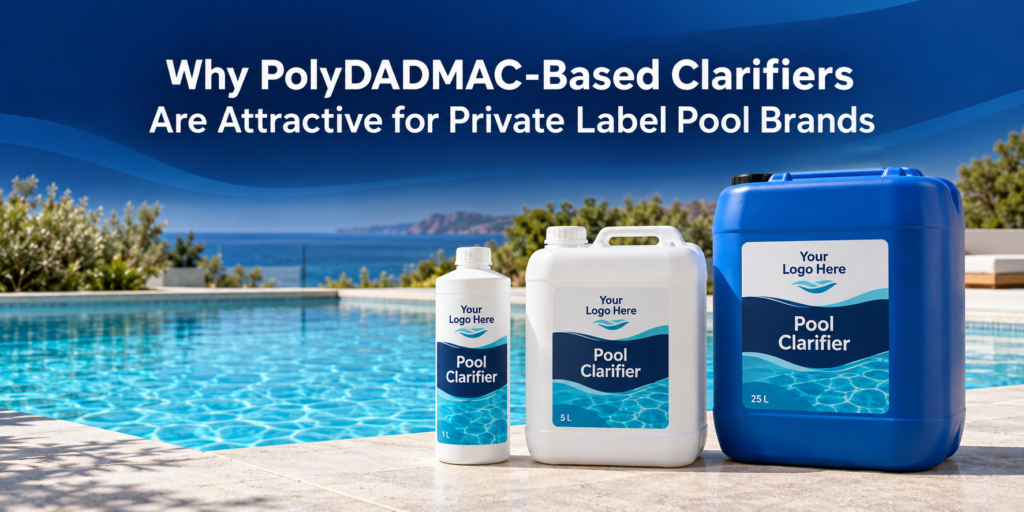
A pool owner may not know what PolyDADMAC means. They do know when the water looks dull.
That gap between a technical ingredient and a clear customer need is where a private label product can earn its place.
For pool chemical distributors, service companies, and growing pool care brands, a clarifier offers a benefit that’s easy to explain: it helps the filtration system remove fine particles that make water look cloudy.
Yet choosing a product to carry your name takes more than finding a liquid that clears a test jar. You need a suitable formula, sound directions, dependable supply, and packaging that works in the customer’s hands.
PolyDADMAC-based clarifiers are attractive because they combine an understandable purpose with room to tailor concentration, pack size, appearance, and service support. Their commercial value depends on how well those choices fit the market.
Let’s look at what makes this chemistry useful—and what a brand should check before putting its logo on the bottle.
First, What Does PolyDADMAC Actually Do?
PolyDADMAC is short for poly(diallyldimethylammonium chloride), a positively charged, or cationic, polymer. Its CAS number is 26062-79-3.
Many fine particles in water carry a negative surface charge. Those charges can help keep particles apart, leaving a haze that is difficult for a filter to capture.
PolyDADMAC can help destabilize these particles through charge neutralization and related particle interactions. Under suitable conditions, particles gather into aggregates that are easier to separate. The precise result depends on the polymer grade, dose, mixing, and water being treated.
Think of fine dust scattered across a workbench. Collecting it becomes easier once it gathers together. The analogy isn’t perfect, but it explains the basic aim.
In a pool clarifier application, the filter still has a job to do. The polymer helps prepare fine suspended material for removal; it doesn’t make that material vanish.
For buyers who want more background on the ingredient, see Eautrix PolyDADMAC.
The Customer Benefit Is Easy to Understand
Some pool products need a long explanation before a customer sees their purpose.
A clarifier starts with a familiar problem:
“The pool has a haze, even though I’ve removed the leaves and cleaned the baskets.”
That gives a brand a clear starting point. It can explain what suspended particles are, why filtration sometimes needs support, and when a clarifier may help.
The message can stay simple:
Helps the filter capture fine particles that contribute to cloudy water.
That statement also sets a useful boundary. Cloudy water can have several causes. A chemical imbalance, active algae, poor circulation, or a filter fault may need attention before clarification will deliver a worthwhile result.
A brand that explains these limits gives customers a better chance of success. It also helps retailers avoid recommending the same bottle for every water problem.
After all, a clear promise is easier to keep.
It Can Fill a Useful Gap in a Pool Care Range
A brand may already sell sanitizers, pH control products, and algaecides. A clarifier adds another role to that range: support for the physical removal of fine suspended particles.
That creates a more complete story at the shelf.
Each product should have a distinct purpose:
| Product category | Main role in the pool care program |
|---|---|
| Sanitizer | Maintains the required disinfection treatment |
| pH adjustment product | Helps bring pH into the intended operating range |
| Algaecide | Provides algae control according to its approved label |
| Polymer clarifier | Helps filtration remove suitable fine suspended particles |
| Filter care product | Addresses specified filter cleaning or maintenance needs |
This structure helps a customer understand why several products may be needed without suggesting that every pool needs every product each week.
It also gives sales staff a useful conversation. Instead of asking only, “Which chemical do you want?” they can ask, “What is happening in the pool?”
For private label brands, that shift matters. It makes the range feel like a supported maintenance program rather than a row of unrelated bottles.
Liquid Formulation Creates Practical Packaging Choices
PolyDADMAC-based clarifiers can be supplied as aqueous liquid formulations. That creates room to develop packs for different customers.
A homeowner may want a bottle that pours neatly and stores on a small shelf. A service technician may care more about a sturdy handle and a cap that won’t leak in a vehicle. A local blender may prefer bulk supply.
The chemistry provides a starting point, but the package determines much of the daily experience.
Possible formats include:
- Small bottles for retail sale.
- Medium jerrycans for frequent users.
- Larger containers for service operations.
- Bulk packs for qualified filling or blending businesses.
There’s a small detail here that brands sometimes miss: a pack must suit the dose.
If the recommended quantity is small, an oversized cap with no clear measuring marks can invite mistakes. If the liquid pours slowly, the neck and closure deserve attention. If a service company uses the product outdoors, a label that smears when wet becomes a nuisance fast.
Good packaging makes correct use easier. That is part of product quality.
One Chemistry Can Support Different Market Positions
A private label brand doesn’t have to serve every pool owner.
It may focus on independent pool shops, service companies, hotels, residential maintenance, or regional distributors. Each group values something slightly different.
For example, a retail product may emphasize easy measurement and plain directions. A professional product may place more weight on documented treatment cost and technical support.
A concentrated version may suit trained users who can measure accurately. A less concentrated version may allow a larger, easier-to-measure dose.
Neither approach wins by default.
The right choice depends on the customer’s equipment, habits, and expectations. It also depends on whether the supplier can validate the proposed formula and directions.
This is why concentration should follow the product brief. Starting with the highest percentage available and building a sales story around it can leave the customer with a product that is awkward to use.
Concentration Offers Flexibility, but Percentage Isn’t the Whole Story
Two clarifiers can list the same polymer and still perform differently.
PolyDADMAC is a family of polymer grades, with differences that can include molecular weight and solution viscosity. Eautrix’s ingredient information, for example, lists several viscosity ranges rather than one universal grade.
For a brand owner, this means an ingredient name alone is an incomplete purchasing specification.
Useful questions include:
- Which polymer grade is used?
- How is polymer concentration defined and tested?
- What finished-product viscosity is acceptable?
- What evidence supports the application rate?
- How does the formula behave with the intended filtration system?
Also clarify whether a quoted percentage refers to polymer active matter, total solids, or another defined measure. Those terms should not be treated as interchangeable without checking the test method.
A thicker product may look stronger to a customer. That doesn’t establish better clarification performance.
The pool test has to settle that question.
Treatment Value Can Be More Useful Than Bottle Price
Private label buyers naturally compare purchase prices. But the cheapest bottle may not deliver the lowest treatment cost.
A more useful comparison links price to a validated dose.
Consider a simple illustration. These are hypothetical figures, not dosing instructions:
| Item | Product A | Product B |
|---|---|---|
| Brand’s cost per 1 L bottle | $4.00 | $6.00 |
| Validated dose for the same test conditions | 100 mL | 50 mL |
| Treatments per bottle | 10 | 20 |
| Product cost per treatment | $0.40 | $0.30 |
Product B costs more per bottle but less per treatment in this example.
That comparison only holds if both products achieve an acceptable result under comparable conditions. A lower stated dose has little value if it leaves the water hazy or requires repeated additions.
The wider cost picture matters too. Include bottles, closures, labels, cartons, freight, storage, leakage, and customer support.
A product that saves a little at purchase but generates frequent complaints may be expensive to carry.
Clear and Blue Versions Give Brands a Visual Choice
Appearance can help a clarifier fit an existing product range.
A clear or lightly colored liquid may suit a simple, technical look. A blue version may fit a range that uses color to help customers identify different treatments.
Eautrix lists both original-color and blue-dyed versions of its PolyDADMAC-based pool clarifier, along with concentration and packaging customization.
However, color should remain a presentation choice unless testing supports a further claim.
A deeper blue does not prove a higher polymer content. It does not show that the product works faster, either.
Any proposed dye should be assessed in the finished formula. Check storage stability, label and container staining, and appearance at the intended application rate.
The aim is a product that looks consistent in the bottle and behaves as expected in the pool. A striking color that causes avoidable questions is a poor trade.
Consistent Quality Can Make Repeat Orders Easier
The first order tests the idea. Later orders test the supplier.
A sample may perform well, but the brand needs confidence that the next production batch will meet the same agreed requirements.
That calls for a written specification covering meaningful properties. Depending on the formula, these may include polymer content, appearance, pH, viscosity, density, and relevant impurity limits.
Test conditions matter. A viscosity result without a defined temperature and method can be hard to compare with another result.
A certificate of analysis, or COA, helps show whether a batch meets the agreed specification. It should be supported by traceable batch records and a clear process for handling changes.
Ask the supplier to notify you before changes to the polymer grade, dye, packaging, or manufacturing process that could affect the approved product.
Customers rarely see this work. They notice its absence when the next bottle pours differently or behaves in an unexpected way.
Better Directions Are a Real Way to Stand Out
A private label clarifier does not need a mysterious ingredient story to earn trust.
Often, the stronger advantage is better guidance.
A useful label explains:
- How to estimate the pool volume.
- How much product to add.
- Whether dilution is required.
- Where and how to apply it.
- How to operate the circulation system.
- When to inspect or clean the filter.
- When to reassess the water before adding more.
Directions should use units familiar to the target market. A metric label may suit one region, while another needs gallons and fluid ounces.
Conversions deserve careful checking. A small unit error can turn sound advice into a poor treatment experience.
Separate instructions may also be needed for an initial clarification treatment and later maintenance use, where both are supported by testing.
The goal is to help someone make the right decision beside a pool, perhaps in bright sun, with wet hands and little patience for fine print.
Filter Compatibility Needs Evidence
“Works with all filters” is an appealing claim. It is also a broad one.
Sand, cartridge, and diatomaceous earth filters have different operating and maintenance requirements. A formula’s suitability should be assessed for the systems named on the label.
Ask how the supplier tested compatibility. A jar test can show particle aggregation, but it does not reproduce every aspect of a working filtration system.
Practical evaluation should look at water clarity, filter pressure, cleaning needs, and any unwanted deposits under the intended conditions.
The same care applies to saltwater pools and different sanitizer programs. A claim should reflect the finished product and its directions, rather than an assumption based on the ingredient name.
A focused, well-supported claim is useful to a retailer. It tells them where they can recommend the product with confidence.
Honest Limits Help Protect the Brand
Clear water looks inviting. It does not, by itself, establish that a pool is properly disinfected.
CDC guidance treats sanitizer control and pH testing as essential parts of home pool care. A clarifier should sit within that maintenance program, with a separate and clearly explained role.
For private label brands, this affects both product education and marketing language.
Avoid unsupported promises such as “makes any pool safe,” “replaces chlorine,” or “solves every cloudy water problem.”
Likewise, do not promise a fixed clearing time unless testing supports the conditions stated. Results can depend on the type of haze, filtration, circulation, dose, and underlying water problem.
Customers can accept that a product has limits. Frustration grows when a label promises an effortless cure and leaves them guessing when it fails.
Plain, accurate language gives the product a fair chance to meet expectations.
Private Label Supply Can Reduce Production Work
Contract manufacturing can let a brand purchase a finished, packed clarifier rather than develop its own blending and filling operation.
That may free the business to focus on customer relationships, distribution, training, and stock planning.
It does not remove the need for technical review.
The brand still needs an agreed formula, approved artwork, suitable documentation, and a clear understanding of responsibilities in its destination market. Regulatory and label review should address the actual composition, claims, and place of sale.
Commercial details deserve the same attention:
What is the minimum order for each pack size? Can one order include several sizes? Who owns unused printed labels? How much remaining shelf life is required on delivery?
These questions may sound less exciting than a new bottle design. They often determine whether a launch runs smoothly.
Test the Finished Product Before Scaling Up
The best sample is the product you intend to sell, in the package you intend to use.
Start by agreeing on a written brief. Define the customer, concentration, appearance, filtration claims, pack sizes, and intended use.
Then evaluate the finished formula under representative conditions. Include an untreated comparison where practical, and keep records of water conditions, dose, circulation, and filter operation.
Check the package as well. Examine closure security, pouring, measuring, label adhesion, and transport protection.
A pilot order can reveal issues that a small laboratory sample will never show. Perhaps the liquid is sound, but the cap leaks after handling. Perhaps the label is clear indoors but hard to read beside the pool.
Fixing those details before a larger order protects both stock and reputation.
How Eautrix Fits a Private Label Product Brief
Eautrix offers a PolyDADMAC-based pool clarifier listed at 10% active ingredient, with private label support, formulation adjustment, and several retail and bulk packaging formats. Its product page provides a starting point for discussing a market-specific product.
Explore Polymer Pool Clarifier to review the offering.
For a useful quotation, share more than a target price. Include your destination market, sales channel, intended pack size, expected volume, and any proposed filter compatibility or performance claims.
You can contact Eautrix about a private label pool clarifier to discuss samples, specifications, and packaging requirements.
The attraction of PolyDADMAC-based clarifiers is practical: an understandable customer need, flexible product presentation, and a useful place within a wider pool care range. A successful private label product builds on those strengths with tested performance and clear support.
Frequently Asked Questions
1. What makes PolyDADMAC suitable for private label pool clarifiers?
PolyDADMAC can help fine suspended particles gather into aggregates that are easier to remove. Liquid formulations also allow brands to develop different concentrations and packaging formats, subject to testing of the finished product.
2. Can a private label PolyDADMAC pool clarifier replace an algaecide?
A clarification claim does not establish algae-control performance. A clarifier primarily supports particle removal. Active algae problems need a suitable treatment program, with each product used according to its label.
3. Is a concentrated private label pool clarifier always better?
No. A concentrated formula may reduce product volume per treatment, but it can demand more precise measurement. Compare validated performance, ease of dosing, and total treatment cost rather than concentration alone.
4. What should brands request from a PolyDADMAC clarifier supplier?
Request a finished-product specification, current SDS, batch COA, supported application directions, stability information, and evidence for proposed compatibility claims. Also confirm packaging requirements, lead times, and change-notification procedures.
5. Does blue PolyDADMAC pool clarifier work better than clear clarifier?
Color alone does not establish performance. Compare the polymer grade, concentration, formula, and test results. A blue dye can support product identity, but the finished formulation still needs stability and application checks.