
GET IN TOUCH
Ask For Sample?
Performance Comparison: Polixetonium Chloride vs Conventional Water Treatment Biocides
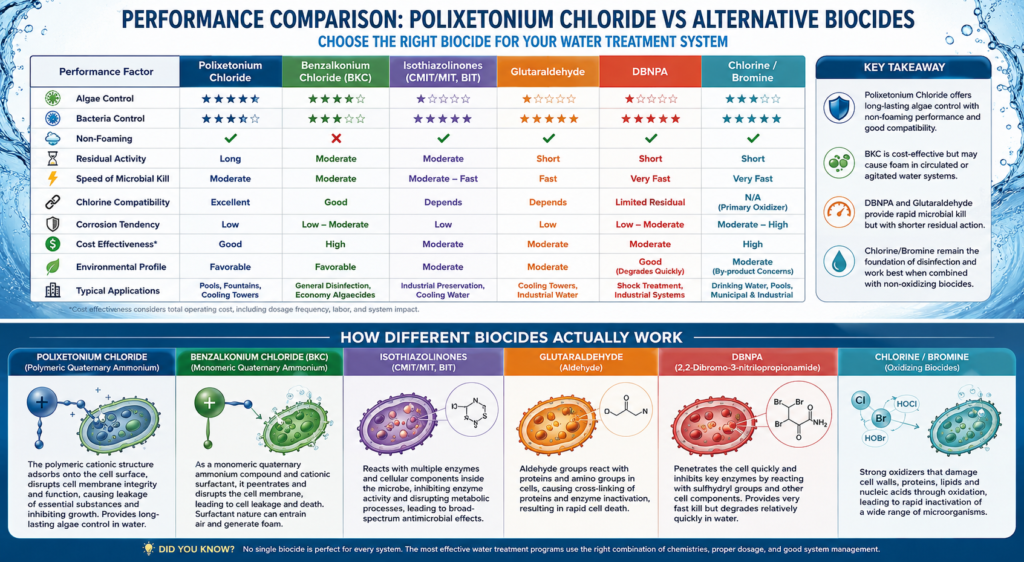
Choosing a water treatment biocide isn’t as simple as comparing price tags or reading a product label. Every water system behaves differently, and every biocide has its own strengths, limitations, and ideal applications.
Some products are designed to eliminate bacteria within minutes. Others are formulated to prevent algae from becoming established over weeks of continuous circulation. Some perform well in industrial cooling systems but create unwanted foam in swimming pools. Others remain effective for longer periods but may not deliver the rapid microbial reduction needed for emergency treatment.
That’s why experienced water treatment professionals rarely ask, “Which biocide is the best?” Instead, they ask a more practical question:
“Which biocide is the best fit for this particular water system?”
Among the many options available, Polixetonium Chloride has become increasingly popular in industrial water treatment and premium pool care because it combines long-lasting algae control with non-foaming performance and excellent compatibility with many common treatment programs.
This article compares Polixetonium Chloride with several widely used water treatment biocides, including traditional quaternary ammonium compounds such as benzalkonium chloride (BKC), isothiazolinones, glutaraldehyde, DBNPA, and oxidizing biocides such as chlorine and bromine. Rather than declaring one product universally superior, we’ll examine where each technology performs best and what factors should guide your selection.
Why Compare Water Treatment Biocides?
Water treatment systems vary enormously. A decorative fountain, a commercial swimming pool, a cooling tower, and a metalworking fluid system all face different microbial challenges.
For example:
- Swimming pools often require reliable algae prevention without producing foam.
- Cooling towers must control bacteria, algae, and biofilm while operating continuously.
- Industrial process water may require compatibility with corrosion inhibitors and scale-control chemicals.
- Metalworking fluids demand effective microbial preservation without destabilizing the fluid formulation.
These different operating conditions mean that no single biocide is ideal for every application.
The right comparison should consider factors such as:
- Target microorganisms
- Speed of microbial control
- Residual activity
- Foam generation
- Chemical compatibility
- Corrosion potential
- Environmental profile
- Overall treatment cost rather than purchase price alone
Looking at these factors together provides a much clearer picture than simply comparing active ingredients or concentration.
What Is Polixetonium Chloride?
Polixetonium Chloride is a polymeric quaternary ammonium compound widely used as a non-oxidizing biocide for water treatment.
Unlike traditional monomeric quaternary ammonium compounds, its polymeric structure gives it several practical advantages in many circulating water systems. It is particularly valued for:
- Excellent algae control
- Broad antimicrobial activity
- Non-foaming performance
- Long residual activity
- Good compatibility with chlorine treatment programs
- Low corrosion tendency compared with many oxidizing biocides
In swimming pool applications, Polixetonium Chloride is commonly used in premium non-foaming algaecides. In industrial systems, it is often incorporated into treatment programs for cooling water and other recirculating water systems where long-term biological control is important.
One additional characteristic is that polymeric quaternary ammonium compounds may also contribute a coagulation-aid effect in certain water treatment applications, helping fine suspended particles aggregate more easily. However, this should be viewed as a secondary benefit rather than the primary purpose of the product.
The Main Types of Water Treatment Biocides on the Market
Although hundreds of commercial formulations are available, most water treatment biocides fall into a few major categories.
| Biocide Type | Typical Representative | Primary Characteristics |
|---|---|---|
| Polymeric Quaternary Ammonium | Polixetonium Chloride | Non-foaming, long residual algae control |
| Monomeric Quaternary Ammonium | Benzalkonium Chloride (BKC) | Economical, effective, but may generate foam |
| Isothiazolinones | CMIT/MIT, BIT | Broad-spectrum industrial preservation |
| Aldehyde Biocides | Glutaraldehyde | Rapid bacterial control, widely used industrially |
| Fast-Acting Non-Oxidizing Biocides | DBNPA | Rapid kill with relatively fast degradation |
| Oxidizing Biocides | Chlorine, Bromine | Strong oxidizing action and rapid disinfection |
Each technology has evolved to solve different treatment challenges rather than replace every other option.
Performance Comparison at a Glance
The following table summarizes the general characteristics of these major biocide technologies. Actual performance will depend on system design, water chemistry, dosage, and operating conditions.
| Performance Factor | Polixetonium Chloride | BKC | Isothiazolinones | Glutaraldehyde | DBNPA | Chlorine/Bromine |
|---|---|---|---|---|---|---|
| Algae Control | ★★★★★ | ★★★★☆ | ★☆☆☆☆ | ★☆☆☆☆ | ★☆☆☆☆ | ★★★☆☆ |
| Bacteria Control | ★★★★☆ | ★★★☆☆ | ★★★★★ | ★★★★★ | ★★★★★ | ★★★★★ |
| Non-Foaming | ✔ | ✘ | ✔ | ✔ | ✔ | ✔ |
| Residual Activity | Long | Moderate | Moderate | Short | Short | Short |
| Compatible with Continuous Circulation | Excellent | Good | Good | Good | Moderate | Good |
| Chlorine Compatibility | Excellent | Generally Good | Depends on program | Depends on program | Limited residual | Primary disinfectant |
| Typical Pool Use | Premium algaecides | Economy algaecides | Rare | Rare | Rare | Primary sanitizer |
| Typical Industrial Use | Cooling water, circulating systems | General disinfectants | Preservation | Cooling water | Shock treatment | Municipal & industrial water |
Rather than viewing these products as direct competitors, many water treatment programs combine different chemistries to achieve complementary performance. For example, a cooling tower treatment program may use an oxidizing biocide for rapid microbial reduction while periodically applying a non-oxidizing biocide to improve overall biological control.
Polixetonium Chloride vs Quaternary Ammonium Compounds (BKC)
This comparison often creates the most confusion because both products belong to the quaternary ammonium family. However, their chemical structures and practical performance differ significantly.
Benzalkonium chloride (BKC) is a monomeric quaternary ammonium compound. It has been used for decades as a disinfectant and algaecide in many industries because it is effective, economical, and easy to formulate.
Polixetonium Chloride, by contrast, is a polymeric quaternary ammonium compound. Its polymeric structure changes the way it behaves in water systems, particularly those involving continuous circulation.
One of the most noticeable differences is foam generation.
Because BKC also functions as a cationic surfactant, agitation and water circulation can produce visible foam. While this may be acceptable in some industrial applications, it is generally undesirable in swimming pools, spas, fountains, and decorative water features where appearance and user experience matter.
Polixetonium Chloride is widely recognized for its non-foaming characteristics, making it especially attractive for premium pool algaecides and recirculating water systems.
Residual performance also differs. Polymeric quaternary ammonium compounds generally remain active longer than conventional monomeric quaternary ammonium compounds under many operating conditions, allowing longer intervals between maintenance treatments in appropriate applications.
Another practical difference is water clarity. While neither product should be considered a primary clarifier, the polymeric structure of Polixetonium Chloride may provide some coagulation-aid properties in certain formulations, helping fine suspended particles aggregate more readily. This secondary effect is not typically associated with benzalkonium chloride.
Polixetonium Chloride vs Isothiazolinones
Isothiazolinones have been trusted industrial preservatives for decades. Products based on CMIT/MIT, MIT, BIT, or related chemistries are commonly used to control bacteria, fungi, and yeast in industrial water systems, paints, coatings, adhesives, and many other water-based formulations.
At first glance, they may appear to compete directly with Polixetonium Chloride. In reality, they solve different problems.
The greatest strength of isothiazolinones is their broad-spectrum antimicrobial activity. They are highly effective against many bacteria and fungi, even at relatively low concentrations, making them an excellent choice for preserving water-based products during storage and use.
However, algae control is generally not their primary purpose. While some activity against algae has been reported under specific conditions, isothiazolinones are typically not selected as the main algaecide in swimming pools or recirculating water systems.
Polixetonium Chloride was developed with a different focus. It is particularly effective at preventing algae growth while also providing broad antimicrobial activity against many microorganisms encountered in water treatment systems. For facilities where algae represent the primary operational challenge, this difference becomes important.
Another consideration is system compatibility.
Many industrial water treatment programs combine oxidizing and non-oxidizing biocides. Depending on dosage strategy, contact time, and system chemistry, isothiazolinones may require careful management to achieve optimum performance alongside other treatment chemicals.
Polixetonium Chloride is generally valued for its compatibility with routine chlorine maintenance programs used in many pool and cooling water applications, allowing it to serve as a complementary non-oxidizing biocide rather than a replacement for sanitizers.
In short:
- Choose isothiazolinones when long-term preservation of water-based products is the primary goal.
- Consider Polixetonium Chloride when algae prevention, non-foaming performance, and residual biological control are key priorities.
Polixetonium Chloride vs Glutaraldehyde
Glutaraldehyde has earned its reputation as one of the most effective fast-acting non-oxidizing biocides available for industrial water treatment. It is widely used in cooling towers, oilfield operations, pulp and paper processing, and certain wastewater applications because of its rapid action against a broad range of microorganisms.
Unlike polymeric quaternary ammonium compounds, glutaraldehyde works by chemically reacting with proteins and enzymes inside microbial cells, leading to rapid cell death.
This fast mode of action makes it an excellent option for situations where microbial populations must be reduced quickly.
However, speed is only one part of the equation.
Once consumed through chemical reactions and natural degradation, glutaraldehyde provides relatively limited residual protection compared with polymeric quaternary ammonium compounds. Systems experiencing continuous biological contamination often require repeated dosing to maintain control.
Polixetonium Chloride takes a different approach.
Rather than acting as a rapid “shock” treatment, it is commonly selected for preventive biological management, helping suppress algae development over extended operating periods when applied according to the treatment program.
Material compatibility is another factor.
Although glutaraldehyde is compatible with many industrial systems, users should always evaluate operating conditions, worker handling procedures, and ventilation because aldehyde-based products require appropriate safety practices.
For facilities looking for ongoing algae prevention with minimal foam generation, polymeric quaternary ammonium compounds often offer practical operational advantages.
Polixetonium Chloride vs DBNPA
Among modern industrial biocides, DBNPA (2,2-Dibromo-3-nitrilopropionamide) is well known for one characteristic:
It works extremely fast.
DBNPA rapidly penetrates microbial cells and quickly reduces bacterial populations. It is frequently selected for industrial systems where immediate microbial knockdown is more important than extended residual protection.
One reason many industrial operators appreciate DBNPA is that it degrades relatively quickly after performing its function. In applications where long-term chemical persistence is not desired, this can be an advantage.
The trade-off is that fast degradation usually means shorter residual activity.
If new microorganisms continuously enter the system, additional dosing may be required to maintain biological control.
Polixetonium Chloride follows a different strategy.
Its value lies less in immediate microbial knockdown and more in maintaining stable biological conditions over time. This makes it particularly suitable for continuously circulating systems where preventive treatment is preferred over repeated emergency interventions.
Another important distinction involves algae.
DBNPA is primarily recognized for bacterial control rather than routine algae prevention, whereas Polixetonium Chloride has established use as an algaecide in swimming pools, decorative water features, and other recirculating water systems.
The decision between these two chemistries often comes down to operational objectives:
- Need rapid microbial reduction? DBNPA may be appropriate.
- Need continuous algae management with minimal foam? Polixetonium Chloride may be a better fit.
Polixetonium Chloride vs Oxidizing Biocides (Chlorine & Bromine)
No discussion of water treatment would be complete without mentioning chlorine and bromine.
These oxidizing biocides remain the foundation of microbial control in countless water treatment systems because they are highly effective, relatively economical, and capable of rapidly inactivating a broad range of microorganisms.
Their mechanism differs completely from that of polymeric quaternary ammonium compounds.
Instead of interacting with microbial cell membranes, chlorine and bromine act through oxidation, damaging essential cellular components and rapidly reducing microbial populations.
For drinking water, public swimming pools, and many industrial systems, oxidizing disinfectants remain indispensable.
However, oxidation also has limitations.
Their concentration can decline quickly because oxidants react not only with microorganisms but also with organic matter, sunlight (in the case of unstabilized chlorine), and various contaminants introduced into the water.
As a result, many systems require continuous monitoring and frequent adjustment to maintain the desired disinfectant residual.
Another consideration is algae prevention.
Although chlorine and bromine help suppress algae growth when properly maintained, heavy algae contamination, biofilm development, or seasonal changes can increase treatment demand. For this reason, many commercial pool operators incorporate a dedicated non-oxidizing algaecide into their maintenance program rather than relying solely on chlorine.
This is where Polixetonium Chloride is commonly used.
Instead of replacing chlorine, it is typically used alongside an oxidizing sanitizer, providing an additional layer of algae control while maintaining its non-foaming characteristics.
This complementary approach is widely adopted because each chemistry addresses different aspects of biological control.
Expert Tip
Think of oxidizing biocides as the system’s primary disinfectant and Polixetonium Chloride as a preventive algae management tool. In many treatment programs, they work together rather than compete with each other.
Which Product Performs Best in Different Applications?
One of the biggest mistakes buyers make is assuming that one chemistry should be used everywhere.
The reality is much more practical: the best biocide depends on the operating environment, the target microorganisms, and the maintenance strategy.
The table below summarizes typical application preferences.
| Application | Generally Preferred Chemistry | Why |
|---|---|---|
| Residential swimming pools | Polixetonium Chloride + Chlorine | Non-foaming algae prevention with continuous sanitation |
| Commercial pools & water parks | Polixetonium Chloride + Chlorine/Bromine | Stable algae control under heavy circulation |
| Decorative fountains | Polixetonium Chloride | Foam-free operation and improved aesthetics |
| Cooling towers | Program-dependent (oxidizing + non-oxidizing biocides) | Broad microbial control through complementary chemistries |
| Metalworking fluids | DBNPA, Glutaraldehyde, or Isothiazolinones depending on formulation | Rapid bacterial control and fluid preservation |
| Water-based coatings & adhesives | Isothiazolinones | Excellent in-can preservation against bacteria and fungi |
| Municipal drinking water | Chlorine/Bromine (or other approved disinfectants) | Regulatory compliance and reliable disinfection |
No single chemistry dominates every application. The most effective treatment programs are often those that combine complementary technologies based on system requirements rather than relying on a single active ingredient.
Cost vs Long-Term Value
When evaluating water treatment biocides, many buyers naturally compare the price per kilogram or price per gallon first. While purchase price is important, it rarely reflects the true operating cost of a treatment program.
The real question should be:
“How much does it cost to maintain biological control over time?”
A lower-priced biocide that requires more frequent dosing, generates excessive foam, or causes operational interruptions may ultimately cost more than a higher-priced product that delivers longer-lasting performance.
Several factors contribute to the total cost of ownership:
- Treatment frequency
- Labor required for dosing and monitoring
- Water quality consistency
- Equipment downtime caused by biological fouling
- Chemical compatibility with the existing treatment program
- Potential maintenance costs related to corrosion or excessive deposits
For example, conventional quaternary ammonium compounds such as benzalkonium chloride (BKC) are often chosen because of their attractive initial cost. However, in systems where foam is undesirable, additional maintenance or operational adjustments may offset part of that cost advantage.
Similarly, fast-acting biocides such as DBNPA may provide excellent microbial reduction, but systems experiencing continuous contamination may require repeated applications because of their relatively short residual activity.
Polixetonium Chloride is often selected not because it is the least expensive option, but because its combination of non-foaming performance, extended residual activity, and effective algae prevention can reduce the overall maintenance burden in suitable applications.
For this reason, experienced buyers usually evaluate cost per month of effective control, rather than simply comparing the purchase price of the active ingredient.
How to Choose the Right Water Treatment Biocide
Selecting the right biocide begins with understanding your water system—not with choosing the most popular product.
Before making a decision, consider the following questions.
What is your primary target?
Different microorganisms require different treatment strategies.
- If algae are the main concern, a polymeric quaternary ammonium compound such as Polixetonium Chloride may be appropriate.
- If rapid bacterial reduction is the priority, products such as glutaraldehyde or DBNPA may be considered.
- If long-term preservation of a water-based formulation is required, isothiazolinones are often preferred.
Is foam acceptable?
Foam may not affect every application, but it can become a significant operational issue in systems with continuous circulation.
Examples include:
- Swimming pools
- Spa pools
- Decorative fountains
- Cooling towers
- Cascading water features
If foam control is important, selecting a non-foaming chemistry can simplify routine maintenance.
Will the biocide be used alone or as part of a treatment program?
Many successful water treatment programs combine multiple chemistries.
For example:
- Oxidizing biocides provide rapid microbial reduction.
- Non-oxidizing biocides help maintain biological control between oxidation cycles.
- Corrosion inhibitors protect metal surfaces.
- Scale inhibitors reduce mineral deposits.
Rather than replacing one chemistry with another, these products often complement each other.
What are the operating conditions?
Consider:
- Water temperature
- pH
- Organic loading
- Sunlight exposure
- Water turnover rate
- Make-up water quality
- Regulatory requirements
A product that performs exceptionally well in one system may not produce the same results in another.
Think Beyond the Product Label
One of the most common purchasing mistakes is selecting a biocide based solely on its active ingredient or concentration.
Performance depends on far more than chemistry alone.
Proper dosage, application timing, circulation, system cleanliness, and routine monitoring all influence the final outcome.
Working with a supplier that understands your specific application often delivers better results than simply purchasing the lowest-cost product.
Common Mistakes When Comparing Water Treatment Chemicals
Comparing biocides can be surprisingly misleading if the comparison focuses on only one performance indicator.
Here are several mistakes that buyers frequently make.
Comparing Only the Purchase Price
A less expensive product may require more frequent treatment, more labor, or additional maintenance.
Always evaluate the total operating cost rather than the unit price alone.
Assuming Faster Means Better
Rapid microbial kill is valuable in many situations, but long-term biological stability often depends on maintaining effective residual control rather than achieving the fastest initial reduction.
The best choice depends on your treatment objectives.
Ignoring Foam Generation
Foam is sometimes dismissed as a cosmetic issue, but in swimming pools, decorative fountains, and highly circulated systems, excessive foam can affect appearance, user experience, and routine operation.
Selecting a chemistry that matches the operational requirements of the system is often more important than maximizing antimicrobial activity alone.
Expecting One Product to Solve Every Problem
No biocide controls every microorganism equally well under every condition.
Effective water treatment usually combines several complementary technologies, supported by proper system monitoring and maintenance.
Overlooking Water Chemistry
Even the most effective biocide can perform poorly if water chemistry is not properly managed.
Parameters such as pH, hardness, suspended solids, and organic contamination all influence treatment performance.
Successful biological control begins with good system management, not just chemical selection.
Final Thoughts
Water treatment professionals have access to more biocide technologies today than ever before. Each offers unique advantages, and each was developed to solve specific operational challenges.
Polixetonium Chloride distinguishes itself through its combination of non-foaming performance, effective algae control, and extended residual activity, making it a practical choice for many recirculating water systems and premium swimming pool algaecide formulations.
Conventional quaternary ammonium compounds such as benzalkonium chloride remain useful where cost is a primary consideration and foam generation is not a significant concern.
Isothiazolinones continue to play an important role in industrial preservation, while glutaraldehyde and DBNPA are widely valued for rapid microbial control in demanding industrial applications.
Meanwhile, oxidizing biocides such as chlorine and bromine remain the foundation of sanitation programs for public water systems and swimming pools.
Instead of asking which product is universally “best,” a more productive question is:
Which chemistry best matches the operating conditions of your system?
The answer often depends on your biological target, water quality, maintenance strategy, and long-term operating objectives.
When these factors are evaluated together, selecting the right biocide becomes a technical decision rather than simply a purchasing decision.
Frequently Asked Questions
1. Is Polixetonium Chloride better than benzalkonium chloride (BKC)?
Not necessarily. The two products are designed for different priorities. Polixetonium Chloride is generally preferred when non-foaming performance, extended algae control, and compatibility with recirculating water systems are important. Benzalkonium chloride is often selected for its lower initial cost and broad disinfectant applications where foam is less of a concern.
2. Why does benzalkonium chloride produce foam while Polixetonium Chloride does not?
Benzalkonium chloride is a monomeric quaternary ammonium compound that also exhibits surfactant properties, making foam generation more likely when water is agitated. Polixetonium Chloride is a polymeric quaternary ammonium compound and is widely recognized for its non-foaming behavior in applications such as swimming pools, fountains, and cooling water systems.
3. Can Polixetonium Chloride be used together with chlorine?
Yes. In many water treatment programs, Polixetonium Chloride is used alongside chlorine as a complementary non-oxidizing algaecide. Chlorine provides primary sanitation, while Polixetonium Chloride helps maintain algae control. Product labels and treatment recommendations should always be followed to ensure proper dosage and compatibility.
4. Which water treatment biocide provides the longest residual protection?
Residual performance varies with system conditions, dosage, water chemistry, and microbial load. Polymeric quaternary ammonium compounds such as Polixetonium Chloride are generally valued for their relatively long-lasting activity, while fast-acting chemistries such as DBNPA are designed for rapid microbial reduction rather than extended residual control.
5. How do I choose the right biocide for my water treatment system?
Begin by identifying the primary microbial challenge, evaluating operating conditions, considering compatibility with existing treatment chemicals, and comparing the total operating cost rather than the purchase price alone. Consulting with an experienced supplier and, when appropriate, conducting field evaluations can help determine the most suitable solution for your specific application.