
GET IN TOUCH
Ask For Sample?
Why Clearer Pool Water Helps Strengthen a Pool Care Brand
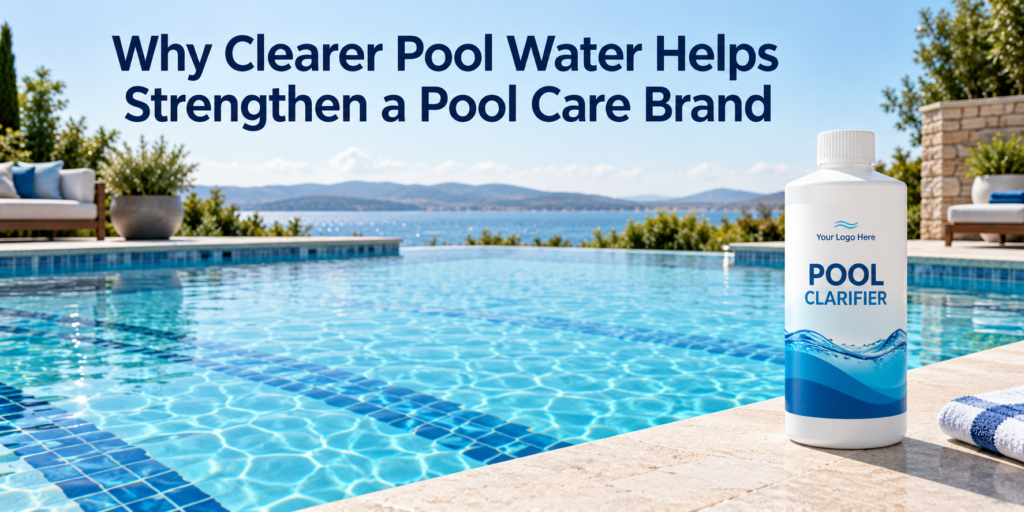
A customer may never ask which polymer is in a pool clarifier. They may not know how a filter captures fine dirt, either.
But they know when their pool looks good.
They can see the steps beneath the surface. The floor tiles look sharp. Sunlight moves through clear water, and the pool looks ready for the weekend.
That visible result matters to a pool care brand. Customers buy chemicals for a purpose, and clearer water gives them something they can recognize. When a product helps deliver that result—and the brand explains how to use it well—the experience can build trust.
Still, there’s more to the story than a bright blue pool photograph. Water clarity depends on filtration, circulation, water balance, sanitation, and the type of contamination present. A clarifier has a specific role within that system.
For pool chemical brands, distributors, and private-label businesses, understanding this link between product performance and customer experience can shape a stronger product line. Here’s how.
Your Brand Promise Becomes Real at the Poolside
A label can promise quality. A website can explain technical features. A sales team can talk about dependable supply.
Then the customer uses the product.
That is where the promise meets the pool.
If a pool owner follows the instructions and sees a useful improvement, the brand starts to mean something practical. It becomes the bottle that helped solve a problem, rather than one more item on a crowded shelf.
Consider a common situation. A customer has checked the water, corrected the chemistry, and confirmed that the filter works. Yet a light haze remains. If a suitable clarifier helps the filter remove those fine particles, the change can be easy to see.
The customer may not remember the term “coagulation.” They may remember that your advice made sense and your product did what you said it could do.
That memory is a valuable part of brand building.
Clear Water Gives Customers an Easy Way to Judge Results
Many parts of pool maintenance are hard to see.
A customer needs a test kit to assess sanitizer levels. They need measurements to understand pH or alkalinity. A pump may circulate water well without creating any striking visual change.
Water clarity is different. It offers an immediate visual reference.
Customers can compare how well they see the pool floor, whether a haze remains, and whether suspended particles still catch the light. Those observations don’t replace testing, but they help customers understand why they bought the product.
This is especially useful for brands that sell through dealers or online stores. Technical information supports the sale, while the result helps customers assess their purchase afterward.
The key is to connect the visible benefit with a fair explanation. “Helps filtration remove fine suspended particles” gives the customer a clear purpose. A sweeping promise to fix every cloudy pool sets the product up for disappointment.
The Emotional Benefit Is Often Relief
Pool owners don’t always buy a clarifier because they enjoy water chemistry.
Sometimes they buy it because guests are coming. Sometimes they have spent days brushing, testing, and cleaning, yet the pool still looks dull. Sometimes they simply want their maintenance effort to show.
There’s a quiet frustration in that last case. The customer has done the work. Why doesn’t the water look better?
When a suitable treatment helps resolve the remaining haze, the benefit goes beyond appearance. It can bring relief and a sense of control.
For a brand, this suggests a useful way to write product copy. Start with the customer’s problem, then explain the product’s role in plain language.
For example:
“Fine particles can leave pool water looking hazy even when larger debris has been removed. This polymer clarifier helps those particles gather into groups that a suitable filter can capture.”
That explanation respects both the customer’s concern and the limits of the product.
Where Does Polymer Pool Clarifier Fit?
A polymer pool clarifier helps address fine suspended particles that can be difficult for a filter to capture on their own.
Many formulations use cationic polymers. “Cationic” means the polymer carries positive charges. These charges can interact with certain particles in the water, helping destabilize them and encouraging them to gather.
The exact action depends on the polymer, its formulation, the dose, and the water conditions.
Think of loose dust scattered across a surface. Individual specks can be hard to collect. Gathering them makes removal more manageable. In a pool, a suitable clarifier supports a related task: helping fine material become easier to filter.
The filter still needs to remove that material. Circulation must carry treated water through the system, and the filter needs appropriate care.
This explains why a clarifier should be presented as part of pool maintenance. A sound product message links the chemical to the equipment and routine that allow it to work.
Clear Water and Safe Water Need Different Proof
This distinction deserves a clear place in any responsible brand message: water that looks clear is not proof that it is properly sanitized.
Appearance cannot confirm the disinfectant level or show whether disease-causing germs are present. The CDC identifies disinfection and pH control as key defenses against swimming-related illness and advises pool owners to test their water regularly.
A clarifier should therefore not be sold as a replacement for a sanitizer, water testing, or proper operating procedures.
For brands, this is also a trust issue. Customers need to know what a product does and when a different action is required.
A clear label can explain the product’s purpose without creating a false sense of security. Retail staff and service teams should use the same distinction when they recommend it.
Honest boundaries make a brand’s useful claims more credible.
Consistent Results Can Encourage Repeat Purchases
A first purchase may come from a promotion, a dealer’s advice, or an urgent problem.
A repeat purchase has a different basis. The customer has experience.
If the product performs reliably under the conditions described on the label, and the instructions are easy to follow, the customer has a reason to buy it again when the same need arises.
That does not mean every pool needs a clarifier every week. Maintenance use should follow the specific product label and the pool’s needs.
It does mean that a successful experience can reduce uncertainty at the next purchase. The customer already knows the bottle, the measuring process, and the steps involved.
For a pool care brand, this familiarity can be more durable than a one-time discount. It gives the customer a practical reason to stay.
Better Instructions Help Customers Get Better Results
A good formulation can still create a poor experience when the directions are vague.
“Add as required” leaves too much room for error. So does a dose expressed in units that customers struggle to use.
Useful instructions should answer the questions people face beside the pool:
- How do I estimate the pool’s water volume?
- How much product should I add?
- Does this formula need dilution?
- Where and how should I add it?
- How should I operate and maintain the filter afterward?
- When should I assess the result before considering another dose?
The answers must come from the tested formulation and its approved label.
Clear directions also help prevent the familiar “more must be better” mistake. With polymer clarifiers, excess dosing can impair performance and may create additional maintenance problems.
A brand protects its reputation when it makes correct use easy. The product, bottle, measuring method, and instructions all contribute to that experience.
Reliable Clarity Support Gives Dealers a Better Sales Conversation
Dealers need products they can explain with confidence.
A clarifier becomes easier to recommend when its role is specific. Staff can ask about the water test results, the filter, and the nature of the cloudiness before deciding whether it fits.
That conversation is more useful than treating every cloudy pool as the same problem.
For example, a light haze from suspended particles may call for a different response from cloudiness linked to active algae, a filtration fault, or a water balance issue.
When a brand provides practical training material, it helps dealers make better recommendations. A short troubleshooting sheet can be especially useful during busy periods, when staff have little time for a long technical discussion.
This support gives the dealer another reason to value the brand. They receive a product plus a clearer way to help their customers.
Service Companies Put Your Brand in Front of Real Pools
Pool service technicians work with changing conditions.
One pool sits beneath trees. Another gets heavy weekend use. A third has equipment that needs attention. The same treatment does not produce the same result in every setting.
For this audience, credibility comes from predictable product behavior and useful technical support.
A suitable clarifier may help a technician address fine suspended matter as part of a broader treatment plan. Yet the brand should avoid promising that it will always reduce visits, save a fixed amount of labor, or deliver clear water within a set number of hours.
Those claims need evidence.
What a brand can provide is a clear description of suitable applications, dose guidance, filter considerations, and troubleshooting steps. Technicians can then judge where the product fits in their work.
When professionals understand a product’s limits, they can use it with greater confidence.
Clearer Water Can Support Premium Positioning
A higher price needs a reason.
An attractive label helps a bottle get noticed, but customers still need to understand the value behind it. For a polymer pool clarifier, that value may include dependable performance, simple dosing, useful packaging, and responsive support.
The cost per bottle tells only part of the story. Buyers may also consider how much water the bottle treats at its labeled dose and how easily they can use it correctly.
Brands should make those comparisons fairly. A concentrated formula is not automatically better for every customer. Some users prefer a product that is easier to measure in small pools, even if it requires more liquid.
Premium positioning works best when it reflects a real user benefit.
“Carefully formulated and clearly explained” may sound less dramatic than “instant crystal clarity,” but it gives a brand a firmer foundation.
Your Clarifier Can Strengthen the Wider Product Range
A customer who has a good experience with one product may become more willing to consider others from the same brand.
That creates an opportunity for a well-planned pool care range.
A clarifier can sit alongside sanitizers, water balance products, algaecides, and filter care products, with each item serving a distinct purpose.
The range should help customers understand what to use and why. If several bottles seem to promise the same result, the shelf can become confusing.
Simple product roles are easier to remember:
- Sanitizers control microorganisms as stated on their labels.
- Water balance products adjust specific water parameters.
- Clarifiers help address certain fine suspended particles.
- Filter care products support equipment maintenance.
A coherent range helps customers follow a maintenance process. It also gives dealers a more organized story to tell.
Private-Label Brands Need More Than a Good-Looking Bottle
For a private-label pool care business, the customer sees your name on the product.
They may never know who manufactured the liquid. If the experience is poor, their questions come to you.
That makes supplier selection part of brand strategy.
Before launching a polymer clarifier, establish a clear specification with the manufacturer. Relevant points can include polymer type, concentration, appearance, pH, viscosity, storage conditions, and packaging compatibility.
The right specification depends on the formula and intended use. A single figure, such as active content, cannot describe the whole product.
It is also useful to agree on batch records, quality documents, sample approval, and how changes will be communicated. If a raw material or formulation changes, the effect on the finished product needs review.
Brand consistency begins before the label is applied.
Packaging Can Make the Brand Feel Easier to Use
Customers experience the package every time they measure and pour.
A bottle that leaks, a cap that is hard to handle, or a label that becomes unreadable can weaken confidence even when the liquid performs well.
For retail users, manageable bottle size and clear measuring guidance matter. Service businesses may place more value on larger containers that pour cleanly and store well.
Packaging checks should reflect the actual formula and shipping conditions. The bottle, closure, seal, and label all need to suit the product.
Color also needs careful communication. A blue clarifier may fit the visual identity of a pool care range, but the color alone does not prove stronger clarification.
The package should help users recognize, handle, and apply the product. That is a practical form of brand quality.
Show Real Results Without Dressing Them Up
Water clarity is well suited to visual content, but photographs need context.
A before-and-after image can mislead if the light, camera angle, water depth, or image editing changes between shots.
For useful comparisons, keep the conditions as consistent as possible. Record the treatment steps, filtration conditions, and time between photographs.
If the pool also received algae treatment, filter cleaning, or water balance correction, say so. The clarifier should not receive sole credit for a result produced by several actions.
Customer stories can still be engaging with these details included. In fact, a realistic explanation often helps readers understand whether their own pool has a similar problem.
The goal is evidence that helps someone make a sound choice.
Measure Whether the Product Is Helping Your Brand
Clearer water is an important outcome. Brand strength needs its own measures.
Useful signals include repeat orders, dealer reorders, customer feedback, complaint themes, and requests for technical support.
Look closely at the reasons behind them.
Are customers unsure how much to add? Do dealers ask the same filter compatibility question? Are some users expecting a clarifier to treat algae?
Those patterns can reveal a gap in the label or sales material. They may also point to a product issue that needs testing.
No single measure proves that a clarifier has increased brand loyalty. Still, a combination of repeat demand, fewer recurring misunderstandings, and positive field feedback can help guide decisions.
Listen to what happens after the sale. That is where the most useful brand lessons often appear.
Turn Visible Performance Into Lasting Confidence
Clearer pool water gives a pool care brand a valuable opportunity: a result customers can see.
But lasting confidence comes from the full experience. The product needs a clear purpose. The formulation needs consistent control. Instructions need to make sense. Claims need to match evidence.
For brands building or expanding a private-label range, polymer pool clarifier deserves attention as a focused part of the maintenance system.
Start with a defined customer need, choose a formula suited to that need, and test it under relevant conditions. Then give customers and dealers the information required to use it well.
When the water looks better and the experience feels straightforward, your brand gains something beyond shelf presence. It gains a reason to be remembered.
Frequently Asked Questions
1. How does clearer pool water help build pool care brand loyalty?
Clearer water gives customers a visible result they can connect with their purchase. When that result is repeatable and supported by helpful instructions, it can encourage trust and repeat buying. Product quality and service remain important parts of loyalty.
2. Can a private-label polymer pool clarifier support a premium brand?
Yes, when the premium offer includes meaningful benefits such as consistent formulation, practical packaging, clear directions, and technical support. A higher price or attractive bottle alone does not establish superior performance.
3. Does clear swimming pool water mean the sanitizer level is correct?
No. Water appearance cannot confirm sanitizer levels or microbiological safety. Pool owners and operators still need water testing, appropriate disinfection, water balance control, and proper equipment operation.
4. Why do customers get different results from the same pool clarifier?
Results can vary with the cause of cloudiness, dose, particle type, water chemistry, circulation, and filter condition. A clarifier suited to fine suspended particles may not resolve a problem caused by active algae or equipment failure.
5. What should distributors check before choosing a pool clarifier supplier?
Check product specifications, batch consistency, supporting documents, packaging compatibility, application guidance, and complaint handling. Evaluate samples in relevant conditions and make sure the product’s claims match the evidence available.