
Outline
- What Is Polyquaternium and Why Does It Have So Many Names?
- Understanding the Polyquaternium Numbering System
- Does the Polyquaternium Number Tell You the Chemical Structure?
- How Are Different Polyquaternium Compounds Classified?
- Why Is Polyquaternium-42 Also Known as Polixetonium Chloride?
- Polyquaternium Applications Across Different Industries
- How to Identify the Right Polyquaternium Compound
- Frequently Asked Questions About Polyquaternium Naming
How Are Polyquaternium Compounds Named and Classified?
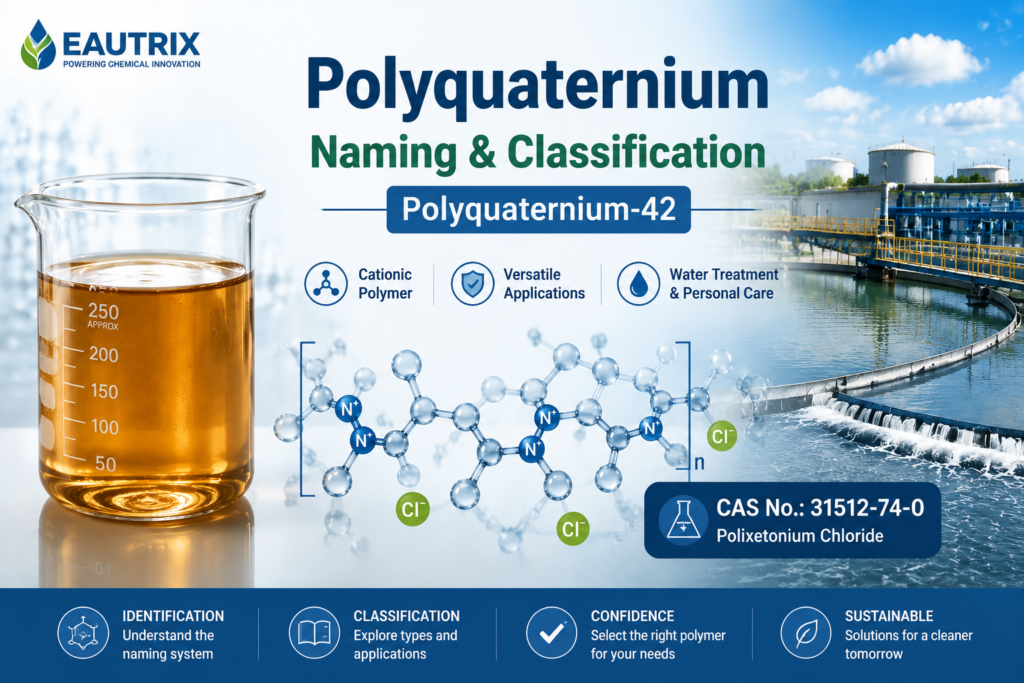
What Is Polyquaternium and Why Does It Have So Many Names?
If you have ever searched for a Polyquaternium product, you may have noticed something confusing: one material can appear under several different names.
A buyer may find terms like Polyquaternium-42, Polixetonium Chloride, or a chemical systematic name that looks almost impossible to remember.
So, what exactly is Polyquaternium?
Polyquaternium is a family name used mainly for quaternary ammonium polymers. These polymers contain positively charged nitrogen groups, also called quaternary ammonium groups, which give them unique properties such as:
- Strong interaction with negatively charged surfaces
- Excellent dispersion ability
- Algae control activity in certain structures
- Conditioning effects in personal care formulations
- Coagulation and flocculation performance
The word itself gives us the first clue:
Poly + quaternium
“Poly” means polymer, while “quaternium” refers to quaternary ammonium chemistry.
But here is where things become interesting.
Unlike traditional chemical naming systems, the number after Polyquaternium does not simply describe the molecular weight, concentration, or performance level.
That is why many people ask:
Why is Polyquaternium-42 numbered 42? Does Polyquaternium-60 mean it is stronger than Polyquaternium-10?
The short answer is: No.
The number is mainly an identification number assigned to different polymer structures.
Understanding the Polyquaternium Numbering System
The Polyquaternium numbering system was created to help organize different cationic polymers, especially those used in cosmetic and industrial applications.
Examples include:
- Polyquaternium-7
- Polyquaternium-10
- Polyquaternium-37
- Polyquaternium-42
- Polyquaternium-47
At first glance, these numbers may look like a ranking system.
However, they are not arranged from simple to advanced, weak to strong, or low performance to high performance.
For example:
Polyquaternium-10 and Polyquaternium-42 are not directly comparable simply because 42 is a larger number.
The number only identifies a specific polymer type that has been registered and recognized within the Polyquaternium naming system.
Think of it like a catalog number.
A product with catalog number 100 is not automatically better than a product with catalog number 20. It simply refers to a different item.
The same idea applies here.
Does the Polyquaternium Number Tell You the Chemical Structure?
This is one of the most common misunderstandings.
The answer is:
The Polyquaternium number gives identification, but it does not fully describe the chemistry.
To understand a Polyquaternium compound, you usually need additional information, including:
- Chemical name
- CAS number
- Monomer structure
- Molecular weight range
- Active content
- Application purpose
For example:
Polyquaternium-42 is associated with:
Chemical name:
Poly[oxyethylene(dimethyliminio)ethylene(dimethyliminio)ethylene dichloride]
CAS Number:
31512-74-0
Common chemical name:
Polixetonium Chloride
The Polyquaternium name is convenient for classification, while the chemical name provides a clearer description of the actual structure.
This is why professional buyers normally confirm materials using CAS numbers rather than relying only on trade names or short names.
How Are Different Polyquaternium Compounds Classified?
Polyquaternium compounds can be classified in several ways depending on their chemistry and application.
1. Classification by Polymer Structure
Different Polyquaternium materials are produced from different monomers.
These structural differences influence:
- Charge density
- Molecular size
- Solubility
- Viscosity
- Compatibility with other chemicals
For example:
Some Polyquaternium compounds are designed mainly for surface conditioning, while others show stronger antimicrobial or algae-control properties.
The polymer backbone matters.
A small structural change can completely change how a polymer behaves.
2. Classification by Application
Another practical method is classification by end use.
Personal Care Polyquaternium Compounds
Many Polyquaternium materials are widely used in:
- Hair conditioners
- Shampoos
- Skin care products
Their main function is usually related to:
- Improving smoothness
- Reducing static electricity
- Creating a conditioning film
For example, some well-known Polyquaternium materials in cosmetics are valued because they attach to hair surfaces.
Water Treatment Polyquaternium Compounds
Some Polyquaternium polymers have applications beyond cosmetics.
Their positive charges allow interaction with negatively charged microorganisms and particles.
Applications may include:
- Algae control
- Microbial control
- Clarification support
- Industrial water treatment
Polyquaternium-42 belongs to this category.
It is better known in industrial markets as Polixetonium Chloride.
You can learn more about its specific chemistry and applications in our guide:
What Is Polixetonium Chloride? A Complete Beginner’s Guide
3. Classification by Functional Properties
Polyquaternium compounds can also be grouped according to what they do.
Conditioning Polymers
These materials mainly improve surface properties.
Typical uses:
- Hair care
- Personal care formulations
Flocculating Polymers
Some cationic polymers help neutralize suspended particles.
They can assist with:
- Water clarification
- Solid-liquid separation
- Wastewater treatment
Related materials include:
PolyDADMAC and Polyamine: Understanding Cationic Polymers for Water Treatment
Antimicrobial or Algae-Control Polymers
Certain quaternary ammonium polymers interact with microorganisms.
Polyquaternium-42 is an example where the polymer structure provides algae-control performance.
Why Is Polyquaternium-42 Also Known as Polixetonium Chloride?
This question appears frequently because the two names look completely different.
Are they different chemicals?
No.
Polyquaternium-42 and Polixetonium Chloride refer to the same polymer.
The reason for the different names comes from different naming systems.
Polyquaternium-42 is a classification name.
It tells people:
“This material belongs to a specific group of quaternary ammonium polymers.”
Polixetonium Chloride is a chemical name used in industrial and regulatory contexts.
It identifies the specific substance.
Different industries often prefer different naming styles.
For example:
- Cosmetic formulators may use Polyquaternium terminology.
- Water treatment professionals may use Polixetonium Chloride.
- Regulatory documents usually rely on chemical names and CAS numbers.
This explains why one material can appear under multiple names.
For buyers, this can feel confusing at first.
But once you understand the naming logic, it becomes much easier.
Why CAS Numbers Matter More Than Product Names
Chemical names can vary.
Trade names can vary even more.
A supplier may describe a product using:
- Brand name
- Marketing name
- Industry nickname
- Chemical classification name
However, the CAS number provides a more reliable reference.
For example:
Polixetonium Chloride
CAS No.: 31512-74-0
When comparing suppliers, buyers should check:
- CAS number
- Active content
- Product specification
- Intended application
- Regulatory requirements
A 60% Polyquaternium-42 solution from two suppliers may look similar, but differences in polymer characteristics can affect actual performance.
Polyquaternium Classification Is About Understanding, Not Memorizing
Many people try to memorize every Polyquaternium number.
Honestly, that is not practical.
There are many different materials, and new applications continue to appear.
A better approach is to understand three questions:
1. What is the chemical structure?
This tells you the basic behavior of the polymer.
2. What is the CAS number?
This confirms the identity.
3. What is the application?
This tells you whether the material fits your project.
A polymer used in shampoo is not automatically suitable for industrial water treatment.
A polymer used for algae control may not work as a cosmetic conditioner.
The name is only the beginning.
Choosing the Right Polyquaternium Compound for Your Application
When selecting a Polyquaternium material, consider:
- Required performance
- Application environment
- Compatibility with other chemicals
- Regulatory requirements
- Concentration and packaging
- Supplier technical support
For industrial buyers, especially those purchasing Polyquaternium-42, it is important to discuss:
- Active content
- Viscosity range
- Storage conditions
- Application dosage
- Technical documentation
A good supplier should provide more than a product name.
They should help you understand whether the chemistry matches your actual system.
Frequently Asked Questions About Polyquaternium Naming
1. What does the number in Polyquaternium mean?
The number identifies a specific Polyquaternium polymer type. It does not represent concentration, strength, molecular weight, or quality ranking.
2. Is Polyquaternium-42 the same as Polixetonium Chloride?
Yes. Polyquaternium-42 and Polixetonium Chloride refer to the same polymer structure, with CAS No. 31512-74-0.
3. Are all Polyquaternium compounds used for water treatment?
No. Many Polyquaternium compounds are used in personal care products, while some specific structures have industrial applications such as algae control and water treatment.
4. How can I identify a Polyquaternium compound correctly?
The most reliable way is to check the CAS number, chemical name, specification sheet, and intended application rather than relying only on the Polyquaternium name.
5. What is the difference between Polyquaternium-42 and other Polyquaternium compounds?
The difference comes from their polymer structure, charge characteristics, and intended applications. Polyquaternium-42 is recognized for industrial uses including algae control and microbial management.