
GET IN TOUCH
Ask For Sample?
What Does Polyquaternium-42 Mean? Understanding the Naming System
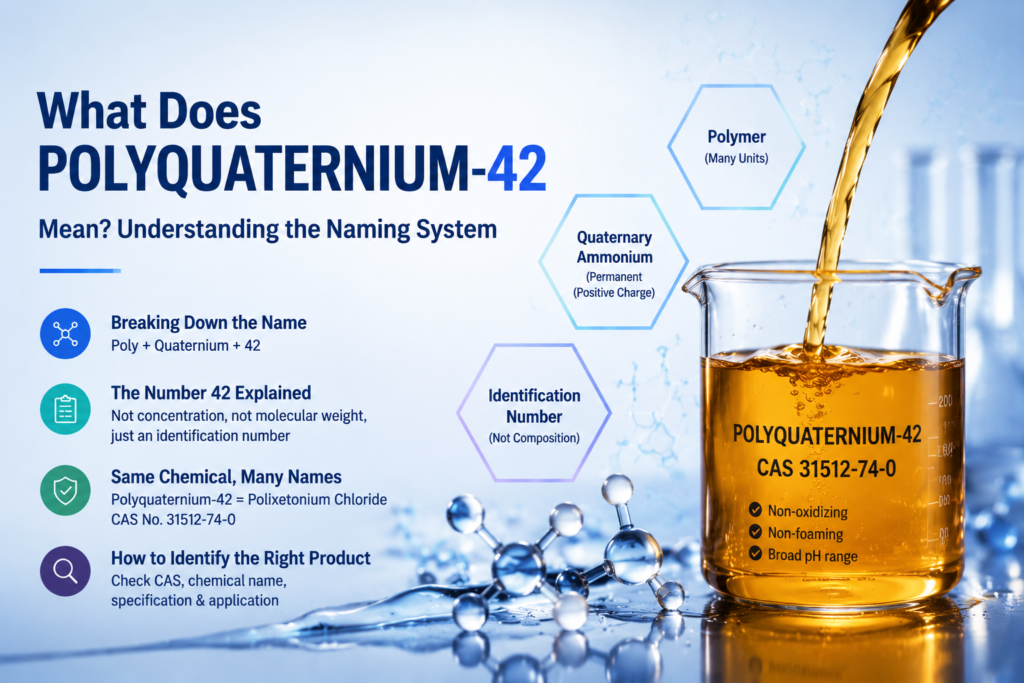
When people first encounter the name Polyquaternium-42, the reaction is often the same:
“Is this a product name, a chemical formula, or just another industry code?”
And honestly, that confusion makes sense.
Chemical names are not always created with buyers in mind. They are usually designed to describe chemical structures, registration systems, or industry classifications. A name like Polyquaternium-42 looks simple, but every part of it carries a specific meaning.
For professionals working with water treatment chemicals, pool chemicals, or industrial biocides, understanding this naming system can save a lot of trouble.
After all, buying the wrong material because two names look similar is not a small mistake. It can affect formulation performance, regulatory documents, and even customer approval.
So, what exactly does Polyquaternium-42 mean?
Let’s break it down.
Why Does Polyquaternium-42 Sound So Complicated?
The word Polyquaternium belongs to a special naming system mainly used for cationic polymers, especially in cosmetic, personal care, and specialty chemical industries.
At first glance, many people assume:
“Polyquaternium-42 must be the 42nd version of the same chemical.”
But that is not how it works.
The number 42 does not mean the polymer contains 42 repeating units, nor does it represent molecular weight, concentration, or performance level.
Instead, it is simply an identification number assigned to a specific polymer under the Polyquaternium naming system.
Think of it like a catalog number.
A book with ISBN number 978-xxx does not tell you how many pages the book has. It simply identifies that specific book.
Polyquaternium numbers work in a similar way.
Breaking Down the Name “Polyquaternium-42”
The name can be divided into two parts:
Poly + Quaternium + 42
Each part tells us something different.
What Does “Poly” Mean in Polyquaternium?
The prefix poly- comes from the Greek word meaning “many.”
In chemistry, it usually indicates a polymer, which means a large molecule made from many smaller repeating units called monomers.
For example:
A single monomer is like one Lego block.
A polymer is the complete structure built from thousands of connected Lego blocks.
Polyquaternium-42 is therefore not a small molecule. It is a polymeric material with many repeating chemical units.
This polymer structure gives it characteristics that are very different from simple quaternary ammonium compounds.
For example:
- longer-lasting surface interaction
- lower volatility
- higher molecular size
- different adsorption behavior
This is one reason polymeric quaternary ammonium compounds are often selected for applications requiring longer-lasting performance.
Understanding “Quaternium” in Chemical Names
The word quaternium refers to a quaternary ammonium structure.
A quaternary ammonium compound contains a nitrogen atom bonded with four organic groups, creating a permanent positive charge.
This positive charge is the key feature.
Because of this charge, quaternary ammonium materials can interact strongly with negatively charged surfaces.
Examples include:
- microbial cell surfaces
- suspended particles
- organic matter
- certain mineral surfaces
This cationic nature explains why many quaternary ammonium compounds are used in:
- antimicrobial applications
- algae control
- conditioning agents
- flocculation processes
However, not all quaternary ammonium compounds behave the same way.
A small molecule like benzalkonium chloride (BKC) and a polymeric quaternary compound like Polyquaternium-42 may both contain quaternary ammonium groups, but their physical behavior can be very different.
Does the Number 42 Represent Chemical Composition?
This is one of the most common misunderstandings.
The answer is:
No.
The “42” in Polyquaternium-42 is not:
- 42% active content
- 42 repeating molecules
- molecular weight 42
- concentration level
- performance rating
It is simply the assigned number in the Polyquaternium classification system.
Similar examples include:
- Polyquaternium-6
- Polyquaternium-7
- Polyquaternium-10
- Polyquaternium-37
- Polyquaternium-42
Each number represents a different polymer type.
The numbering system helps industries distinguish between different cationic polymers without using extremely long chemical names every time.
Why Are Polyquaternium Numbers Assigned?
The main reason is practicality.
Some polymer chemical names are extremely long.
For example, Polyquaternium-42 is also known by its chemical name:
Poly[oxyethylene(dimethyliminio)ethylene(dimethyliminio)ethylene dichloride]
That name provides structural information, but imagine using it in everyday communication:
“Please send us your quotation for Poly[oxyethylene(dimethyliminio)…]”
It is not exactly convenient, right?
The Polyquaternium naming system creates a shorter reference.
Instead of memorizing a long chemical description, industries can use:
Polyquaternium-42
The same concept exists in many industries:
- polymers have trade names
- pharmaceuticals have generic names
- chemicals have CAS numbers
- cosmetic ingredients have INCI names
Different naming systems solve different problems.
Where Does Polyquaternium-42 Fit in the Polyquaternium Family?
The Polyquaternium family includes many different cationic polymers.
They are not interchangeable.
For example:
| Name | General Characteristics |
|---|---|
| Polyquaternium-6 | Highly cationic polymer, often used for conditioning and flocculation |
| Polyquaternium-7 | Copolymer used mainly in personal care formulations |
| Polyquaternium-10 | Cellulose-based cationic polymer |
| Polyquaternium-37 | Cationic polymer with thickening properties |
| Polyquaternium-42 | Specific polymeric quaternary ammonium compound |
Although they share the same “Polyquaternium” family name, their molecular structures and applications can be completely different.
This is why buyers should never select a material only based on the Polyquaternium number.
Is Polyquaternium-42 the Same as Polixetonium Chloride?
This is where many industrial buyers become confused.
The short answer is:
Yes, Polyquaternium-42 is commonly used as another name for Polixetonium Chloride.
Polixetonium Chloride is the chemical identity commonly used in industrial and regulatory contexts.
Polyquaternium-42 is the ingredient naming designation.
The relationship can be summarized as:
Polixetonium Chloride = Polyquaternium-42
Other names may include:
- Poly[oxyethylene(dimethyliminio)ethylene(dimethyliminio)ethylene dichloride]
- WSCP
- CAS No. 31512-74-0
However, buyers should always confirm through:
- CAS number
- specification sheet
- active content
- supplier documentation
because commercial names can sometimes vary between regions.
For a detailed comparison, you can also read:
Is Polyquaternium-42 the Same as Polixetonium Chloride?
Different Names Used Around the World
One chemical can have several names depending on who is using it.
A researcher may prefer:
Poly[oxyethylene(dimethyliminio)ethylene(dimethyliminio)ethylene dichloride]
A cosmetic database may list:
Polyquaternium-42
An industrial supplier may use:
Polixetonium Chloride
A commercial product may have a brand name.
This is common in the chemical industry.
The challenge is not that there are too many names.
The challenge is knowing how those names connect.
That is why CAS numbers are so important.
For Polyquaternium-42:
CAS No.: 31512-74-0
acts like a chemical fingerprint.
Because one chemical can appear under several different names, understanding the terminology is only the first step. Buyers also need to know the basic properties, physical form, and typical applications of the material before making a purchasing decision.
For a complete introduction covering the chemical identity, characteristics, and industrial uses of this polymeric quaternary ammonium compound, please see:
What Is Polixetonium Chloride? A Complete Beginner’s Guide
How Buyers Should Identify Polyquaternium-42 Correctly
When sourcing Polyquaternium-42, do not rely only on the product name.
A professional buyer should check:
1. CAS Number
Confirm:
31512-74-0
2. Chemical Name
Check whether the supplier provides the correct chemical identity.
3. Active Content
Commercial products are usually supplied as concentrated solutions rather than pure polymer.
For example, many industrial grades are supplied around:
- 60% active solution
4. Application Data
Ask whether the grade is suitable for:
- algae control
- cooling water treatment
- industrial biocide applications
- other specialty uses
A similar-looking polymer may not deliver the same performance.
Why Naming Systems Matter in Industrial Applications
Names are not just words.
They influence:
- purchasing decisions
- regulatory communication
- technical documentation
- customer approval
- product development
Imagine ordering a spare part for a machine but only describing its color.
It may look right, but the internal design could be completely different.
Chemical sourcing works the same way.
A correct name helps start the conversation.
A CAS number, specification sheet, and technical understanding complete it.
Frequently Asked Questions
1. What does Polyquaternium-42 mean?
Polyquaternium-42 is a naming designation for a specific cationic polymer. The number 42 is an identification number and does not represent concentration, molecular weight, or chemical formula.
2. Is Polyquaternium-42 the same as Polixetonium Chloride?
Yes. Polyquaternium-42 is commonly used as an ingredient name for Polixetonium Chloride, which has CAS No. 31512-74-0.
3. Does Polyquaternium-42 mean 42% active ingredient?
No. The number 42 is only part of the naming system. Commercial products may have different active concentrations, such as 60% solutions.
4. How can I confirm I am buying the correct Polyquaternium-42?
Always check the CAS number, chemical name, technical specification, and supplier documentation before purchase.
5. Why does Polyquaternium-42 have multiple names?
Different industries use different naming systems. Chemical names, INCI names, trade names, and CAS numbers each serve different purposes.