
Outline
- Understanding Polixetonium Chloride and Why Proper Storage Matters
- Recommended Storage Conditions for Polixetonium Chloride
- Packaging Options and Their Role in Product Stability
- Safe Handling Practices During Loading, Unloading, and Use
- Transportation Considerations for Global Buyers
- Common Storage Mistakes That May Affect Product Quality
- How Suppliers Can Support Better Chemical Management
- Frequently Asked Questions About Storing and Handling Polixetonium Chloride
Storage and Handling of Polixetonium Chloride: A Practical Guide for Global Buyers
Polixetonium Chloride is a specialized cationic polymer widely used in industrial water treatment, cooling water systems, metalworking fluids, and pool algae control applications. As more companies look for reliable non-oxidizing biocides with low foaming characteristics, the demand for Polixetonium Chloride continues to grow.
However, buying a high-quality product is only the first step. Have you ever considered what happens after the drums arrive at your warehouse? A chemical can meet all specifications when it leaves the factory, but improper storage or handling may create unnecessary problems later.
The good news? Polixetonium Chloride is relatively easy to store and handle when a few practical guidelines are followed. Understanding its physical characteristics, packaging requirements, and handling recommendations can help buyers maintain product performance from delivery to final application.
This guide explains the key points that international buyers, distributors, and end users should know when managing Polixetonium Chloride supplies.
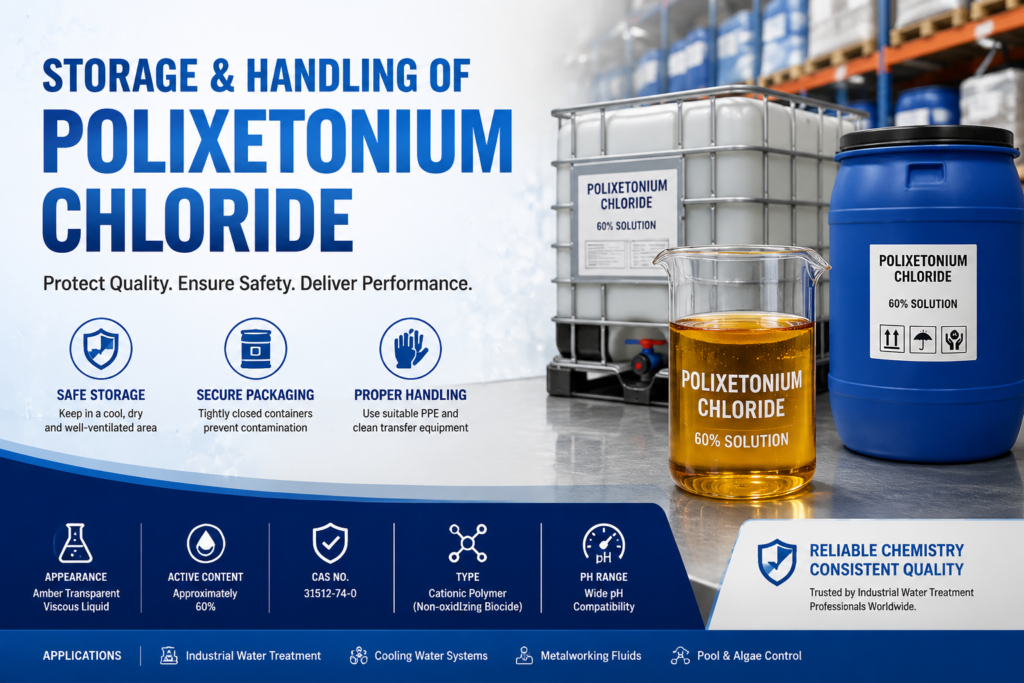
Understanding Polixetonium Chloride and Why Storage Matters
Polixetonium Chloride, also known as Polyquaternium-42 or WSCP (Water Soluble Cationic Polymer), is a water-soluble cationic polymer supplied mainly as a concentrated liquid solution.
Typical commercial products are supplied as:
- Active content: approximately 60%
- Appearance: amber transparent viscous liquid
- CAS No.: 31512-74-0
- Non-oxidizing biocide
- Compatible with a wide pH range
Because it is a concentrated polymer solution, its physical properties are different from many traditional liquid chemicals. It is not a thin, water-like liquid. Instead, it has noticeable viscosity, similar to many specialty polymer products.
Think about it this way: storing Polixetonium Chloride is not like storing ordinary water treatment chemicals. It is closer to managing a specialty ingredient used in a technical formulation. Small details — temperature, container condition, contamination control — can influence how smoothly the product performs.
Why does this matter?
For industrial users, inconsistent storage conditions may lead to:
- Changes in viscosity
- Difficult pumping or transferring
- Increased handling time
- Potential contamination risks
- Problems during formulation
Proper storage protects not only the chemical itself but also your production schedule and customer satisfaction.
Recommended Storage Conditions for Polixetonium Chloride
The ideal storage environment for Polixetonium Chloride is simple: keep it clean, dry, and temperature controlled whenever possible.
1. Store in a Cool and Dry Area
Polixetonium Chloride should generally be stored in a covered warehouse away from direct sunlight and extreme weather conditions.
Recommended practices include:
- Avoid prolonged exposure to high temperatures
- Protect containers from freezing conditions
- Keep storage areas dry and well ventilated
- Avoid placing containers directly on wet floors
Temperature is one of the most important factors.
Like many polymer solutions, Polixetonium Chloride may experience changes in viscosity when exposed to very high or very low temperatures. For example, colder conditions can make the liquid thicker, which may affect pumping and transfer operations.
A warmer environment may reduce viscosity, but excessive heat over a long period is not recommended because it may affect long-term product stability.
The simple rule is: avoid extremes.
2. Keep Containers Tightly Closed
Once the original container is opened, maintaining good sealing practices becomes important.
A properly closed container helps prevent:
- Dust contamination
- Foreign materials entering the product
- Accidental mixing with incompatible chemicals
Although Polixetonium Chloride is a stable aqueous solution, contamination from external sources can create problems during sensitive applications.
For example, a customer producing specialty water treatment formulations may require consistent performance batch after batch. A small amount of contamination may not be visible, but it can influence the final product quality.
3. Avoid Contact With Strong Anionic Materials
Because Polixetonium Chloride is a cationic polymer, compatibility with other chemicals should always be considered.
Strong anionic compounds may interact with cationic polymers and potentially reduce performance.
During storage:
- Keep Polixetonium Chloride separated from strong anionic chemicals
- Avoid using the same transfer equipment without proper cleaning
- Label storage areas clearly
This is especially important for distributors handling multiple water treatment chemicals in the same warehouse.
Packaging Options and Their Role in Product Stability
The packaging used for Polixetonium Chloride is not just about transportation convenience. It also plays an important role in maintaining product quality.
Common industrial packaging includes:
- 25 L plastic containers
- 200 L plastic drums
- 1000 L IBC totes
For international shipments, IBC totes and plastic drums are commonly selected because they provide a good balance between handling efficiency and cost control.
Plastic Drums
Plastic drums are suitable for:
- Smaller production facilities
- Trial orders
- Regional distributors
- Customers requiring flexible inventory management
Advantages include:
- Easy handling
- Lower initial commitment
- Convenient storage
IBC Tote Packaging
IBC totes are often preferred for larger industrial users.
Advantages include:
- Reduced packaging cost per kilogram
- Easier bulk transfer
- Lower labor requirements
- Better warehouse efficiency
For companies using Polixetonium Chloride continuously in production, IBC packaging can significantly simplify material management.
When receiving bulk packaging, buyers should check:
- Container integrity
- Seal condition
- Label information
- Batch number
- Production date
- Appearance of the product
Safe Handling Practices During Daily Operations
Handling Polixetonium Chloride is straightforward, but professional chemical management habits are always recommended.
Wear Appropriate Personal Protection Equipment
During transfer operations, operators should use suitable protective equipment according to workplace safety requirements.
Typical precautions include:
- Protective gloves
- Safety glasses
- Suitable protective clothing
The goal is simple: avoid unnecessary skin and eye contact.
Even chemicals considered relatively easy to handle should be treated responsibly.
Use Clean Transfer Equipment
One common mistake is using the same pumps, hoses, or containers for different chemical products without proper cleaning.
For Polixetonium Chloride, dedicated or well-cleaned equipment is recommended.
Why?
Because residual chemicals from previous materials may create compatibility problems. This is particularly important when equipment has previously handled strong anionic polymers.
A few minutes spent cleaning equipment can prevent hours of troubleshooting later.
Mix According to Application Requirements
Polixetonium Chloride is commonly used as a concentrated solution. Before application, users should follow their own formulation procedures or supplier recommendations.
Avoid unnecessary dilution or mixing with unknown materials.
In water treatment applications, performance depends not only on the chemical itself but also on:
- Water chemistry
- System conditions
- Dosage control
- Contact time
Transportation Considerations for Global Buyers
For international buyers, transportation planning is an important part of chemical sourcing.
Polixetonium Chloride is typically shipped as a liquid chemical product in industrial packaging.
Before shipment, buyers should confirm:
- Packaging requirements
- Container compatibility
- Shipping documentation
- Import regulations in the destination country
Working with an experienced supplier can make this process much smoother.
A reliable supplier should provide documents such as:
- Certificate of Analysis (COA)
- Safety Data Sheet (SDS)
- Product specification
- Packaging information
For first-time buyers, asking these questions before shipment can prevent unexpected delays.
You may also consider discussing:
- Expected storage period
- Recommended warehouse conditions
- Handling procedures after arrival
Good chemical supply is not only about sending a product from point A to point B. It is about making sure the product performs correctly after it arrives.
Common Storage Mistakes That May Affect Product Quality
Even experienced chemical buyers sometimes overlook simple storage details.
Here are several common mistakes:
Mistake 1: Leaving Containers Outdoors
Outdoor storage may seem convenient, especially when warehouse space is limited.
However, sunlight, rain, and temperature fluctuations can gradually affect packaging and product conditions.
Whenever possible, store Polixetonium Chloride indoors or under proper protection.
Mistake 2: Ignoring Temperature Changes
A container stored in winter conditions may behave differently from one stored in summer conditions.
Before use, allow the product to reach a suitable working temperature if necessary.
Mistake 3: Mixing Different Chemical Residues
Using contaminated pumps or containers is one of the easiest ways to create avoidable problems.
Clean equipment matters.
Mistake 4: Buying Without Considering Inventory Planning
Some buyers focus only on purchase price and overlook storage time.
For specialty chemicals, a reasonable inventory plan helps maintain quality and reduce unnecessary warehouse pressure.
A lower price is not always a better deal if handling becomes difficult later.
How Suppliers Can Support Better Chemical Management
A professional Polixetonium Chloride supplier does more than provide drums or IBC totes.
Good suppliers help customers understand:
- Product characteristics
- Storage recommendations
- Application limitations
- Packaging options
- Technical considerations
At Eautrix, we believe successful chemical supply is built around communication.
Before shipment, customers can discuss:
- Required packaging size
- Target application
- Expected consumption volume
- Storage environment
This approach helps buyers select a suitable product solution rather than simply purchasing a chemical container.
For buyers evaluating suppliers, our article How to Evaluate a Polixetonium Chloride Manufacturer provides additional points to consider when comparing technical capability, quality control, and service support.
If you are planning your first purchase, you may also find How to Request Samples of Polixetonium Chloride useful before placing a larger order.
Frequently Asked Questions About Storage and Handling of Polixetonium Chloride
1. What is the recommended storage temperature for Polixetonium Chloride?
Polixetonium Chloride should be stored in a cool, dry place and protected from extreme temperatures. Avoid prolonged exposure to excessive heat or freezing conditions to maintain stable physical properties.
2. Can Polixetonium Chloride be stored in IBC totes?
Yes. IBC totes are commonly used for bulk storage and transportation of Polixetonium Chloride because they provide efficient handling and good protection during industrial operations.
3. Does Polixetonium Chloride require special handling procedures?
Polixetonium Chloride is relatively easy to handle, but operators should use proper protective equipment, avoid contamination, and follow workplace chemical safety procedures.
4. Can Polixetonium Chloride be stored with other water treatment chemicals?
It can be stored in the same facility, but strong anionic chemicals and incompatible materials should be separated to prevent unwanted interactions.
5. How long can Polixetonium Chloride be stored?
Under recommended storage conditions, the product typically has a shelf life of 36 months. The storage period depends on packaging conditions, temperature, and warehouse management. Properly stored material in sealed containers can maintain good quality for an extended period. Buyers should always check supplier recommendations and batch information.