
Outline
- Why Long-Term Value Matters More Than Initial Price
- What Does Long-Term Value Mean for Water Treatment Chemicals?
- How Polixetonium Chloride Creates Lasting Performance
- Lower Maintenance Costs Through Stable Biological Control
- Longer Equipment Life with Non-Oxidizing Chemistry
- Reduced Chemical Consumption Over Time
- Fewer Operational Interruptions and Cleaner Systems
- Real Industries That Benefit from Long-Term Value
- How to Evaluate Long-Term Value Before Choosing a Supplier
- Final Thoughts
- FAQs
How Polixetonium Chloride Delivers Long-Term Value ?
When purchasing industrial water treatment chemicals, it’s easy to focus on one number—the price per kilogram.
But experienced buyers know something important: the lowest purchase price rarely leads to the lowest operating cost.
A chemical that costs slightly more yet lasts longer, performs more consistently, and reduces maintenance often delivers a much better return over months or years.
That’s exactly why many industrial water treatment professionals continue choosing Polixetonium Chloride.
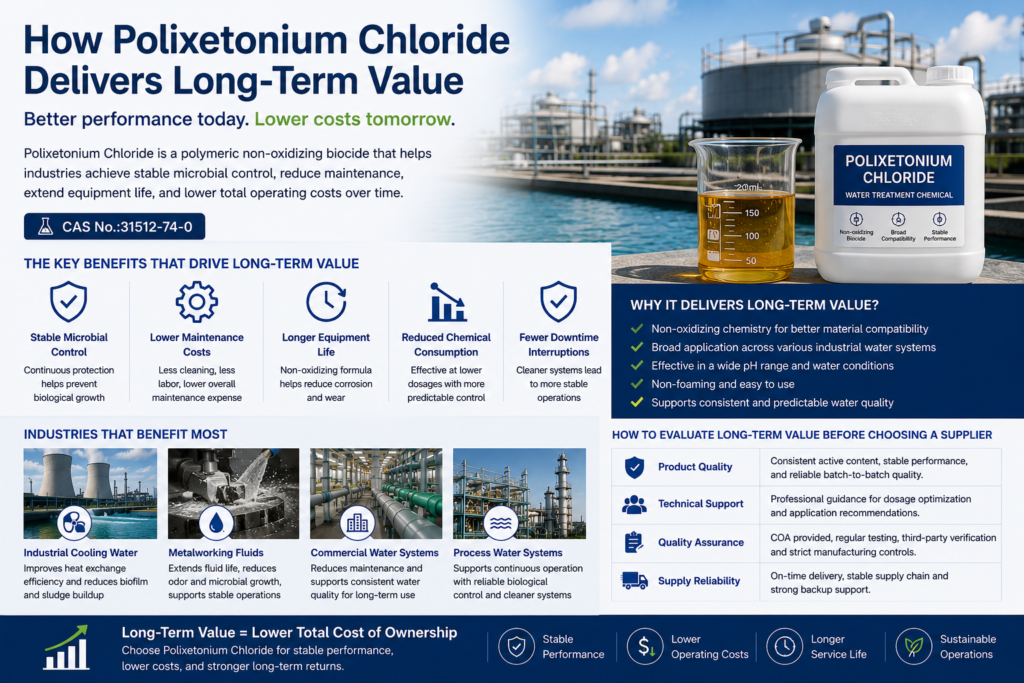
Rather than simply killing microorganisms, this polymeric non-oxidizing biocide helps operators maintain cleaner systems, reduce downtime, and extend equipment life. The result isn’t just better water quality—it’s measurable long-term value.
Let’s look at where that value really comes from.
Why Long-Term Value Matters More Than Initial Price
Imagine two products.
- Product A costs 10% less.
- Product B costs a little more.
After one year:
- Product A required frequent re-treatment.
- Heat exchangers fouled more quickly.
- Pumps required additional cleaning.
- Production stopped several times for maintenance.
Meanwhile, Product B kept the system stable with fewer interventions.
Which product actually saved money?
For industrial cooling water, metalworking fluids, and other recirculating systems, the true cost includes much more than chemical purchases.
It also includes:
- Labor
- Equipment maintenance
- Water consumption
- Energy efficiency
- Production downtime
- Replacement parts
- Cleaning frequency
This broader perspective is where Polixetonium Chloride often demonstrates its strongest advantages.
What Does Long-Term Value Mean for Water Treatment Chemicals?
Long-term value isn’t a marketing phrase.
It can usually be measured through operational indicators such as:
- Stable microbial control
- Reduced slime formation
- Longer cleaning intervals
- Lower maintenance expenses
- Extended equipment lifespan
- Predictable chemical performance
- Lower total cost of ownership (TCO)
Instead of asking:
“How much does this drum cost?”
A better question is:
“How much will this chemical cost me over the next two years?”
That’s the mindset adopted by experienced purchasing managers.
How Polixetonium Chloride Creates Lasting Performance ?
Polixetonium Chloride is a polymeric quaternary ammonium compound designed as a non-oxidizing biocide.
Unlike oxidizing products that are consumed rapidly during reactions, polymeric biocides generally provide more sustained microbial control under properly managed operating conditions.
Some practical advantages include:
- Broad compatibility with many industrial water systems
- Non-foaming performance
- Stable operation across a wide pH range
- Lower corrosion risk than many oxidizing biocides
- Continuous suppression of biological growth through routine dosing
Rather than causing sharp peaks and valleys in microbial activity, operators often achieve a more stable biological balance.
That consistency becomes valuable over time.
Lower Maintenance Costs Through Stable Biological Control
One of the biggest hidden expenses in industrial water systems isn’t chemical cost.
It’s maintenance.
Microbial slime can cause:
- Heat transfer loss
- Blocked pipelines
- Reduced flow rates
- Increased pump load
- Biofilm accumulation
- Higher energy consumption
When microorganisms remain under control, these problems develop much more slowly.
Facilities may benefit from:
- Longer intervals between cleanings
- Less manual labor
- Lower maintenance budgets
- Improved operating efficiency
The savings often exceed the additional cost of using a higher-quality treatment program.
Longer Equipment Life with Non-Oxidizing Chemistry
Equipment replacement is expensive.
Cooling towers, pumps, heat exchangers, and piping systems represent major capital investments.
Because Polixetonium Chloride is a non-oxidizing biocide, it generally avoids many of the aggressive oxidative reactions associated with chlorine-based treatments.
When properly incorporated into a complete water treatment program, operators may experience:
- Reduced corrosion risk
- Better protection for metal components
- Lower stress on seals and elastomers
- Longer equipment service life
Extending equipment life by even a few years can generate significant savings.
Reduced Chemical Consumption Over Time
Many facilities assume cheaper chemicals automatically reduce costs.
Not necessarily.
If a product requires:
- higher dosing,
- more frequent additions,
- emergency shock treatments,
- or repeated corrective actions,
its annual chemical consumption may actually increase.
Polixetonium Chloride is commonly selected because operators can often maintain biological control through consistent preventive dosing rather than reacting to recurring contamination.
This creates:
- More predictable inventory management
- Easier purchasing plans
- Reduced emergency procurement
- More stable operating costs
Fewer Operational Interruptions and Cleaner Systems
Downtime is one of the most expensive costs in manufacturing.
Unexpected shutdowns may involve:
- Lost production
- Overtime labor
- Equipment cleaning
- Product waste
- Delivery delays
Microbiological contamination is rarely dramatic.
Instead, it slowly builds until performance declines.
Stable biological control helps reduce the likelihood of those gradual performance losses becoming major operational problems.
Many maintenance teams appreciate this simply because the system becomes more predictable.
And predictability has value.
Real Industries That Benefit from Long-Term Value
Many industries prioritize lifecycle cost over purchase price.
Typical applications include:
Industrial Cooling Water
Stable microbial control helps improve heat exchange efficiency while reducing biofilm-related maintenance.
Metalworking Fluids
Routine biocide treatment can help extend fluid service life, reduce odor caused by microbial growth, and support more stable machining operations.
Commercial Water Systems
Facilities operating continuously often benefit from reduced maintenance requirements and more consistent water quality.
Process Water Systems
Plants seeking long operating cycles frequently value consistent biological control over short-term chemical savings.
How to Evaluate Long-Term Value Before Choosing a Supplier
Not every Polixetonium Chloride supplier offers the same level of value.
Instead of comparing only price, consider evaluating:
Product Quality
- Active content consistency
- Batch-to-batch stability
- Reliable viscosity
- Transparent quality documentation
Technical Support
Can the supplier help optimize dosage?
Can they explain application differences?
Can they provide technical recommendations based on your operating conditions?
Quality Assurance
Look for suppliers that provide:
- Certificate of Analysis (COA)
- Regular production testing
- Third-party verification where appropriate
- Consistent manufacturing controls
Supply Reliability
Reliable delivery is part of long-term value.
A delayed shipment can easily cost far more than a small price difference.
Final Thoughts
Long-term value isn’t created by buying the cheapest chemical.
It’s created by reducing the total cost of operating your water system.
Polixetonium Chloride helps achieve that goal through:
- Stable microbial control
- Lower maintenance requirements
- Reduced downtime
- Longer equipment life
- Predictable operating costs
- Reliable long-term performance
For many industrial users, these operational benefits become far more important than the initial purchase price.
When evaluating suppliers, look beyond the quotation.
Ask how their product can help reduce your costs over the next several years—not just the next purchase order.
Frequently Asked Questions
1. Why is long-term value more important than product price?
A lower-priced chemical may require higher dosage, more frequent cleaning, or increased maintenance. Evaluating the total cost of ownership provides a more accurate picture of overall operating costs.
2. Does Polixetonium Chloride help reduce maintenance frequency?
In many properly managed water treatment programs, stable microbial control can reduce slime accumulation and extend intervals between system cleanings.
3. Can Polixetonium Chloride help extend equipment life?
Because it is a non-oxidizing biocide, it is generally less aggressive toward system materials than oxidizing treatments, which may contribute to longer equipment service life when used appropriately.
4. Which industries benefit most from its long-term value?
Industrial cooling water systems, metalworking fluid applications, commercial water systems, and various process water operations commonly use Polixetonium Chloride where consistent biological control is important.
5. How should buyers compare different Polixetonium Chloride suppliers?
Look beyond price alone. Compare product consistency, active content, quality documentation, technical support, manufacturing reliability, and supply stability to assess the supplier’s overall long-term value proposition.