
GET IN TOUCH
Ask For Sample?
How to Evaluate Polixetonium Chloride Performance ?
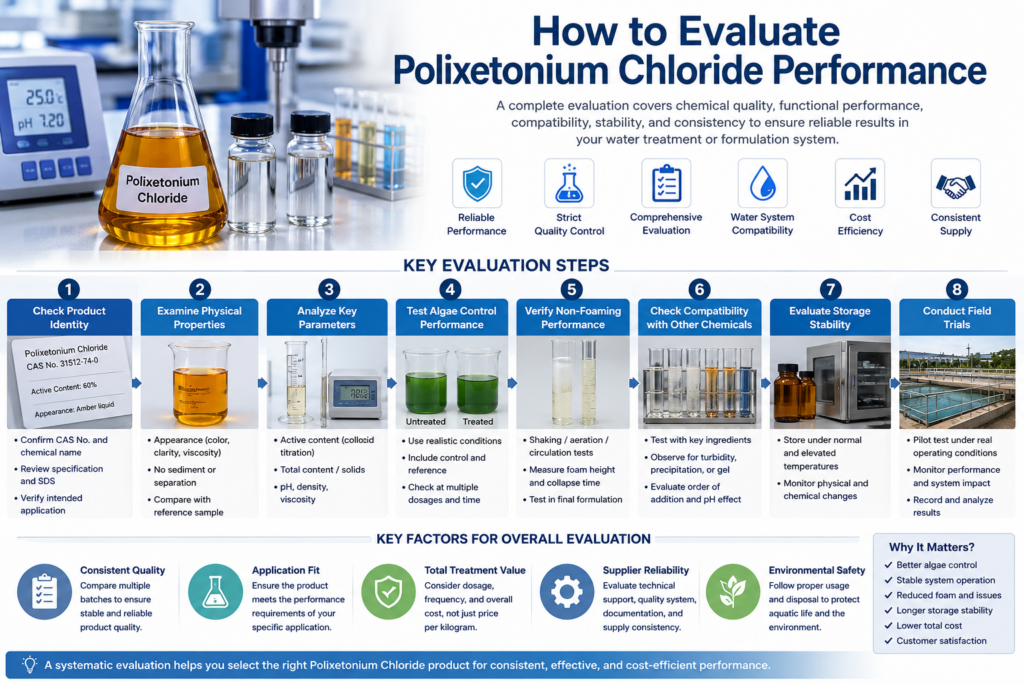
Polixetonium Chloride can look deceptively simple.
It usually arrives as an amber, transparent, viscous liquid. You check the certificate of analysis, confirm the concentration, and perhaps run a quick laboratory test. Everything seems fine. Yet once the material enters a swimming pool, cooling system, metalworking fluid, or another water-based process, its actual performance may tell a more complicated story.
Two samples can carry the same product name and the same claimed concentration but behave quite differently. One may control algae reliably, remain non-foaming, and retain its physical stability during storage. Another may pass the basic specification yet deliver weaker results, create compatibility problems, or vary noticeably from batch to batch.
So, how should a buyer evaluate Polixetonium Chloride performance without relying on a single number?
The key is to examine three connected areas:
- Chemical and physical quality
- Functional performance in the intended system
- Consistency across batches, storage conditions, and operating environments
A strong evaluation does not ask only, “Does this sample meet the specification?” It asks a more useful question: “Will this product continue to perform under the conditions that matter to my formulation or process?”
Let’s break that down.
What Does “Good Performance” Actually Mean?
Polixetonium Chloride, CAS No. 31512-74-0, is a cationic polymer used in several antimicrobial and water-treatment applications. Public chemical records identify it as a polymeric substance, while US regulatory sources list it in connection with pesticidal and antimicrobial uses.
But “performance” is not one universal property.
For a pool chemical formulator, good performance may mean effective algae control without foam, metal staining, or excessive interference with routine treatment chemicals.
For an industrial water-treatment company, it may mean stable activity across changing pH, temperature, organic load, and circulation conditions.
For a metalworking-fluid producer, it may involve compatibility with the fluid system, preservation performance, and an acceptable effect on emulsion stability.
For a chemical distributor, performance may be judged by something less dramatic but equally important: whether every shipment looks, tests, stores, and functions like the previous one.
That distinction matters. A product should be evaluated in the context of its intended use—not through a generic pass-or-fail test.
Start with the Product’s Identity
Before discussing performance, confirm that the material is what the supplier says it is.
Polixetonium Chloride is associated with CAS No. 31512-74-0. It may also appear under names connected with Polyquaternium-42 or its longer chemical description. Because commercial names are not always used consistently, the CAS number and chemical identity should be reviewed alongside the product specification and safety data sheet.
Identity checks may include:
- Product name and chemical name
- CAS number
- Manufacturer’s product code
- Active concentration range
- Total content or solids-related value
- Typical pH, viscosity, and density
- Safety and regulatory documentation
- Intended application
This may sound basic, but naming confusion is surprisingly common in cationic polymer markets. Products with related functions may be described using similar commercial terms even though their structures, concentrations, or performance profiles are not identical.
A reliable supplier should be able to explain the product clearly rather than simply forwarding a certificate with a familiar name printed at the top.
Examine Appearance Before Reaching for an Instrument
Visual inspection is not a complete test, but it is one of the fastest ways to notice an abnormal batch.
A typical concentrated Polixetonium Chloride product may appear as an amber, transparent, viscous liquid. The exact shade can vary slightly, especially when concentration, raw materials, or production conditions differ. Still, the material should normally appear reasonably uniform.
Look for:
- Unexpected cloudiness
- Suspended particles
- Sediment at the bottom
- Layer separation
- Gel-like lumps
- Unusual darkening
- Large differences between batches
- A sudden change in flow behavior
A small color difference does not automatically signal poor quality. Color alone is rarely enough to judge functional performance. However, a major change—especially when accompanied by turbidity, sediment, or altered viscosity—deserves investigation.
Here is the practical point: visual appearance works best as a consistency check.
Keep a properly stored reference sample from an approved batch. When a new shipment arrives, compare the two under similar lighting and at a similar temperature. That simple habit can reveal changes that may not stand out when each batch is viewed on its own.
Active Ingredient and Solid Content Are Not the Same Thing
Concentration is often treated as the central measure of Polixetonium Chloride quality. It is important, of course, but buyers should first understand what the reported concentration represents.
A specification may list:
- Active Ingredient
- Solid content
- Assay
- Nonvolatile matter
These terms should not be assumed to mean exactly the same thing.
Active Ingredient is intended to represent the portion associated with the functional active substance, based on the supplier’s defined analytical approach. Solid Content or solids-related measurements may include other nonvolatile components present in the product.
That means a product described as “60% active” should not automatically be considered identical to another product described as “60% solids.”
The numerical value may look the same. The analytical meaning may not.
This is one of the most important questions to ask a supplier:
What exactly does the reported percentage measure, and which test principle is used?
For Polixetonium Chloride, active ingredient may be evaluated through a charge-based analytical method such as colloid titration. The basic principle is that the cationic polymer reacts with an oppositely charged standard material. The measured charge interaction is then used to assess the active polymer content.
A buyer does not necessarily need every confidential laboratory detail. Still, the supplier should be able to explain whether the value reflects active charge, total nonvolatile content, or another property.
Otherwise, comparisons between suppliers may be misleading.
Why Active Ingredient Alone Cannot Predict Results
A higher reported active ingredient usually means more concentrated material, but it does not guarantee better practical performance.
Actual results may also be affected by:
- Polymer structure
- Molecular-weight distribution
- Charge characteristics
- Residual raw materials
- Production control
- Product age
- Storage history
- Water chemistry
- Contamination level
- Interactions with other ingredients
Think of it like coffee. Two cups may contain the same measured amount of coffee solids, yet taste very different because the beans, roast, grind, and extraction were not the same.
Polixetonium Chloride is more technical than your morning coffee, naturally, but the lesson holds: concentration is only part of the story.
The most dependable assessment pairs concentration testing with physical measurements and application trials.
Check pH and Density—Then Look for Patterns
pH and density are routine specification items, but they become more valuable when evaluated over time.
A single passing pH result confirms that the sample falls within the accepted range. A record covering twenty batches reveals whether the process is genuinely controlled.
That difference is easy to overlook.
Why pH Matters
Polixetonium Chloride is used in water-based systems where pH can affect compatibility, formulation stability, and treatment conditions. The pH value should therefore be measured according to the stated method, including the specified dilution when applicable.
An unexpected shift may indicate:
- Raw-material variation
- Production inconsistency
- Contamination
- Aging
- Incorrect sampling
- A change in test procedure
Why Density Matters
Density can help confirm concentration and batch uniformity. It is not a substitute for active-content analysis, but it can serve as a quick supporting check.
When active content, density, and viscosity all move together in an unusual direction, the pattern may be more informative than any one result.
Suppose a batch shows lower density, lower viscosity, and weaker application performance. Each individual difference might appear small. Together, they suggest that the batch deserves closer review.
Quality evaluation works best when data points talk to one another.
Test Algae Control Under Realistic Conditions
For many users, algae control is the most important functional measure of Polixetonium Chloride performance.
Laboratory screening can compare samples, but the test design must reflect actual use. A highly simplified test may produce neat numbers while failing to predict performance in a pool or industrial system.
Important variables include:
- Algae species
- Initial algae concentration
- Product dosage
- Contact time
- Water temperature
- pH
- Hardness
- Organic contamination
- Light exposure
- Circulation
- Presence of other treatment chemicals
The evaluation should include an untreated control. Without a control, it is difficult to know whether the observed reduction came from the product, natural decline, environmental stress, or another factor.
A reference product is also useful. Test the new sample against a previously approved batch under identical conditions.
This creates three meaningful points of comparison:
- Untreated control
- Approved reference sample
- New sample
Measure performance at more than one dosage whenever possible. A product may appear effective at a high concentration but perform poorly near the normal use level. Dose-response testing provides a clearer view of efficiency.
Regulatory and ecological data also remind us that Polixetonium Chloride is biologically active and can be hazardous to aquatic organisms when released improperly. Application testing and disposal should therefore be conducted with appropriate controls and environmental safeguards.
Do Not Confuse Fast Action with Lasting Control
A product that creates a quick visual improvement is not necessarily the strongest long-term performer.
Performance should be observed across a suitable period. Depending on the application, useful measurements may include:
- Initial reduction in algae growth
- Time required to achieve control
- Regrowth after treatment
- Residual preventive effect
- Performance after dilution or water replacement
- Response under repeated contamination
- Interaction with normal maintenance treatment
This is especially important when evaluating products for preventive use. Preventing visible algae from developing is not the same test as treating a heavily contaminated system.
Those are related jobs, but not identical ones.
A fair evaluation may therefore require both:
- A curative test against established growth
- A preventive test under repeated algae exposure
The better-performing sample is not always the one that looks most dramatic during the first few hours.
Confirm That “Non-Foaming” Holds Up in Practice
Polixetonium Chloride is commonly valued for non-foaming performance in circulating water applications. Yet this property should still be checked in the final formulation or operating system.
A raw material may show little foam by itself but behave differently when combined with surfactants, fragrances, cleaners, emulsifiers, or other additives.
Foam testing can include:
- Controlled shaking tests
- Aeration tests
- Pump circulation tests
- Recirculating laboratory loops
- Comparison before and after formulation
- Observation of foam height and collapse time
Do not evaluate foam only at the instant of agitation. Record how much foam forms and how quickly it disappears.
Also examine the untreated formulation. Sometimes the polymer is blamed for foam that actually comes from another ingredient.
That is why formulation testing matters. Raw-material data provide a starting point; the finished system provides the final answer.
Study Compatibility Before Scaling Up
Polixetonium Chloride carries cationic charge. This characteristic supports its biological activity, but it also means compatibility must be considered carefully.
Strongly anionic chemicals can interact with cationic polymers. Depending on the materials, concentrations, order of addition, pH, and water conditions, the interaction may cause:
- Turbidity
- Precipitation
- Loss of activity
- Gel formation
- Sediment
- Changes in viscosity
- Filter blockage
- Unstable formulations
Compatibility should therefore be evaluated with the actual chemicals used in the customer’s system.
A useful test series may include:
- Polixetonium Chloride in local water
- Polixetonium Chloride with each major formulation ingredient
- The complete formulation
- Concentrated mixtures before dilution
- Final use dilution
- Samples stored at normal and elevated temperatures
The order of addition should also be tested. In polymer chemistry, adding A to B can sometimes produce a different local concentration environment from adding B to A. Same ingredients, different result. Chemistry has a sense of humor like that.
When incompatibility appears, do not immediately reject the product. First review concentration, dilution, mixing intensity, and addition sequence. The problem may lie in the formulation process rather than the raw material itself.
Test with the Customer’s Actual Water
Deionized water is useful for controlled laboratory comparisons. It is not always a good representation of the customer’s operating conditions.
Real water may contain:
- Calcium and magnesium
- Iron or manganese
- Suspended solids
- Natural organic matter
- Chloride or sulfate
- Residual treatment chemicals
- Microbial contamination
- Process residues
These components can affect clarity, compatibility, and functional performance.
A strong evaluation program begins with standardized laboratory water for comparison, then repeats the test using representative field water.
For export customers, regional differences can be significant. A formulation that looks perfectly clear in soft water may behave differently in a hard-water market. A product that performs well in a clean test system may require a different dosage when the organic load increases.
Realistic water testing reduces unpleasant surprises after commercial launch.
Observe Storage Stability, Not Just Fresh Quality
A newly produced batch may pass every test and still develop problems after several months.
Storage evaluation should examine whether the product remains physically and functionally stable under expected warehouse and transport conditions.
Check for changes in:
- Color
- Clarity
- Odor
- pH
- Density
- Viscosity
- Sediment
- Layer separation
- Active content
- Application performance
Samples can be stored at normal warehouse temperature and under controlled elevated or low-temperature conditions. Freeze-thaw testing may be relevant when shipments could experience cold climates.
Accelerated testing is useful for identifying possible weaknesses, but it does not perfectly reproduce real-time aging. Ideally, both accelerated and long-term retained-sample programs should be used.
Packaging belongs in this assessment too.
The material may be chemically stable while the container, cap, seal, or liner creates trouble. Watch for leakage, paneling, swelling, discoloration, label damage, and contamination around the closure.
A good chemical in unsuitable packaging is still a commercial problem.
Move from Laboratory Screening to a Controlled Field Trial
Laboratory tests help remove obviously unsuitable samples. They cannot reproduce every feature of a working system.
Before full commercial adoption, conduct a controlled field trial whenever the application allows it.
The field trial should have:
- A clearly defined objective
- Baseline operating data
- A documented dosage
- A consistent addition method
- Agreed observation points
- A reference treatment where practical
- Defined success and failure criteria
- Records of any operational changes
Avoid changing several chemicals at the same time. If the biocide, dispersant, pH program, and operating schedule all change together, you may see improvement—but you will not know what caused it.
Start at a technically justified dosage rather than the lowest imaginable cost. Once stable performance is confirmed, dosage can be adjusted carefully.
A low dose that fails is not economical. It is merely cheap for a few days.
Compare Total Treatment Value, Not Price per Kilogram
Buyers often compare Polixetonium Chloride by unit price. That is understandable, but it can hide the real cost.
A lower-priced product may require:
- A higher dosage
- More frequent application
- Additional clarifying treatment
- More cleaning
- More customer complaints
- Greater inventory
- Extra laboratory checks
- Reformulation work
A slightly higher-priced material may deliver more value if it offers stronger concentration consistency, dependable non-foaming behavior, stable storage, and predictable field results.
A simple value comparison can consider:
Treatment cost = product price × actual dosage × treatment frequency
Then add the operational costs linked to failures, variation, handling, and support.
This is not about assuming expensive material is better. It is about comparing what the buyer actually receives from each dollar spent.
Review Batch-to-Batch Consistency
A sample can be excellent. A supplier must be consistent.
Ask for certificates from several production batches rather than reviewing only one sample certificate. Compare active content, total content, viscosity, density, pH, and appearance.
Look for the width and pattern of variation.
A supplier that consistently produces near the middle of its specification may offer more predictable performance than one whose batches repeatedly sit close to opposite limits.
For important applications, retain samples from incoming shipments and build a trend chart. Over time, this can reveal gradual changes that individual certificates do not show.
Useful records include:
- Batch number
- Production date
- Receipt date
- Appearance
- Active content
- Total content
- pH
- Density
- Viscosity
- Application-test result
- Packaging condition
- Final approval decision
This creates a practical quality history. It also makes supplier discussions more objective. Instead of saying, “This batch feels different,” you can show exactly what changed.
Evaluate the Supplier as Part of the Product
Performance is not limited to what happens inside the drum.
A dependable supplier should be able to provide:
- A clear and realistic specification
- A certificate of analysis for each batch
- A current safety data sheet
- Traceable production records
- Retained-sample management
- Consistent analytical methods
- Technical explanations when results vary
- Appropriate packaging options
- Support during formulation or field trials
- Honest discussion of limitations
Third-party testing can add another layer of confidence. It is especially valuable when confirming key parameters or obtaining information that is not part of routine release testing, such as molecular-weight characterization or selected toxicological data.
However, third-party testing should support—not replace—the manufacturer’s own quality system. A factory must understand and control its own product.
Ask how out-of-specification results are handled. Ask whether test instruments are calibrated. Ask how reference standards are managed. These questions reveal far more than a polished brochure.
A Practical Polixetonium Chloride Evaluation Checklist
Before approving a new grade or supplier, review the following areas.
Documentation
- Chemical identity and CAS number confirmed
- Specification reviewed
- Test methods understood
- Safety data sheet available
- Several batch certificates compared
Physical Quality
- Amber, transparent, viscous appearance is consistent with the approved standard
- No unexpected sediment or phase separation
- Odor is normal for the product
- Packaging is clean, sealed, and compatible
Analytical Quality
- Active content meets the agreed range
- Active content is distinguished from total content
- pH meets specification using the stated test method
- Density is consistent
- Viscosity is tested under controlled conditions
Functional Quality
- Algae-control test completed
- Normal-use dosage included in the test
- Untreated control used
- Approved reference batch included
- Non-foaming performance confirmed
- Compatibility tested with key chemicals
- Representative field water evaluated
Commercial Reliability
- Storage stability assessed
- Field trial completed where appropriate
- Batch variation reviewed
- Supplier technical support evaluated
- Actual treatment cost calculated
No single box proves that a product is excellent. Together, however, these checks create a much stronger decision.
Final Thoughts
Evaluating Polixetonium Chloride performance is not about finding one perfect laboratory number.
Active content matters. So do viscosity, density, pH, appearance, algae-control performance, foam behavior, chemical compatibility, storage stability, and batch consistency. More importantly, these properties must be judged under conditions that resemble the intended application.
The smartest approach follows a simple path:
Confirm the identity. Understand the specification. Compare analytical data. Test the function. Check compatibility. Run a field trial. Watch consistency over time.
That may sound more demanding than choosing the lowest quotation and checking a certificate. It is. But it is also far less costly than discovering a performance problem after formulation, shipment, or customer use.
A reliable Polixetonium Chloride product should not merely pass on paper. It should behave predictably—batch after batch, drum after drum, and treatment after treatment.
Frequently Asked Questions
1. What is the most important test for evaluating Polixetonium Chloride quality?
There is no single test that can fully establish quality. Active-content analysis should be combined with viscosity, pH, density, appearance, compatibility, and application-performance testing.
2. Is 60% active Polixetonium Chloride the same as 60% solids content?
Not necessarily. Active content and solids or total content may be based on different analytical principles. Buyers should confirm what the reported percentage represents before comparing products.
3. Does higher viscosity mean better Polixetonium Chloride performance?
Not automatically. Viscosity can reflect concentration and polymer characteristics, including molecular-weight-related differences, but the result must fall within a suitable and consistent range. Functional testing is still required.
4. How can I test whether Polixetonium Chloride is truly non-foaming?
Test the material under shaking, aeration, or recirculation conditions at the intended dosage. Repeat the test in the finished formulation because surfactants and other ingredients may affect foam behavior.
5. How should buyers compare Polixetonium Chloride suppliers?
Compare several batches, not just one sample. Review active content, total content, viscosity, density, pH, physical appearance, application results, storage stability, documentation, packaging quality, and technical support.