
Outline
- Why Polixetonium Chloride Performance Needs Optimization
- Start with the Right Product Quality
- Match the Dose to the Actual Treatment Goal
- Prevention Usually Beats Corrective Treatment
- Improve Distribution Through Better Dosing
- Keep the Water System Physically Clean
- Understand Chemical Compatibility
- Coordinate Polixetonium Chloride with Oxidizing Sanitizers
- Watch the Effect of Anionic Chemicals
- Control Water Conditions That Affect Results
- Use Monitoring Data Instead of Guesswork
- Optimize Performance in Swimming Pools
- Optimize Performance in Industrial Water Systems
- Avoid Common Performance Mistakes
- Build a Practical Treatment Program
- Final Thoughts
- FAQs
Optimizing Performance with Polixetonium Chloride
Polixetonium Chloride can be remarkably effective when it is used under the right conditions. Yet even a reliable water treatment chemical may deliver disappointing results when dosage, circulation, compatibility, or water conditions are overlooked.
That is the part people sometimes miss.
A product can meet every specification on its certificate of analysis and still underperform in the field. Why? Because chemical quality is only one piece of the puzzle. The treatment program, water chemistry, equipment condition, contamination level, and dosing method all influence the final result.
Polixetonium Chloride, CAS No. 31512-74-0, is a cationic polymeric active ingredient commonly supplied as an amber, transparent, viscous liquid. It is widely associated with non-foaming algae control in swimming pools, decorative water systems, and selected industrial water applications. Registered product labels also describe uses in pools, spas, fountains, and certain metalworking fluid systems.
Its main attraction is easy to understand: it provides non-oxidizing microbial control without creating the heavy foam often linked with conventional monomeric quaternary ammonium compounds.
Still, purchasing Polixetonium Chloride is not the same as optimizing it.
The real question is this: how can formulators, distributors, pool chemical brands, and industrial users obtain more consistent performance from every kilogram of product?
Let’s break it down.
Why Polixetonium Chloride Performance Needs Optimization
Polixetonium Chloride carries positive charges along its polymer structure. These cationic sites are attracted to negatively charged biological surfaces and suspended matter in water.
This attraction helps the polymer associate with algal cells and other target organisms. Once contact occurs, the compound can interfere with the normal condition of the cell surface and suppress further growth.
That sounds straightforward. In a laboratory flask, perhaps it is.
A real water system is far messier.
Organic contamination, suspended solids, dead algae, detergents, anionic polymers, poor circulation, sunlight, temperature changes, and irregular sanitizer levels may all affect how much active material reaches its intended target.
Think of it like trying to deliver a package through a crowded railway station. The package may be correct, the address may be correct, and the courier may be excellent. But if every passage is blocked, delivery becomes slow and uncertain.
Performance optimization is therefore about removing those obstacles.
Start with the Right Product Quality
Before adjusting dosage, begin with the product itself.
A stable, correctly manufactured grade gives the treatment program a dependable starting point. An inconsistent material makes every later adjustment more difficult.
Important quality indicators may include:
- Active ingredient or active content
- Total content or solids-related test values
- Appearance and clarity
- pH
- Density
- Viscosity
- Batch-to-batch consistency
- Storage stability
Polixetonium Chloride is commonly supplied as an amber, transparent, viscous aqueous liquid. Unusual cloudiness, separation, sediment, or a major color change may indicate contamination, storage damage, or production inconsistency.
Viscosity also deserves attention. It is not merely a handling value printed on a specification sheet. In polymer products, viscosity may reflect differences in polymer structure, molecular size distribution, concentration, or production conditions.
Higher viscosity does not automatically mean better performance. Lower viscosity does not automatically mean poor quality either. The useful question is whether viscosity remains within the agreed specification and stays consistent from one batch to another.
That consistency matters to formulators because it affects:
- Pumping
- Dilution
- Mixing time
- Filling speed
- Finished-product viscosity
- Dose repeatability
A brand producing thousands of bottles cannot afford a raw material that behaves differently every month.
Match the Dose to the Actual Treatment Goal
There is no single ideal Polixetonium Chloride dosage for every situation.
The correct amount depends first on what the treatment is expected to do.
Is the goal to:
- Prevent algae before it becomes visible?
- Control early-stage growth?
- Support recovery after an algae outbreak?
- Maintain a commercial pool with a heavy bather load?
- Protect a decorative fountain?
- Treat a water-based industrial system?
- Preserve a diluted metalworking fluid?
These are different jobs. They should not be treated with one fixed dosage copied from a general brochure.
For example, an EPA-registered Busan 77 label distinguishes between treatment of visible algae, treatment of freshly cleaned water, and routine maintenance. It also states that uniform distribution is necessary for maximum effectiveness.
That distinction tells us something important: initial treatment and maintenance treatment are not interchangeable.
An initial dose may need to address a higher biological load. A maintenance dose only needs to suppress regrowth after the system has been brought under control.
Using a light maintenance dose against a severe outbreak often leads to frustration. On the other hand, repeatedly applying a heavy corrective dose to already clean water may increase cost without producing a matching benefit.
More chemical is not always more effective. Sometimes it is simply more chemical.
Prevention Usually Beats Corrective Treatment
Polixetonium Chloride often performs most efficiently as part of a preventive program.
Once algae form a dense layer on walls, steps, pipe surfaces, filter media, or water features, treatment becomes more difficult. The active ingredient must reach organisms that may be hidden beneath layers of biomass, debris, oil, or scale.
Visible algae are often only the part you can see.
Growth may also exist in:
- Low-flow corners
- Behind ladders
- Inside poorly circulated pipes
- Beneath removable fittings
- Around return inlets
- Inside filters
- Along rough plaster or tile joints
A regular maintenance program keeps the biological load lower. Lower contamination means less demand on the treatment chemical, easier filtration, and more predictable water quality.
It is much like brushing your teeth. Two minutes every day is easier than dealing with a serious dental problem later. Not a glamorous comparison, perhaps, but it works.
When heavy algae are already present, mechanical cleaning is usually needed before or alongside chemical treatment. The registered label for Busan 77 instructs users to manually clean heavy algae growth before treatment in certain applications.
That is not a minor detail. Removing biomass physically reduces the burden placed on the chemical.
Improve Distribution Through Better Dosing
Polixetonium Chloride cannot work well if it remains concentrated in one small part of the system.
Good distribution may sound obvious, yet uneven dosing is a common reason for uneven results.
In a swimming pool, adding the product near a strong return flow can help it spread through the water. The circulation pump should normally operate long enough to move treated water around the whole pool.
In an industrial tank, the ideal dosing point is usually where turbulence or recirculation can rapidly disperse the material. A quiet corner beside the tank wall may be convenient for the operator, but convenience does not guarantee good mixing.
Several factors affect distribution:
- Circulation rate
- Tank or pool shape
- Number and position of return lines
- Dead zones
- Mixing energy
- Product viscosity
- Dilution practice
- Dosing speed
Because concentrated Polixetonium Chloride is viscous, some systems may benefit from pre-dilution with clean water before dosing. Pre-dilution can improve handling and help the active material spread more evenly.
However, the diluted solution should usually be prepared with suitable water and used within a reasonable period. Long storage of an improvised dilution may introduce contamination or create stability questions that were not present in the original product.
The aim is simple: distribute the product, not damage it.
Keep the Water System Physically Clean
Chemical treatment should not become an excuse to ignore physical maintenance.
Polixetonium Chloride may help control algae, but it cannot remove every leaf, oil film, mineral deposit, or lump of dead organic material. These contaminants may consume treatment chemicals, shelter microorganisms, and place extra strain on filters.
A better program combines chemical and physical control.
That may include:
- Brushing pool walls and steps
- Vacuuming settled debris
- Cleaning strainers
- Maintaining filters
- Removing leaves promptly
- Controlling oil and detergent contamination
- Inspecting low-flow areas
- Flushing stagnant lines where appropriate
Dead algae should also be removed. Killing algae without removing the residue may leave cloudy water and organic material behind.
This is where users sometimes become confused. They add an algaecide, see the green color fade, and expect crystal-clear water within minutes.
Algae control and water clarification are related, but they are not exactly the same process.
Polixetonium Chloride’s cationic polymer structure may assist the gathering of fine negatively charged matter under suitable conditions. Still, its primary role in these applications remains microbial or algae control. Filtration, circulation, cleaning, and a suitable clarification program may still be needed.
Understand Chemical Compatibility
Chemical compatibility is one of the most important parts of Polixetonium Chloride optimization.
Polixetonium Chloride is cationic. In simple terms, it carries positive electrical charges.
That gives it useful attraction toward negatively charged surfaces. It also creates a possible weakness: strong anionic materials may react with it.
Anionic chemicals carry negative charges. When a strongly cationic polymer meets a strongly anionic product at high local concentrations, they may bind together.
Possible results include:
- Reduced biological performance
- Haze
- Precipitation
- Floc formation
- Deposits
- Filter loading
- Unstable finished formulations
This does not mean every anionic substance will always cause a visible reaction. Concentration, water chemistry, molecular structure, mixing, addition order, and contact time all matter.
Still, formulators should take the risk seriously.
Compatibility should be checked before combining Polixetonium Chloride with:
- Strong anionic surfactants
- Anionic flocculants
- Certain detergent systems
- Concentrated negatively charged polymers
- Unfamiliar multipurpose additives
A small laboratory compatibility test is far cheaper than discovering instability after a commercial batch has been filled.
Check the mixture immediately, then examine it again after several hours and several days. Look for haze, sediment, separation, viscosity change, or loss of activity.
The key point? A mixture that looks clear for five minutes is not automatically stable for twelve months.
Coordinate Polixetonium Chloride with Oxidizing Sanitizers
Polixetonium Chloride is often used alongside chlorine- or bromine-based pool maintenance programs. Registered directions for Busan 77 include use in chlorinated water systems. However, the label warns against mixing the product directly with concentrated dry or liquid chlorine products.
There is a big difference between compatibility in diluted pool water and direct mixing in a container.
Inside a properly operated pool, both products may form part of the broader treatment program. In concentrated form, direct chemical contact may create instability, unwanted reactions, or handling hazards.
Therefore:
- Never mix concentrated products casually
- Add products separately
- Follow the product label
- Allow proper water circulation
- Avoid pouring two concentrates into the same dosing vessel
- Train operators to distinguish water compatibility from concentrate compatibility
Polixetonium Chloride should also not be treated as a complete replacement for every sanitizer.
In swimming pools, oxidizing sanitizers and polymeric algaecides usually perform different functions. Chlorine or bromine handles the main sanitation demand, while Polixetonium Chloride may support algae prevention and reduce the chance of visible growth.
Trying to make one product perform every task usually leads to a weaker program.
Watch the Effect of Anionic Chemicals
Strong anionic chemicals deserve a separate discussion because they can quietly reduce performance.
Imagine applying the correct dose of Polixetonium Chloride, yet a large portion of it immediately binds with an anionic cleaner residue. The treatment may appear weak even though the product itself is fine.
The active polymer has simply met the wrong partner first.
Possible sources of anionic interference include:
- Residual cleaning products
- Detergent contamination
- Certain process additives
- Anionic dispersants
- Wastewater carried into a recirculating system
- Incompatible clarifiers or polymers
Where interference is suspected, review the full chemical program rather than raising the Polixetonium Chloride dosage immediately.
Increasing the dose without finding the cause may only produce more residue, higher cost, or greater filter loading.
A jar test can help reveal whether two products form haze or floc. For more formal evaluation, the active level and microbial response should also be checked under realistic water conditions.
Control Water Conditions That Affect Results
Polixetonium Chloride is valued partly because it can function across a useful range of water conditions. Even so, no treatment chemical operates independently of the surrounding system.
Performance may be influenced by:
- pH
- Water temperature
- Organic load
- Turbidity
- Hardness
- Suspended solids
- Sunlight exposure
- Circulation
- Existing algae level
- Sanitizer residual
- Frequency of water replacement
High organic contamination can increase treatment demand. Poor circulation creates untreated zones. Heavy turbidity may interfere with contact. Warm water and strong sunlight may accelerate biological growth.
In swimming pools, a neglected sanitizer residual can place unrealistic pressure on the algaecide. Polixetonium Chloride may be useful, but it should not be asked to rescue an entire maintenance program every weekend.
For industrial systems, process changes may matter just as much. A new raw material, leaking oil, higher operating temperature, or longer production run may change the biological load suddenly.
When performance changes, ask what changed in the system before blaming the chemical.
Use Monitoring Data Instead of Guesswork
Guesswork is expensive.
A better treatment program records a few practical indicators and uses them to refine dosage over time.
For a swimming pool, useful records may include:
- Water volume
- Product concentration
- Dose per treatment
- Treatment date
- Sanitizer residual
- pH
- Water temperature
- Weather conditions
- Bather load
- Visible algae observations
- Filter pressure
- Water clarity
For an industrial system, monitoring may also include:
- Microbial counts
- System volume
- Make-up water rate
- Blowdown
- Organic contamination
- Operating temperature
- Product additions
- Process interruptions
- Equipment cleanliness
- Changes in other chemicals
This does not need to become a giant spreadsheet nobody reads.
A simple, consistent log often reveals patterns quickly. Perhaps algae return after heavy rain. Maybe performance drops when circulation hours are reduced. Perhaps a new detergent causes haze after dosing.
Without records, every problem looks mysterious. With records, many problems become surprisingly ordinary.
Optimize Performance in Swimming Pools
For swimming pool applications, performance optimization begins with an accurate pool volume.
An incorrect volume estimate leads directly to an incorrect dose. A pool believed to contain 100,000 liters may actually hold 125,000 liters after depth variations, balance tanks, and connected water features are included.
That 25% difference matters.
A practical pool program should consider the following.
Clean Before Corrective Treatment
Brush visible algae and remove debris. Heavy deposits protect underlying growth and create extra chemical demand.
Restore Normal Water Balance
Check pH and sanitizer conditions. An algaecide should support the maintenance program, not compensate indefinitely for basic water imbalance.
Dose at a Point of Strong Circulation
Add the product where it can disperse rapidly. Keep circulation running according to the product directions and system design.
Use the Correct Treatment Stage
Initial treatment, visible-algae treatment, and routine maintenance require different approaches. EPA-registered directions for Busan 77 provide different dose ranges for these situations and repeat maintenance treatment at defined intervals.
Maintain the Filter
A dirty or overloaded filter cannot efficiently remove dead algae and suspended debris.
Observe Before Automatically Redosing
Check whether the problem is live algae, dead algae, mineral haze, pollen, or suspended dirt. Green or cloudy water does not always have the same cause.
Yes, water can be dramatic. It does not always tell you what is wrong at first glance.
Optimize Performance in Industrial Water Systems
Industrial applications require a more site-specific approach.
System design, contamination sources, water turnover, operating temperature, and contact time can vary widely. A treatment that performs well in one cooling loop may need adjustment in another.
Industrial users should first define the target clearly.
Is the main issue:
- Algae caused by sunlight exposure?
- General microbial growth?
- Slime formation?
- Degradation of a water-based process fluid?
- Odor?
- Loss of process stability?
Polixetonium Chloride has registered uses covering several microbial-control categories, but the exact permitted application and dosage depend on the local registration and product label.
Pilot testing is especially useful in industrial systems.
A sound trial may compare:
- Current treatment performance
- A lower Polixetonium Chloride dose
- A medium dose
- A higher dose within the permitted range
- Different dosing intervals
- Alternative dosing points
Performance should be judged by measurable results rather than appearance alone.
For example, a clean-looking system may still have microbial activity. Conversely, a temporary increase in suspended matter may occur after deposits begin to loosen.
Industrial water treatment is rarely a one-number decision.
Avoid Common Performance Mistakes
Several mistakes appear again and again.
Using a Maintenance Dose for Heavy Contamination
A small preventive dose may not control an established outbreak.
Adding Product Without Cleaning
Heavy biomass consumes chemical and blocks contact.
Dosing into a Dead Zone
The product remains concentrated locally and fails to reach the whole system.
Directly Mixing Concentrated Chemicals
Compatibility in water does not mean concentrates should share a container.
Ignoring Anionic Interference
Strong anionic products may bind with the cationic polymer.
Assuming More Is Always Better
Overdosing may increase cost, residue, or operational problems without improving control.
Treating Every Cloudy-Water Problem as Algae
Cloudiness may come from suspended solids, dead algae, minerals, filter problems, or poor circulation.
Failing to Verify Product Concentration
A finished algaecide containing 10% active material cannot be dosed as though it were a 60% concentrate.
Confusing Active Content with Other Content Values
Suppliers may use terms such as active content, solids, assay, or total content differently. Buyers should confirm the test basis rather than comparing percentages by name alone.
Ignoring Local Regulations
Polixetonium Chloride is regulated as a pesticide active ingredient in certain markets and applications. Use claims, labels, dosage instructions, and registrations must match local legal requirements. EPA documents also identify aquatic environmental risks, so discharge and disposal should be managed carefully.
Build a Practical Treatment Program
A good optimization program does not need to be complicated.
Start with these steps:
- Confirm the product specification and concentration.
- Calculate the true system volume.
- Identify the treatment goal.
- Measure the initial contamination level.
- Remove heavy physical deposits.
- Review every chemical used in the system.
- Check for strong anionic materials.
- Choose a suitable dosing point.
- Apply a permitted initial or corrective dose.
- Record the result.
- Establish a maintenance interval.
- Adjust one variable at a time.
That last point is easy to overlook.
When dose, circulation, pH, sanitizer level, filtration time, and cleaning method are all changed on the same day, it becomes impossible to know which adjustment helped.
Change one or two controlled factors. Observe. Record. Then refine.
This slower-looking method usually reaches a stable answer faster.
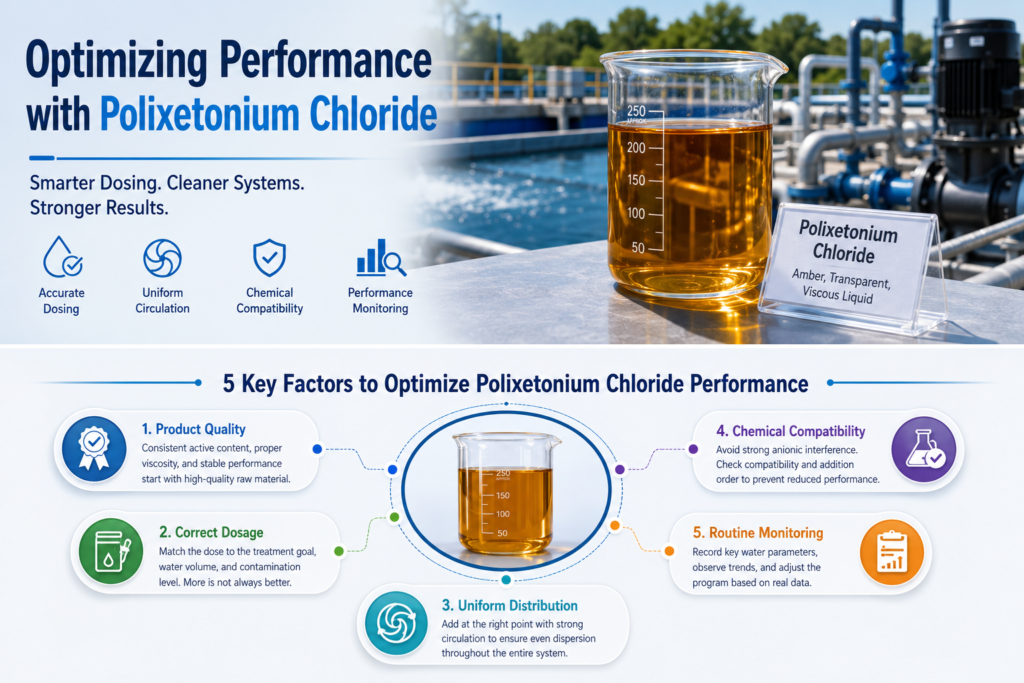
Final Thoughts
Optimizing Polixetonium Chloride performance is not simply about finding the highest acceptable dose.
The strongest results usually come from a balanced program: consistent product quality, correct concentration, accurate system volume, good distribution, proper cleaning, sensible chemical compatibility, and regular monitoring.
Polixetonium Chloride does its best work when it reaches the target before being consumed, neutralized, diluted unevenly, or blocked by contamination.
That is the real lesson.
A high-quality chemical matters. But the system around the chemical matters just as much.
When those two parts work together, users can gain more reliable algae control, reduce unnecessary overdosing, maintain cleaner water, and obtain better value from each treatment.
Frequently Asked Questions
1. What is the best dosage of Polixetonium Chloride for algae control?
The best dosage depends on product concentration, water volume, contamination level, application, and local label directions. Corrective treatment usually requires a different dose from routine preventive maintenance.
2. Can Polixetonium Chloride be used with chlorine?
It may be used as part of a chlorinated pool program when permitted by the product label. However, concentrated Polixetonium Chloride should not be mixed directly with concentrated liquid or dry chlorine products.
3. Why is Polixetonium Chloride not controlling algae effectively?
Common causes include an insufficient dose, inaccurate water volume, heavy existing algae, poor circulation, dirty filters, high organic contamination, or interference from strong anionic chemicals.
4. Does Polixetonium Chloride improve water clarity?
Its cationic polymer structure may help gather certain negatively charged suspended particles under suitable conditions. However, its primary role is algae or microbial control, and it should not automatically replace a dedicated clarification and filtration program.
5. How can manufacturers test Polixetonium Chloride compatibility in a formulation?
Manufacturers can begin with small-scale compatibility and storage tests using the intended concentrations and addition order. The mixture should be checked for haze, sediment, separation, viscosity change, and performance loss over time.