
GET IN TOUCH
Ask For Sample?
Selecting the Right Grade of Polixetonium Chloride
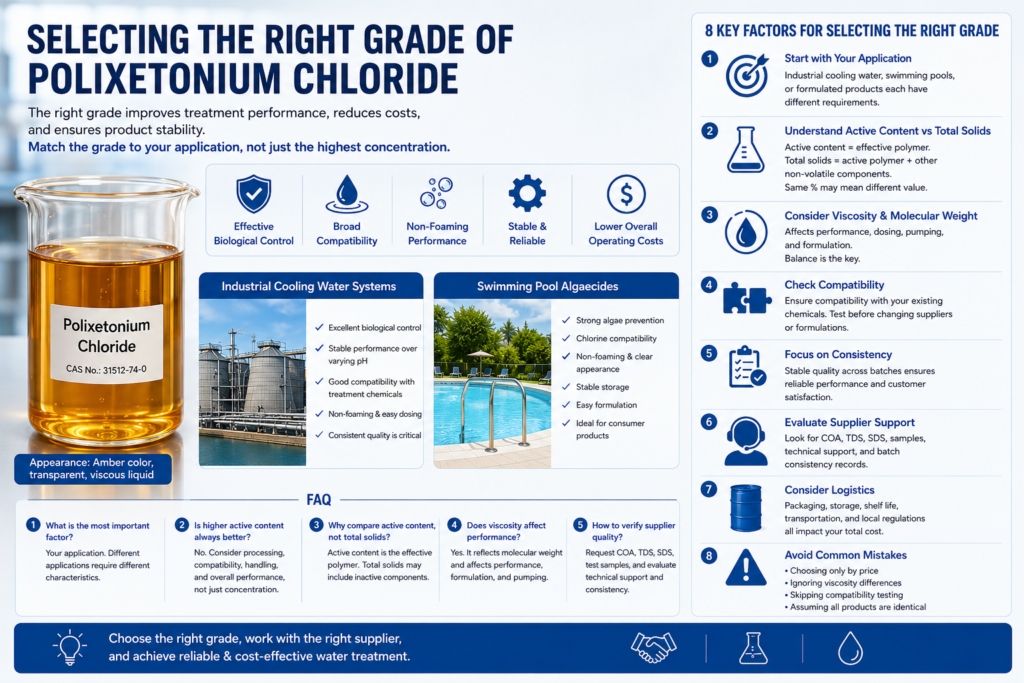
Choosing a water treatment chemical isn’t just about finding the lowest price or the highest concentration. When it comes to Polixetonium Chloride, selecting the right grade can have a noticeable impact on treatment performance, product stability, operating costs, and even customer satisfaction.
Many buyers assume that all Polixetonium Chloride products are essentially the same. They share the same CAS number, so they must perform the same, right?
Not exactly.
Different manufacturers produce different grades with variations in active content, viscosity, molecular weight, impurities, production consistency, and quality control. Those differences may not be obvious on the label, but they often become clear after the product is put into service.
Let’s look at how to choose the grade that actually fits your application.
Why Choosing the Right Grade Matters ?
Polixetonium Chloride is widely used as a non-foaming polymeric biocide in industrial water treatment and swimming pool formulations. It is valued for its long-lasting algae control, broad compatibility, and relatively low impact on equipment.
However, selecting an unsuitable grade may lead to problems such as:
- Reduced algae control efficiency
- Higher treatment costs
- Difficult formulation processing
- Inconsistent product quality
- Customer complaints
- Unnecessary shipping expenses
Interestingly, the “highest specification” is not always the best specification.
The best choice is the one that matches your application.
What Does “Grade” Mean for Polixetonium Chloride?
Unlike commodity chemicals, Polixetonium Chloride is available in several commercial grades.
The differences typically include:
- Active ingredient concentration
- Total solids
- Molecular weight
- Viscosity
- Color and clarity
- Residual raw materials
- Production consistency
- Intended application
Two products labeled “60%” may actually perform differently because the manufacturing process differs.
This is why experienced formulators rarely judge quality based on concentration alone.
Start with Your Application, Not the Highest Concentration
One of the biggest purchasing mistakes is assuming that a higher concentration automatically delivers better value.
Ask yourself first:
- Is the product used in industrial cooling water?
- Is it formulated into a swimming pool algaecide?
- Is it supplied as a concentrate for dilution?
- Will it be blended with other treatment chemicals?
- Does your production equipment have viscosity limitations?
These questions matter more than simply comparing percentages.
A product optimized for industrial systems may not be the ideal choice for consumer pool products, and vice versa.
Understanding Active Content vs Total Solids
This is one of the most overlooked details in the market.
Many suppliers advertise a product as “60% Active Content.”
Others specify 60% Total Solids.
Although these numbers appear identical, they do not necessarily represent the same chemical composition.
In general:
- Active Content refers to the amount of effective polymer responsible for treatment performance.
- Total Solids include the active polymer together with other non-volatile components that do not necessarily contribute to performance.
As a result, two products labeled “60%” may contain different amounts of effective polymer.
For professional buyers, understanding exactly how the specification is defined is essential when comparing quotations.
If you’re interested in how active content is measured using colloid titration, feel free to contact us. We’re always happy to discuss testing methods and industry standards.
Viscosity and Molecular Weight: Why They Matter ?
Many buyers focus only on active content and overlook viscosity.
That’s a mistake.
For polymeric quaternary ammonium compounds like Polixetonium Chloride, viscosity often provides useful information about molecular weight.
Generally speaking:
- Higher molecular weight often produces higher viscosity.
- Higher molecular weight may improve long-term algae control in certain applications.
- Excessively high viscosity may make pumping, mixing, or filling more difficult.
The ideal balance depends on your formulation process.
A supplier with tight viscosity control usually demonstrates stronger manufacturing consistency.
Selecting the Right Grade for Cooling Water Systems
Industrial cooling water systems typically require a product that offers:
- Excellent biological control
- Stable performance over varying pH conditions
- Good compatibility with corrosion inhibitors
- Non-foaming behavior
- Easy dosing
For these systems, consistent quality is often more important than chasing the highest concentration.
Unexpected batch variation can disrupt treatment programs and increase operating costs.
Selecting the Right Grade for Swimming Pool Algaecides
Pool chemical manufacturers often have slightly different priorities.
A suitable grade should provide:
- Strong algae prevention
- Excellent chlorine compatibility
- Non-foaming performance
- Clear appearance
- Stable storage
- Easy formulation
Appearance also matters.
Consumers expect a professional-looking product with consistent color and clarity.
For private-label manufacturers, stable quality across production batches is especially important because it helps maintain brand reputation.
Compatibility with Your Existing Water Treatment Program
Before introducing a new grade, confirm its compatibility with your existing formulation.
Polixetonium Chloride generally performs well with many common treatment chemicals.
However, strong anionic chemicals may reduce its effectiveness because of ionic interactions.
Whenever changing suppliers or formulations, laboratory compatibility testing is recommended before large-scale production.
A small test today can prevent a much larger problem later.
Packaging, Storage, and Transportation Considerations
The right grade should also fit your logistics.
Common packaging options include:
- 25 L plastic jerrycans
- 200 L HDPE drums
- 1000 L IBC totes
For export projects, buyers should also consider:
- Container loading efficiency
- Shelf life
- Temperature during transportation
- Ease of handling
- Local regulatory requirements
These practical factors can influence total purchasing costs more than many people expect.
Common Mistakes When Selecting a Grade
Even experienced buyers occasionally overlook important details.
Some of the most common mistakes include:
- Choosing only by price
- Comparing concentration without understanding the specification method
- Ignoring viscosity differences
- Skipping compatibility testing
- Overlooking batch-to-batch consistency
- Assuming all suppliers manufacture identical products
Avoiding these mistakes usually leads to more reliable long-term performance.
How to Evaluate a Supplier Before Purchasing
A trustworthy supplier should provide more than just a competitive quotation.
Consider asking for:
- Certificate of Analysis (COA)
- Technical Data Sheet (TDS)
- Safety Data Sheet (SDS)
- Batch consistency records
- Sample for evaluation
- Technical support during product selection
A supplier willing to discuss technical details often becomes a valuable long-term partner rather than simply a vendor.
Final Thoughts
Selecting the right grade of Polixetonium Chloride isn’t about buying the strongest product or the cheapest one. It’s about matching the material to your application, understanding what the specifications actually mean, and working with a manufacturer that delivers consistent quality.
Pay close attention to active content, viscosity, molecular weight, compatibility, and manufacturing consistency. These factors have a much greater influence on real-world performance than a single percentage on a product label.
If you’re evaluating different grades of Polixetonium Chloride or comparing supplier specifications, we’d be glad to discuss your application and help you identify the most suitable solution for your water treatment needs.
Frequently Asked Questions (FAQ)
1. What is the most important factor when selecting a grade of Polixetonium Chloride?
The most important factor is your application. Industrial cooling water systems, swimming pool algaecides, and formulated products may each require different characteristics, such as viscosity, molecular weight, or active content.
2. Is a higher active content always better?
Not necessarily. A higher active content may reduce transportation costs, but it is not always the best choice for every formulation. Processing requirements, compatibility, and handling characteristics should also be considered.
3. Why should I compare active content instead of only total solids?
Active content represents the effective polymer responsible for treatment performance, while total solids may include other non-volatile components. Comparing the two correctly helps you evaluate the true value of different products.
4. Does viscosity affect the performance of Polixetonium Chloride?
Yes. Viscosity often reflects molecular weight, which can influence treatment performance, formulation behavior, and pumping characteristics. Consistent viscosity also indicates good manufacturing control.
5. How can I verify the quality of a Polixetonium Chloride supplier?
Request documentation such as a COA, TDS, and SDS, ask about batch-to-batch consistency, evaluate technical support, and test samples under your own operating conditions before placing a large order.