
Outline
- Why Real-World Applications Matter
- What Makes Polixetonium Chloride Different
- Case Study 1: Cooling Water System Algae Control
- Case Study 2: Industrial Water Recirculation
- Case Study 3: Swimming Pool Water Treatment
- Case Study 4: Metalworking Fluid Preservation
- Lessons Learned from Different Applications
- How to Achieve the Best Results
- Final Thoughts
- Frequently Asked Questions
Case Studies of Polixetonium Chloride Applications
When people evaluate a water treatment chemical, laboratory data is only part of the picture. The real question is much simpler:
How does it perform in actual applications?
That’s where case studies become valuable. They show how a product behaves under practical operating conditions instead of ideal laboratory environments.
Polixetonium Chloride (CAS No. 31512-74-0) has been used in industrial water treatment for many years because of its non-foaming performance, broad-spectrum antimicrobial activity, and long-lasting algae control. It is especially valued in systems where excessive foam or heavy metal-based products would create operational problems.
In this article, we’ll look at several typical application scenarios and discuss why Polixetonium Chloride continues to be selected by water treatment professionals around the world.
What Makes Polixetonium Chloride Different?
Before looking at specific examples, it’s worth understanding why this polymeric biocide is used in such a wide variety of water systems.
Compared with many conventional water treatment chemicals, Polixetonium Chloride offers several practical advantages:
- Non-foaming during circulation
- Effective algae prevention
- Broad antimicrobial performance
- Good compatibility with most common water treatment programs
- Stable performance over a wide pH range
- Suitable for continuous maintenance programs
- Lower corrosion concerns than many oxidizing biocides
Because it is a polymeric quaternary ammonium compound, its mode of action differs from oxidizing disinfectants. Rather than rapidly oxidizing contaminants, it interacts with microorganisms through its positively charged polymer structure, providing sustained biological control.
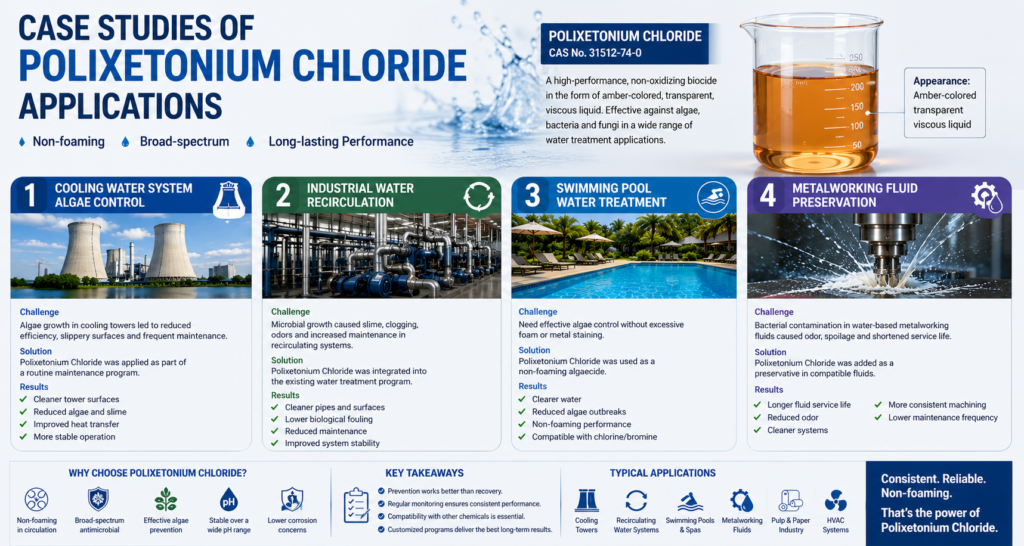
Case Study 1: Cooling Water System Algae Control
The Challenge
An industrial cooling tower operating outdoors experienced recurring algae growth during the summer months.
Operators noticed:
- Green algae on tower walls
- Slippery surfaces
- Reduced heat exchange efficiency
- Increased maintenance frequency
Traditional oxidizing treatments controlled the algae temporarily, but frequent dosing increased operational complexity.
The Solution
The facility incorporated Polixetonium Chloride into its routine maintenance program as a non-oxidizing biocide.
Typical Results
After establishing regular treatment intervals, operators generally observed:
- Cleaner tower surfaces
- Reduced visible algae growth
- Improved water clarity
- Less biological slime accumulation
- More stable cooling system operation
Instead of repeatedly reacting to algae outbreaks, the maintenance program shifted toward preventive biological control.
Case Study 2: Industrial Water Recirculation
Closed and semi-closed water systems often experience biological contamination even when fresh makeup water appears clean.
The Challenge
A manufacturing facility reported:
- Microbial slime deposits
- Increased filter cleaning
- Reduced circulation efficiency
- Unpleasant odors
Mechanical cleaning alone failed to solve the recurring problem.
The Approach
Polixetonium Chloride was incorporated into the existing water treatment program alongside other compatible chemicals.
Rather than replacing the complete treatment program, it became one component of a broader biological control strategy.
Typical Improvements
Operators commonly reported:
- Cleaner piping surfaces
- Lower biological fouling
- Reduced maintenance interruptions
- Improved overall system stability
The key benefit wasn’t simply killing microorganisms—it was reducing the formation of biofilms that interfere with system performance.
Case Study 3: Swimming Pool Water Treatment
Perhaps the best-known application of Polixetonium Chloride is in professional swimming pool algaecide formulations.
The Challenge
Pool operators often need algae control without creating excessive foam or causing metal staining.
Copper-based products may leave stains under certain water conditions, while some surfactant-containing products can increase foam.
Why Polixetonium Chloride?
Because it offers:
- Non-foaming performance
- Long-lasting preventive algae control
- Compatibility with chlorine and bromine programs
- No copper addition
- Suitable for routine maintenance
Practical Outcome
Well-maintained pools typically experience:
- Clearer water
- Reduced algae outbreaks
- Lower maintenance workload
- Better swimmer experience
An additional advantage is that Polixetonium Chloride remains compatible with normal sanitizer programs instead of replacing them.
Case Study 4: Metalworking Fluid Preservation
One of the established industrial applications of Polixetonium Chloride is the preservation of water-based metalworking fluids.
The Challenge
Water-based cutting fluids naturally provide favorable conditions for microbial growth.
Without adequate preservation, manufacturers may encounter:
- Bacterial contamination
- Offensive odors
- Reduced fluid service life
- Equipment fouling
- Poor working conditions
Application Strategy
Polixetonium Chloride is introduced into compatible water-based metalworking fluid systems as a preservative to help control bacterial growth during service.
It is generally suitable for:
- Synthetic metalworking fluids
- Semi-synthetic fluids
- Certain soluble oil formulations that do not contain incompatible anionic surfactants
Typical Benefits
Facilities commonly report:
- Longer fluid service intervals
- Reduced odor development
- Cleaner fluid systems
- More consistent machining conditions
- Lower maintenance frequency
As with any preservative, treatment programs should be developed according to the specific fluid formulation and operating conditions.
Lessons Learned from Different Applications
Although these applications involve different industries, several common patterns emerge.
Prevention Works Better Than Recovery
Waiting until heavy algae or microbial contamination appears usually requires more effort than maintaining routine preventive treatment.
Regular Monitoring Matters
Even high-performance biocides work best when water quality is monitored consistently.
Parameters such as:
- Biological activity
- System cleanliness
- Water replacement rate
- Operating temperature
all influence treatment performance.
Compatibility Is Important
Polixetonium Chloride performs best when used within a properly designed water treatment program.
Before combining it with other specialty chemicals, compatibility should always be confirmed, especially when strong anionic chemicals are involved.
How to Achieve the Best Results
Every water system is different.
Factors affecting treatment performance include:
- Water chemistry
- Organic contamination
- Temperature
- Flow conditions
- System design
- Treatment frequency
- Existing microbiological load
Because of these variables, successful users typically customize their treatment programs rather than relying on a one-size-fits-all approach.
Working with experienced suppliers can help optimize dosage strategy, compatibility evaluation, and long-term maintenance planning.
Final Thoughts
Real-world applications demonstrate why Polixetonium Chloride has remained an important non-oxidizing biocide for industrial and recreational water treatment.
From cooling towers and recirculating industrial systems to swimming pools and metalworking fluids, its combination of non-foaming performance, reliable algae control, and broad antimicrobial activity makes it suitable for many demanding environments.
While every system requires its own treatment program, these representative case studies show a common theme: consistent preventive treatment generally delivers better long-term performance than reactive intervention after biological contamination has already developed.
Frequently Asked Questions
1. Which industries commonly use Polixetonium Chloride?
It is widely used in industrial cooling water systems, recirculating water systems, swimming pool algaecide formulations, and the preservation of compatible water-based metalworking fluids.
2. Can Polixetonium Chloride replace chlorine?
No. It is typically used as a non-oxidizing biocide that complements, rather than replaces, oxidizing sanitizers such as chlorine or bromine in many water treatment programs.
3. Why is Polixetonium Chloride considered non-foaming?
Its polymeric structure allows it to control algae and microorganisms without the foaming commonly associated with some quaternary ammonium surfactants, making it suitable for circulating water systems.
4. Is Polixetonium Chloride compatible with all water treatment chemicals?
It is compatible with many commonly used treatment chemicals, but strong anionic chemicals may reduce its effectiveness. Compatibility testing is recommended before introducing new chemical combinations.
5. How can users maximize the performance of Polixetonium Chloride?
The best results are achieved through preventive maintenance, regular water monitoring, proper dosage control, and a treatment program tailored to the specific operating conditions of the system.