Outline
- Why Polixetonium Chloride Stands Out in Modern Water Treatment
- Advantage #1: Broad-Spectrum Microbial Control
- Advantage #2: Non-Foaming Performance for Continuous Systems
- Advantage #3: Long-Lasting Residual Activity
- Advantage #4: Excellent Compatibility with Water Treatment Programs
- Advantage #5: Cost-Effective Performance with Lower Maintenance
- How to Maximize the Benefits of Polixetonium Chloride
- Conclusion
- FAQs
Top 5 Advantages of Polixetonium Chloride
When selecting a non-oxidizing biocide for industrial water treatment or swimming pool applications, performance matters—but so do stability, compatibility, and long-term operating costs.
That’s exactly why Polixetonium Chloride has become a trusted choice across many industries. Unlike oxidizing biocides that work quickly and disappear, Polixetonium Chloride provides sustained microbial control while remaining compatible with many common water treatment programs.
If you’re evaluating water treatment chemicals, understanding its key advantages can help you decide whether it’s the right solution for your application.
Let’s take a closer look.
Why Polixetonium Chloride Stands Out in Modern Water Treatment
Polixetonium Chloride is a polymeric quaternary ammonium compound widely used as a non-oxidizing biocide and algaecide. It is especially valued for applications where continuous protection is more important than rapid oxidation.
Typical applications include:
- Industrial cooling water systems
- Decorative fountains
- Commercial water systems
- Swimming pools
- Water storage systems
- Certain industrial process water applications
Rather than relying on oxidation, Polixetonium Chloride disrupts microbial cell membranes through its cationic polymer structure, helping control algae and many microorganisms over an extended period.
So, what makes it different from many traditional treatment chemicals?
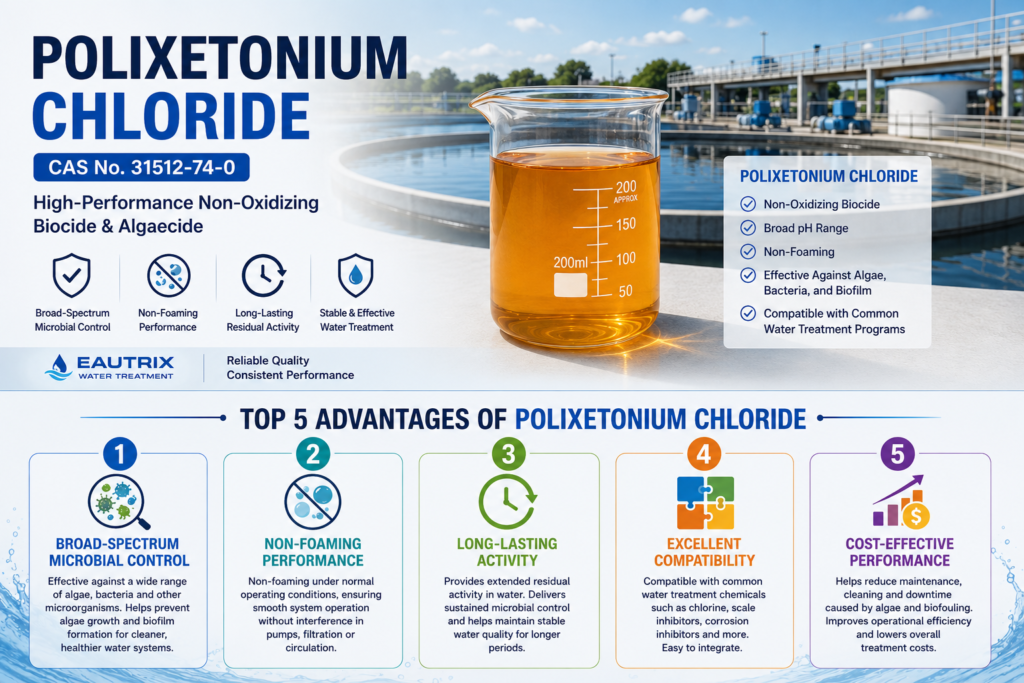
Here are the five biggest advantages.
1. Broad-Spectrum Microbial Control
One of the biggest strengths of Polixetonium Chloride is its ability to control a wide range of microorganisms.
It is particularly effective against many common algae species that frequently cause water quality problems, including green algae and other nuisance algae found in industrial and recreational water systems.
By interfering with the integrity of microbial cell membranes, the polymer causes leakage of essential cellular components, eventually leading to cell death.
This mechanism offers several practical benefits:
- Helps prevent algae growth before it becomes severe
- Reduces biofilm formation
- Maintains cleaner water systems
- Supports more stable water quality
Unlike some oxidizing products that lose effectiveness rapidly, the polymer continues working after application, providing ongoing protection.
2. Non-Foaming Performance for Continuous Systems
Foam may seem like a minor issue, but in many industrial systems it creates real operational problems.
Excessive foaming can:
- Reduce pump efficiency
- Interfere with filtration
- Affect circulation
- Increase maintenance requirements
- Create operational headaches
One of the well-known advantages of Polixetonium Chloride is its non-foaming behavior under recommended operating conditions.
This makes it particularly suitable for:
- Cooling towers
- Closed-loop water systems
- Recirculating industrial water
- Commercial swimming pools
- Decorative water features
For facilities operating around the clock, minimizing foam means smoother operation and fewer interruptions.
Sometimes the simplest advantage is also one of the most valuable.
3. Long-Lasting Residual Activity
Many treatment chemicals work fast—but disappear just as quickly.
Polixetonium Chloride behaves differently.
Because it is a polymeric biocide with relatively high molecular weight, it remains active in treated water longer than many fast-consuming oxidizing biocides. Instead of being rapidly consumed through oxidation reactions, it continues interacting with microorganisms over time.
This sustained activity can help:
- Extend treatment intervals
- Maintain more consistent microbial control
- Reduce sudden algae outbreaks
- Improve overall treatment stability
For operators, this often means fewer emergency treatments and more predictable water quality.
Of course, the actual treatment schedule should always be determined through routine water monitoring and the specific operating conditions of each system.
4. Excellent Compatibility with Water Treatment Programs
Modern water treatment rarely relies on a single chemical.
Instead, facilities typically use a complete treatment program that may include:
- Chlorine
- Bromine
- Scale inhibitors
- Corrosion inhibitors
- Dispersants
- Flocculants
- pH adjustment chemicals
Polixetonium Chloride generally integrates well into many of these programs when used appropriately.
Its compatibility allows operators to improve algae control without completely redesigning their existing treatment strategy.
This flexibility is one reason why the product is widely adopted by professional water treatment companies.
As always, compatibility should be confirmed through laboratory evaluation or field testing before introducing any new chemical into an existing treatment program.
5. Cost-Effective Performance with Lower Maintenance
The purchase price of a chemical tells only part of the story.
The real question is:
How much does it cost to maintain clean, stable water over time?
Because Polixetonium Chloride combines broad-spectrum activity, residual performance, and non-foaming characteristics, many users find that it helps reduce several indirect operating costs, including:
- Less frequent algae clean-up
- Reduced manual maintenance
- Improved equipment cleanliness
- Lower downtime caused by biological contamination
- More consistent water quality
While treatment costs always depend on dosage, water quality, and system design, many facilities appreciate the balance between performance and operational efficiency.
Sometimes paying slightly more for the right chemistry saves considerably more in maintenance later.
How to Maximize the Benefits of Polixetonium Chloride
Even the best water treatment chemical performs better when used correctly.
To achieve consistent results, consider the following recommendations:
Monitor water quality regularly
Routine testing helps determine the proper treatment schedule.
Follow supplier dosage recommendations
Both underdosing and overdosing can reduce treatment efficiency.
Maintain proper circulation
Good mixing allows the polymer to distribute evenly throughout the system.
Combine with a complete maintenance program
Mechanical cleaning, filtration, and water balance remain important parts of overall water management.
Purchase from a reliable manufacturer
Consistent product quality—including active content, viscosity, and production control—helps ensure predictable performance.
Conclusion
Polixetonium Chloride continues to gain popularity because it addresses many of the challenges faced in modern water treatment.
Its combination of broad-spectrum microbial control, non-foaming performance, long-lasting activity, compatibility with existing treatment programs, and cost-effective operation makes it a dependable solution for many industrial and recreational water systems.
No single chemical is perfect for every application. However, when long-term algae control, operational stability, and maintenance efficiency are priorities, Polixetonium Chloride remains one of the most practical choices available.
Selecting a high-quality product from an experienced manufacturer—and applying it according to proper treatment guidelines—can help maximize both performance and value.
Frequently Asked Questions
1. What is the main advantage of Polixetonium Chloride?
Its biggest advantage is the combination of long-lasting microbial control and non-foaming performance, making it suitable for continuous water treatment systems.
2. Is Polixetonium Chloride compatible with chlorine?
Yes. It is commonly used alongside chlorine-based treatment programs when applied according to recommended treatment procedures.
3. Why is Polixetonium Chloride considered a non-oxidizing biocide?
Unlike oxidizing biocides, it controls microorganisms primarily by disrupting cell membranes rather than through oxidation reactions.
4. Does Polixetonium Chloride help reduce maintenance costs?
It can help lower maintenance requirements by reducing algae growth, minimizing biofilm formation, and supporting more stable water quality when incorporated into a well-managed treatment program.
5. How can I choose a high-quality Polixetonium Chloride supplier?
Look for manufacturers that provide consistent active content, reliable quality control, complete technical documentation (such as COA, TDS, and SDS), and application support for your specific water treatment needs.