
GET IN TOUCH
Ask For Sample?
Common Mistakes When Using Polixetonium Chloride
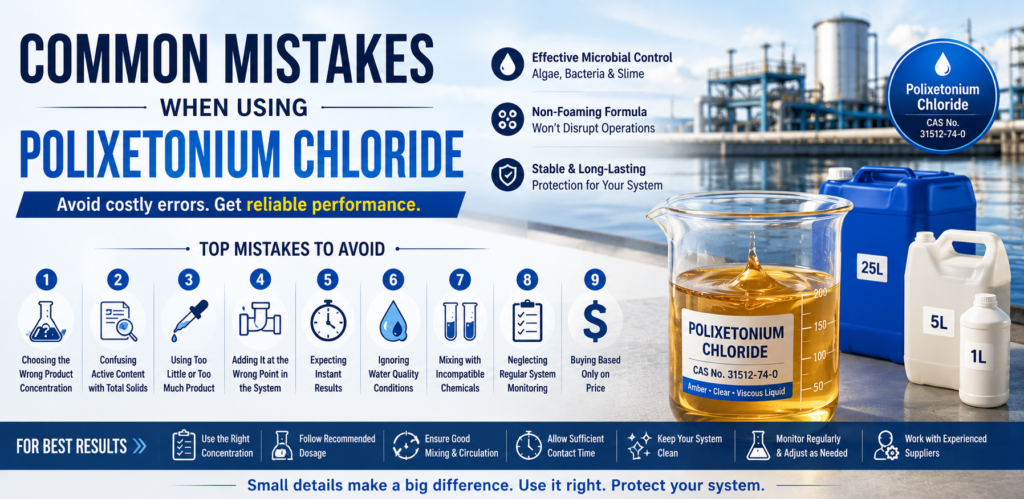
Water treatment professionals often choose Polixetonium Chloride (CAS No. 31512-74-0) because it provides reliable, non-foaming control of algae, bacteria, and slime-forming microorganisms across many industrial and commercial water systems. When applied correctly, it offers long-lasting protection while helping reduce maintenance costs.
Yet here’s something interesting: when users complain that a product “doesn’t work,” the problem is often not the chemistry itself. It’s the way the product is selected, dosed, or applied.
A few small mistakes can significantly reduce treatment efficiency. The good news? Nearly all of them are easy to avoid once you know what to look for.
This guide explains the most common mistakes users make with Polixetonium Chloride and how to avoid them for better performance and more consistent results.
Why Even a Good Biocide Can Deliver Poor Results
Polixetonium Chloride is a polymeric quaternary ammonium biocide. Unlike oxidizing biocides such as chlorine, it works by interacting with negatively charged microbial cell membranes, disrupting their integrity and eventually causing cell death.
Because its mode of action is different, its performance depends on several practical factors, including:
- Product quality
- Active concentration
- Dosage
- Contact time
- Water chemistry
- System cleanliness
If any one of these factors is overlooked, treatment results may fall short of expectations.
Let’s look at where problems usually begin.
Mistake #1: Choosing the Wrong Product Concentration
Not every Polixetonium Chloride product on the market contains the same concentration.
Some products are supplied around 30%, while others are approximately 60% active. Assuming that every product performs the same often leads to underdosing or overdosing.
For example:
- A system designed for a 60% product cannot simply substitute a lower-concentration material at the same dosage.
- Purchasing solely by price without comparing concentration can increase the actual treatment cost.
Always verify:
- Active content
- Product specification
- Recommended dosage based on concentration
The lowest purchase price isn’t always the lowest operating cost.
Mistake #2: Confusing Active Content with Total Solids
This is one of the most overlooked issues in the market.
Many manufacturers advertise products as having 60% active content, while others may label products as 60% solids. Although these figures look similar, they do not necessarily represent the same amount of active ingredient.
In many cases, a product specified as 60% active content contains a higher proportion of effective biocidal polymer than a product described only by total solids.
Understanding this difference helps buyers make more accurate comparisons between suppliers instead of relying only on the number printed on the specification sheet.
If you’re comparing products from different manufacturers, it’s worth asking how the active content is determined and what analytical method is used.
Mistake #3: Using Too Little or Too Much Product
It’s tempting to assume:
More chemical means better control.
Actually, that’s rarely true.
Underdosing may allow algae or microorganisms to survive and recover quickly.
Excessive dosing, meanwhile, increases chemical costs without necessarily improving control.
The proper dosage depends on factors such as:
- Water volume
- Organic contamination
- Existing microbial load
- Water replacement frequency
- Operating conditions
Following supplier recommendations and adjusting based on monitoring results usually produces the best balance between performance and cost.
Mistake #4: Adding It at the Wrong Point in the System
Even the best biocide cannot work efficiently if it never reaches the problem area.
Poor injection locations may result in:
- Uneven distribution
- Dead zones
- Insufficient contact time
- Local over-concentration
For circulating water systems, the product is typically introduced where rapid mixing can occur.
Good circulation allows the polymer to disperse evenly throughout the entire system rather than remaining concentrated in one location.
Mistake #5: Expecting Instant Results
This misconception appears surprisingly often.
Unlike shock oxidizers that may produce visible changes very quickly, Polixetonium Chloride works through a different mechanism.
Existing algae populations may require sufficient contact time before complete control is achieved.
Heavy contamination, especially systems with established biofilms, may need repeated treatment together with mechanical cleaning.
Patience matters.
Consistent treatment usually provides better long-term control than chasing immediate visual results.
Mistake #6: Ignoring Water Quality Conditions
Water quality strongly influences biocide performance.
Factors that deserve attention include:
- Organic contamination
- Suspended solids
- Scale deposits
- Biofilm accumulation
- pH
- Water turnover rate
If thick deposits or heavy biofilms already exist, the biocide may struggle to reach microorganisms hidden beneath the surface.
Cleaning the system before treatment often improves performance significantly.
Think of it this way—you wouldn’t paint over heavy rust and expect a perfect finish. Water treatment follows a similar principle.
Mistake #7: Mixing with Incompatible Chemicals
Not every water treatment chemical is automatically compatible.
Depending on system conditions, mixing products without evaluation may reduce effectiveness or create unwanted interactions.
Before combining Polixetonium Chloride with other specialty chemicals, consider:
- Water treatment program design
- Product compatibility
- Addition sequence
- Manufacturer recommendations
If you’re uncertain, laboratory compatibility testing or supplier guidance can prevent expensive mistakes.
Mistake #8: Neglecting Regular System Monitoring
Adding chemical without monitoring is a little like driving with your eyes closed.
Regular inspections help identify problems before they become expensive.
Useful monitoring may include:
- Visual algae inspection
- Water clarity
- Microbial testing
- System cleanliness
- Chemical consumption trends
Monitoring also helps optimize dosage instead of relying on guesswork.
Mistake #9: Buying Based Only on Price
Everyone wants to save money.
But selecting the lowest-priced product often leads to hidden costs later.
Lower-priced materials may differ in:
- Actual active polymer content
- Manufacturing consistency
- Molecular characteristics
- Quality control
- Technical support
Reliable suppliers usually provide:
- COA
- Technical Data Sheet (TDS)
- Safety Data Sheet (SDS)
- Consistent production quality
- Technical application guidance
Looking beyond the initial purchase price often results in lower total operating costs.
How to Get the Best Performance from Polixetonium Chloride
Fortunately, avoiding these mistakes isn’t difficult.
A few practical habits make a noticeable difference:
- Select the correct concentration for your application.
- Compare active content instead of looking only at total solids.
- Follow recommended dosage guidelines.
- Inject the product where mixing is effective.
- Allow sufficient contact time.
- Keep systems reasonably clean before treatment.
- Verify compatibility before combining chemicals.
- Monitor system performance regularly.
- Work with experienced suppliers that provide technical support.
When these basic principles are followed, Polixetonium Chloride typically delivers stable, economical, and reliable microbial control.
Final Thoughts
Polixetonium Chloride has earned its reputation as an effective non-foaming polymeric biocide for industrial water treatment, cooling water systems, and related applications. However, even high-quality chemistry cannot compensate for incorrect application.
Most performance issues come back to a handful of avoidable mistakes—incorrect concentration selection, confusion between active content and total solids, improper dosing, poor application practices, or insufficient monitoring.
Understanding these common pitfalls helps operators improve treatment efficiency, reduce operating costs, and extend system reliability.
Sometimes the biggest improvement doesn’t come from changing the chemical. It comes from changing how the chemical is used.
Frequently Asked Questions
1. What is the most common mistake when using Polixetonium Chloride?
The most common mistake is using an incorrect dosage or selecting the wrong product concentration. Always calculate dosage based on the product’s actual active content and your system’s operating conditions.
2. Is 60% active content the same as 60% solids?
No. These terms are not necessarily interchangeable. A product labeled as 60% active content may contain more effective polymer than one labeled only as 60% solids, depending on how each value is determined.
3. Can adding more Polixetonium Chloride improve performance?
Not always. Excessive dosing generally increases treatment costs without providing proportional improvements. The correct dosage should match the microbial load and system requirements.
4. Why doesn’t Polixetonium Chloride eliminate algae immediately?
Polixetonium Chloride works through a polymeric, non-oxidizing mechanism that requires adequate contact time. Systems with heavy algae growth or established biofilms may require repeated treatment and physical cleaning for the best results.
5. How can I choose a reliable Polixetonium Chloride supplier?
Look beyond price. Choose suppliers that provide consistent product quality, complete technical documentation (COA, TDS, SDS), stable manufacturing, and professional technical support. Comparing active content rather than total solids can also help you make a more informed purchasing decision.