
Outline
- Why Water Systems Keep Running into the Same Problems
- Problem #1: Persistent Algae Growth in Swimming Pools
- Problem #2: Cloudy Water and Poor Clarity
- Problem #3: Foam Caused by Conventional Algaecides
- Problem #4: Short Protection Between Treatments
- Problem #5: Water Quality Issues in Decorative Fountains
- Problem #6: Algae Challenges in Water Features and Artificial Lakes
- Problem #7: Compatibility Problems with Chlorine and Bromine
- Problem #8: Metal Staining from Copper-Based Algaecides
- Problem #9: Maintaining Water Quality During Pool Winterization
- Problem #10: Frequent Maintenance and High Operating Costs
- Why Poly(2-hydroxypropyldimethylammonium chloride) Solves Multiple Problems at Once
- Frequently Asked Questions
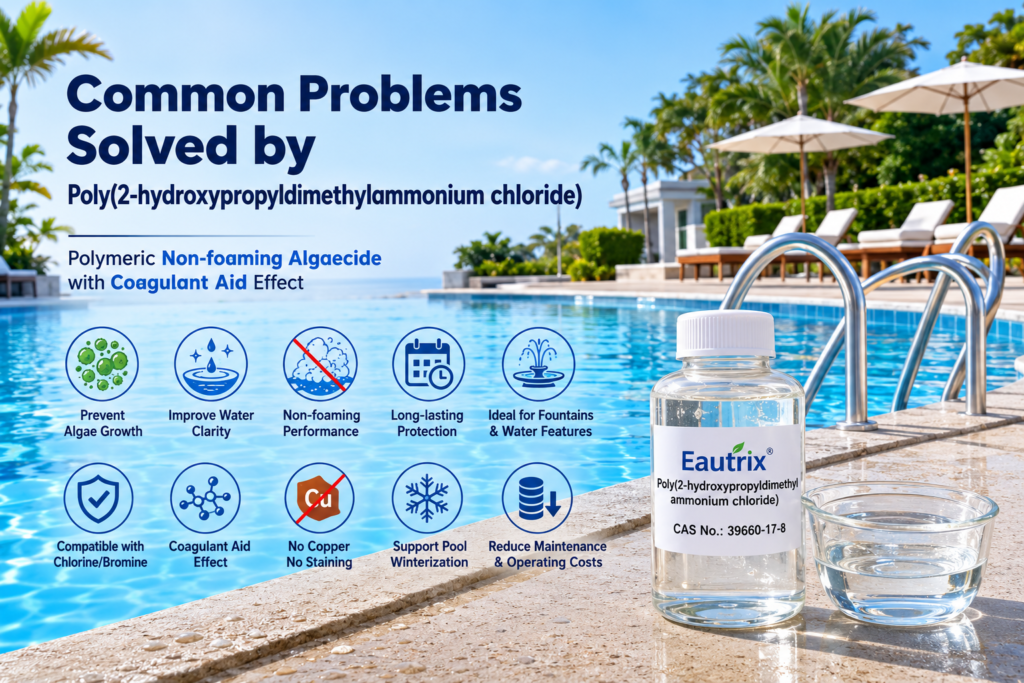
Common Problems Solved by Poly(2-hydroxypropyldimethylammonium chloride)
Have you ever cleaned a swimming pool only to see green algae return a few days later? Or watched perfectly clear water slowly become cloudy for no obvious reason?
These are common frustrations for pool owners, water treatment professionals, and facility managers. Many water quality problems don’t happen because the disinfectant isn’t working. Instead, they occur because algae, suspended particles, and organic contaminants gradually build up until the water becomes difficult to manage.
That’s where Poly(2-hydroxypropyldimethylammonium chloride) comes in.
Also known by its CAS No. 39660-17-8, this polymeric quaternary ammonium compound has become a trusted solution for swimming pools, decorative fountains, and other recreational water systems. Unlike many conventional algaecides, it is non-foaming, compatible with standard sanitizing programs, and provides an additional coagulant aid effect, helping maintain cleaner and clearer water.
In this guide, we’ll look at the most common water quality problems this polymer helps solve and explain why it has become a preferred choice in many commercial and residential applications.
Why Water Systems Keep Running into the Same Problems
Water may look crystal clear one day and noticeably different the next.
That’s because water is constantly changing. Sunlight, rain, wind, swimmers, dust, pollen, cosmetics, leaves, and microorganisms all introduce new contaminants.
Over time, these factors can lead to:
- Algae growth
- Reduced water clarity
- Suspended fine particles
- Increased maintenance
- Poor visual appearance
- Higher chemical consumption
Many pool owners try to fix each issue separately.
One chemical for algae.
Another for clarification.
Another for stain prevention.
Another for maintenance.
The result? More products, more testing, and more work.
Poly(2-hydroxypropyldimethylammonium chloride) offers a different approach by addressing several of these issues simultaneously.
Problem #1: Persistent Algae Growth in Swimming Pools
Algae are usually the first visible sign that water chemistry has started drifting out of balance.
Green water can develop surprisingly fast, especially during:
- Hot summer weather
- Heavy rainfall
- High bather loads
- Poor circulation
- Inconsistent sanitizer levels
Some common freshwater algae include Chlorella vulgaris, Scenedesmus spp., and other microscopic green algae that multiply rapidly under favorable conditions.
Simply shocking the pool often kills existing algae, but it doesn’t always prevent new growth.
Poly(2-hydroxypropyldimethylammonium chloride) works differently.
Because it is a polymeric quaternary ammonium compound, its positively charged polymer chains interact with negatively charged algal cell surfaces. This disrupts essential cell functions and inhibits further growth.
Rather than acting as a rapid oxidizer, it provides ongoing algae control when used as part of a routine maintenance program.
Benefits include:
- Effective prevention of common swimming pool algae
- Non-oxidizing mode of action
- Long-lasting residual activity
- Suitable for routine preventive maintenance
- Compatible with chlorine and bromine systems
For many pool operators, preventing algae is far easier—and less expensive—than treating a full bloom.
Problem #2: Cloudy Water and Poor Clarity
Sometimes the water isn’t green.
It just looks dull.
Cloudiness often results from extremely small suspended particles that are too fine for filtration alone.
These particles may include:
- Dead algae
- Fine dust
- Organic debris
- Sunscreen residues
- Environmental contaminants
Traditional clarifiers can help, but many facilities prefer products that provide multiple functions.
One advantage of Poly(2-hydroxypropyldimethylammonium chloride) is that, besides serving as an algaecide, it also functions as a coagulant aid.
Here’s how that helps.
The positively charged polymer can attract and bridge tiny negatively charged suspended particles, encouraging them to combine into larger aggregates that are more easily removed by the pool filtration system.
It’s important to note that this product is primarily an algaecide, not a dedicated pool clarifier. However, its coagulant aid effect often contributes to improved water clarity as part of a complete maintenance program.
Many users notice:
- Cleaner-looking water
- Better filter performance
- Reduced fine particle suspension
- Improved overall appearance
Sometimes the difference isn’t dramatic overnight—but after several filtration cycles, the water often looks noticeably brighter.
Problem #3: Foam Caused by Conventional Algaecides
Few things make a swimming pool look less inviting than foam floating across the surface.
Foaming becomes especially troublesome in:
- Spas
- Water parks
- Interactive fountains
- Decorative pools
- High-circulation systems
Many conventional algaecides, particularly those based on low-molecular-weight quaternary ammonium compounds, can produce unwanted foam under vigorous circulation.
That creates additional maintenance headaches and often leads users to reduce treatment levels—even when algae control is still needed.
Poly(2-hydroxypropyldimethylammonium chloride) is different.
Its polymeric structure allows it to deliver algae control without generating foam under normal operating conditions.
This non-foaming characteristic makes it especially attractive for facilities where appearance matters as much as performance.
Advantages include:
- Clean water surface
- Better visual appeal
- No foam accumulation around return jets
- Suitable for high-circulation systems
- Reduced customer complaints in commercial facilities
For hotels, resorts, aquatic centers, and residential pools alike, that’s one less problem to worry about.
Problem #4: Short Protection Between Treatments
One of the biggest frustrations in pool maintenance is having to treat the same problem over and over again.
You add chemicals.
The water looks great for a few days.
Then algae begin to return, and the maintenance cycle starts all over again.
Why does this happen?
Many traditional algaecides work quickly, but their effectiveness can diminish relatively fast. As their concentration drops, algae can begin to recover if conditions remain favorable.
Poly(2-hydroxypropyldimethylammonium chloride) offers a different approach.
Its polymeric molecular structure allows it to remain active in the water for a longer period than many conventional low-molecular-weight quaternary ammonium compounds. Instead of delivering a rapid “kill-and-disappear” effect, it provides continuous preventive activity as part of a well-managed water treatment program.
That doesn’t mean it replaces chlorine or bromine. Rather, it complements them by helping suppress algae growth between routine sanitizer treatments.
For pool operators, this can lead to several practical benefits:
- More consistent algae prevention
- Longer intervals between corrective treatments
- Less emergency shocking due to algae outbreaks
- More stable water quality during busy seasons
- Reduced maintenance workload
Think of it as preventive maintenance rather than emergency repair. Keeping algae under control from the beginning is almost always easier than dealing with a full bloom later.
Problem #5: Water Quality Issues in Decorative Fountains
Decorative fountains present a unique challenge.
Unlike swimming pools, they’re often exposed to constant sunlight, airborne dust, bird activity, falling leaves, and limited water turnover. Many also operate continuously, making appearance just as important as water quality.
Without proper treatment, fountain water may develop:
- Green algae on walls and nozzles
- Slippery biofilms
- Reduced water transparency
- Dirty-looking surfaces
- Increased cleaning frequency
Mechanical cleaning can remove visible algae, but it doesn’t stop new colonies from developing.
Poly(2-hydroxypropyldimethylammonium chloride) is widely used in fountain maintenance because it helps prevent algae growth while maintaining an attractive appearance.
Another advantage is its non-foaming performance.
Many decorative fountains feature waterfalls, cascades, or high-pressure spray nozzles that create intense water agitation. Foaming products quickly become obvious in these systems and can spoil the visual effect.
Because this polymer remains non-foaming under normal operating conditions, it is well suited for ornamental water features where aesthetics matter.
Users often report:
- Cleaner fountain surfaces
- Less visible algae accumulation
- Better water clarity over time
- Reduced manual cleaning
- More attractive public displays
For hotels, shopping centers, office buildings, and municipal landscapes, these improvements can significantly reduce routine maintenance.
Problem #6: Algae Challenges in Water Features and Artificial Lakes
Large ornamental ponds and artificial lakes create a different set of problems.
Compared with swimming pools, they have:
- Much larger water volumes
- Continuous exposure to sunlight
- Natural nutrient input
- Seasonal temperature changes
- Limited circulation in some areas
These conditions encourage algae growth, especially during warm weather.
Unchecked algae can cause:
- Green water
- Floating algae mats
- Unpleasant odors
- Reduced visual appeal
- Increased maintenance costs
Although complete algae elimination is rarely practical in large outdoor systems, regular treatment can help keep growth under control.
Poly(2-hydroxypropyldimethylammonium chloride) is commonly incorporated into algae management programs for ornamental water features because of its preventive action and compatibility with routine maintenance practices.
Its polymeric structure also means it performs without introducing heavy metals into the water.
For landscape managers, that can simplify long-term maintenance while helping preserve the appearance of decorative lakes and ponds.
Typical application areas include:
- Hotel landscapes
- Residential communities
- Business parks
- Botanical gardens
- Golf course water features
- Public parks
The goal isn’t sterile water.
The goal is attractive, manageable water that stays visually appealing throughout the season.
Problem #7: Compatibility Problems with Chlorine and Bromine
Many pool owners assume that adding more chemicals automatically increases the risk of unwanted reactions.
Fortunately, that isn’t always the case.
Poly(2-hydroxypropyldimethylammonium chloride) is designed to work alongside the sanitizers already used in most swimming pools.
When applied according to the manufacturer’s recommendations, it is generally compatible with standard chlorine- and bromine-based disinfection programs. Instead of replacing these sanitizers, it serves as a complementary algae-control product.
This compatibility offers several practical advantages.
Greater Flexibility in Water Treatment
Pool operators don’t need to redesign their maintenance program.
The polymer can simply become part of an existing treatment routine while chlorine or bromine continues to provide primary disinfection.
More Stable Water Appearance
Because algae are suppressed before they become established, sanitizer demand associated with algae contamination may be reduced.
That often contributes to:
- More consistent water clarity
- Fewer visible algae problems
- Less unexpected corrective treatment
- Improved swimmer satisfaction
Simplified Routine Maintenance
Rather than switching between different algae-control products throughout the season, many facilities maintain a regular dosing schedule using one compatible polymeric algaecide.
This simplifies inventory management and helps create a more predictable maintenance routine.
For commercial pools that operate every day, consistency is often just as valuable as treatment performance.
Problem #8: Metal Staining from Copper-Based Algaecides
Copper-based algaecides have been used for decades because they are effective against many types of algae.
However, they aren’t always the right choice for every pool.
Over time, dissolved copper ions can accumulate in the water. Under certain water chemistry conditions—particularly when pH rises or total alkalinity fluctuates—these metal ions may contribute to staining on pool surfaces or discoloration of light-colored finishes. In some cases, copper may also leave greenish deposits on hair or swimsuits.
Removing metal stains often requires additional chemicals, specialized treatments, or even acid washing.
That’s one more maintenance task that nobody enjoys.
Poly(2-hydroxypropyldimethylammonium chloride) provides an attractive alternative because it is a metal-free polymeric algaecide.
Since it contains no copper, it does not introduce additional metal ions into the water. This helps avoid the potential staining issues associated with metal-based algae control products while still providing reliable preventive algae control.
For many pool professionals, that means:
- No added copper in the treatment program
- Lower risk of metal-related staining
- Better compatibility with light-colored pool finishes
- Cleaner-looking water over the long term
- Simplified maintenance planning
For premium residential pools, hotels, and commercial aquatic facilities, preserving the appearance of the pool can be just as important as controlling algae.
Problem #9: Maintaining Water Quality During Pool Winterization
Closing a pool for the winter doesn’t mean water quality can be ignored.
In fact, the months when a pool sits unused often create ideal conditions for algae to begin developing unnoticed.
When spring arrives, owners may discover:
- Green water
- Heavy algae growth
- Dirty pool walls
- Increased chemical demand
- Hours of extra cleaning before reopening
Starting the season with an algae bloom can quickly erase the time and money saved during winter.
Many pool maintenance professionals include Poly(2-hydroxypropyldimethylammonium chloride) as part of a complete winterization program (Winter Algaecide) to help suppress algae growth during the off-season.
When combined with proper water balance, sanitation, and a well-fitted pool cover, it helps the pool reopen in much better condition.
Potential benefits include:
- Cleaner water after winter
- Less algae removal during spring opening
- Reduced shock treatment requirements
- Faster pool startup
- Lower seasonal maintenance costs
Of course, no winter algaecide can compensate for poor water balance or improper pool closure.
But when used correctly, it can become an important part of a successful winter maintenance strategy.
Problem #10: Frequent Maintenance and High Operating Costs
Here’s a question worth asking:
What costs more—buying quality chemicals, or constantly fixing avoidable problems?
For many commercial facilities, labor is actually one of the biggest operating expenses.
Every unexpected algae bloom means additional work:
- Manual brushing
- Vacuuming
- Filter cleaning
- Shock treatments
- Water testing
- Customer complaints
- Possible pool closures
The direct cost of chemicals is only part of the equation.
The real cost often includes lost time, increased labor, and interruptions to normal operations.
Because Poly(2-hydroxypropyldimethylammonium chloride) combines effective algae prevention with a helpful coagulant aid effect, many operators find that routine maintenance becomes more predictable.
Instead of reacting to problems after they appear, they can focus on preventing them.
That preventive approach may contribute to:
- More stable water quality
- Reduced emergency maintenance
- Better filtration efficiency
- Lower overall chemical adjustments
- Improved operating efficiency
For businesses that manage multiple pools or large recreational facilities, those savings can add up over an entire swimming season.
Why Poly(2-hydroxypropyldimethylammonium chloride) Solves Multiple Problems at Once
One reason this polymer has remained popular for many years is that it doesn’t address just one issue.
It supports several aspects of water quality simultaneously.
Let’s summarize what it brings to a maintenance program.
| Common Problem | How the Polymer Helps |
|---|---|
| Persistent algae | Helps prevent common swimming pool algae growth |
| Cloudy water | Provides a coagulant aid effect that assists particle removal |
| Foam | Non-foaming under normal operating conditions |
| Short treatment intervals | Offers lasting preventive algae control as part of routine maintenance |
| Decorative fountains | Maintains appearance without foam formation |
| Artificial lakes | Helps manage algae in ornamental water systems |
| Chlorine compatibility | Works alongside chlorine and bromine programs |
| Copper staining | Metal-free formulation helps avoid introducing copper ions |
| Winter algae | Supports winter pool maintenance programs |
| High maintenance costs | Helps reduce corrective maintenance through prevention |
Perhaps the biggest advantage isn’t any single feature.
It’s the combination.
Instead of purchasing separate specialty products for every small issue, many water treatment programs can be simplified by using one polymeric algaecide that addresses several common challenges at the same time.
That makes routine maintenance easier, more consistent, and often more economical.
Conclusion
Water quality problems rarely appear overnight.
Algae, suspended particles, and declining clarity usually develop gradually, often long before they become visible.
That’s why prevention is generally more effective than correction.
Poly(2-hydroxypropyldimethylammonium chloride) has earned its reputation by helping solve many of the most common problems found in swimming pools, decorative fountains, and other recreational water systems. Its non-foaming performance, compatibility with chlorine and bromine, metal-free formulation, and additional coagulant aid effect make it a versatile choice for modern water treatment programs.
While no single product can replace proper filtration, circulation, and water balance, incorporating the right polymeric algaecide into a regular maintenance program can make day-to-day water management much easier.
If you’re looking for a reliable Poly(2-hydroxypropyldimethylammonium chloride supplier, selecting a product with consistent active content, stable quality, and dependable technical support is just as important as choosing the chemistry itself.
Cleaner water starts with smarter prevention.
Frequently Asked Questions
1. Is Poly(2-hydroxypropyldimethylammonium chloride) mainly an algaecide or a clarifier?
It is primarily a polymeric algaecide designed to prevent algae growth. In addition, its cationic polymer structure provides a coagulant aid effect, helping fine suspended particles aggregate so they can be removed more efficiently by the filtration system. It should not be considered a dedicated pool clarifier.
2. Does Poly(2-hydroxypropyldimethylammonium chloride) produce foam?
No. One of its key advantages is its non-foaming performance under normal operating conditions. This makes it especially suitable for swimming pools, spas, decorative fountains, and other water features with high circulation or splash effects.
3. Can it be used together with chlorine or bromine?
Yes. Poly(2-hydroxypropyldimethylammonium chloride) is generally compatible with standard chlorine- and bromine-based sanitizing programs when used according to the manufacturer’s recommendations. It complements these disinfectants by helping prevent algae growth rather than replacing them.
4. Does it contain copper?
No. Poly(2-hydroxypropyldimethylammonium chloride is a metal-free polymeric algaecide and contains no copper. As a result, it does not introduce copper ions into the pool water, helping avoid the potential staining issues sometimes associated with copper-based algaecides.
5. Where is Poly(2-hydroxypropyldimethylammonium chloride) commonly used?
The product is widely used in:
- Residential swimming pools
- Commercial swimming pools
- Decorative fountains
- Water parks
- Ornamental ponds
- Artificial lakes and landscape water features
- Pool winterization programs
- Professional pool maintenance services
Its combination of algae prevention, non-foaming performance, and coagulant aid properties makes it suitable for a wide range of recreational water treatment applications.