
GET IN TOUCH
Ask For Sample?
Why Hotels and Resorts Need Reliable Pool Algae Prevention Programs?
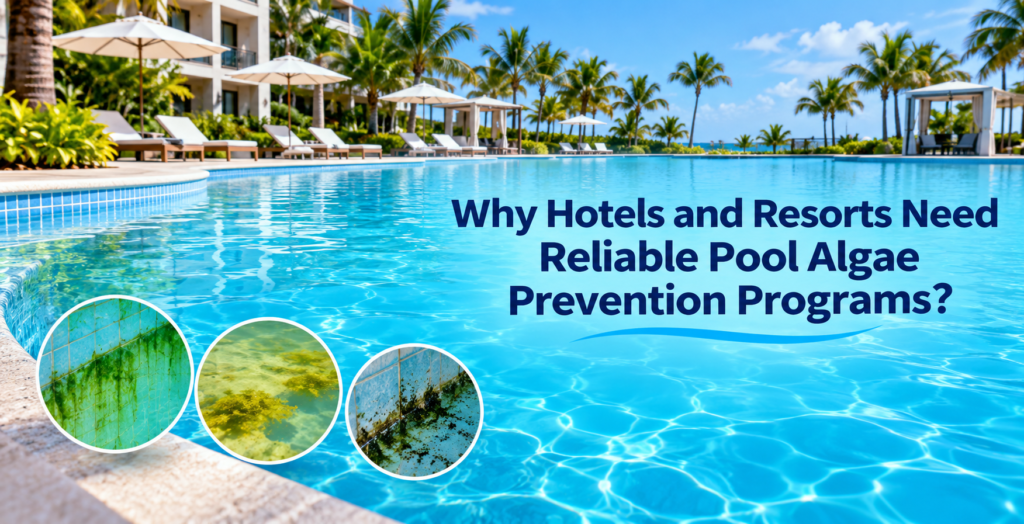
A sparkling blue swimming pool is more than a luxury at a hotel or resort. It’s part of the guest experience. Whether visitors are enjoying a family vacation, relaxing at a beachfront resort, or taking a morning swim before a business meeting, they expect the pool to be clean, inviting, and ready to use.
But behind that beautiful blue water lies a challenge that hotel managers and pool maintenance teams know all too well: algae.
Algae can appear when water conditions, sanitizer levels, circulation, or filtration fall out of control. What starts as a faint green tint or a slippery patch on the pool wall can soon become a costly maintenance problem.
For hotels and resorts, the stakes are higher than they are for most residential pools. A single pool closure can disrupt guest activities, create complaints, and put extra pressure on the maintenance team.
That’s why a reliable pool algae prevention program isn’t just about keeping the water looking good. It’s about protecting guest satisfaction, supporting safe pool operations, controlling maintenance costs, and keeping an important hotel amenity available.
Let’s explore why algae prevention matters so much in hospitality settings—and how hotels can build a practical, consistent pool care program.
SEO title: Hotel & Resort Pool Algae Prevention Guide | Eautrix
Meta description: Discover why hotels and resorts need reliable pool algae prevention programs to protect guest satisfaction, reduce maintenance costs, and maintain clear pool water.
Article framework: Guest experience and business risks → causes of algae growth → prevention strategy → treatment choices → operational planning → FAQs.
A Hotel Pool Is More Than Just a Swimming Area
Think about the role a swimming pool plays in a resort.
For some guests, it’s the main reason they booked the property. Families may spend hours around the pool, while couples look forward to peaceful afternoons beside the water. At luxury resorts, the pool can even become the centerpiece of the property’s marketing photos.
Now imagine those same guests arriving to find cloudy water, green patches on the pool walls, or a notice saying the pool is temporarily closed.
Not exactly the vacation experience they expected, right?
The appearance and availability of the pool can influence how guests feel about the entire property. Even when other facilities are excellent, a poorly maintained swimming pool may leave a lasting negative impression.
This is why professional hotel pool maintenance must go beyond occasional cleaning. It requires a planned approach that keeps water quality consistent throughout the operating season.
A reliable algae prevention program helps achieve that goal.
Why Algae Problems Can Be Especially Costly for Hotels and Resorts
Residential pool owners may be able to close their pools for a few days without much trouble. Hotels rarely have that luxury.
A commercial swimming pool is a shared facility used by many guests, often with changing bather loads throughout the day.
When algae becomes a problem, the consequences can extend well beyond the water itself.
Guest complaints and negative reviews
A swimming pool with visible algae can quickly damage guest confidence.
Even if the problem is limited to a small area, visitors may question the cleanliness of the entire facility.
Guests don’t usually distinguish between algae growth, mineral staining, or other water quality issues. They simply see a pool that doesn’t look clean.
That perception matters.
Online reviews and guest photos can influence future booking decisions, especially for properties that promote their swimming pools as a major attraction.
Unexpected pool closures
Algae outbreaks may require additional brushing, vacuuming, water treatment, filtration, and follow-up testing.
If the water becomes unsafe or visibility is poor, the pool may need to remain closed until it meets applicable operating requirements.
For a busy resort, this creates a real operational challenge.
A pool closure during a holiday weekend can affect hundreds of guests, depending on the property’s size and occupancy.
Higher maintenance costs
Once algae becomes established, removing it often takes more work than preventing it.
Maintenance teams may need to spend additional time cleaning pool surfaces, checking filters, adjusting water chemistry, and restoring normal operating conditions.
Severe outbreaks may also increase water, energy, and chemical consumption.
The exact cost depends on the pool size, equipment, local water conditions, and severity of the problem. Still, the principle is simple: consistent prevention is generally easier to manage than repeated emergency cleanup.
Extra pressure on hotel staff
Hotel maintenance teams already handle a long list of responsibilities.
Unexpected pool problems can pull staff away from routine inspections, equipment servicing, and other property maintenance tasks.
A structured algae prevention program helps reduce avoidable surprises and makes pool care easier to schedule.
Why Are Hotel Swimming Pools More Vulnerable to Algae?
Algae spores can enter outdoor swimming pools through wind, rain, dust, debris, and contaminated equipment. Once introduced, they may grow if the pool environment becomes favorable.
Hotels and resorts often face several conditions that make algae control more demanding.
Heavy and changing bather loads
Hotel pools may experience quiet mornings followed by crowded afternoons.
Swimmers introduce sweat, skin oils, sunscreen, and other organic material into the water. These substances can increase sanitizer demand and place additional pressure on filtration.
If the treatment system doesn’t respond to these changes, sanitizer levels may fall below the required range.
Warm water and strong sunlight
Many resorts operate in warm climates where outdoor pools receive hours of sunlight.
Warm water can support faster biological growth under favorable conditions, while sunlight can accelerate the loss of unstabilized free chlorine.
This combination makes regular water testing and sanitizer control essential.
Large pools and complex circulation systems
Resort swimming pools may include shallow lounging areas, decorative features, connected spas, waterfalls, and unusual pool shapes.
Some areas can receive weaker circulation than others.
Poorly circulated zones may develop lower sanitizer residuals and allow debris or biofilms to accumulate.
Seasonal changes and unpredictable weather
Outdoor hotel pools face changing environmental conditions.
Heavy rain can introduce debris and alter water chemistry. Dust storms, strong winds, and nearby landscaping may add organic material to the pool.
During peak tourist seasons, increased guest activity can further increase treatment demand.
A reliable prevention program must account for these changes rather than relying on a fixed chemical routine throughout the year.
What Does a Reliable Pool Algae Prevention Program Include?
A good algae prevention program isn’t built around one chemical product. It’s a combination of water testing, disinfection, filtration, cleaning, and preventive treatment.
Each part supports the others.
For example, an algaecide may help suppress algae growth, but it can’t compensate for poor circulation or consistently low sanitizer levels.
Hotel pool operators need a system that addresses the full picture.
1. Maintain proper sanitizer levels
Chlorine and other approved disinfectants form the foundation of swimming pool water treatment.
They help control harmful microorganisms and prevent conditions that support algae growth.
For many public pools, CDC guidance identifies a minimum free chlorine level of 1 ppm, or 2 ppm when cyanuric acid is used. Local regulations may require different or higher levels.
Hotels must follow the applicable public pool regulations and the instructions for their treatment systems.
The key is consistency.
Sanitizer levels should be checked frequently enough to respond to changes in bather load, weather, and water conditions.
2. Keep pH under control
Pool water pH affects sanitizer performance, swimmer comfort, and equipment conditions.
When pH moves outside the appropriate range, chlorine may become less effective or water may become more irritating to swimmers.
The CDC recommends maintaining pool pH between 7.0 and 7.8, while some local public pool codes specify a narrower range.
Routine testing helps maintenance teams identify changes before they develop into larger problems.
3. Support effective circulation and filtration
Water must move through the treatment system to maintain consistent quality.
Poor circulation can create areas where sanitizer levels are lower and debris accumulates.
Hotel pool maintenance teams should regularly inspect pumps, filters, skimmers, return inlets, and other circulation equipment.
Special attention should be given to corners, steps, shallow areas, and decorative water features.
Filtration also removes suspended particles that can reduce water clarity.
4. Brush and clean pool surfaces
Even a well-treated pool needs physical cleaning.
Brushing helps remove deposits and disrupt early algae growth on walls, floors, steps, and other surfaces.
Vacuuming and skimming remove debris before it places additional demand on the treatment system.
For resort pools with complex shapes, a detailed cleaning schedule is particularly valuable.
5. Consider a preventive algaecide
An appropriately registered or authorized pool algaecide can provide an additional layer of algae control when used according to its approved label.
This is particularly useful for pools exposed to heavy use, warm weather, or repeated environmental contamination.
However, algaecides are supplemental treatments, not substitutes for approved pool disinfectants.
They should be incorporated into the maintenance program only after checking product suitability, local regulations, water chemistry, and compatibility with existing treatment chemicals.
Why Preventive Algae Control Is Better Than Emergency Treatment
There’s a big difference between maintaining a clean pool and trying to recover one that has already turned green.
Preventive maintenance focuses on keeping conditions unfavorable for algae growth.
Emergency treatment focuses on correcting an existing problem, often while guests are waiting for the pool to reopen.
Consider the practical differences.
| Maintenance factor | Preventive program | Reactive treatment |
|---|---|---|
| Water appearance | Aims to maintain consistent clarity | May require recovery from visible algae |
| Chemical management | Planned testing and treatment | Corrective treatment may be needed |
| Labor requirements | Predictable cleaning routines | Extra cleaning and monitoring |
| Pool availability | Lower risk of algae-related closures | Greater risk of interrupted access |
| Operating costs | Easier to plan and manage | More variable |
| Guest experience | More consistent | Greater chance of complaints |
Prevention doesn’t guarantee that algae will never appear. Equipment failures, unexpected contamination, and extreme weather can still create problems.
But a structured program reduces avoidable risks and helps staff respond earlier.
For hotel operators, that predictability has real value.
How Polyquat 60 Algaecide Can Support Hotel Pool Maintenance
Among the products used for pool algae control, polymer-based algaecides have attracted interest because of their formulation characteristics.
One example is Polyquat 60 Algaecide, based on Polixetonium Chloride, also known as Polyquaternium-42, CAS No. 31512-74-0.
Polyquat 60 is a cationic polymer-based algaecide used in certain swimming pool algae control formulations.
Its properties make it worth considering when developing a preventive pool maintenance program, subject to product approval and label requirements.
Non-oxidizing algae control
Unlike chlorine, Polyquat 60 is a non-oxidizing treatment.
It works through interactions between the positively charged polymer and negatively charged components of algal cells, helping interfere with normal cellular function.
This provides a different approach to algae control from chlorine-based oxidation.
However, it does not replace chlorine or another approved disinfectant for maintaining sanitary swimming pool water.
Low-foaming characteristics
Foaming can be an unwelcome problem in swimming pools, especially where water features create turbulence.
Some conventional quaternary ammonium algaecides can produce noticeable foam.
Polyquat 60 formulations are generally valued for their low-foaming characteristics, making them potentially suitable for pools with fountains, waterfalls, or other water movement.
Actual foam performance depends on the formulation, concentration, and water conditions.
Metal-free formulation possibilities
Copper-based algaecides can be effective, but they may create staining concerns under certain water chemistry conditions.
Polyquat 60 itself does not require copper as its active ingredient.
A copper-free Polyquat formulation can therefore be attractive to hotels concerned about metal-related staining on pool surfaces.
Of course, staining can still arise from other metals present in the pool water, so balanced water chemistry remains important.
Compatibility with routine chlorination
Polyquat 60 products can be formulated for use alongside conventional chlorination programs.
This allows them to serve as supplemental algae control products without replacing the primary sanitizer.
Compatibility should still be verified for the specific commercial formulation.
Concentrated chemicals should never be mixed directly unless the manufacturer explicitly permits it.
Flexible formulation and packaging
Hotels and resorts differ greatly in size.
A small boutique hotel may have one swimming pool, while a large resort may operate several pools with different volumes and treatment systems.
For chemical distributors and private label pool care brands, Polyquat 60 can be supplied in different packaging formats to serve these markets.
1L bottles
Suitable for retail distribution, smaller pool service requirements, and selected maintenance applications.
5L containers
Convenient for professional pool service companies and smaller commercial accounts.
25L drums
A practical packaging format for professional pool maintenance and commercial chemical distribution.
200L drums and 1000L IBCs
Designed for bulk distribution, professional formulators, and larger chemical purchasing operations.
Eautrix supplies Polyquat 60 Algaecide raw material and supports customized concentration and private label packaging requirements for business customers.
For more product information, visit Eautrix Pool Chemical Products.
How Hotels Can Build a Practical Algae Prevention Schedule
A prevention program works best when it becomes part of normal hotel operations.
The goal isn’t to make maintenance more complicated. It’s to create a routine that staff can follow, record, and review.
Daily: Check the essentials
Daily pool maintenance should focus on water quality and visible conditions.
Staff should inspect water clarity, measure sanitizer residuals and pH at the frequency required by local regulations, and check for unusual debris or discoloration.
They should also confirm that circulation and filtration equipment is operating correctly.
For busy public pools, testing may be required multiple times each day or continuously through an approved monitoring system.
Any abnormal result should trigger corrective action.
Weekly: Review trends and clean thoroughly
Weekly maintenance should include a more detailed review of pool conditions.
This may involve brushing walls and steps, inspecting filters, checking chemical consumption, and reviewing test records.
Where a preventive algaecide is part of the approved treatment program, staff should follow the product’s labeled application schedule.
The correct frequency and dosage depend on the actual formulation, pool volume, operating conditions, and applicable regulations.
A universal weekly algaecide dose isn’t appropriate for every hotel pool.
Monthly: Evaluate overall performance
Monthly reviews help managers identify recurring problems.
Does one pool consistently require more chlorine than the others? Are algae spots appearing in the same corner? Does water clarity decline during high-occupancy weekends?
These patterns can reveal circulation issues, filtration problems, or weaknesses in the maintenance schedule.
Managers should also review chemical inventory, equipment service records, and staff training needs.
Seasonally: Prepare for changing conditions
Resorts with seasonal operations need additional planning.
Before the busy season, maintenance teams should inspect equipment, verify treatment systems, and confirm that sufficient chemicals and testing supplies are available.
During peak occupancy, testing and cleaning schedules may need adjustment.
For seasonal closures, winterization should follow the equipment manufacturer’s guidance, local conditions, and approved chemical product labels.
A preventive program should change with the pool’s operating environment—not remain frozen on a checklist.
The Role of Staff Training in Reliable Algae Prevention
Even the most carefully designed pool maintenance program can fail if staff don’t understand how to implement it.
Hotel maintenance teams need clear instructions, reliable testing equipment, and consistent recordkeeping.
Training should cover water testing, chemical handling, equipment inspection, cleaning procedures, and emergency response.
Staff should also understand the difference between a disinfectant and an algaecide.
This distinction is essential.
A pool can look clear while still having inadequate disinfection. Likewise, an algaecide may suppress visible algae without making contaminated water safe for swimming.
Chemical safety training is equally important.
Pool chemicals should be stored according to their labels and safety data sheets. Incompatible chemicals must be separated, and concentrated products should never be mixed without explicit manufacturer instructions.
For hotels operating several pools, written standard operating procedures can help maintain consistent treatment across the property.
Choosing the Right Pool Algaecide for Commercial Hospitality Use
Hotel operators and professional pool service companies should evaluate algaecides based on more than purchase price.
A product that appears inexpensive may create additional costs if it causes excessive foam, staining, compatibility problems, or inconsistent results.
The following factors deserve attention:
- Regulatory approval: Confirm that the product is registered or authorized for the intended use and location.
- Active ingredient: Understand the chemistry and concentration of the formulation.
- Performance: Review relevant efficacy data and the types of algae covered by the approved label.
- Foaming behavior: Consider pools with waterfalls, fountains, or strong circulation.
- Staining potential: Check whether the formulation contains copper or other metals.
- Compatibility: Confirm suitability for the existing disinfection and filtration systems.
- Documentation: Request the product label, safety data sheet (SDS), and certificate of analysis (COA), where applicable.
- Supply reliability: Consider packaging quality, lead times, and consistency between production batches.
For hotels that purchase chemicals through a pool service contractor, these questions can form part of the supplier evaluation process.
The lowest price per container doesn’t always mean the lowest cost of maintaining a pool.
Why Consistent Chemical Quality Matters
Commercial pool maintenance depends on predictable results.
When a hotel uses the same product repeatedly, maintenance staff need confidence that its concentration and physical characteristics remain consistent.
Unexpected changes in a chemical product can affect handling, dosing calculations, and treatment performance.
For Polyquat 60 Algaecide, quality evaluation may include active ingredient concentration, appearance, pH, density, and viscosity.
Eautrix’s standard Polyquat 60 material is an amber, transparent, viscous liquid with an active ingredient concentration typically specified at approximately 58–61%.
These raw material specifications are useful for formulation and quality control, but they are not a substitute for finished-product efficacy testing or regulatory authorization.
For professional buyers, batch-to-batch consistency and clear technical documentation are important parts of supplier selection.
Pool Algae Prevention and the Bigger Guest Experience
There’s an interesting connection between pool maintenance and hospitality management.
Guests rarely notice a pool that’s maintained perfectly. They simply enjoy it.
They notice when something goes wrong.
A clean, clear swimming pool supports the relaxed atmosphere that hotels and resorts work hard to create.
It also allows the property to deliver the experience promised in its photographs, website, and booking descriptions.
But appearance is only one part of the story.
A well-managed pool should also meet the applicable public health and safety requirements.
That means maintaining proper disinfection, monitoring water quality, controlling algae, and keeping equipment in good working condition.
Reliable algae prevention contributes to this broader goal by reducing one important source of water quality problems.
For resort managers, it’s an investment in operational consistency as much as visual appeal.
Can Better Algae Prevention Help Control Operating Costs?
Yes, although the savings depend on the property and its existing maintenance performance.
Preventing recurring algae outbreaks may help reduce unexpected cleaning work, corrective chemical treatments, and downtime.
It can also make chemical purchasing more predictable.
For example, a hotel that regularly experiences algae growth after busy weekends may benefit from reviewing sanitizer demand, filtration capacity, and maintenance staffing.
The solution may involve improved circulation, more frequent testing, changes to cleaning schedules, or an approved supplemental algaecide.
In some cases, equipment improvements may offer greater value than adding more chemicals.
That’s why commercial pool algae prevention should be treated as a system rather than a single-product solution.
A well-managed system aims to maintain reliable water quality while avoiding unnecessary treatment and waste.
Why Pool Chemical Distributors Should Pay Attention to the Hotel Market
Hotels and resorts represent an important customer segment for professional pool chemical distributors.
Unlike many residential pool owners, hospitality facilities require regular maintenance throughout their operating seasons.
They may also work with dedicated pool service contractors or centralized purchasing teams.
These customers often value product reliability, technical support, suitable packaging, and consistent supply.
For distributors developing their own pool chemical brands, a professional algae prevention product can complement an existing range of disinfectants, pH control chemicals, and water clarifiers.
Polyquat-based formulations may be particularly interesting where buyers seek low-foaming, copper-free algae control products.
However, commercial success depends on meeting the regulatory requirements of the target market and providing accurate, supported product claims.
Eautrix works with business customers interested in Polyquat 60 raw materials, custom concentrations, and private label pool chemical packaging.
Product development should begin with a clear understanding of the intended market, regulatory pathway, and customer requirements.
A Reliable Pool Is Part of a Reliable Resort
Hotels and resorts invest heavily in creating memorable guest experiences.
Beautiful landscaping, comfortable rooms, excellent service, and inviting swimming pools all contribute to that experience.
Yet the pool can become a source of frustration when algae growth interrupts normal operations.
A reliable pool algae prevention program helps reduce that risk.
By combining consistent disinfection, balanced water chemistry, effective filtration, routine cleaning, staff training, and suitable supplemental treatments, hotels can maintain more predictable pool conditions.
Products such as Polyquat 60 Algaecide may play a supporting role where they are approved and appropriate for the facility.
The larger lesson is straightforward: preventing algae is easier to manage than repeatedly responding to outbreaks.
And for a hotel or resort, a pool that’s consistently clean, clear, and available helps deliver exactly what guests came to enjoy.
Frequently Asked Questions About Hotel Pool Algae Prevention
1. How often should hotels use algaecide in their swimming pools?
The application frequency depends on the algaecide formulation, approved product label, pool conditions, and local regulations. Some products are labeled for periodic preventive treatment, while others have different instructions. Hotels should follow the specific product label and never use algaecide as a replacement for routine disinfection.
2. Is Polyquat 60 Algaecide suitable for commercial hotel swimming pools?
Polyquat 60-based formulations can be suitable for certain commercial pool algae control programs because of their non-oxidizing, low-foaming, and potentially copper-free characteristics. However, suitability depends on the finished product’s registration or authorization, approved label, water treatment system, and local requirements.
3. What causes recurring algae growth in resort swimming pools?
Common contributing factors include inadequate sanitizer residuals, poor circulation, insufficient filtration, debris accumulation, and inconsistent maintenance. Warm weather and heavy bather loads can increase treatment demand. Identifying the underlying cause is essential for long-term algae prevention.
4. Can hotels prevent pool algae without using additional algaecides?
Yes. Proper disinfection, balanced water chemistry, effective filtration, and routine cleaning are the primary defenses against algae. Many pools can maintain good algae control without a separate algaecide. Supplemental products may be considered when they provide a justified benefit and are approved for the intended application.
5. What should hotel managers look for when purchasing pool algae prevention chemicals in bulk?
Hotel managers should check regulatory approval, active ingredient concentration, product performance data, compatibility, packaging, storage requirements, and supplier reliability. Professional buyers should also request relevant technical documentation, including the SDS, product label, and COA where applicable. Consistent product quality is especially important for commercial pool maintenance programs.