
GET IN TOUCH
Ask For Sample?
The Difference Between Preventive and Corrective Algae Treatment
A swimming pool can look perfect on Monday and turn cloudy green by Friday. It’s a frustrating sight, especially when the water was clear just a few days ago.
The truth is, algae problems rarely appear out of nowhere. They often start long before you see green patches on the walls or a change in water color. Poor circulation, low sanitizer levels, and hidden organic buildup can give algae the chance to grow.
That’s why pool professionals use two different approaches to algae management: preventive algae treatment and corrective algae treatment.
Both have their place. Yet they serve different purposes, require different levels of effort, and can lead to very different maintenance costs.
Preventive treatment aims to stop algae from gaining a foothold. Corrective treatment deals with algae that have already become a visible problem.
So, which approach makes more sense for your pool? And where do polymer-based algaecides, such as Polyquat 60, fit into a reliable algae control program?
Let’s explore the differences, the chemistry behind each approach, and the practical steps that help keep pool water clear.
Preventive vs. Corrective Algae Treatment: A Quick Comparison
Before getting into the details, here’s a simple comparison.
| Feature | Preventive treatment | Corrective treatment |
|---|---|---|
| Main purpose | Reduce the risk of algae growth | Control and remove existing algae |
| When to use | Before visible algae appear | After algae become visible or are confirmed |
| Pool condition | Usually clear and balanced | May be green, cloudy, or stained |
| Main approach | Maintain sanitizer, circulation, cleaning, and suitable algaecide support | Restore sanitizer, brush, filter, vacuum, and treat algae |
| Chemical demand | Often lower and more predictable | May be higher, depending on severity |
| Labor required | Routine maintenance | More intensive cleaning and testing |
| Downtime | Usually little or none when products are used correctly | Swimming may need to stop during treatment |
| Long-term goal | Stable water quality | Restore water quality and prevent recurrence |
The key difference is timing.
Prevention manages the conditions that allow algae to grow. Correction tackles algae after those conditions have already caused trouble.
Neither approach replaces proper pool sanitation. Even an effective algaecide cannot make up for consistently poor chlorine control, inadequate filtration, or neglected pool cleaning.
What Is Preventive Algae Treatment?
Preventive algae treatment is a planned maintenance approach that helps reduce the chance of algae developing in swimming pool water.
Instead of waiting for visible growth, pool owners maintain water conditions that make algae growth less likely.
This usually includes:
- Keeping free chlorine or another approved sanitizer within the required range.
- Maintaining suitable pH and water balance.
- Running the circulation and filtration systems for sufficient periods.
- Brushing pool surfaces and removing debris.
- Using a compatible preventive algaecide when appropriate.
Think of preventive algae control like maintaining your car. Regular checks and small adjustments help avoid costly repairs later.
A pool works in much the same way.
Why Prevention Matters Even When the Water Looks Clear
Clear water doesn’t always mean algae are absent.
Microscopic algae cells can enter a pool through wind, rainwater, swimming equipment, or contaminated debris. Under favorable conditions, they can multiply before anyone notices a problem.
Warm water, sunlight, nutrients, and insufficient sanitizer residuals can all contribute to algae growth.
A pool may look clean while early algae growth is developing in poorly circulated areas, behind ladders, around steps, or inside surface imperfections.
Preventive maintenance helps reduce these risks before the pool develops visible algae.
The Role of Preventive Algaecides
Preventive algaecides are chemical products used to help inhibit algae growth.
They are usually applied as part of a wider pool maintenance program rather than as a replacement for chlorine.
One important category is polymer-based algaecides.
For example, Polyquat 60 Algaecide, based on Polixetonium Chloride (CAS No. 31512-74-0), is a non-oxidizing polymer-based product used in pool algae control formulations.
Depending on the approved formulation and product label, Polyquat 60 can be used in preventive algae management and certain corrective treatment programs.
Its non-foaming character and metal-free composition make it attractive for pool care applications where foam and metal-related staining are concerns.
However, treatment rates and approved uses depend on the exact product, its active concentration, and local regulatory requirements.
What Is Corrective Algae Treatment?
Corrective algae treatment begins when algae have already developed in the pool.
At this stage, the problem is no longer just a risk. It has become an active maintenance issue.
You may notice green water, slippery walls, colored patches, or recurring algae growth in certain areas.
Corrective treatment aims to control the algae, remove dead and living material, and restore suitable swimming conditions.
Unlike routine prevention, corrective treatment often requires several coordinated actions.
What Happens During a Corrective Treatment?
A typical corrective treatment process involves testing the water, restoring appropriate sanitizer levels, brushing affected surfaces, and running the filtration system.
Vacuuming and filter cleaning help remove accumulated material.
A suitable algaecide may also be used if its label permits treatment of existing algae.
The important point is that killing algae and removing algae are not the same thing.
Even after algae are no longer viable, dead cells and fine debris may remain suspended in the water. These particles can cause cloudiness until filtration and physical cleaning remove them.
That explains why a pool may still look dull or cloudy after a successful algae treatment.
Why Corrective Treatment Takes More Work
Once algae become established, they may spread across pool surfaces and accumulate in areas with poor circulation.
Corrective treatment must address both the algae and the conditions that allowed them to grow.
For example, if the chlorine level fell because the pool’s circulation system was not operating correctly, adding an algaecide without fixing the circulation issue may produce only temporary improvement.
The algae could return.
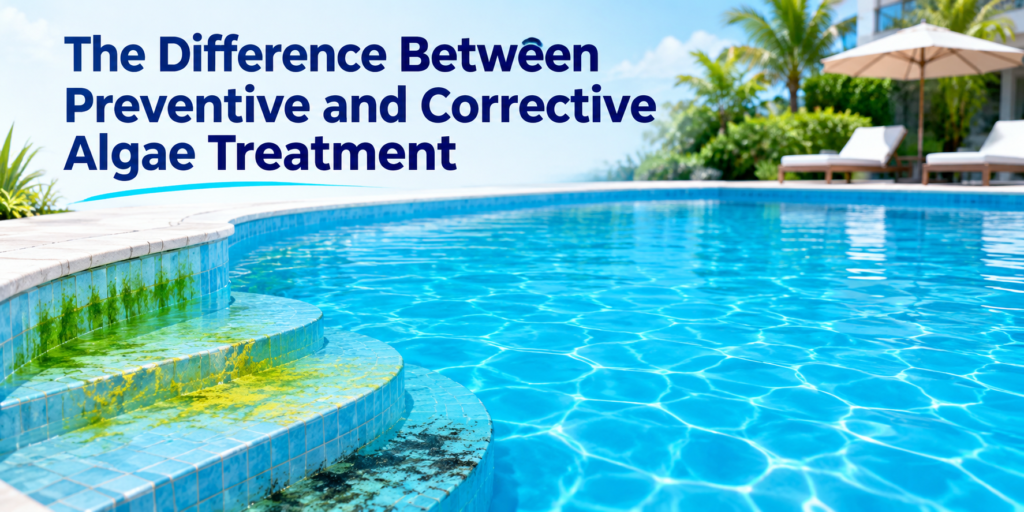
That’s why professional pool service companies focus on identifying the cause, not just removing the visible symptoms.Hero image alt text: “Preventive vs corrective algae treatment in a swimming pool, showing green algae buildup on pool steps beside clear blue water.”
How Does Polyquat 60 Work in Algae Control?
Polyquat 60 belongs to a class of cationic polymers. The word cationic means that the polymer carries positive electrical charges.
These charges play an important role in how the chemical interacts with algae cells.
Algae cell surfaces generally contain negatively charged components. Positively charged polymer molecules can interact with these surfaces, potentially disrupting normal cell functions and inhibiting growth.
This makes Polyquat 60 useful as an active ingredient in certain non-oxidizing algaecide formulations.
However, Polyquat 60 does not work in the same way as chlorine.
Chlorine is an oxidizing sanitizer. It reacts with a wide range of contaminants and helps control microorganisms in pool water.
Polyquat 60 is a non-oxidizing algaecide. Its primary role is algae control, not general pool disinfection.
Understanding this distinction helps prevent one of the most common mistakes in pool maintenance: expecting an algaecide to replace a sanitizer.
Why Polyquat 60 Is Often Used for Prevention
A well-maintained pool already has suitable sanitizer levels, balanced water chemistry, and functioning filtration.
Under these conditions, a compatible preventive algaecide can provide additional protection against algae growth.
Polyquat 60 has several characteristics that make it attractive for this purpose:
- Non-foaming performance: Suitable for formulations designed to avoid persistent foam during normal pool circulation.
- Metal-free formulation: Does not introduce copper or other metal-based algaecide ingredients that may contribute to staining.
- Non-oxidizing chemistry: Provides a different algae control mechanism from chlorine.
- Formulation flexibility: Can be supplied at different concentrations for suitable commercial products.
- Maintenance applications: Can support routine algae prevention when used according to approved label directions.
These characteristics explain why polymer-based algaecides are of interest to pool chemical distributors, maintenance companies, and private label brands.
Still, compatibility must be assessed for each finished formulation. A polymer that performs well in one pool chemical system may behave differently when combined with other treatment products.
Can Polyquat 60 Be Used for Corrective Algae Treatment?
Yes, some registered Polyquat 60 formulations have directions for treating existing algae.
But there’s an important qualification.
A product’s ability to help control algae does not mean it can replace the complete corrective treatment process.
If a pool has a severe algae bloom, the treatment may require restoring the sanitizer residual, brushing affected surfaces, cleaning the filter, and removing accumulated debris.
A Polyquat 60 formulation may play a supporting role where its approved label permits that use.
For example, a pool with early signs of green algae may respond to a combination of corrected water chemistry, brushing, adequate filtration, and a suitable algaecide.
A heavily contaminated pool may need a more intensive corrective program.
The severity of the algae problem matters.
So does the type of algae involved.
Green, Yellow, and Black Algae: Does the Treatment Change?
Not all algae problems behave the same way.
Pool professionals commonly describe algae by their visible appearance, although color alone does not provide a precise biological identification.
Often associated with green water, slippery surfaces, and visible deposits. Early treatment may be easier than controlling a widespread bloom.
May appear as yellowish or brownish deposits, especially in shaded areas. Thorough brushing and cleaning of equipment are important because deposits can recur.
Often appears as dark, firmly attached spots on porous pool surfaces. Persistent colonies may require repeated brushing and a targeted treatment program. Some black deposits are stains rather than algae, so identification matters.
The corrective treatment approach should reflect the actual problem, pool surface, sanitizer system, and approved product instructions.
For example, aggressive brushing may be suitable for some plaster surfaces but can damage certain vinyl or fiberglass finishes.
There is no single chemical treatment that works equally well in every situation.
Preventive Algae Treatment: A Practical Maintenance Routine
A preventive program doesn’t have to be complicated.
What matters most is consistency.
1. Maintain the Correct Sanitizer Residual
Free chlorine is one of the main defenses against algae growth in chlorinated pools.
Its effectiveness depends on factors such as pH, cyanuric acid concentration, sunlight exposure, and swimmer load.
Follow the applicable public health requirements and the sanitizer manufacturer’s directions.
For many residential chlorine pools, a pH of approximately 7.2–7.8 is a common operating target, while chlorine requirements depend on the system and stabilizer level.
Don’t rely on a single chlorine reading without considering the rest of the water chemistry.
2. Keep Water Moving
Algae can develop in areas where circulation is weak.
Steps, corners, ladders, and recessed fittings may receive less water movement than the main swimming area.
Proper circulation helps distribute sanitizer and other treatment chemicals throughout the pool.
It also allows the filter to capture suspended particles.
3. Brush and Clean Regularly
Brushing removes deposits and helps expose developing algae to sanitizer.
It also prevents dirt and organic matter from collecting on pool surfaces.
Regular skimming, vacuuming, and filter maintenance reduce the amount of material that can interfere with water treatment.
4. Apply Preventive Algaecide When Appropriate
Some maintenance programs include periodic algaecide applications.
The exact schedule and dosage depend on the finished product label, active ingredient concentration, pool volume, and local conditions.
Avoid assuming that every Polyquat 60 product has the same treatment rate.
A 60% active concentrate and a diluted retail formulation are not interchangeable on a volume-for-volume basis.
5. Monitor Conditions That Increase Algae Risk
Warm weather, heavy rainfall, high swimmer loads, and extended periods of low sanitizer residual can increase maintenance demands.
Pools may also need extra attention before long periods of inactivity or seasonal closure.
A preventive program should adapt to these conditions rather than follow an inflexible chemical schedule.
Corrective Algae Treatment: How to Restore a Problem Pool
When algae are already visible, a structured treatment process helps avoid wasted chemicals and repeated cleaning.
Here’s a practical sequence.
Step 1: Identify the Problem
Check whether the discoloration is caused by algae, suspended dirt, metals, or another water quality issue.
Green water can sometimes result from dissolved metals rather than living algae.
Treating the wrong problem may make the situation worse.
Step 2: Test the Water
Measure free chlorine, pH, and other relevant parameters.
For stabilized chlorine pools, cyanuric acid concentration is particularly important because it affects chlorine activity.
Use a suitable test kit and follow the treatment instructions applicable to the pool.
Step 3: Correct the Water Chemistry
Restore the sanitizer residual and pH according to the appropriate corrective treatment procedure.
Some products require particular water conditions before application.
Never mix concentrated pool chemicals together, and never combine products unless their labels expressly permit it.
Step 4: Brush Affected Surfaces
Brush algae deposits from walls, steps, and other affected areas using equipment suitable for the pool surface.
This helps expose attached growth to the treatment chemicals.
Step 5: Apply an Approved Algae Treatment
If an algaecide is needed, select a product whose label covers the intended corrective use.
Follow its specific directions for dosage, application, compatibility, and swimming restrictions.
Do not assume that a preventive maintenance dose is sufficient for an established algae bloom.
Step 6: Filter and Remove Debris
Operate the filtration system as directed and clean or backwash the filter when required.
Vacuum accumulated debris and remove dead algae material.
If the water remains cloudy, investigate filtration performance before adding more chemicals.
Step 7: Confirm Recovery Before Swimming
The pool should meet applicable sanitizer, pH, clarity, and other safety requirements before reopening.
The bottom of the pool must be clearly visible, and any product-specific waiting periods must be satisfied.
Once conditions are restored, resume the preventive maintenance program.
Which Approach Costs Less?
Preventive algae treatment generally offers better cost control than repeated corrective treatment.
Why?
Because an established algae problem may involve more than the cost of an algaecide.
Additional expenses can include:
- Increased sanitizer and other treatment chemical consumption.
- Extra labor for brushing and vacuuming.
- Longer filtration periods and increased energy demand.
- Additional filter cleaning or replacement.
- Water loss from backwashing or draining.
- Temporary pool closure and lost operating time.
For a residential pool, these costs may be inconvenient.
For a hotel, resort, water park, or commercial swimming facility, the impact can be much greater.
A closed swimming pool may affect guest satisfaction, maintenance schedules, and operating revenue.
Preventive maintenance cannot eliminate every algae problem, but it can reduce the frequency and severity of avoidable incidents.
Does Prevention Always Mean Using More Chemicals?
Not necessarily.
A good preventive program starts with proper sanitation, water balance, and circulation.
Additional algaecide should serve a defined purpose.
Adding chemicals without testing or evaluating the pool’s condition is not an effective preventive strategy.
In fact, unnecessary chemical applications can increase costs and create compatibility problems.
The goal is not to use more chemicals.
It’s to maintain better control.
Why Preventive Treatment Matters for Commercial Pools
Commercial swimming pools face different operating conditions from residential pools.
Hotels, resorts, fitness centers, and public swimming facilities may experience large changes in swimmer load throughout the day.
Outdoor pools also face changing weather conditions, airborne debris, and seasonal temperature fluctuations.
These factors can affect sanitizer demand and algae growth risk.
A preventive program helps pool operators maintain more predictable water quality.
It can also reduce emergency maintenance calls.
Consider a resort pool during a busy summer weekend.
If algae begin to develop on Friday evening, corrective treatment may interfere with weekend operations.
Even if the algae can be controlled quickly, filtration and water clarity recovery may take additional time.
By contrast, regular testing, adequate circulation, surface cleaning, and appropriate preventive treatment can reduce the chance of that disruption.
For commercial operators, consistency is often more valuable than a dramatic last-minute chemical treatment.
Preventive Algae Treatment During Pool Winterization
Seasonal pool closure presents another important algae control challenge.
When a pool is closed for winter, regular maintenance may become less frequent.
Yet algae can still develop when temperatures rise or sanitizer levels decline.
A winterization program may include cleaning, balancing the water, adjusting sanitizer levels, and applying a suitable winter algaecide.
Polyquat-based products are used in certain winter algae prevention formulations.
Their non-foaming and metal-free characteristics can be useful for pool owners who want to avoid unnecessary foam or metal staining concerns.
However, winter algaecide is only one part of proper pool closure.
The pool must also be prepared according to local climate conditions, equipment requirements, and the applicable product instructions.
In freezing climates, protecting plumbing and equipment from ice damage is especially important.
When the pool reopens, the water should be tested and treated before swimming resumes.
What Should Pool Chemical Distributors Look for in an Algaecide?
For distributors and private label pool chemical brands, the difference between preventive and corrective treatment has commercial importance.
Customers don’t always purchase pool chemicals based on their chemical names.
They purchase solutions to specific problems.
Some want to keep clear water clear.
Others need help restoring a pool affected by algae.
These are different buying situations, and product communication should reflect that distinction.
Active Ingredient and Concentration
The active ingredient determines the chemical’s fundamental function.
For Polyquat 60 Algaecide, the commonly referenced active ingredient is Polixetonium Chloride, CAS No. 31512-74-0.
A concentrate containing approximately 60% active ingredient differs substantially from a diluted retail formulation.
Distributors should confirm the concentration basis, product specification, and finished formulation before comparing supplier quotations.
Preventive and Corrective Label Claims
Product labels should accurately describe the intended uses.
A formulation marketed for algae prevention should not automatically be promoted as a treatment for severe algae blooms.
Corrective treatment claims require appropriate supporting evidence and regulatory authorization where applicable.
This is particularly important for brands entering regulated markets.
Product Appearance and Packaging
Packaging affects both logistics and customer experience.
Common private label packaging formats for pool algaecides include 1L bottles, 5L containers, and 25L drums.
Larger industrial packaging may include 200L drums and 1000L IBCs.
The standard Polyquat 60 concentrate is generally an amber, transparent, viscous liquid.
Finished product appearance may vary with concentration and formulation.
Packaging materials should be evaluated for chemical compatibility, leak resistance, transport requirements, and labeling suitability.
Quality Documentation
Professional buyers should request appropriate product documentation, including:
- Certificate of Analysis (COA).
- Safety Data Sheet (SDS).
- Technical specifications.
- Active ingredient concentration information.
- Packaging specifications.
- Available stability and compatibility data.
- Applicable regulatory and registration documentation.
For private label products, label claims and application directions should also be reviewed before commercialization.
Can One Algaecide Product Serve Both Markets?
Potentially, yes.
A suitable algaecide formulation may have both preventive and corrective applications if supported by its performance data and approved labeling.
However, the two applications may require different treatment rates.
The product’s concentration, label instructions, and local regulations determine how it can be marketed and used.
For a distributor, this creates several possible product strategies.
A concentrated algaecide may be positioned toward professional pool service companies.
A lower-concentration formulation may be developed for routine retail maintenance.
Seasonal products may focus on winter algae prevention.
But these commercial differences should never be based on branding alone. Each finished formulation needs appropriate testing, instructions, and regulatory review.
Common Mistakes in Algae Treatment
Even experienced pool owners can make mistakes when dealing with algae.
One of the most common is waiting too long.
A small patch of algae may seem harmless, but it can become a larger maintenance problem when sanitizer levels remain inadequate.
Another mistake is adding algaecide without checking chlorine and pH.
Chemical treatment is much less reliable when the underlying water conditions are ignored.
Overdosing is another concern.
More algaecide does not always mean faster or better results. Excessive application may cause unnecessary costs, water quality issues, or compatibility problems.
Some pool owners also overlook the filter.
Chemical treatment may control algae, but suspended debris still needs to be removed.
Finally, a pool that looks clear after treatment is not necessarily ready for swimming.
Water clarity is important, but sanitizer and other safety parameters must also meet the required conditions.
Building a Better Algae Management Program
The most reliable approach combines prevention with a clear corrective response plan.
Preventive maintenance should be the foundation.
That means routine testing, appropriate sanitizer levels, circulation, filtration, and cleaning.
An approved algaecide can provide additional algae control where suitable.
Corrective treatment should be available when problems occur.
The key is to identify the cause, restore water chemistry, remove algae and debris, and then return to routine maintenance.
For pool professionals, this creates a practical cycle:
01
Test
Check sanitizer and water balance
02
Prevent
Maintain circulation, cleaning, and algae control
03
Correct
Respond to visible algae or poor water conditions
04
Verify
Confirm recovery and resume maintenance
This approach can reduce unnecessary chemical use, improve operating consistency, and help protect the swimming experience.
Choosing the Right Polyquat 60 Supplier for Your Pool Care Brand
For pool chemical distributors, formulation quality is just as important as product positioning.
A consistent Polyquat 60 supply helps support reliable finished product manufacturing.
Buyers should evaluate active ingredient concentration, appearance, viscosity, batch consistency, packaging quality, and documentation.
Eautrix supplies Polyquat 60 Algaecide based on Polixetonium Chloride (CAS No. 31512-74-0), with options for bulk supply and private label development.
Available packaging configurations can be discussed for retail, professional, and distributor applications.
For buyers developing their own preventive algae treatment products, formulation concentration and packaging can be considered alongside local regulatory requirements.
Contact Eautrix at info@eautrix.com to discuss Polyquat 60 specifications, sample evaluation, and private label algaecide requirements.
Final Thoughts: Prevention First, Correction When Needed
Preventive and corrective algae treatments are not competing methods.
They are two parts of the same pool maintenance strategy.
Prevention reduces the likelihood of algae growth through consistent sanitation, water balance, cleaning, and suitable supporting products.
Correction addresses algae after they appear and helps restore acceptable water conditions.
For most pools, prevention should receive the greatest attention.
It’s usually easier to maintain a clear pool than to recover one after a serious algae bloom.
And when corrective treatment becomes necessary, the most effective response combines chemistry with proper cleaning, filtration, and water testing.
Polyquat 60 Algaecide can support algae management programs when used in suitable, properly labeled formulations.
But the real secret to reliable algae control isn’t a single chemical.
It’s consistent pool care.
Frequently Asked Questions (FAQ)
1. What is the main difference between preventive and corrective algae treatment?
Preventive algae treatment helps reduce algae growth before visible problems develop. Corrective algae treatment addresses algae that are already present. Prevention focuses on regular sanitation and maintenance, while correction usually requires more intensive cleaning, filtration, and chemical treatment.
2. Can Polyquat 60 Algaecide be used for both preventive and corrective pool algae treatment?
Certain Polyquat 60 formulations can be used for both purposes when their approved labels include those applications. Treatment rates may differ, and established algae problems often require additional sanitizer management, brushing, and filtration.
3. How often should preventive algaecide be added to a swimming pool?
Application frequency depends on the specific algaecide formulation, its active concentration, the pool’s operating conditions, and the product label. Some products provide periodic maintenance directions, but algaecide should never replace routine sanitizer testing and control.
4. Is preventive algae treatment cheaper than removing an established algae bloom?
Preventive maintenance is generally more economical because severe algae blooms may require additional chemicals, labor, filtration, and pool downtime. However, unnecessary algaecide applications can also increase costs, so treatment should reflect actual pool needs.
5. What is the best way to prevent algae from returning after corrective treatment?
Maintain appropriate sanitizer levels, balanced pH, effective circulation, regular brushing, and clean filtration equipment. Identify and correct the conditions that caused the original algae problem. A compatible preventive algaecide may provide additional protection when used according to its approved label.