
GET IN TOUCH
Ask For Sample?
How Algae Problems Develop in Commercial Swimming Pools?
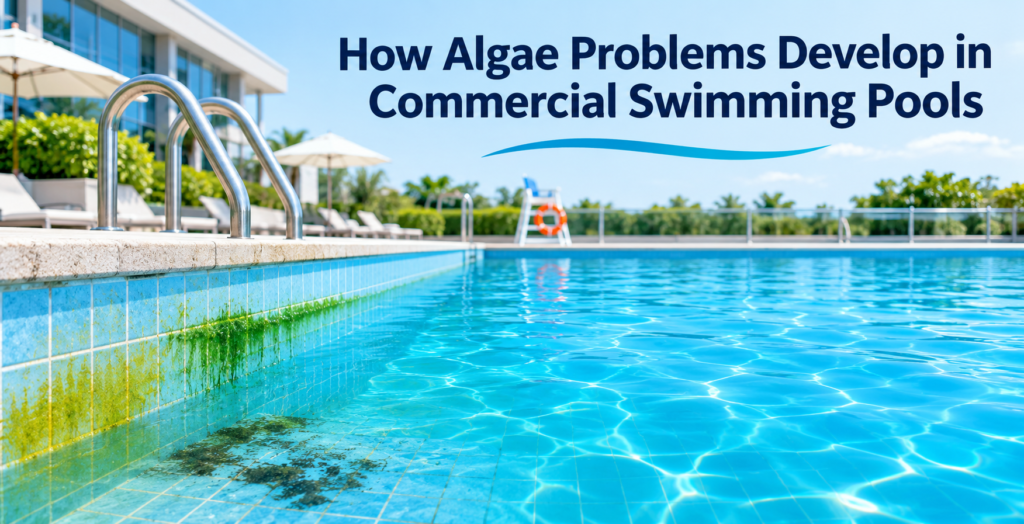
Commercial swimming pools can look crystal clear one day and show signs of algae growth just a few days later. A green tint appears near the steps. Dark spots form along the tile line. The water loses its sparkle, and the maintenance team faces a problem that seems to have come out of nowhere.
But algae problems rarely appear without warning.
In most cases, they develop through a series of small changes in water chemistry, circulation, filtration, and pool use. One missed chemical adjustment may not cause an outbreak. Yet when several factors occur together, algae can gain a foothold.
For hotels, resorts, aquatic centers, fitness clubs, and public swimming facilities, this is more than a cosmetic issue. Algae can affect water clarity, increase chemical demand, create slippery surfaces, and lead to unexpected pool closures.
Understanding how algae problems develop in commercial swimming pools helps operators recognize early warning signs, improve preventive maintenance, and avoid costly treatment cycles.
This guide explains the causes, stages, risk factors, and practical prevention methods behind commercial pool algae growth.
Why Are Commercial Swimming Pools Vulnerable to Algae?
Commercial pools face conditions that differ from those of typical residential pools.
A backyard pool may serve one family. A hotel pool might welcome dozens or hundreds of swimmers throughout the day. Public aquatic facilities can experience even greater changes in bather load.
Each swimmer introduces substances that affect water quality, including sweat, skin cells, body oils, and residues from personal care products.
These materials don’t automatically cause algae. However, they can increase the demand for sanitizer and add organic matter to the water.
Commercial facilities also face other challenges:
- Long operating hours and frequent swimmer activity
- High water temperatures in heated pools
- Outdoor exposure to sunlight, dust, and debris
- Complex circulation systems with areas of weak water movement
- Variable chemical demand during busy periods
- Large pool surfaces that require regular brushing and inspection
The problem is often a combination of these factors.
A pool may have a functioning filtration system and still develop algae if sanitizer levels fall or water movement is poor in certain areas.
That’s why commercial pool algae prevention requires more than adding chemicals on a fixed schedule.
How Does Algae Enter Swimming Pool Water?
Algae are simple organisms that can grow in water when conditions support them.
Algae cells or spores may enter outdoor swimming pools through windblown dust, rainwater, leaves, contaminated equipment, and other environmental sources.
Swimmers and maintenance tools may also introduce material from nearby water environments.
Preventing every algae cell from entering a commercial pool is neither practical nor necessary. The real goal is to maintain water conditions that prevent algae from establishing and multiplying.
A properly maintained sanitizer residual is the main defense.
When that defense weakens, algae may begin to grow on pool surfaces or in the water itself.
The Five Stages of Algae Development in Commercial Pools
Algae growth doesn’t follow an exact five-step biological timetable. Still, the process can be understood through five practical stages that help pool operators identify problems before they become severe.
Stage 1: Algae Enter the Pool
Microscopic algae enter the water through normal environmental exposure. The pool may look perfectly clear, and routine tests may show no obvious problem.
Stage 2: Sanitizer Protection Weakens
Free chlorine may decline because of heavy swimmer use, sunlight, increased organic load, or chemical-feed problems. Areas with poor circulation may receive less effective sanitizer exposure.
Stage 3: Algae Establish on Surfaces
Algae may begin growing in corners, along steps, near ladders, or in other areas with limited water movement. At this stage, the problem may appear as faint discoloration or slippery deposits.
Stage 4: Visible Growth Develops
Green patches, yellowish deposits, or dark spots become easier to notice. Some algae may spread into the water, contributing to a green appearance and reduced clarity.
Stage 5: The Outbreak Affects Pool Operations
More extensive algae growth can increase treatment needs, place additional demand on filtration, and require the facility to restrict swimming until safe water conditions are restored.
These stages explain why early action matters so much. A small patch near a pool step may be much easier to manage than a widespread bloom that affects the entire swimming area.
What Causes Algae Growth in Commercial Swimming Pools?
Several operating conditions can create opportunities for algae to grow. Understanding their roles helps maintenance teams find the cause rather than simply treating the visible symptoms.
1. Low Free Chlorine Levels
Free chlorine is one of the most important controls against algae growth in chlorinated commercial pools.
When its concentration falls below the required operating range, the pool becomes more vulnerable to algae and other microbial problems.
Free chlorine can decline because of:
- Heavy swimmer loads
- High organic contamination
- Strong sunlight in outdoor pools
- Chemical feeder malfunction
- Inadequate monitoring or chemical adjustment
For example, a hotel pool may maintain suitable chlorine levels in the morning. After several hours of heavy use, however, the sanitizer demand may rise.
If chemical feeding doesn’t keep pace, the chlorine residual can fall.
The pool might still look clear, but its protection has weakened.
This is one reason operators should monitor sanitizer levels throughout operating hours, with testing frequency based on local requirements and pool conditions.
2. Poor Water Circulation
Even when chlorine is present, it must reach all parts of the pool.
Poor circulation can create areas where water exchanges more slowly, sometimes called dead zones.
These areas often occur around steps, recessed corners, decorative structures, and other features that interrupt normal water flow.
If sanitizer distribution is weak and surfaces are not brushed regularly, algae may establish in these locations.
Pool operators should inspect return jets, circulation patterns, pump performance, and areas where deposits repeatedly appear.
3. Inadequate Filtration
Filtration helps remove suspended particles and debris from pool water.
When filters become overloaded, damaged, or poorly maintained, water clarity may decline and particulate material may remain in circulation.
It’s important to understand that filtration and sanitization perform different jobs.
A filter removes particles. A sanitizer controls susceptible microorganisms.
A well-maintained filter cannot compensate for inadequate chlorine levels. Likewise, chlorine alone cannot remove all suspended particles.
Commercial pool operators need both systems working together.
4. Unbalanced Pool Water Chemistry
Water chemistry affects the performance of pool treatment programs.
In chlorinated pools, pH is especially important because it influences the balance between different forms of free chlorine.
As pH rises, the proportion of hypochlorous acid—the more effective disinfecting form of chlorine—generally decreases.
Other parameters, including cyanuric acid in outdoor pools, also influence sanitizer performance.
High cyanuric acid concentrations can reduce chlorine’s disinfecting activity at a given free chlorine reading.
Pool operators should maintain all chemical parameters within applicable health-code requirements and the ranges specified for their treatment systems.
5. High Water Temperature
Warm water can support faster biological growth under suitable conditions.
Heated hotel pools, therapy pools, and indoor aquatic facilities may face increased challenges when water temperature combines with heavy use and insufficient sanitizer control.
Warm water can also increase chemical demand through greater swimmer activity and other operating effects.
Temperature alone doesn’t cause an algae outbreak. But it can contribute to conditions that favor growth when other controls are weak.
6. Sunlight and Outdoor Exposure
Outdoor commercial pools face a double challenge.
Sunlight can support photosynthesis in algae, while ultraviolet radiation can also break down unstabilized free chlorine.
Wind and rain may introduce additional debris, dust, and other contaminants.
This makes outdoor hotel and resort pools especially sensitive to changes in weather and operating conditions.
Maintaining appropriate sanitizer levels and managing stabilizer concentrations are essential parts of outdoor pool care.
7. Irregular Brushing and Surface Cleaning
Some algae establish on surfaces before the water changes color.
Brushing helps remove deposits and disrupt surface growth, making it easier for the treatment system to contact affected areas.
If brushing is neglected, algae may remain in grout lines, corners, steps, or other difficult-to-clean locations.
Automatic cleaners can help with routine maintenance, but they may not reach every surface.
Manual inspection and targeted brushing still matter, particularly in large commercial pools.Hero image alt text: Commercial swimming pool showing early green algae growth along tiled walls and dark algae-like deposits on the pool floor, illustrating how algae problems develop in commercial swimming pools.
What Types of Algae Are Common in Commercial Pools?
Not every algae problem looks the same. Color, location, and surface behavior can offer useful clues, although visual appearance alone cannot confirm the organism involved.
| Common description | Typical appearance | Maintenance concern |
|---|---|---|
| Green algae | Green patches or green-tinted water | Can spread when sanitizer control is inadequate |
| Mustard or yellow algae | Yellow or brownish powder-like deposits | May return if affected surfaces and equipment aren’t treated |
| Black algae | Dark spots or embedded-looking patches | Can be difficult to remove from porous surfaces |
One point deserves attention: not every black spot is black algae, and not every yellow deposit is mustard algae. Metal staining, dirt, and other deposits can look similar.
Accurate identification matters because the wrong treatment can waste chemicals without solving the underlying problem.
Why Can Algae Return After Pool Treatment?
Few things frustrate a commercial pool maintenance team more than seeing algae return soon after treatment.
The pool was brushed. Chemicals were added. The water cleared.
Then, several days later, the same patches appeared.
Why?
Often, the visible algae were treated without correcting the conditions that allowed growth in the first place.
A circulation dead zone may still exist. Chlorine levels may continue to fall during peak swimming hours. Contaminated cleaning equipment may be reintroduced. Or surface deposits may not have been fully removed.
This is why algae control should be viewed as an ongoing operating process rather than a single chemical treatment.
Effective recovery involves both removing existing growth and restoring the pool’s normal protective conditions.
How Commercial Pool Algae Problems Affect Business Operations
Algae growth creates challenges beyond water appearance.
For commercial facilities, the consequences can extend into staffing, maintenance budgets, customer satisfaction, and regulatory compliance.
Higher Chemical and Maintenance Costs
An established algae outbreak may require additional sanitizer, brushing, vacuuming, filtration, and water testing.
Maintenance teams may also spend more time cleaning surfaces and monitoring recovery.
Repeated outbreaks can increase costs even when each individual treatment appears manageable.
Reduced Guest Satisfaction
Guests expect clean, inviting swimming pools.
A green tint or visible surface growth can raise concerns about facility maintenance, even before a swimmer understands the cause.
For hotels and resorts, pool appearance is part of the guest experience. A poorly maintained pool can affect how visitors perceive the property as a whole.
Unexpected Pool Closures
When water conditions fail to meet applicable public-health requirements, operators may need to close the pool until compliance is restored.
Algae itself is not the only concern. Inadequate sanitizer levels or poor water clarity may indicate that essential safety controls are not working as intended.
Pool closure decisions must follow local health regulations rather than visual appearance alone.
Increased Pressure on Maintenance Teams
Commercial pools often operate under tight schedules.
An algae outbreak can force maintenance staff to change planned tasks, conduct additional testing, and coordinate treatment around facility opening hours.
Preventing recurring outbreaks can therefore improve both water quality and operating efficiency.
How Can Commercial Pools Prevent Algae Before It Becomes Visible?
The most effective prevention programs combine water chemistry control, mechanical maintenance, and routine inspection.
Maintain Reliable Sanitizer Levels
Keep free chlorine or another approved primary sanitizer within the range required by local health authorities.
Pay attention to changes in swimmer load, weather, water temperature, and chemical demand.
Automatic chemical controllers can support consistency, but they still require calibration, maintenance, and independent verification.
Keep Water Circulating Effectively
Check pumps, return jets, skimmers, and circulation patterns.
Look for areas where debris accumulates or algae repeatedly appears.
These locations may indicate weak circulation or inadequate surface cleaning.
Maintain Filtration Performance
Inspect filters according to the equipment manufacturer’s instructions.
Monitor operating pressure, flow, and other relevant indicators. Clean or backwash filters when required.
Filtration performance should be evaluated together with water clarity and circulation, not from filter pressure alone.
Brush Pool Surfaces Regularly
Pay special attention to steps, corners, ladders, tile lines, and textured surfaces.
Brushing removes deposits and helps prevent surface growth from becoming established.
The correct frequency depends on pool design, usage, and maintenance conditions.
Track Water Chemistry Trends
A single test result provides a snapshot.
A maintenance log reveals patterns.
Recording sanitizer levels, pH, water temperature, combined chlorine, and other required parameters can help identify recurring problems.
For example, if chlorine consistently drops during afternoon swimming sessions, the operator may need to review feeder capacity, operating procedures, or testing frequency.
Consider a Supplemental Algaecide Program
Some commercial pool operators use approved algaecides as part of a broader maintenance program.
Polymeric algaecides, including certain polyquaternary ammonium compounds, may be used to help control algae where the specific product is registered and labeled for that purpose.
However, an algaecide is not a replacement for a required sanitizer residual.
The correct product, concentration, treatment rate, and application method depend on its approved label and the applicable local regulations.
Where Does Polyquat 60 Algaecide Fit into Commercial Pool Maintenance?
Polyquat 60 is a common name for certain concentrated polymeric algaecide formulations based on Polixetonium Chloride, also identified as Polyquaternium-42, CAS No. 31512-74-0.
These products are associated with non-oxidizing algae control.
Unlike chlorine-based oxidizing sanitizers, Polyquat 60 formulations work through a different chemical mechanism. Their cationic polymer structure can interact with negatively charged biological surfaces.
Depending on the formulation and approved use, they may serve as supplemental algae-control products in swimming pool maintenance.
Some characteristics that make Polyquat 60 formulations of interest to commercial pool chemical buyers include:
- Non-oxidizing chemistry
- Generally low-foaming behavior in suitable formulations
- Metal-free formulations that do not introduce copper-based staining concerns
- Potential compatibility with chlorine-based pool treatment programs, subject to label directions
- Availability in concentrated liquid forms for commercial packaging and distribution
Yet product selection requires care.
A 60% active polymer concentrate is not automatically suitable for direct use in every commercial swimming pool. The finished formulation must be assessed for its intended application, legal registration, labeling, and compatibility.
Commercial operators should use only products approved for swimming pool algae control in their jurisdiction.
For distributors and private-label pool chemical brands, Eautrix offers information about Polyquat 60 and specialty pool chemical solutions.
Algaecide vs. Pool Clarifier: Why the Difference Matters
Commercial pool operators sometimes confuse algae-control chemicals with water clarifiers.
Both may contribute to better-looking pool water, but they serve different purposes.
| Feature | Pool algaecide | Polymer pool clarifier |
|---|---|---|
| Primary purpose | Control susceptible algae | Help remove fine suspended particles |
| Main function | Biological algae control | Particle aggregation |
| Typical application | Supplemental algae prevention or treatment | Water clarity improvement |
| Replaces sanitizer? | No | No |
| Corrects poor circulation? | No | No |
A polymer pool clarifier may help fine particles form larger aggregates that filters can capture more easily.
However, clarifiers don’t necessarily kill or control algae.
Likewise, treating algae doesn’t guarantee that all remaining suspended material will disappear without adequate filtration.
For professional buyers, understanding these distinctions is important when developing a complete commercial pool chemical product range.
A Practical Commercial Pool Algae Prevention Checklist
INTERACTIVE MAINTENANCE CHECKLIST
Maintenance review
0 of 8 completeVerify sanitizer and pH levels at the required frequencyInspect water clarity and pool surfacesCheck chemical feeders and circulation equipmentRemove debris and clean skimmer basketsBrush areas prone to algae growthReview filtration performance and maintenance needsRecord test results and investigate unusual trendsCheck that supplemental treatments comply with product labels
Reset
This checklist is a general maintenance aid, not a substitute for a facility’s required testing schedule or operating procedures.
Why Prevention Is More Cost-Effective Than Repeated Algae Treatment
Preventive maintenance doesn’t eliminate every possible algae problem.
Equipment can fail. Weather can change quickly. Unexpected swimmer loads can increase chemical demand.
But a well-managed pool is better prepared to handle these changes.
Regular testing helps operators catch sanitizer problems early. Brushing reduces the chance that surface growth becomes established. Effective circulation and filtration support more consistent water quality.
The benefits extend beyond algae control.
A reliable maintenance program can reduce emergency treatment needs, support clearer water, and make operating costs more predictable.
For commercial facilities, consistency is often more valuable than a dramatic recovery after an outbreak.
Final Thoughts: Algae Problems Start Small, but Their Impact Can Be Large
Algae problems in commercial swimming pools usually develop when several protective measures weaken together.
Low sanitizer levels, poor circulation, inadequate surface cleaning, and changing operating conditions can create opportunities for algae to grow.
By the time water turns green, the underlying problem may have been developing for some time.
The most effective response is to identify the cause, restore appropriate water conditions, and maintain a consistent prevention program.
Supplemental products such as properly approved Polyquat 60 algaecides may have a place in that program, but they should support—not replace—sanitization, filtration, circulation, and routine cleaning.
For commercial pool operators, the goal isn’t simply to remove algae when it appears. It’s to keep the pool safe, clear, and ready for swimmers day after day.
Frequently Asked Questions (FAQ)
1. How quickly can algae develop in a commercial swimming pool?
Under favorable conditions, visible algae growth may develop within a few days after sanitizer protection becomes inadequate. The timing depends on temperature, sunlight, water chemistry, circulation, and the amount of algae already present.
2. Can algae grow in a commercial pool that still has chlorine?
Yes. Algae may develop when the free chlorine residual is too low for the pool’s conditions, when sanitizer distribution is poor, or when other water chemistry factors reduce treatment effectiveness. A detectable chlorine reading alone doesn’t prove that the water is adequately protected.
3. What are the first signs of algae growth in hotel swimming pools?
Early signs may include slippery surfaces, faint green or yellow deposits, recurring discoloration around steps, and patches in areas with weak circulation. These symptoms should prompt inspection and water testing, since dirt and staining can look similar.
4. Is Polyquat 60 suitable for commercial swimming pool algae prevention?
Polyquat 60-based formulations may be suitable as supplemental algaecides when the finished product is registered or otherwise legally authorized for the intended pool use. Operators must follow the specific product label and should not use industrial polymer concentrates as pool treatments without appropriate authorization.
5. How can commercial pool operators prevent recurring algae outbreaks?
The most reliable approach is to maintain required sanitizer levels, control pH and other water chemistry parameters, ensure effective circulation and filtration, brush pool surfaces, and investigate repeated problem areas. Approved supplemental algaecides may also be considered as part of a complete maintenance program.