
GET IN TOUCH
Ask For Sample?
Why Low-Foaming Algaecides Matter for Swimming Pool Maintenance?
A clean swimming pool should have clear water, smooth circulation, and a surface that looks inviting. But what happens when the algaecide you use creates a layer of foam across the water?
It’s not just an eyesore. Excess foam can make pool care harder, affect the swimming experience, and raise questions about water quality. For pool owners, service companies, and chemical distributors, this makes one product feature worth a closer look: low-foaming performance.
Low-foaming algaecides help control algae without adding unwanted foam to the pool. They can be especially useful in pools with strong water movement, such as those with waterfalls, return jets, or attached spas.
But there’s more to the story. Not all algaecides behave the same way, and a product labeled “non-foaming” doesn’t mean foam can never appear.
This guide explains why foam forms, how low-foaming algaecides work, and why polymer-based products such as Polyquat 60 can be a practical choice for routine pool maintenance.
What Causes Foam in Swimming Pools?
Before comparing algaecides, it helps to understand why pool water foams in the first place.
Foam forms when air becomes trapped in water and bubbles remain stable long enough to collect at the surface. Water movement creates the bubbles, while certain dissolved substances help keep them from bursting.
Think about washing dishes. Plain water can form bubbles when shaken, but add a little soap and those bubbles last much longer. A similar effect can happen in swimming pools.
Several factors can contribute to pool foam.
- Foaming algaecides: Some quaternary ammonium compounds, often called quats, have surfactant properties that can stabilize bubbles.
- Body care products: Shampoo, sunscreen, lotions, and cosmetics may introduce foam-forming substances.
- Organic contamination: Sweat, body oils, and other residues can contribute to persistent surface bubbles.
- Strong water agitation: Waterfalls, spa jets, and return fittings introduce air and make existing foam more visible.
- Excess chemical dosing: Adding more of a foaming product than the label allows can make the problem worse.
Not every bubble signals a chemical problem. Air entering through a suction-side leak, for example, can create visible bubbles without the same foam-stabilizing mechanism.
The key difference is persistence. Bubbles that disappear almost at once are less concerning than a thick layer that remains on the surface.
Why Do Some Algaecides Produce More Foam Than Others?
The answer comes down to chemistry.
Many traditional algaecides contain quaternary ammonium compounds. These positively charged chemicals can interact with negatively charged components of algal cells and membranes.
Some also act as surfactants. A surfactant lowers the surface tension of water and can help bubbles remain stable. That’s useful in cleaning products, but not so welcome in a swimming pool.
Traditional quaternary ammonium algaecides
Certain conventional quat-based algaecides can produce noticeable foam, especially when used at high concentrations or in pools with strong water movement.
Their performance varies with the active ingredient, formulation, dose, and water conditions. It would be misleading to say every conventional quat algaecide foams heavily.
Still, foam is a common reason pool professionals look for alternative formulations.
Polymeric quaternary ammonium algaecides
Polymeric algaecides contain larger molecular structures with multiple charged sites along a polymer chain.
One familiar example is Polyquat 60 Algaecide, a product category based on polymeric quaternary ammonium chemistry.
Compared with many conventional, low-molecular-weight quat algaecides, Polyquat 60 formulations are generally associated with much lower foaming.
That makes them attractive for pools where water appearance and surface movement matter.
Copper-based algaecides
Copper-based products offer another approach to algae control. They generally don’t create foam through the same surfactant mechanism.
However, copper introduces a different set of concerns. Under certain water conditions, excess dissolved copper can contribute to staining or discoloration.
Polymeric, metal-free algaecides can avoid adding copper to pool water, although this doesn’t eliminate every possible source of staining.
What Makes Low-Foaming Algaecides So Useful?
1. They help preserve the pool’s appearance
A clear blue pool can lose its appeal when foam gathers near the edges or return jets. Low-foaming algaecides reduce the chance of the treatment itself causing that problem.
Image alt: Clear blue swimming pool water with a smooth surface, illustrating the visual benefits of low-foaming pool algaecides.
This matters most in places where appearance is part of the customer experience. Hotels, resorts, fitness clubs, and premium residential pools all depend on water that looks clean and well cared for.
Even when foam isn’t dangerous by itself, swimmers may see it as a sign of poor maintenance. That perception can affect confidence in the facility.
2. They suit pools with strong water movement
Some pools have more agitation than others.
A quiet residential pool may have little visible turbulence. A resort pool with waterfalls, deck jets, and connected water features may introduce much more air into the water.
Foam-forming ingredients become more noticeable in these conditions.
A low-foaming algaecide helps reduce one possible source of persistent bubbles, making it easier to maintain an attractive surface during normal circulation.
3. They reduce the need to troubleshoot product-related foam
Imagine a pool service technician finishing routine treatment, only to receive a call the next morning about white foam around the steps.
Now the technician has to investigate. Was the dose too high? Did swimmers introduce soap or lotion? Is there a circulation issue?
Using a low-foaming formulation removes one common contributor from that list.
It doesn’t guarantee a foam-free pool, but it can make routine maintenance more predictable.
4. They support a more comfortable swimming experience
Most swimmers don’t want to move through patches of persistent foam. They want water that feels clean and looks natural.
Foam itself is not a reliable measure of health risk, but a heavily foaming surface can make it harder to judge whether the water needs attention.
Low-foaming products help maintain the visual conditions swimmers expect, while proper sanitizer levels, filtration, and water balance remain essential for safety.
5. They can help professional pool brands reduce complaints
For distributors and private label pool chemical brands, product performance extends beyond the active ingredient’s ability to control algae.
Customers also notice how a product behaves after application.
A formula that provides algae control while minimizing foam may lead to fewer appearance-related complaints, especially from pool service companies managing many sites.
Of course, low foam is only one part of quality. A reliable algaecide also needs consistent active content, suitable stability, clear dosing instructions, and accurate labeling.
Polyquat 60: A Low-Foaming Approach to Algae Control
One of the most widely recognized types of low-foaming polymeric algaecide is Polyquat 60.
The term commonly refers to a formulation containing approximately 60% active polymeric quaternary ammonium compound, although exact product specifications and regulatory identities must be checked.
Eautrix supplies a Polyquat 60 Algaecide based on Polixetonium Chloride, associated with CAS No. 31512-74-0.
This material is a cationic polymer. In simple terms, its molecules carry positive charges that can interact with negatively charged surfaces, including components of algal cells.
Its algae-control performance depends on concentration, contact conditions, algae species, and the complete formulation.
Key characteristics of Polyquat 60
| Characteristic | Practical relevance |
|---|---|
| Low-foaming behavior | Helps limit product-related foam during circulation |
| Polymeric cationic chemistry | Provides a different formulation profile from many conventional quats |
| Non-oxidizing action | Does not replace chlorine or another primary sanitizer |
| Metal-free formulation | Does not add copper as an active ingredient |
| Concentrated liquid form | Suitable for dilution and different packaging formats |
| Maintenance applications | Can support algae prevention when used according to an approved label |
Polyquat 60 is not a substitute for balanced pool chemistry. It works as part of a broader maintenance program that includes filtration, circulation, cleaning, and disinfection.
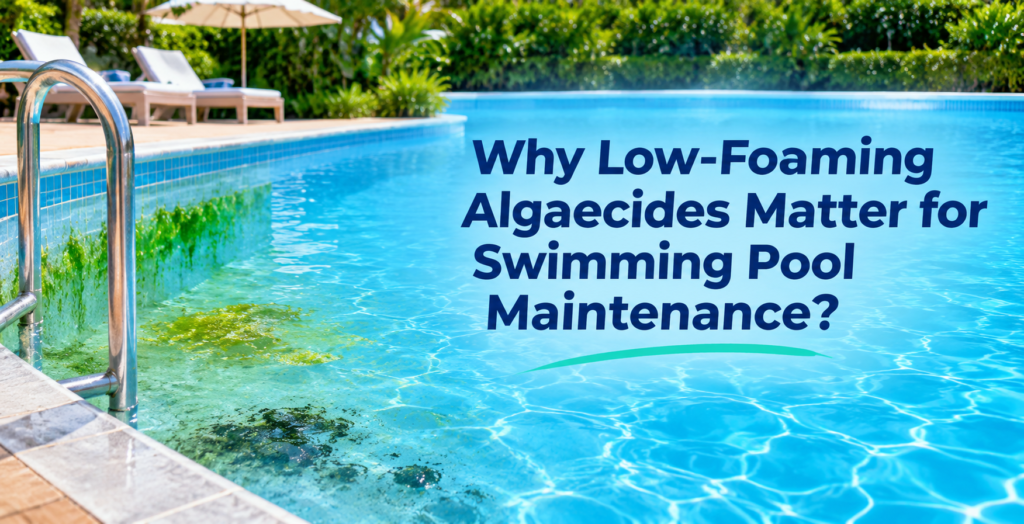
For distributors, concentrated formulations can also provide flexibility in packaging and product development, subject to local registration and labeling requirements.Hero image alt: Swimming pool with visible green algae along one wall and clear blue water, illustrating why low-foaming algaecides matter for swimming pool maintenance.
Low-Foaming vs. Foaming Algaecides: What’s the Difference?
Not every pool needs the same algaecide. The right product depends on the pool’s design, water conditions, treatment goals, and local regulations.
Here’s how the main categories compare.
| Feature | Conventional Quat Algaecides | Polyquat 60 Algaecides | Copper-Based Algaecides |
|---|---|---|---|
| Foaming tendency | Can be moderate to high | Generally low | Generally low |
| Main chemistry | Small-molecule quats | Cationic polymer | Copper compounds |
| Metal content | Usually metal-free | Metal-free | Contains copper |
| Staining concern | No copper added | No copper added | Possible copper staining |
| Routine algae prevention | Product-dependent | Suitable when label-approved | Product-dependent |
| Water feature suitability | May cause visible foam | Often a good fit | Low foam, but copper needs monitoring |
| Main consideration | Foam potential | Dose and formulation quality | Metal accumulation and water balance |
The important point? Low foam doesn’t automatically mean better algae control.
A product must still be effective against the target algae under actual pool conditions. Foaming behavior and algae-control performance are two separate properties.
A good maintenance program considers both.
Why Low-Foaming Algaecides Matter for Commercial Pools
Commercial swimming pools face different demands from small residential pools.
They may have more swimmers, longer operating hours, larger filtration systems, and stricter maintenance procedures. Water appearance is also closely linked to the facility’s reputation.
Hotels and resorts
Guests often judge a swimming pool before they enter it.
A smooth, clear surface creates a positive first impression. Persistent foam, even when caused by an approved treatment product, may raise questions about cleanliness.
Low-foaming algaecides can help minimize this issue, particularly in pools with decorative fountains or waterfalls.
Fitness clubs and aquatic centers
These facilities often operate on fixed maintenance schedules.
Technicians need chemical products that behave consistently. Unexpected foam can generate extra inspections and customer questions.
A well-formulated low-foaming algaecide may make maintenance more predictable, though water testing and proper dosing remain essential.
Professional pool service companies
A service company may maintain dozens of pools each week. Each pool has different circulation patterns, swimmer loads, and water chemistry.
A low-foaming product can be useful across this varied customer base because it reduces one common source of appearance-related problems.
For service companies, fewer unnecessary troubleshooting visits can be valuable. However, the actual cost savings depend on the product, customer conditions, and service schedule.
Does Low Foam Mean Better Pool Water Quality?
Not necessarily.
A pool can look crystal clear and still have inadequate sanitizer levels. It can also have some harmless air bubbles while meeting its required water quality parameters.
Low foam is mainly a formulation and appearance characteristic. It should not be used as a substitute for water testing.
Good swimming pool maintenance still requires attention to:
- Free chlorine or another approved primary sanitizer
- pH and total alkalinity
- Filtration and circulation
- Cyanuric acid, where relevant
- Calcium hardness
- Regular brushing and debris removal
- Proper chemical dosing
For many chlorine-treated pools, a pH range around 7.2–7.8 is commonly recommended, although local codes and product labels may specify narrower limits.
Algaecides are supplemental products. They help manage algae but should not be relied upon to disinfect pool water or make it safe for swimming.
Can Low-Foaming Algaecides Be Used with Chlorine?
Many Polyquat 60 formulations are intended for use in properly chlorinated swimming pools.
That’s an important advantage because chlorine remains a primary part of most pool sanitation programs.
However, compatibility should be understood correctly.
Being suitable for a chlorinated pool doesn’t mean an algaecide should be mixed directly with concentrated chlorine products.
Never combine algaecide and chlorine chemicals in the same container unless the manufacturer specifically provides an approved procedure.
It’s also worth remembering that strong oxidizing conditions can affect some organic polymer ingredients. The manufacturer’s application instructions should determine timing, dose, and any restrictions following shock treatment.
For routine maintenance, the goal is straightforward: maintain the required sanitizer residual and use the algaecide as a supporting treatment.
How to Choose a Reliable Low-Foaming Algaecide
For professional buyers, foam performance should be evaluated alongside product quality.
A supplier may describe a product as low-foaming, but the claim becomes more useful when it can be supported by consistent testing.
Check the active ingredient
Start with the chemical identity.
For Polyquat 60 products, request the active ingredient name, CAS number, and concentration.
Also ask whether the product contains additional surfactants, solvents, dyes, or other formulation ingredients that could affect foam behavior.
Request foam performance data
A controlled foam test can help compare formulations.
For example, a laboratory may use a defined concentration, water temperature, agitation method, and foam-height measurement.
Buyers should compare products under the same test conditions. A foam-height result without a test method or concentration has limited value.
Review the technical documents
Professional buyers should request a current Technical Data Sheet (TDS), Safety Data Sheet (SDS), and Certificate of Analysis (COA).
For regulated algaecide markets, buyers should also verify the applicable product registration, approved uses, and label claims.
Test under realistic conditions
A laboratory result is useful, but actual pool water may behave differently.
Test the product at its intended dose, using representative water chemistry and circulation conditions.
Look for persistent foam, unwanted color changes, cloudiness, and any compatibility concerns.
If you’re sourcing for a private label brand, consider comparing more than one production batch.
Consider packaging and supply consistency
A low-foaming algaecide must also reach customers in suitable packaging with consistent quality.
Eautrix offers Polyquat 60 Algaecide supply options including 1L bottles, 5L containers, 25L drums, 200L drums, and 1000L IBCs, subject to order requirements.
Private label packaging and concentration customization can be discussed for different markets.
Why Low-Foaming Performance Matters for Private Label Pool Brands
For pool chemical distributors, a product’s value isn’t limited to what happens inside the pool.
Packaging, labeling, ease of application, and customer feedback all influence repeat purchases.
A low-foaming algaecide offers a clear feature that customers can understand.
Rather than relying on broad claims such as “premium quality,” brands can explain a practical benefit: the product is designed to help control algae while minimizing unwanted foam.
That’s a useful message for pool service companies, commercial facilities, and homeowners with water features.
Still, product claims should remain specific and supported by testing. “Low-foaming” is generally more defensible than promising “zero foam under all conditions.”
For buyers developing a product range, Eautrix can discuss Polyquat 60 concentrations, packaging formats, and private label requirements.
Learn more through the Eautrix product portfolio or visit Eautrix to explore the company’s pool water treatment solutions.
Common Mistakes When Using Low-Foaming Algaecides
Even a good formulation can perform poorly when used incorrectly.
One common mistake is overdosing. Adding extra algaecide does not guarantee better algae control. It may increase treatment cost and create unwanted water effects.
Another mistake is using algaecide as a replacement for chlorine. A non-oxidizing algaecide is not a primary sanitizer, and it cannot replace routine disinfection.
Some pool operators also assume that a low-foaming product will eliminate foam already present in the water. It won’t necessarily do that.
If the foam comes from detergents, lotions, or another chemical, changing the algaecide alone may not solve the problem.
Finally, never assume that two products with the same active ingredient concentration have identical performance. The full formulation, manufacturing consistency, and application conditions all matter.
The Bottom Line: Less Foam, More Predictable Pool Care
Low-foaming algaecides matter because pool maintenance is about more than algae control.
Water appearance, swimmer comfort, chemical compatibility, and consistent treatment all play a role.
Polyquat 60 is a useful example of polymeric algaecide chemistry that can offer low-foaming performance without introducing copper into the pool.
For homeowners, this can mean fewer appearance-related problems. For professional pool service companies, it can simplify routine care. And for private label brands, it provides a practical product feature worth communicating.
The right algaecide still needs proper dosing, reliable quality, and compliance with local regulations.
A good algaecide should help control algae without creating another maintenance problem.
Frequently Asked Questions
1. What is the best low-foaming algaecide for swimming pools?
Polyquat 60 is a common low-foaming algaecide category for swimming pool maintenance. It uses polymeric quaternary ammonium chemistry and is generally less prone to foam than many conventional quat formulations. The best product depends on pool conditions, approved label uses, and local regulations.
2. Does Polyquat 60 algaecide cause foam in pool water?
Polyquat 60 is generally considered low-foaming, but it isn’t guaranteed to produce no foam. Excess dosing, other chemicals, organic contamination, and strong water agitation can all contribute to visible foam. Proper application helps minimize these issues.
3. Can I use low-foaming algaecide in a saltwater swimming pool?
Some low-foaming algaecides are suitable for saltwater pools that use chlorine generators. However, compatibility depends on the specific formulation and its approved label. Always check the manufacturer’s instructions before treatment.
4. Is a low-foaming algaecide better than a copper-based algaecide?
Each type has advantages. Polymeric low-foaming algaecides can provide algae control without adding copper, reducing concerns related to copper accumulation and staining. Copper-based products may also be effective, but they require attention to metal levels and water chemistry.
5. Can pool chemical distributors purchase private label Polyquat 60 algaecide in bulk?
Yes. Eautrix offers Polyquat 60 Algaecide for bulk supply and private label discussions, with packaging options such as 1L, 5L, 25L, 200L, and 1000L IBC. Buyers should confirm specifications, local registration requirements, labeling, and order quantities before purchasing.