
GET IN TOUCH
Ask For Sample?
Understanding Non-Oxidizing Algaecides for Swimming Pools
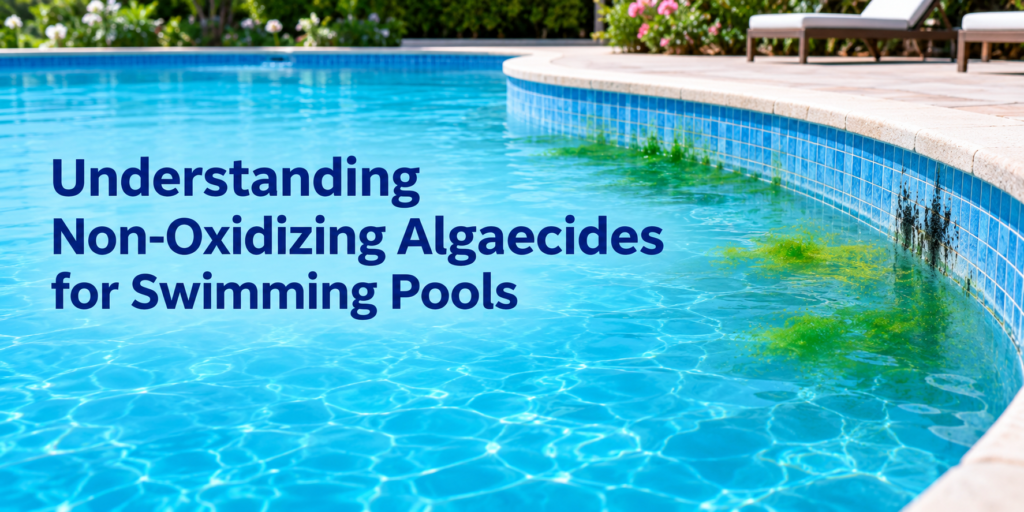
A swimming pool can look clean one day and show signs of algae the next. A green tint appears near the steps. The walls feel a bit slippery. Or small dark spots start to form in the corners.
Sound familiar?
Algae can be a stubborn problem for pool owners and service teams. Even a well-kept pool may face algae growth when chlorine levels fall, circulation slows, or warm weather puts extra stress on the water.
That’s where non-oxidizing algaecides can play a useful role.
Unlike chlorine-based sanitizers, these products control algae through chemical actions that don’t rely on oxidation. Some help prevent new algae growth, while others support treatment of an existing problem.
But here’s the catch: not all non-oxidizing algaecides work the same way. Their active ingredients, strengths, side effects, and ideal uses can vary.
In this guide, we’ll explain how non-oxidizing algaecides work, how they compare with oxidizing treatments, and why polymer-based products such as Polyquat 60 have become an important part of professional pool care.
What Is a Non-Oxidizing Algaecide?
A non-oxidizing algaecide is a chemical product designed to kill algae or limit their growth without using oxidation as its main mode of action.
Oxidizing chemicals, such as chlorine, damage microorganisms through reactions that affect key cell structures and biological molecules. Non-oxidizing algaecides use other methods, often involving interactions with algae cell membranes.
Many common non-oxidizing algaecides contain positively charged compounds. These compounds are attracted to negatively charged sites on algae cells, where they can interfere with normal cell function.
Think of it like this: chlorine attacks through chemical oxidation, while many non-oxidizing algaecides disrupt the cell’s protective barrier.
The result can be reduced algae growth, damage to existing algae, or both, depending on the formulation and dose.
Common types include:
- Polymeric quaternary ammonium compounds (polyquats): Often used for low-foaming algae prevention and maintenance.
- Simple quaternary ammonium compounds (quats): Can provide algae control but may cause foaming, especially at excessive doses.
- Copper-based algaecides: Use dissolved copper ions to inhibit algae, but may cause staining or discoloration if poorly managed.
- Specialty blended algaecides: Combine compatible active ingredients for particular treatment goals.
These products aren’t interchangeable. A polymeric algaecide may behave quite differently from a copper-based formula, even though both fall under the non-oxidizing category.
How Do Non-Oxidizing Algaecides Work?
To understand their value, it helps to know a little about algae cells.
Algae need healthy cell membranes to survive. These membranes help regulate the movement of water, nutrients, and other substances between the cell and its surroundings.
Many cationic non-oxidizing algaecides interfere with that process.
1. Attraction to algae cell surfaces
Many algae cell surfaces carry a net negative electrical charge under typical pool water conditions.
Cationic algaecides contain positively charged groups. This creates an electrostatic attraction between the treatment chemical and the algae surface.
That attraction helps bring the active ingredient into close contact with the target organism.
2. Disruption of cell membrane function
After contact, certain quaternary ammonium compounds can disturb membrane structure and permeability.
When membrane integrity is lost, algae cells may struggle to control their internal environment.
This can lead to cellular damage and, with sufficient exposure, cell death.
The exact response depends on the algaecide chemistry, algae species, concentration, and water conditions.
3. Suppression of further algae growth
Non-oxidizing algaecides may also help limit the development of new algae populations.
This is one reason they’re often used in preventive pool maintenance programs.
However, a maintenance dose is not necessarily strong enough to clear a heavy bloom. Established algae growth may require brushing, filtration, restoration of sanitizer levels, and additional treatment according to the product label.
4. Support for water clarity
Some cationic polymers can interact with suspended particles as well as biological surfaces.
Depending on the formulation, these interactions may help particles aggregate, making them easier for the filtration system to capture.
Still, an algaecide shouldn’t automatically be treated as a pool clarifier. Water clarification performance needs to be evaluated for each formulation.
Non-Oxidizing vs. Oxidizing Algaecides: What’s the Difference?
Both approaches can help manage algae, but they serve different roles in a pool treatment program.
| Feature | Non-oxidizing algaecides | Oxidizing treatments |
|---|---|---|
| Main action | Membrane disruption or other non-oxidative effects | Oxidative damage |
| Common examples | Polyquats, quats, copper compounds | Chlorine-based treatments |
| Primary role | Prevention and supplemental algae control | Sanitization and oxidation |
| Foaming | Depends on chemistry; polyquats are often low-foaming | Not normally a primary concern |
| Staining risk | Copper formulas may stain; metal-free polyquats avoid added copper | Depends on water metals and conditions |
| Organic contaminant oxidation | Not their main function | A major function of chlorine |
| Replaces routine sanitizer? | No | Chlorine can serve as the primary sanitizer |
One point deserves special attention: non-oxidizing algaecides do not replace chlorine or another approved pool sanitizer.
A pool can be free of visible algae and still contain harmful bacteria or other pathogens.
An algaecide supports algae management. A sanitizer maintains microbiological water safety.
For reliable pool care, both functions need to be understood.Hero image alt text: “Non-oxidizing algaecides for swimming pools, showing clear blue pool water with green and dark algae growth along the tiled walls.”
Why Polyquat 60 Is a Popular Non-Oxidizing Algaecide
Among polymer-based non-oxidizing algaecides, Polyquat 60 is a familiar choice in swimming pool maintenance.
The term Polyquat 60 generally refers to a formulation containing approximately 60% active polymeric quaternary ammonium compound. The specific chemical identity should always be confirmed through the product’s technical documentation.
One example is Polixetonium Chloride, CAS No. 31512-74-0, also associated with Polyquaternium-42.
Unlike simple quaternary ammonium compounds, Polyquat 60 uses a polymeric structure with multiple positively charged sites.
This molecular structure influences how the product interacts with algae and other surfaces in pool water.
Low-foaming performance
Foam can be a nuisance in swimming pools, especially where water is heavily agitated.
Think of spa jets, waterfalls, fountains, and busy pool returns. A foaming algaecide can leave an unwanted layer of bubbles on the surface.
Polyquat 60 is generally considered a low-foaming alternative to many simple quat algaecides.
That makes it attractive for pools where surface appearance matters.
However, low-foaming doesn’t mean that every formulation is completely foam-free under all conditions.
Metal-free algae control
Many Polyquat 60 formulations contain no intentionally added copper or other metallic algaecide ingredients.
This matters because dissolved metals can create staining problems when pool chemistry isn’t properly controlled.
Copper, for example, can contribute to greenish or dark stains on pool surfaces and may discolor hair under certain conditions.
A metal-free polyquat avoids introducing copper through the algaecide itself.
Of course, it won’t remove copper or iron already present in the pool.
Compatibility with routine chlorination
Polyquat 60 can be used as part of a chlorine-based pool maintenance program when the product label permits it.
This gives pool operators a way to combine routine sanitization with supplemental algae prevention.
Still, compatibility isn’t the same as unlimited chemical stability.
High concentrations of oxidizing sanitizer can degrade certain organic polymers. For that reason, product-specific directions concerning shock treatment, dosing intervals, and chemical addition should be followed.
Never mix concentrated algaecide and chlorine products directly.
Flexible maintenance applications
Polyquat-based products are used in a range of pool care situations, including routine preventive maintenance and seasonal closing programs.
A product designed for weekly maintenance may use a different application rate from one intended for winter closing.
The active ingredient may be similar, but the treatment objective is different.
That’s why the concentration and approved label directions matter more than the marketing name alone.
What About Other Types of Non-Oxidizing Algaecides?
Polyquat 60 isn’t the only option. Understanding the alternatives helps pool professionals and chemical buyers make more informed decisions.
Simple quaternary ammonium algaecides
Simple quat compounds are widely known for their antimicrobial activity.
They can interact with algae cell membranes and interfere with normal cell function.
Their main drawback in swimming pool applications is their tendency to produce foam, especially when used at excessive concentrations or in highly agitated water.
Some formulations are suitable for routine algae control, but performance and foaming depend on the specific ingredient.
Copper-based algaecides
Copper ions interfere with important biological processes in algae.
Copper-based algaecides can provide effective algae control when properly formulated and applied.
However, water chemistry needs careful attention.
High copper concentrations, elevated pH, and certain oxidation conditions can increase the risk of copper deposits and staining.
For pool owners who prefer to avoid adding metals, polymer-based products may be more appealing.
Other cationic polymer formulations
Different cationic polymers may be formulated for algae control or related pool treatment functions.
For example, EPI/DMA polymers are used in various water treatment applications. Certain formulations may be developed for supplemental algae management.
But a polymer’s use as a coagulant doesn’t automatically establish its effectiveness as an algaecide.
The specific composition, intended use, test results, and regulatory approval must support any algae-control claim.
When Should You Use a Non-Oxidizing Algaecide?
The right timing depends on the pool’s condition.
A clean pool needs a different approach from one with a visible algae bloom.
Routine preventive maintenance
This is one of the most common uses for non-oxidizing algaecides.
A suitable maintenance product can help reduce the risk of algae developing between routine cleaning and sanitization cycles.
It may be particularly useful when:
- Pool water temperatures are rising.
- Sunlight exposure is high.
- Bathing loads are increasing.
- Algae problems have occurred in the past.
- Certain pool areas have weaker circulation.
However, the first line of defense remains proper sanitizer residual, water balance, brushing, and filtration.
An algaecide is an extra layer of protection, not a shortcut around routine care.
Early signs of algae growth
A small green patch near a step or corner may be an early warning.
Before adding treatment chemicals, test the water and inspect the circulation system.
Low sanitizer residual, poor circulation, and accumulated debris may be contributing to the problem.
A labeled non-oxidizing algaecide may support treatment, but it should be used within a broader corrective maintenance plan.
Seasonal pool closing
When a pool is prepared for winter, algae prevention becomes an important concern.
Water may remain covered for months, with limited circulation and reduced maintenance.
Certain non-oxidizing algaecides are formulated for seasonal closing programs.
Their purpose is to help limit algae growth during the closed period.
Still, winter performance depends on several factors, including water temperature, closing chemistry, cover condition, and the amount of organic debris entering the pool.
A winter algaecide cannot compensate for a poorly cleaned pool.
How to Use Non-Oxidizing Algaecides Correctly
Using more chemical doesn’t always produce better results.
In fact, excessive dosing can waste product, increase operating costs, and create unwanted water quality problems.
The following process helps pool owners use algaecides more responsibly.
Step 1: Test the pool water
Before adding an algaecide, measure the key water parameters.
These generally include free chlorine, pH, total alkalinity, and other parameters required by the pool’s treatment program.
For a typical chlorine-treated residential pool, pH is commonly maintained around 7.2–7.8, subject to applicable local requirements and the sanitizer system.
If chlorine is too low, correct that problem first.
Step 2: Calculate the pool volume
Accurate pool volume is essential for proper dosing.
For a rectangular pool:
\[ \text{Volume (m³)}=\text{Length (m)}\times\text{Width (m)}\times\text{Average Depth (m)} \]
For example, a pool measuring 10 meters long, 5 meters wide, and 1.5 meters deep has a volume of:
\[ 10\times5\times1.5=75\text{ m³} \]
That’s 75,000 liters of water.
The next step is to apply the product’s approved dose for that volume.
Step 3: Follow the product label
Different non-oxidizing algaecides have different recommended doses.
Even products with similar active ingredient percentages may have different approved application rates.
Don’t assume that two products labeled “60%” can be dosed in exactly the same way.
Use the label for the specific product and application.
Step 4: Ensure adequate circulation
Water circulation helps distribute treatment chemicals throughout the pool.
Follow the label instructions for pump operation and application points.
Avoid adding concentrated chemical directly onto sensitive pool surfaces unless the instructions specifically permit it.
Step 5: Brush and clean the pool
Algae often attach to surfaces rather than remaining suspended in water.
Brushing helps expose these areas to the treatment program and removes attached material.
Pay special attention to steps, ladders, corners, behind fittings, and other areas with limited water movement.
Step 6: Monitor the results
After treatment, check water chemistry and observe changes in the pool.
If the water remains cloudy or algae continue to appear, investigate the underlying cause.
Repeatedly adding algaecide without correcting poor sanitation or circulation is unlikely to provide a lasting solution.
Can Non-Oxidizing Algaecides Replace Chlorine?
No. And this distinction is essential.
Chlorine performs several functions in pool water. It helps control harmful microorganisms and oxidizes many contaminants introduced by swimmers and the environment.
Non-oxidizing algaecides have a narrower purpose.
They primarily target algae or help prevent algae growth.
A pool that looks sparkling blue isn’t necessarily safe to swim in.
Water safety depends on appropriate sanitizer residuals, filtration, water balance, and compliance with applicable health requirements.
The most reliable approach combines proper sanitation with supplemental algae prevention where needed.
What Factors Affect Non-Oxidizing Algaecide Performance?
Algaecide performance isn’t determined by active ingredient concentration alone.
Real pool conditions can change the result.
Water pH
Water pH influences the behavior of many treatment chemicals and affects chlorine effectiveness.
Although some cationic polymer algaecides remain functional across a relatively broad pH range, this doesn’t mean pool pH can be ignored.
Keep the water within the range required for safe pool operation.
Water temperature
Warm water often encourages faster algae growth.
As temperatures rise, the pool may need closer monitoring and more frequent sanitation checks.
Temperature can also affect chemical stability and biological activity.
Organic contamination
Leaves, pollen, sunscreen, body oils, and other organic materials place additional demands on pool treatment systems.
Heavy contamination can reduce sanitizer effectiveness and complicate algae control.
Physical cleaning remains important even when a high-quality algaecide is used.
Water circulation
Poor circulation creates areas where treatment chemicals may not be distributed well.
These areas can become favorable locations for algae growth.
A properly sized and maintained circulation system is just as important as the treatment product.
Chemical interactions
Some pool treatment chemicals can interact with cationic polymers.
For example, certain anionic materials may reduce the effectiveness of cationic products or cause precipitation.
The effect depends on the formulation and concentration.
Pool operators should avoid combining chemicals without confirmed compatibility and should follow each product’s application instructions.
Why Product Concentration Matters for Professional Buyers
For pool chemical distributors and private label brands, concentration is more than a number printed on a bottle.
It affects formulation design, dosing, packaging, transportation, and customer expectations.
Consider a concentrated polymeric algaecide.
A higher active ingredient content may allow a smaller volume of product to deliver a specified amount of active material.
That can be useful for professional service companies handling large pools.
However, concentrated products require accurate dosing instructions.
For retail markets, a diluted ready-to-use formulation may be easier for homeowners to measure and apply.
Neither approach is automatically better.
The right choice depends on the target market, product registration, user experience, and intended application.
For buyers evaluating Polyquat 60, several specifications deserve attention:
| Specification | Why it matters |
|---|---|
| Active ingredient content | Helps establish formulation strength |
| Chemical identity and CAS number | Confirms the intended active ingredient |
| Appearance | Supports incoming quality inspection |
| pH | Helps assess batch consistency |
| Viscosity | Affects handling and filling |
| Density | Supports volume-to-weight calculations |
| Batch consistency | Helps maintain predictable product quality |
| Storage stability | Supports shelf-life planning |
A certificate of analysis (COA) should provide relevant batch-specific quality data.
The safety data sheet (SDS) should identify applicable hazards and handling requirements.
For algaecidal use, buyers should also request appropriate efficacy evidence and verify that the product is authorized for its intended market.
Private Label Non-Oxidizing Algaecides: What Should Distributors Consider?
For pool chemical distributors, non-oxidizing algaecides can be a useful addition to an established maintenance range.
A private label product allows the distributor to build a consistent brand identity across several pool care categories.
But successful private labeling requires more than choosing a bottle and printing a logo.
Choose the right formulation
Start with the intended application.
Is the product designed for residential pool maintenance, commercial service companies, or seasonal winter closing?
A concentrated professional formulation may not be suitable for a homeowner-oriented retail line without appropriate instructions and packaging.
The formulation must also meet the relevant legal requirements for its intended use.
Select practical packaging
Common packaging formats for liquid pool chemicals include:
1L bottles
Residential retail and smaller pool maintenance applications
5L jerrycans
Pool service companies and professional users
25L containers
Commercial maintenance and distributor supply
Larger drums and IBCs may also be appropriate for bulk industrial or professional distribution.
Packaging should be compatible with the formulation and meet applicable transport requirements.
Check product stability
A private label algaecide needs to remain stable throughout its expected storage period.
Buyers should assess potential changes in appearance, viscosity, active ingredient content, and packaging compatibility.
Storage stability testing is particularly important when a formulation contains added dyes or other ingredients.
Review regulatory requirements
Algaecides are regulated products in many markets.
In the United States, products making pesticidal algae-control claims generally require registration under applicable EPA requirements unless a specific exemption applies.
In the European Union, biocidal products are subject to the Biocidal Products Regulation and relevant authorization rules.
A supplier’s ability to manufacture a chemical doesn’t automatically mean that the finished algaecide can legally be marketed in every country.
Buyers should confirm the required registrations, approved claims, labels, and permitted uses before import or sale.
How Eautrix Supports Polymer-Based Pool Chemical Development
For businesses exploring polymer-based pool treatment products, Eautrix focuses on cationic polymer chemistry and specialty pool chemical formulations.
Its product range includes Polyquat 60 Algaecide based on Polixetonium Chloride (CAS 31512-74-0), along with other polymer-based water treatment products.
Depending on formulation requirements, supply discussions may cover active ingredient concentration, packaging size, labeling, and OEM or private label development.
For buyers, the important step is to match the formulation to the intended application and confirm technical, quality, and regulatory suitability before commercial distribution.
You can explore the Eautrix product range or contact info@eautrix.com for product information and technical discussions.
Common Mistakes When Using Non-Oxidizing Algaecides
Even experienced pool operators can make mistakes when dealing with algae.
One common mistake is treating algaecide as a substitute for maintaining sanitizer residuals.
Another is applying a preventive maintenance dose to a pool with a heavy algae bloom and expecting an immediate result.
Overdosing is also a concern.
Adding extra product may increase cost and create compatibility or water quality issues without improving performance.
Finally, some operators focus entirely on chemical treatment while overlooking the physical causes of algae growth.
Dirty filters, poor circulation, debris accumulation, and neglected brushing can undermine even a well-designed treatment program.
The lesson is simple: algae control works best when chemical treatment and routine maintenance support each other.
Choosing the Right Non-Oxidizing Algaecide
The ideal product depends on what the pool actually needs.
For routine algae prevention, a low-foaming polymeric algaecide may be attractive.
For a pool where metal staining is a concern, a metal-free formulation can help avoid adding more copper.
For commercial pools, buyers may place greater importance on concentrated formulations, consistent quality, and practical bulk packaging.
And for private label brands, product stability, regulatory compliance, and clear customer instructions are essential.
There is no single algaecide that solves every pool problem.
The goal is to select a product that fits the pool’s maintenance system rather than expecting the chemical to compensate for poor water care.
Final Thoughts
Non-oxidizing algaecides offer a useful way to support algae control without relying on oxidation as their main mechanism.
Polymeric quaternary ammonium compounds, simple quats, and copper-based products each have their own characteristics.
Among these options, Polyquat 60 is valued for its generally low-foaming behavior, metal-free formulation possibilities, and suitability for preventive algae-control programs.
But the strongest results come from a complete approach: balanced water, adequate sanitizer residuals, good circulation, effective filtration, and regular cleaning.
For pool owners, that means fewer surprises when algae season arrives.
For professional buyers and distributors, it means selecting a formulation that delivers consistent quality, meets market requirements, and fits the way customers actually maintain their pools.
Frequently Asked Questions (FAQ)
1. What is the difference between non-oxidizing algaecide and chlorine shock?
Non-oxidizing algaecides control algae through mechanisms such as cell membrane disruption or interference with biological processes. Chlorine shock raises chlorine concentration to provide stronger oxidation and sanitization. They have different functions, and algaecides should not replace an approved sanitizer.
2. Is Polyquat 60 a non-oxidizing algaecide?
Yes. Polyquat 60 is a common name for concentrated polymeric quaternary ammonium algaecide formulations. These products work through non-oxidizing mechanisms and are commonly associated with low-foaming algae prevention. Always verify the specific active ingredient and concentration.
3. Can I use a non-oxidizing algaecide in a saltwater swimming pool?
Some non-oxidizing algaecides are suitable for saltwater pools that use salt chlorine generators. Compatibility depends on the formulation and equipment. Check the product label and equipment manufacturer’s instructions before application.
4. How often should I add non-oxidizing algaecide to my swimming pool?
Application frequency depends on the product, pool volume, water conditions, and treatment purpose. Some products have weekly maintenance instructions, while others are designed for seasonal use. Always follow the approved label rather than applying a fixed schedule to every formulation.
5. Is a metal-free non-oxidizing algaecide better for preventing pool stains?
A metal-free algaecide avoids introducing copper or other metallic active ingredients through the treatment product, which can help reduce one potential source of staining. However, it cannot prevent stains caused by metals already present in the water or by other pool chemistry problems.