
GET IN TOUCH
Ask For Sample?
How Polyquat Algaecide Helps Support Preventive Pool Maintenance?
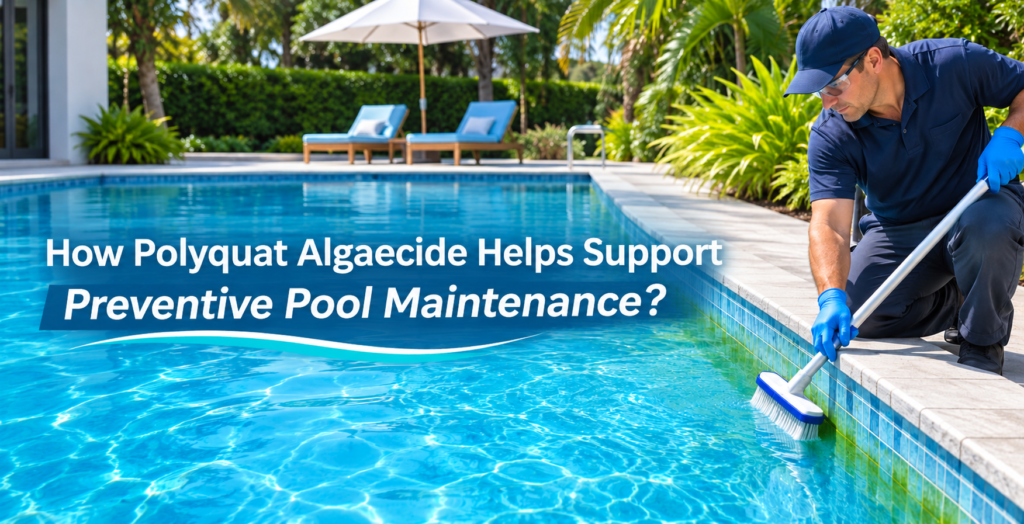
A practical guide to preventing algae growth, maintaining clear pool water, and building a more reliable pool care routine with Polyquat 60 Algaecide.
A clear swimming pool doesn’t stay clear by chance. Behind that inviting blue water is a steady routine of testing, filtration, cleaning, and chemical treatment.
Yet even a well-maintained pool can develop algae. A few hot days, heavy rainfall, poor circulation, or a sudden rise in swimmer activity may be enough to create trouble. Before long, the walls feel slippery, the water looks dull, and the pool owner faces another round of cleaning.
Wouldn’t it be easier to help stop algae before it becomes visible?
That’s where Polyquat Algaecide can play a useful role.
As a non-oxidizing, polymer-based algaecide, Polyquat helps control algae growth when used as part of a complete pool maintenance program. Its low-foaming, metal-free properties make it appealing for residential pools, commercial facilities, and professional pool service companies.
But there’s an important point: Polyquat isn’t a replacement for chlorine, filtration, or balanced water chemistry. It works alongside these essential measures.
Let’s look at how Polyquat Algaecide supports preventive pool maintenance, when to use it, and why consistent treatment can make pool care more manageable.
Why Preventive Pool Maintenance Matters More Than You Think
Algae problems rarely appear out of nowhere.
Microscopic algae cells may enter swimming pools through wind, rainwater, bathing suits, cleaning tools, or nearby plants. Under favorable conditions, they can multiply and settle on pool surfaces.
Warm water, sunlight, and poor circulation can make the situation worse.
The frustrating part? By the time green patches become visible, algae may already be established on pool walls, steps, corners, or other poorly circulated areas.
A reactive maintenance approach usually follows a familiar pattern:
- Algae becomes visible in the pool.
- The owner increases chemical treatment.
- Pool surfaces require brushing and vacuuming.
- The filtration system needs extra attention.
- Water clarity may take time to recover.
This process can consume chemicals, labor, and valuable swimming time.
Preventive pool maintenance takes a different approach. Instead of waiting for visible growth, it aims to keep pool conditions unfavorable for algae.
That means maintaining proper sanitizer levels, balancing water chemistry, cleaning surfaces, running filtration equipment, and using a suitable preventive algaecide where appropriate.
Polyquat Algaecide adds another layer of algae control to this routine.
It doesn’t make regular pool care unnecessary. Rather, it helps make the overall program more resilient.
What Is Polyquat Algaecide, and How Does It Work?
Polyquat Algaecide belongs to a family of polymeric quaternary ammonium compounds. These are positively charged polymers used in certain water treatment applications.
One commonly used Polyquat 60 active ingredient is Polixetonium Chloride, associated with CAS No. 31512-74-0.
Unlike oxidizing sanitizers such as chlorine, Polyquat acts through interactions between its cationic polymer structure and algae cells.
The word cationic simply means positively charged.
Algae cell surfaces often carry negatively charged sites. Positively charged polymer molecules can interact with these surfaces and interfere with normal cellular functions, helping inhibit algae growth.
Think of it as a second line of defense.
Chlorine handles the essential work of pool sanitation and oxidation, while Polyquat helps control algae through a different chemical mechanism.
This distinction matters because algae prevention and pool disinfection aren’t the same thing.
A swimming pool can look clear yet still have unsafe sanitizer levels. Likewise, a pool with adequate sanitizer may still develop localized algae if circulation, cleaning, or other conditions are poor.
Polyquat helps address algae control, but it must be supported by proper sanitation.
Seven Ways Polyquat Algaecide Supports Preventive Pool Maintenance
1. It Helps Control Algae Before Visible Growth Appears
The greatest advantage of preventive algae treatment is timing.
Once algae forms visible colonies, pool cleaning becomes more demanding. Brushing, vacuuming, filter cleaning, and corrective chemical treatment may all be needed.
Polyquat is useful because registered formulations can be applied as a routine maintenance treatment, even when the pool shows no visible algae.
Regular treatment helps limit algae development before it becomes a noticeable problem.
This is especially valuable in outdoor swimming pools exposed to sunlight, rainfall, dust, and changing weather conditions.
For pool owners, the benefit is simple: fewer surprises and a more consistent maintenance routine.
For professional service companies, preventive algae control may also reduce unexpected callbacks.
Of course, results depend on product concentration, approved dosage, pool conditions, and overall maintenance quality.
2. It Provides Low-Foaming Algae Control
Not all algaecides behave the same way.
Some conventional quaternary ammonium algaecides can create foam, particularly when overdosed or used in pools with strong water movement.
Foam can become noticeable around waterfalls, return jets, fountains, and other water features.
Polymeric quaternary ammonium algaecides are known for their low-foaming characteristics. The CDC’s Model Aquatic Health Code guidance also distinguishes polyquats from simple quaternary ammonium algaecides in this respect. cdc.gov
For preventive maintenance, this offers several practical benefits.
Pool operators can maintain algae control without introducing the same foaming concerns associated with some simple quat products.
The advantage becomes more important in decorative pools, resort swimming pools, and facilities where water appearance is part of the customer experience.
However, low foaming doesn’t mean unlimited dosing is safe. Excessive treatment can still create water quality or operational problems.
Always follow the product’s approved instructions.
3. It Avoids Adding Copper to Pool Water
Copper-based algaecides are another common option for controlling swimming pool algae.
They can be effective, but copper requires careful management because excessive dissolved metal levels may contribute to staining or discoloration.
Pool surfaces, fittings, and even swimmers’ hair may be affected under certain conditions.
Polyquat offers a metal-free approach.
Because the active ingredient is an organic polymer rather than a copper compound, it doesn’t introduce copper through the algaecide itself.
This can be attractive for pools with light-colored finishes, decorative surfaces, or existing concerns about metal accumulation.
It doesn’t mean Polyquat can remove copper already present in pool water. Existing metals still require separate testing and treatment when necessary.
For routine algae prevention, though, avoiding additional metal input can simplify water management.
4. It Works Alongside Normal Chlorine Treatment
A common question is whether Polyquat can be used in a chlorinated swimming pool.
For properly formulated products, the answer is generally yes, subject to the approved label.
Polyquat is intended to complement conventional pool care systems, including chlorine-based sanitation.
This makes it suitable for maintenance programs that already include:
- Routine free chlorine testing and adjustment
- pH monitoring and correction
- Filtration and circulation
- Pool brushing and vacuuming
- Periodic corrective treatment when required
The key is to use each product for its intended purpose.
Chlorine remains responsible for essential disinfection. Polyquat provides supplemental algae control.
The two products should never be mixed together in concentrated form. Add chemicals separately, following their respective labels and safe handling instructions.
5. It Helps Maintain a More Consistent Pool Appearance
Clear water matters.
For homeowners, a sparkling pool creates a pleasant place to relax. For hotels, resorts, fitness clubs, and public facilities, pool appearance also shapes visitors’ impressions.
Algae can quickly spoil that experience.
Green patches on walls, slippery steps, or cloudy-looking water may make guests question the quality of pool maintenance.
By helping prevent algae growth, Polyquat can support a cleaner, more attractive pool environment.
However, water clarity depends on more than algae control.
Fine particles, suspended dirt, inadequate filtration, poor water balance, and other contaminants can also cause cloudiness.
If a pool remains cloudy despite good algae control, the problem may require filtration adjustments or a separate clarifier.
For example, a PolyDADMAC-based Polymer Pool Clarifier is designed to help aggregate fine suspended particles so the filtration system can remove them more effectively.
Algaecides and clarifiers have different primary functions. They can serve complementary roles in a complete maintenance program when the product labels and formulations permit.
6. It Can Reduce the Need for Repeated Corrective Cleaning
Cleaning a pool after a severe algae outbreak is rarely a quick job.
Walls may need repeated brushing. Filters can collect large amounts of debris. Some pools require additional vacuuming or treatment before normal use resumes.
Preventive algae control aims to reduce the frequency of these situations.
When Polyquat is used correctly alongside proper sanitation and circulation, it may help reduce the likelihood of algae-related maintenance emergencies.
That can be valuable for pool service professionals managing many properties.
Imagine a service technician responsible for dozens of residential pools during a hot summer.
Even a small reduction in unexpected algae problems can help protect scheduled service time.
Still, no algaecide guarantees that algae will never return. Poor sanitizer control, neglected filtration, or prolonged circulation failures can overwhelm a preventive program.
The goal is better risk management, not zero maintenance.
7. It Fits Seasonal Pool Maintenance Programs
Swimming pools face different challenges throughout the year.
In summer, high temperatures and increased swimmer activity place more pressure on water treatment systems.
During spring opening, pools may contain debris, stagnant water, or algae that developed during the off-season.
In autumn, leaves and organic material can increase the cleaning workload.
And in regions where pools close for winter, algae prevention becomes part of the winterization plan.
Polyquat-based products may be used in different seasonal programs where their registered labels permit those uses.
For example, a winter algaecide formulation may help limit algae development during the closed season, reducing the amount of cleanup needed when the pool reopens.
But winter treatment isn’t a substitute for proper closing procedures.
Water balance, cleaning, equipment preparation, and protection against freezing remain essential.
The most reliable approach is to treat Polyquat as one component of seasonal maintenance rather than a stand-alone solution.Image alt text: Pool maintenance technician brushing algae from the tiled wall of a clear blue outdoor swimming pool as part of a preventive algae control program.
How to Include Polyquat 60 in a Preventive Pool Maintenance Routine
Knowing why Polyquat works is helpful. Knowing how to include it in a regular maintenance plan is even more valuable.
A good preventive program doesn’t need to be complicated. It needs to be consistent.
Step 1: Start with Balanced Pool Water
Before adding an algaecide, check the basic water chemistry.
Pay attention to free chlorine, pH, total alkalinity, and other parameters relevant to the pool.
For many conventional chlorine pools, a pH range of approximately 7.2–7.8 is commonly used, although local regulations and equipment requirements may differ.
If the water is poorly balanced, adding more algaecide won’t solve the underlying problem.
Proper sanitizer control remains the first priority.
Step 2: Keep the Filtration System Working
Water circulation helps distribute treatment chemicals throughout the pool.
It also moves suspended particles toward the filter.
Check that pumps, return jets, skimmers, and filters are functioning correctly.
Pay particular attention to corners, steps, and other areas where water movement may be limited.
Even a good algaecide may struggle to protect surfaces that receive poor circulation and little cleaning.
Step 3: Brush Pool Surfaces Regularly
Brushing is one of the simplest ways to reduce algae-related problems.
It removes deposits from surfaces and helps prevent algae from becoming established in small cracks or rough areas.
Focus on pool walls, steps, ladders, corners, and areas behind fittings.
Brushing also supports chemical treatment by exposing algae growing on pool surfaces.
The CDC’s aquatic health guidance emphasizes combining algaecide treatment with frequent, thorough brushing. cdc.gov
Step 4: Apply Polyquat According to the Approved Product Label
Polyquat products are available at different active ingredient concentrations, including formulations commonly marketed as Polyquat 30 and Polyquat 60.
Their dosing requirements are not interchangeable.
An initial treatment may differ from a routine maintenance dose. Treatment for visible algae may also require a different procedure.
For reference, certain EPA-registered polyquat formulations specify maintenance applications at intervals of approximately five to seven days. This is an example of product-specific labeling, not a universal dosing recommendation. www3.epa.gov
Use the directions approved for the exact product, concentration, and market.
Do not add concentrated Polyquat directly to other pool chemicals.
Step 5: Monitor Results and Adjust the Overall Maintenance Program
After treatment, continue monitoring pool conditions.
Check for early signs of algae, such as slippery surfaces, green discoloration, or unusual deposits.
Also review sanitizer levels, water balance, filter performance, and circulation.
If algae repeatedly returns, simply increasing the Polyquat dose may not be the answer.
The cause could be poor circulation, insufficient sanitizer, contaminated equipment, or a persistent problem in a particular section of the pool.
Find the cause first. Then correct the maintenance program.
A Practical Preventive Pool Maintenance Schedule
The following example shows how Polyquat can fit into a wider pool care routine. Actual schedules depend on pool use, local regulations, weather, and the product label.
| Maintenance activity | Suggested frequency |
|---|---|
| Check sanitizer and pH | Daily or as required |
| Inspect water clarity and surfaces | Daily |
| Check circulation and filtration | Daily |
| Brush walls, steps, and corners | Weekly or more often |
| Vacuum and clean pool surfaces | As needed |
| Inspect and clean filters | Based on pressure and condition |
| Apply preventive Polyquat treatment | According to the registered label |
| Review water balance and maintenance records | Weekly or as required |
For commercial pools, testing and inspection requirements may be more frequent.
The main principle is simple: preventive algaecide treatment should support regular maintenance, not replace it.
Polyquat Algaecide vs. Chlorine: Why Both Have Different Jobs
It’s tempting to think that adding Polyquat means using less chlorine.
But that isn’t the right way to plan pool sanitation.
Chlorine and Polyquat perform different functions.
| Feature | Polyquat Algaecide | Chlorine |
|---|---|---|
| Main purpose | Algae control | Disinfection and oxidation |
| Chemical action | Non-oxidizing | Oxidizing |
| Controls algae | Yes, as labeled | Yes, with proper treatment |
| Disinfects pool water | Not a substitute for sanitizer | Yes |
| Adds copper | No | No, for ordinary chlorine products without added copper |
| Routine maintenance role | Supplemental algae prevention | Essential sanitizer management |
| Replaces filtration | No | No |
Polyquat can help manage algae without adding an oxidizing chemical.
Chlorine, meanwhile, is needed to control harmful microorganisms and maintain sanitary swimming conditions.
Even when an algaecide reduces algae-related demand, pool operators must continue maintaining the required sanitizer residual.
A clear pool isn’t necessarily a safe pool.
When Is Preventive Polyquat Treatment Especially Useful?
Although Polyquat can be included in many maintenance programs, certain situations make preventive algae control particularly relevant.
During Hot Summer Weather
Warm weather can favor algae growth, especially when sunlight is strong and sanitizer levels fluctuate.
Outdoor pools also tend to experience heavier use during summer.
A consistent preventive program can help reduce algae-related surprises during peak swimming season.
After Heavy Rainfall
Rain can introduce dirt, organic material, and other contaminants into pool water.
Heavy rainfall may also affect water balance and sanitizer demand.
After a storm, check water chemistry, remove debris, inspect filtration, and assess whether scheduled algae prevention is appropriate.
Don’t assume that adding extra algaecide alone will restore proper water conditions.
In Pools Surrounded by Trees and Landscaping
Leaves, pollen, soil, and other organic debris can enter pools from nearby vegetation.
These materials increase the cleaning burden and may contribute to conditions that favor algae.
Frequent skimming, brushing, filtration, and preventive algae control can help manage these challenges.
In Commercial Swimming Pools
Hotels, resorts, residential communities, and fitness centers often need predictable pool maintenance.
Unexpected algae outbreaks can lead to complaints, additional service work, and temporary interruptions.
For these facilities, consistent preventive treatment can be more practical than relying only on corrective action.
However, commercial operators must follow applicable public health rules and approved chemical use requirements.
Why Polyquat 60 Is Attractive for Professional Pool Maintenance
Polyquat 60 is commonly associated with a concentrated polymeric algaecide formulation containing approximately 60% active ingredient.
Its concentrated format can be attractive for professional pool care businesses and chemical distributors.
One advantage is that a concentrated product may require less liquid per treatment than a lower-strength formulation, assuming comparable active ingredients and label directions.
That can affect storage, handling, and transportation planning.
Another advantage is formulation flexibility.
For chemical distributors and pool care brands, Polyquat-based products may be offered in different packaging sizes and concentrations to serve different markets.
For example, Eautrix supplies Polyquat 60 Algaecide for B2B applications, with packaging options that may include:
- 1L bottles for retail pool care products
- 5L containers for professional maintenance
- 25L drums for service companies and distributors
- 200L drums for bulk supply
- 1000L IBCs for larger commercial orders
The concentrated raw material is typically an amber-colored, transparent, viscous liquid.
Packaging, labeling, and formulation requirements can be discussed according to the intended market.
However, the availability of a chemical formulation doesn’t automatically authorize its sale as an algaecide in every country.
In the United States, for example, products making algae-control claims generally require EPA pesticide registration and approved labeling before lawful distribution. Other markets have their own regulatory requirements. US EPA
Buyers should verify the registration status of the finished product before commercial sale.
Common Mistakes That Weaken Preventive Algae Control
Even experienced pool operators can make mistakes when introducing a new treatment product.
One common error is treating Polyquat as a substitute for chlorine.
Another is applying more algaecide whenever the water looks cloudy, without checking whether algae is actually causing the problem.
Overdosing can waste chemicals and may create unwanted water treatment effects.
Using the wrong concentration is another concern. A 60% formulation cannot automatically be dosed at the same rate as a 30% formulation.
Some operators also neglect physical cleaning.
Chemical treatment works better when brushing, filtration, and circulation are maintained.
Finally, mixing concentrated pool chemicals is a serious safety mistake.
Even products that are compatible after proper dilution in pool water should not be premixed in a container.
Read the safety data sheet and approved product label before handling any pool chemical.
How Preventive Algae Control Can Support Lower Maintenance Costs
Preventive treatment does involve a regular chemical expense.
So why might it be economical?
Because algae outbreaks can create costs beyond the price of the chemicals used to treat them.
A serious outbreak may require additional labor, filter cleaning, water testing, and corrective treatment.
For commercial facilities, interruptions to pool availability may create further costs.
A well-managed preventive program can help reduce the risk of these events.
However, savings aren’t guaranteed.
The financial benefit depends on product cost, pool conditions, treatment frequency, and how effectively the overall maintenance program works.
For professional pool service companies, the strongest value may be predictability.
A consistent maintenance schedule is easier to manage than repeated emergency visits.
That makes Polyquat worth considering not just as a chemical product, but as part of a planned service approach.
Choosing the Right Polyquat Algaecide for Your Market
For distributors and private label pool chemical brands, product selection deserves careful attention.
The first consideration is the active ingredient and its concentration.
Different polymeric algaecides may be marketed using similar names, so buyers should verify the chemical identity rather than relying on the product name alone.
For Polyquat 60 based on Polixetonium Chloride, CAS No. 31512-74-0 is an important identification reference.
Next, review the supplier’s technical documentation.
A reliable supplier should provide an appropriate certificate of analysis, safety data sheet, and relevant product specifications.
Important parameters may include active ingredient content, appearance, pH, density, and viscosity.
Packaging also matters.
A retail brand may prefer convenient 1L bottles, while a commercial distributor may need 25L drums or IBC supply.
Private label buyers should also consider label design, batch consistency, packaging compatibility, and applicable market registration requirements.
For further information about available products and custom supply, visit Eautrix Pool Chemical Products.
A Better Pool Maintenance Strategy Starts Before Algae Appears
The most effective pool maintenance programs don’t wait for water to turn green.
They rely on regular testing, proper sanitation, balanced water chemistry, reliable filtration, and physical cleaning.
Polyquat Algaecide can strengthen that approach by adding a supplemental method of algae control.
Its non-oxidizing action, low-foaming characteristics, and metal-free composition make it a useful choice for many preventive maintenance programs.
For homeowners, that may mean fewer algae-related interruptions.
For pool service companies, it can support more predictable maintenance.
For distributors and pool chemical brands, Polyquat 60 offers an established product category with applications in both residential and professional pool care.
The real value comes from using it correctly.
Prevent algae where possible, maintain sanitizer levels, and keep the entire pool care system working together.
That’s how preventive maintenance helps keep swimming pools clean, inviting, and ready for use.
Frequently Asked Questions About Polyquat Algaecide
1. Can Polyquat Algaecide prevent algae growth in swimming pools?
Yes. Polyquat Algaecide is designed to help control algae growth when applied according to the approved product label. It works most effectively as part of a complete preventive pool maintenance program that includes sanitation, filtration, water balance, and regular cleaning.
2. How often should Polyquat 60 be added for preventive pool maintenance?
Application frequency depends on the exact formulation and its approved label. Some registered Polyquat products specify maintenance treatment approximately every five to seven days. Always follow the directions for the specific product rather than using a general dosing schedule.
3. Can Polyquat Algaecide be used with chlorine in a swimming pool?
Yes, properly formulated Polyquat products can generally be used in chlorinated pools when their labels permit it. Polyquat supports algae control, while chlorine provides essential disinfection. Never mix the concentrated chemicals together, and always maintain the required sanitizer level.
4. Is Polyquat 60 better than copper-based algaecide for routine pool maintenance?
Polyquat 60 offers certain advantages, including low-foaming behavior and a metal-free formulation that doesn’t add copper to pool water. Copper-based products may also provide effective algae control, but they require attention to metal levels and staining risks. The better choice depends on the pool’s conditions and the approved product uses.
5. Is Polyquat Algaecide suitable for commercial pool maintenance and private label products?
Polyquat-based algaecides can be suitable for commercial pool maintenance where permitted by the relevant product registration and local regulations. They are also available for private label formulation and packaging projects. Buyers should confirm active ingredient specifications, product quality, labeling requirements, and market authorization before sale or use.