
GET IN TOUCH
Ask For Sample?
What Causes Algae Growth in Residential and Commercial Swimming Pools?
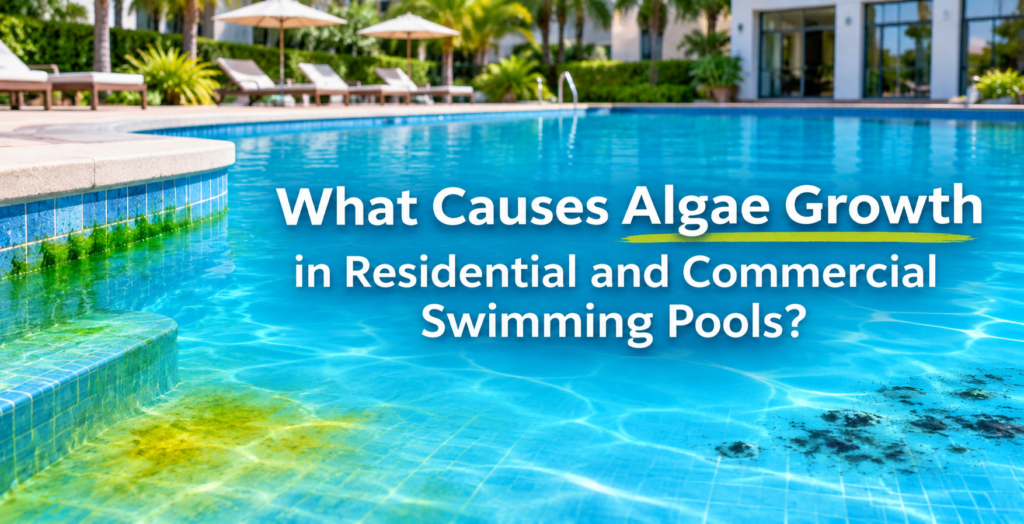
A swimming pool can look perfect on Monday and turn cloudy green by Thursday. The water was clear, the pump was running, and the chlorine test seemed fine. So what went wrong?
Algae growth is one of the most common problems in residential and commercial swimming pools. It can appear as green water, slippery walls, yellow patches, or dark spots that refuse to disappear.
The frustrating part? Algae rarely develop because of one single mistake. More often, several small problems come together: low sanitizer levels, poor water circulation, warm temperatures, and missed cleaning routines.
For homeowners, an algae bloom can ruin a weekend of swimming. For hotels, resorts, aquatic centers, and commercial pool operators, it can lead to pool closures, extra chemical costs, unhappy guests, and potential health concerns.
The good news is that most algae problems are preventable.
This guide explains what causes algae growth in swimming pools, why some pools are more vulnerable than others, and how pool professionals can build a more reliable algae prevention program.
SEO title: What Causes Algae Growth in Swimming Pools? | Eautrix
Meta description: Discover what causes algae growth in residential and commercial swimming pools, from low chlorine and poor circulation to heat, sunlight, and maintenance mistakes.
Why Does Algae Grow in Swimming Pool Water?
Algae are simple, photosynthetic organisms that can enter pool water from the surrounding environment.
They may arrive through windblown dust, rainwater, leaves, soil, contaminated equipment, or even swimwear that has been used in natural bodies of water.
Once algae enter a pool, they can multiply when conditions allow.
Three conditions are especially important:
- Insufficient effective sanitizer: Algae survive when the pool lacks enough active disinfectant to control their growth.
- Poor circulation and cleaning: Stagnant areas and dirty surfaces allow algae to establish themselves.
- Favorable environmental conditions: Warm water, sunlight, and available nutrients can support rapid growth.
A well-maintained pool may contain algae cells without developing a visible bloom. Effective sanitation and routine cleaning keep them under control.
Problems begin when that protection weakens.
Algae also aren’t just a cosmetic concern. A pool with visible algae may have inadequate disinfection, and the same conditions can allow harmful microorganisms to persist. Algae themselves are not necessarily the main health risk, but their presence is a warning that water treatment needs attention.
1. Low Chlorine Levels: The Most Common Cause of Pool Algae
Chlorine is the primary sanitizer in many residential and commercial swimming pools.
When properly maintained, free chlorine helps control algae and inactivate many disease-causing microorganisms.
However, chlorine is continuously consumed or lost through several processes.
Sunlight breaks down unstabilized chlorine. Swimmers introduce sweat, body oils, and other contaminants. Leaves and organic debris increase sanitizer demand. Heavy rainfall can also change pool chemistry and dilute treatment chemicals.
As chlorine becomes less available, algae gain an opportunity to grow.
Why a normal chlorine reading may not tell the whole story
Imagine a backyard pool that receives a chlorine treatment in the morning. By late afternoon, strong sunlight and heavy swimmer activity have reduced the free chlorine concentration.
The pool may still look clear. Yet algae can begin growing on poorly circulated surfaces before the water shows any visible change.
This is why occasional chlorine testing may not be enough during periods of heavy use.
Pool operators should monitor free chlorine, pH, and cyanuric acid (CYA) when applicable, rather than relying on water appearance alone.
For public pools, the U.S. Centers for Disease Control and Prevention (CDC) recommends maintaining at least 1 ppm free chlorine in pools without cyanuric acid and at least 2 ppm when cyanuric acid is used. Local health codes and product labels may require different or higher levels.
These values are minimum public-health recommendations, not guarantees against algae under every operating condition.
2. Poor Water Circulation Creates Hidden Algae Hotspots
Even when pool chemistry is correct, inadequate circulation can leave certain areas vulnerable.
Think of a swimming pool as a large mixing tank. The pump moves water through the filtration system, while return jets help distribute treated water.
When circulation is weak, some areas receive less effective mixing.
Common problem areas include:
- Pool corners and steps
- Behind ladders and handrails
- Shallow shelves and recessed seating
- Areas behind decorative water features
- Deep-end walls and floor transitions
Algae can attach to these surfaces, especially when brushing is neglected.
Why circulation matters more in commercial pools
Commercial pools often have more complex shapes and higher swimmer loads.
A resort pool may include shallow lounging areas, curved walls, fountains, and connected sections. These features can create areas with limited water movement.
Even a powerful pump cannot guarantee that every corner receives adequate circulation.
Commercial operators should evaluate return-jet placement, pump performance, filtration flow, and actual mixing throughout the pool.
Poor circulation does not always mean the entire filtration system is undersized. Sometimes, the problem is simply how water moves through the pool.
3. Warm Water and Strong Sunlight Accelerate Algae Growth
Algae use light as an energy source, and many common pool algae grow faster under favorable warm conditions.
That makes outdoor swimming pools particularly vulnerable during summer.
Long daylight hours, higher water temperatures, and increased swimming activity can create a difficult combination.
Warm weather also increases chlorine demand in many pools, particularly when swimmer activity and organic contamination rise.
Does sunlight always cause algae?
Not exactly.
Sunlight supports photosynthesis, but it also affects sanitizer stability.
Ultraviolet radiation can break down free chlorine, especially in outdoor pools without adequate stabilizer.
Cyanuric acid helps protect chlorine from rapid sunlight degradation. However, excessive CYA can reduce the proportion of chlorine present in its most active forms, so the relationship between free chlorine and CYA must be managed carefully.
This explains why two outdoor pools exposed to the same sunlight may experience very different algae problems.
One pool maintains effective sanitation and good circulation. The other loses chlorine protection during the afternoon.
The difference is not simply the weather. It is how well each pool responds to changing conditions.
4. High pH Can Reduce Chlorine Effectiveness
Pool water pH affects swimmer comfort, equipment performance, and sanitizer chemistry.
For chlorine-treated pools, pH also influences the balance between hypochlorous acid (HOCl) and hypochlorite ion (OCl⁻).
Hypochlorous acid is generally the more effective disinfecting form of free chlorine.
As pH rises, a greater share of unstabilized free chlorine shifts toward hypochlorite ion.
That can weaken disinfection performance and make algae control more difficult.
What pH range should pool operators maintain?
The CDC recommends a pH range of 7.0–7.8 for public aquatic venues, while many pool maintenance programs target approximately 7.2–7.6 for routine operation.
The correct operating range must also meet local regulations and equipment requirements.
In pools using cyanuric acid, chlorine chemistry is more complex than the simple HOCl/OCl⁻ balance, so pH should not be considered in isolation.
The key is consistency.
Large pH fluctuations can make sanitation harder to manage, especially in commercial pools with automated chemical dosing systems.
5. Nutrients and Organic Debris Give Algae More Opportunities
Algae need nutrients to grow.
Phosphorus and nitrogen are among the nutrients that can support algae growth. These may enter swimming pools through environmental contamination, fertilizers, rainwater runoff, dust, and other sources.
Leaves, grass clippings, pollen, and soil can also introduce contaminants and increase sanitizer demand.
But there is an important distinction.
Nutrients alone do not cause a pool algae bloom when effective sanitizer residuals are maintained.
A pool can contain measurable phosphates and remain algae-free with proper sanitation.
Similarly, reducing phosphates does not replace chlorine or other approved sanitizers.
Are phosphate removers necessary?
Not always.
Phosphate removal may serve as a supplemental strategy in pools with persistent nutrient-related issues, but it is not a substitute for effective disinfection.
Pool professionals should first examine sanitizer levels, circulation, filtration, and cleaning practices before assuming that phosphates are the main cause.
For many residential pools, basic maintenance solves the problem without additional specialty chemicals.
6. Inadequate Filtration Allows Water Quality to Decline
Circulation moves water. Filtration removes suspended particles.
Both functions are essential, but they are not the same.
A pool filter captures debris and fine particles as water passes through the filtration media.
When filters become clogged, damaged, incorrectly maintained, or poorly matched to operating conditions, water clarity can decline.
Suspended particles may also increase chlorine demand or make it harder to maintain a clean pool.
How different filter types affect maintenance
Sand, cartridge, and diatomaceous earth (DE) filters have different operating characteristics.
Sand filters are widely used in residential and commercial pools because they are durable and relatively straightforward to maintain.
Cartridge filters offer effective fine-particle removal but require periodic cleaning and replacement.
DE filters can capture very fine particles, although they require specific handling and maintenance procedures.
Regardless of filter type, operators should follow the equipment manufacturer’s cleaning instructions and monitor pressure, flow, and water clarity.
A clean filter supports algae prevention, but filtration alone cannot replace chemical sanitation.
7. Irregular Brushing and Cleaning Let Algae Establish Themselves
Pool walls may look smooth, but algae can attach to surface imperfections, grout lines, corners, and other protected areas.
Once attached, algae can become more difficult to remove than free-floating cells.
Biofilms—communities of microorganisms embedded in a protective matrix—can also develop on wet surfaces. They are not identical to algae growth, but they can complicate sanitation and cleaning.
Routine brushing helps remove attached material and exposes it to circulating sanitizer.
This is especially important for plaster, tile, grout, and textured pool finishes.
A robotic pool cleaner can reduce manual work, but it may not reach every step, corner, or recessed area.
Regular inspection and targeted brushing remain valuable, even in pools with automated cleaning systems.
8. Heavy Swimmer Loads Increase the Risk of Algae Growth
A private backyard pool used by four family members faces different challenges from a hotel pool used by hundreds of guests.
Swimmers introduce sweat, skin cells, cosmetics, sunscreen, and other contaminants into the water.
These substances can increase chlorine demand and make water treatment more difficult.
Commercial pools often experience sudden changes in swimmer loads. A hotel pool may be relatively quiet in the morning and crowded by mid-afternoon.
If chemical dosing does not respond to increased demand, sanitizer levels can fall.
This creates an opportunity for algae growth.
Why commercial pools need closer monitoring
Public and commercial swimming pools generally require more frequent water testing and recordkeeping than residential pools.
Depending on local regulations, operators may need to monitor chlorine and pH several times daily or use continuous monitoring equipment supported by manual verification.
Automated chemical controllers can help maintain stable conditions, but they still require calibration, inspection, and maintenance.
The goal is not simply to add more chemicals. It is to maintain effective treatment as pool conditions change.
9. Rainstorms, Wind, and Environmental Contamination
Weather can change pool water quality surprisingly quickly.
Heavy rain may dilute sanitizer concentrations, alter pH, and introduce dirt or organic contaminants.
Wind can carry pollen, leaves, dust, and soil into outdoor pools.
Stormwater runoff can introduce additional contaminants if surrounding drainage is poorly designed.
After severe weather, pool operators should inspect the water, remove debris, test sanitizer and pH levels, and restore appropriate operating conditions.
A swimming pool should not automatically be considered safe simply because the water still looks blue.
For commercial facilities, reopening after severe contamination or flooding may require additional procedures under local health regulations.
10. Poor Winterization and Seasonal Reopening
Seasonal swimming pools face a special challenge.
During winter, pumps may operate less frequently, water temperatures fall, and routine maintenance becomes less consistent.
Cold water generally slows algae growth, but it does not guarantee that algae will disappear.
As temperatures rise in spring, surviving algae can multiply when sunlight and nutrients become available.
This is why some pools develop green water shortly after reopening.
How winter maintenance affects spring water quality
A successful winterization program usually includes proper water balance, cleaning, removal of organic debris, appropriate sanitizer management, and secure pool covering.
Some operators also use a winter algaecide as a supplemental treatment.
However, winter algaecides should be used only according to approved product labeling and applicable regulations.
They do not replace proper pool sanitation or winterization procedures.
Residential vs. Commercial Pools: What Makes Algae Growth Different?
Although algae grow under similar biological conditions, the operating risks can differ considerably.
| Factor | Residential swimming pools | Commercial swimming pools |
|---|---|---|
| Swimmer load | Usually lower and more predictable | Often high and variable |
| Water testing | Homeowner or service technician | Trained staff, often with automated monitoring |
| Circulation | Usually simpler pool geometry | May include complex layouts and water features |
| Maintenance | Daily to weekly tasks depending on conditions | Routine daily attention and documented procedures |
| Algae consequences | Lost swimming time and extra cleaning costs | Closures, regulatory concerns, guest complaints, and revenue loss |
| Prevention focus | Consistent sanitation and cleaning | Continuous control, inspection, and documented water quality management |
A commercial pool does not necessarily develop algae faster than a residential pool.
In fact, a well-managed commercial facility may maintain more stable water chemistry because it has trained operators and automated equipment.
The real difference is the scale of the consequences when treatment fails.
How Can You Tell Which Type of Algae Is Growing?
Different algae-like growth patterns can appear in swimming pools.
Recognizing their appearance can help guide inspection and treatment, although visual identification alone is not always reliable.
Green algae
The most familiar type. It may turn water green or create slippery green deposits on walls and steps. It often appears when sanitizer levels fall.
Yellow or mustard algae
Often appears as yellow-brown, dusty patches, especially in shaded areas. It can return if contaminated surfaces and equipment are not treated thoroughly.
Black algae
Typically forms dark, stubborn spots on porous pool surfaces. Its protective growth structure can make removal difficult, so repeated brushing and proper treatment may be needed.
Not every dark or yellow stain is algae. Metals, minerals, and organic staining can produce similar appearances.
When the cause is uncertain, pool professionals should confirm the problem before applying chemical treatments.
How to Prevent Algae Growth in Swimming Pools
The most effective algae prevention strategy combines proper sanitation, circulation, cleaning, and routine monitoring.
No single chemical can compensate for all maintenance problems.
A practical algae prevention checklist
Pool algae prevention checklist
0 of 8 completeTest free chlorine and pH at a frequency appropriate for the pool and local rules.Maintain sanitizer levels that meet applicable health codes and product instructions.Check cyanuric acid in stabilized outdoor chlorine pools.Inspect pumps, return jets, filters, and circulation performance.Brush walls, steps, corners, and other areas where algae may attach.Remove leaves, pollen, and organic debris before they accumulate.Inspect water quality after storms or unusually heavy swimming activity.Use supplemental algaecides only where approved and appropriate.
Reset checklist
For commercial facilities, operators should also maintain water testing records, inspect chemical dosing equipment, and establish clear procedures for responding to out-of-range readings.
The best prevention program is one that staff can follow consistently—not one that looks impressive on paper but becomes difficult to maintain.
Can Polyquat 60 Algaecide Help Prevent Algae Growth?
Alongside chlorine sanitation and routine cleaning, some pool maintenance programs use polymer-based algaecides for supplemental algae control.
One widely recognized category is Polyquat 60 Algaecide, based on a cationic polymer commonly identified as Polixetonium Chloride (CAS No. 31512-74-0), also associated with Polyquaternium-42.
Cationic polymers carry positive electrical charges along their molecular chains. Their interaction with negatively charged biological surfaces can contribute to algae control.
Polyquat-based algaecides are non-oxidizing, meaning they work through mechanisms different from chlorine oxidation.
Depending on the formulation and approved uses, they may offer several practical features:
- Low-foaming or non-foaming performance
- No copper-related metal staining
- Compatibility with properly managed chlorine sanitation programs
- Supplemental algae prevention during routine maintenance
- Potential suitability for seasonal pool care programs
These properties make polymer-based algaecides relevant to pool chemical distributors, professional service companies, and private label pool care brands.
However, Polyquat 60 is not a replacement for chlorine or another approved primary sanitizer.
Its use must follow the registered product label, including treatment rates, application instructions, and any restrictions.
Why product concentration matters
Commercial algaecide products can contain different concentrations of active polymer.
A concentrated 60% formulation and a diluted maintenance product are not interchangeable on a volume-for-volume basis.
Pool professionals and distributors should evaluate the active ingredient concentration, formulation stability, intended application, and regulatory status before selecting a product.
For businesses developing their own pool chemical ranges, Eautrix provides information about cationic polymer and specialty pool chemical solutions.
The appropriate formulation should be chosen according to the target market, customer needs, and local regulatory requirements.
What Should You Do When a Pool Already Has Algae?
Prevention is easier than recovery, but an existing algae problem can often be corrected through a systematic treatment process.
First, stop swimming and assess the pool’s condition.
Test free chlorine, pH, and cyanuric acid where applicable. Inspect filtration, circulation, and any obvious contamination.
Next, remove debris and brush affected surfaces to disturb attached algae.
Correct water chemistry and apply an appropriate algae treatment or chlorine remediation procedure according to the product label and applicable pool guidance.
Keep the filtration system operating as required and clean the filter when necessary.
Continue testing and cleaning until the water is clear, sanitizer levels are stable, and the pool meets all applicable reopening requirements.
Avoid adding several pool chemicals at once without checking compatibility. Never mix concentrated pool chemicals together, and follow the required safety precautions for each product.
For public pools, local health codes and facility procedures take priority over general maintenance advice.
The Real Secret to Algae-Free Pool Water Is Consistency
A swimming pool does not turn green simply because it is outdoors, warm, or heavily used.
Algae blooms occur when environmental conditions favor growth and the pool’s sanitation and maintenance systems fail to keep it under control.
Low chlorine, poor circulation, inadequate cleaning, and changing swimmer loads are among the most important contributors.
For residential pool owners, the solution often starts with more consistent testing and basic maintenance.
For commercial pool operators, reliable algae prevention depends on coordinated water chemistry management, equipment maintenance, staff training, and documented operating procedures.
Supplemental treatments, including properly approved polymer-based algaecides, can support these programs when used correctly.
The goal is simple: maintain clean, clear, properly disinfected water before algae have a chance to become a visible problem.
Frequently Asked Questions (FAQ)
1. Why does my swimming pool keep getting algae even when I add chlorine?
Recurring algae may indicate that free chlorine falls too low between treatments, circulation is inadequate, or attached algae remain on pool surfaces. High cyanuric acid, poor brushing, and heavy organic contamination can also contribute. Test the water and inspect the whole maintenance system rather than increasing chlorine blindly.
2. Can algae grow in a swimming pool with high chlorine levels?
Visible algae can persist temporarily even after chlorine levels are raised, especially in poorly circulated areas or protective surface growth. However, sustained effective sanitizer levels, adequate circulation, and cleaning should prevent most common pool algae from establishing themselves.
3. What causes green algae in commercial swimming pools?
Common causes include insufficient sanitizer residuals, heavy swimmer loads, weak circulation, dirty filters, and inconsistent cleaning. Complex pool designs and changing water demand can make these problems harder to control.
4. Does Polyquat 60 Algaecide prevent green and mustard algae?
Appropriately registered Polyquat 60 formulations may help prevent or control specified algae types when used according to their labels. Effectiveness depends on the formulation, treatment rate, algae species, and pool conditions. It should complement, not replace, proper sanitation.
5. How often should a residential swimming pool be treated to prevent algae?
There is no single treatment schedule suitable for every pool. Chlorine and pH should be checked regularly, with more frequent testing during hot weather and heavy use. Supplemental algaecide application intervals depend on the approved product label, water conditions, and maintenance program.