
GET IN TOUCH
Ask For Sample?
Why Non-Metal Pool Algaecides Are Popular in Professional Pool Care?
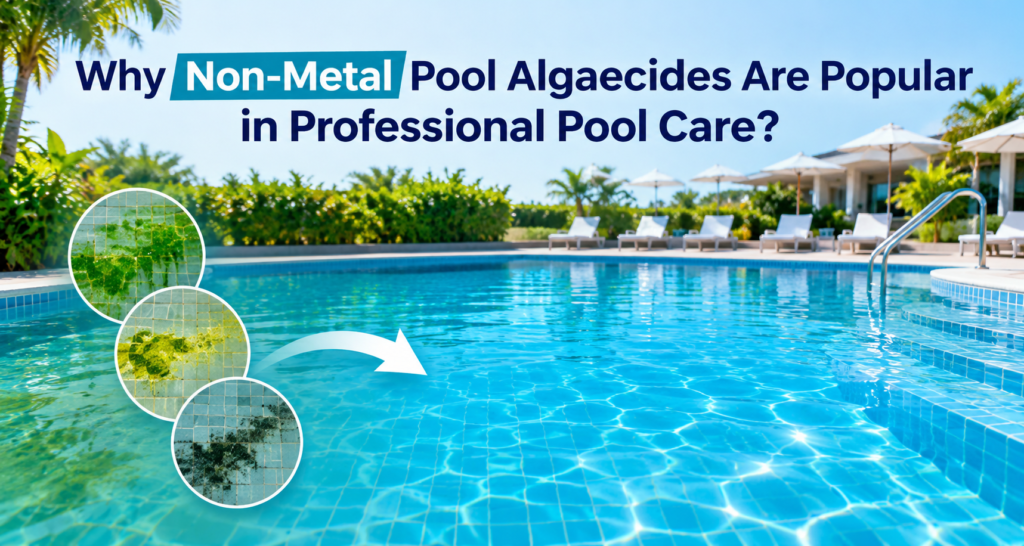
A clear swimming pool looks simple. Blue water, clean tiles, and a surface that sparkles in the sun. Yet anyone who manages a commercial pool knows how much work goes into keeping it that way.
Algae can turn a beautiful pool into a maintenance headache. Green patches appear on the walls. Water loses its shine. Guests complain, and pool operators face extra cleaning, chemical treatment, and sometimes unexpected closures.
That’s why many pool professionals are paying closer attention to non-metal pool algaecides.
Unlike traditional copper-based products, non-metal algaecides can help control algae without adding copper or other stain-forming metals to pool water. Some polymer-based formulas also offer low-foaming performance, making them attractive for routine maintenance in hotels, resorts, residential communities, and public swimming pools.
But what makes these products so useful? Are they always better than metal-based algaecides? And how can pool chemical distributors select the right formula for professional customers?
Let’s look at the chemistry, the practical benefits, and the reasons behind their appeal.
Suggested URL slug: why-non-metal-pool-algaecides-are-popular
Meta description: Discover why non-metal pool algaecides are popular in professional pool care, from stain prevention and low-foam formulas to easier pool maintenance.
What Exactly Is a Non-Metal Pool Algaecide?
A non-metal pool algaecide is a chemical treatment designed to prevent or control algae without relying on metal ions, such as copper, as its main active ingredient.
These products may use different organic compounds, including quaternary ammonium compounds and certain cationic polymers.
One important example is Polyquat 60 Algaecide, a polymer-based product associated with Polixetonium Chloride (CAS No. 31512-74-0), also known as Polyquaternium-42 in relevant product literature.
Polyquat 60 is often supplied as a concentrated liquid containing approximately 60% active ingredient, although exact specifications vary by formulation and supplier.
Its cationic polymer structure plays an important role in algae control.
Algae cells generally carry negatively charged sites on their surfaces. Positively charged polymer molecules can interact with these sites, disrupting normal cell functions and helping inhibit algae growth.
The precise action depends on the polymer structure, concentration, algae species, and water conditions.
There’s one key point to remember: non-metal does not mean chemical-free, and it does not mean every non-metal algaecide works the same way.
A basic quaternary ammonium algaecide may produce noticeable foam when water is agitated. A suitable polymeric algaecide, by contrast, can offer much lower foaming behavior.
That difference matters when treating busy swimming pools.
1. No Added Copper Means Less Risk of Metal Staining
Imagine a resort pool with beautiful white plaster, pale stone steps, and decorative tiles. Now imagine greenish or dark stains appearing around the waterline.
Not exactly the look guests expect.
Copper-based algaecides can be effective against algae, but repeated use may increase the copper concentration in pool water. Under certain conditions, dissolved copper can precipitate or deposit on pool surfaces.
Changes in pH, oxidation conditions, and water balance can make the problem worse.
Copper may also contribute to discoloration of light-colored hair under some conditions.
Non-metal pool algaecides avoid adding copper as part of their active treatment chemistry.
This offers several practical benefits:
- Lower risk of staining associated with added copper
- No additional copper load from the algaecide
- Less concern about copper accumulation during repeated treatments
- Greater appeal for pools with light-colored finishes
- A useful alternative when metal concentrations are already elevated
Of course, non-metal algaecides cannot remove copper already present in the water. Metals may still enter through source water, corrosion, or other pool chemicals.
Still, avoiding another source of copper can make water management easier.
For professional pool operators, preventing a stain is usually much cheaper than removing one.
2. Low-Foaming Formulas Work Better in Busy Pools
Foam may seem like a minor issue. In a commercial swimming pool, though, it can become a very visible problem.
Waterfalls, return jets, spa spillovers, and strong circulation all create water movement. Some traditional quaternary ammonium algaecides can foam under these conditions.
A layer of bubbles near the pool steps or return outlets may leave guests wondering whether the water is properly maintained.
Polymeric non-metal algaecides, including suitable Polyquat 60 formulations, are valued for their low-foaming characteristics.
Why low foam matters in professional pool care
- Helps maintain a clean-looking water surface
- Reduces visible foam around return jets and water features
- Supports routine maintenance in pools with continuous circulation
- Limits foam-related complaints from swimmers and property managers
Low foam doesn’t guarantee better algae control. It’s a separate performance feature.
Yet for hotel pools and aquatic facilities, appearance matters almost as much as technical performance. Guests judge water quality with their eyes long before they see a test report.
A low-foaming algaecide helps operators maintain that polished, professional appearance.
3. Compatible with Chlorine-Based Pool Care Programs
Chlorine remains the primary sanitizer in many professional swimming pools. It helps control bacteria, viruses, and other microorganisms while contributing to algae prevention.
So where does a non-metal algaecide fit?
Think of chlorine as the main defense and a suitable algaecide as an extra layer of algae control.
Many Polyquat 60 formulations can be used as part of chlorine-based maintenance programs when applied according to their approved product labels.
They may help reduce the chance of algae developing in areas where circulation is weak or algae pressure is high.
However, compatibility doesn’t mean the products should be mixed together in concentrated form.
Pool operators should add each chemical separately, follow label directions, and maintain proper circulation.
It’s also important to understand that an algaecide does not replace chlorine or another approved primary sanitizer.
Even a pool that looks crystal clear can contain harmful microorganisms if sanitizer levels are inadequate.
For commercial pools, non-metal algaecides are most useful as part of a complete water care program that includes sanitation, filtration, circulation, cleaning, and regular testing.
4. They Support Preventive Pool Maintenance
Anyone who has dealt with a serious algae bloom knows the frustration.
The pool turns cloudy. Green deposits cling to the walls. Staff spend hours brushing, vacuuming, and cleaning filters. Chemical consumption increases, and the pool may need to close until water quality is restored.
Preventive maintenance aims to avoid that situation.
A suitable non-metal algaecide can help suppress algae growth before a visible bloom develops, especially when used alongside adequate sanitizer levels and good circulation.
For professional service companies, this can offer several operational advantages.
First, planned treatment is easier to schedule than emergency cleanup. Service teams can incorporate an algaecide into a regular maintenance visit where its use is justified.
Second, prevention can reduce the risk of algae-related disruptions. This is particularly valuable for hotels, fitness centers, and community pools that must remain available to customers.
Third, consistent preventive care may help reduce the need for aggressive corrective treatment.
That doesn’t mean adding more algaecide is always better. Excessive dosing can waste chemicals and, depending on the formulation, may cause unwanted water-quality effects.
The goal is controlled, label-compliant application—not constant chemical addition.
5. No Metal Buildup from Repeated Algaecide Treatments
Professional pools may operate throughout the year, particularly in warm climates or indoor facilities.
A treatment used repeatedly over many months deserves close attention.
Copper does not disappear simply because the algae have been controlled. Without water replacement or suitable removal methods, copper may remain in the pool and contribute to a rising metal concentration.
A non-metal algaecide avoids introducing additional copper with each application.
This can be valuable for facilities that have limited water replacement, expensive decorative finishes, or strict water-quality management requirements.
However, non-metal products still need responsible dosing.
Polymeric algaecides may interact with suspended particles, filter media, organic matter, and other treatment chemicals. Their persistence and removal depend on the formulation and pool conditions.
They should not be described as residue-free or environmentally harmless simply because they contain no copper.
The real benefit is more specific: they avoid the accumulation of metal ions introduced by metal-based algaecides.
That is a meaningful advantage, without overstating what the chemistry can do.
Hero image alt text: Professional resort swimming pool with clear blue water and examples of green, yellow, and black algae, illustrating the benefits of non-metal pool algaecides in professional pool care.
6. Polyquat 60 Offers a Practical Choice for Professional Pool Care
Not all non-metal algaecides have the same chemical structure or performance.
For professional buyers, Polyquat 60 deserves particular attention because it combines polymer-based algae control with low-foaming characteristics.
Polyquat 60 Algaecide typically contains a concentrated aqueous solution of Polixetonium Chloride, CAS No. 31512-74-0.
A representative 60% product is an amber-colored, transparent, viscous liquid. It is commonly supplied for further formulation, repackaging, or use in finished algaecide products, subject to applicable regulations.
Its main advantages include:
- Non-metal active chemistry
- Low-foaming characteristics
- Non-oxidizing algae control
- Suitability for preventive maintenance programs
- Compatibility with many conventional pool treatment programs when used as directed
- Availability in concentrated formulations for professional and commercial supply chains
The concentration is particularly relevant for chemical distributors.
A concentrated product allows manufacturers and private label brands to develop different finished formulations for different market requirements.
However, buyers should distinguish between the active ingredient concentration and the recommended application dose.
A 60% concentrate is not automatically six times more effective than a 10% finished product under all conditions. Performance also depends on dosage, formulation quality, water chemistry, and the type of algae being treated.
Concentrated chemicals also require careful handling, accurate dilution, and suitable packaging.
For professional pool care, consistent formulation quality is just as important as the concentration printed on the label.
7. Non-Metal Algaecides Can Help Reduce Maintenance Costs
Professional pool operators rarely judge a chemical by its purchase price alone.
They also consider labor, water replacement, filter cleaning, customer complaints, and the risk of closing a pool for corrective treatment.
A low-cost algaecide may seem attractive at first. But what happens if it causes foam, contributes to staining, or requires repeated corrective work?
Those hidden costs can quickly exceed the savings on the chemical itself.
Consider a hotel pool that develops a serious algae problem during its busiest season. The maintenance team may need to brush the surfaces, adjust water chemistry, clean filters, and apply additional treatment.
If the pool must close, the financial impact may extend beyond chemical costs.
A suitable preventive algaecide can help reduce the likelihood of algae-related disruptions, although it cannot eliminate that risk.
For professional buyers, a more useful comparison is the total cost of maintaining acceptable water quality.
That includes:
| Cost factor | Why it matters |
|---|---|
| Chemical cost | Determines direct treatment expense |
| Treatment frequency | Affects chemical consumption and labor |
| Foam control | Influences water appearance and complaints |
| Staining risk | May affect surface cleaning and restoration costs |
| Algae prevention | Can reduce corrective maintenance needs |
| Product consistency | Helps maintain predictable dosing and performance |
This is why some professional service companies are willing to pay more for a well-formulated polymeric algaecide.
They aren’t simply buying a bottle of chemical. They’re buying a tool that can support more predictable maintenance.
8. They Fit Different Commercial Pool Environments
Professional swimming pools operate under very different conditions.
An indoor fitness center may have steady temperatures and continuous use. A tropical resort faces intense sunlight, heavy bather loads, and warm water. A seasonal community pool may sit unused for months.
These differences affect algae pressure and maintenance requirements.
Hotels and resorts
Non-metal algaecides can support algae prevention without adding copper. Low-foaming formulations are especially attractive where water appearance affects guest satisfaction.
Public and community pools
Operators may value predictable maintenance and reduced staining risk. Any algaecide must comply with local public pool regulations and facility operating rules.
Residential communities
Maintenance contractors can incorporate suitable non-metal products into scheduled care programs, helping control algae between service visits.
Seasonal and winterized pools
Certain non-metal formulations are used in winter maintenance programs to help limit algae growth during extended closure periods.
The right product depends on the pool’s conditions, the local climate, and the treatment program.
For instance, warm water and strong sunlight may increase algae pressure, while covered winter pools present different challenges related to stagnant water and organic debris.
No single algaecide can solve every problem.
Still, the flexibility of non-metal formulations makes them attractive to service companies managing different types of pools.
9. Non-Metal vs. Copper-Based Algaecides: Which Is Better?
It’s tempting to say that non-metal algaecides are always the better choice.
But the comparison isn’t quite that simple.
Copper-based algaecides can provide effective algae control when used correctly. They may be useful in specific situations, depending on the algae species, product registration, and water conditions.
Non-metal products offer different advantages, particularly when avoiding copper accumulation and staining is a priority.
Here’s a practical comparison.
| Feature | Polymeric non-metal algaecide | Copper-based algaecide |
|---|---|---|
| Main active chemistry | Organic polymer | Copper compounds |
| Adds copper to water | No | Yes |
| Copper-related staining risk | Does not add copper-related risk | Possible under certain conditions |
| Foaming | Generally low for Polyquat 60 | Depends on formulation |
| Algae control | Depends on dose and algae species | Depends on dose and algae species |
| Repeated-use concern | Polymer residuals and interactions | Copper accumulation |
| Typical role | Prevention and algae control | Prevention and algae control |
| Replaces sanitizer | No | No |
For a commercial pool with sensitive surfaces, a polymeric non-metal product may be an attractive choice.
For a pool facing a specific algae problem, treatment selection should consider the organism involved and the instructions on the registered product label.
The best choice is the one that controls algae effectively without creating unnecessary problems elsewhere in the water treatment system.
10. How Professional Pool Operators Should Use Non-Metal Algaecides
Even a well-designed algaecide can disappoint if applied incorrectly.
Pool chemistry is a connected system. Sanitizer levels, pH, circulation, filtration, and organic contamination all affect treatment results.
A professional maintenance program should begin with basic water quality management.
Start with sanitizer control. Maintain chlorine or another approved sanitizer within the required range for the facility. An algaecide should support the sanitation program, not replace it.
Check water balance. Monitor pH, total alkalinity, calcium hardness, and other relevant parameters. Poor water balance can contribute to surface problems and reduce the reliability of the overall treatment program.
Keep water moving. Algae often become established in areas with poor circulation. Steps, corners, ladders, and shaded surfaces deserve attention.
Brush and clean surfaces. Chemical treatment works better as part of a complete maintenance routine. Physical cleaning helps remove deposits and exposes algae to treatment.
Follow the product label. Use the correct dose for preventive maintenance or corrective treatment. Never assume that instructions for one concentration apply to another.
Record treatment results. Commercial operators benefit from keeping records of water tests, chemical additions, and maintenance activities.
A simple maintenance log can reveal patterns that might otherwise go unnoticed.
For example, if algae repeatedly appear near one return line, the problem may involve circulation rather than insufficient algaecide.
Adding more chemical won’t fix a poorly directed return jet.
11. What Should Pool Chemical Distributors Look for in a Non-Metal Algaecide?
For distributors and private label brands, selecting a non-metal algaecide involves more than checking the price per kilogram.
Product quality, regulatory status, packaging, and technical support all affect commercial success.
A reliable supplier should be able to explain the product’s chemical identity and provide appropriate technical documentation.
For a Polyquat 60-based product, important specifications may include:
| Specification | Representative information |
|---|---|
| Chemical name | Polixetonium Chloride |
| CAS No. | 31512-74-0 |
| Active ingredient | Approximately 60% |
| Appearance | Amber, transparent, viscous liquid |
| Chemical type | Cationic polymer |
| Treatment category | Non-oxidizing, non-metal algaecide |
| Foam characteristics | Low-foaming formulation |
| Common packaging | 1L, 5L, 25L, 200L, 1000L IBC |
These are representative product characteristics, not universal specifications. Actual values and claims should be confirmed using the supplier’s current TDS, COA, SDS, and applicable product registration.
For professional purchasing, the supplier should also provide information about storage stability, packaging compatibility, shelf life, and batch-to-batch consistency.
If a distributor plans to sell the product under its own brand, label compliance becomes especially important.
In the United States, products marketed with pesticidal or algae-control claims generally fall under EPA pesticide regulations, unless a specific exemption applies. State-level requirements may also apply.
In the European Union, biocidal product requirements must be considered under the Biocidal Products Regulation.
A chemical’s availability for industrial supply does not automatically authorize its sale as a finished swimming pool algaecide.
Distributors should confirm the applicable registration, labeling, and import requirements before commercial launch.
12. Private Label Opportunities for Non-Metal Pool Algaecides
Non-metal algaecides also create opportunities for pool chemical brands that want to expand their maintenance product range.
A distributor may already sell chlorine products, pH adjusters, and water clarifiers. Adding a polymeric algaecide can provide customers with another tool for algae prevention.
Private label manufacturing allows distributors to develop products under their own brand identity.
Depending on the supplier’s capabilities and local regulatory requirements, customization may include different packaging sizes, label designs, concentrations, and product positioning.
For example, a retail-focused brand may prefer 1L bottles for homeowners, while a professional service company may need 5L or 25L containers.
Larger commercial buyers may prefer drums or IBCs for controlled repackaging or manufacturing.
The choice depends on sales channels, handling practices, transport costs, and local market demand.
A concentrated Polyquat 60 product can serve as a starting material for different formulations, but dilution or reformulation must be technically validated.
Changes in active ingredient concentration, additives, or labeling may also affect registration requirements.
This is particularly important for brands entering regulated markets.
13. Why Product Consistency Matters More Than a Low Price
Two products may both claim to contain 60% active ingredient, yet their handling and performance characteristics may differ.
Viscosity, impurities, residual raw materials, formulation stability, and analytical methods can affect product quality.
For a professional pool chemical brand, inconsistent batches create practical problems.
One batch may be easy to pour and dilute. Another may behave differently during packaging or application.
Unexpected changes can lead to customer complaints, dosing confusion, and additional technical support work.
That’s why experienced buyers look beyond the product name.
They review certificates of analysis, compare samples, and test the material under realistic conditions.
For a new supplier, a sensible evaluation may include laboratory checks, packaging trials, storage observations, and controlled application testing where permitted.
A slightly lower purchase price is not much of a bargain if the product creates recurring quality issues.
Consistency helps distributors build trust with their customers—and trust is difficult to replace once it’s lost.
14. Eautrix Polyquat 60 Algaecide for Professional and Private Label Markets
At Eautrix, Polyquat 60 Algaecide is part of a product portfolio focused on cationic polymers and specialty pool water treatment chemicals.
The product is based on Polixetonium Chloride (CAS No. 31512-74-0), a non-metal, non-oxidizing polymer used in algae-control formulations.
Eautrix offers concentrated Polyquat 60 material and packaging options suited to different distribution and manufacturing requirements.
Typical packaging options
1L bottle
5L container
25L container
Illustrative packaging images; final packaging, labeling, and product specifications depend on the order.
For distributors and pool chemical brands, private label packaging and formulation discussions can help identify a product format suited to the target market.
Eautrix can also discuss sample evaluation and technical specifications before commercial purchasing decisions.
For more information, visit Eautrix or contact info@eautrix.com.
15. The Future of Non-Metal Algaecides in Professional Pool Care
Professional pool maintenance is moving toward more controlled chemical management.
Operators increasingly need products that work within established sanitation programs, support clear water, and reduce avoidable maintenance problems.
Non-metal algaecides fit several of these needs.
Their appeal is not based on a claim that metal-based products never work. Rather, polymeric non-metal formulations offer a different balance of properties.
They can help control algae without adding copper, and suitable formulations provide low-foaming performance.
For distributors, the opportunity lies in offering dependable products backed by clear technical information and appropriate regulatory documentation.
For pool operators, the value comes from using the right chemical in the right way.
A well-maintained pool still needs effective sanitation, balanced water, good circulation, filtration, and regular cleaning.
An algaecide is one part of that system.
And when everything works together, the result is what every pool owner wants: clear, inviting water that stays ready for swimmers.
Frequently Asked Questions (FAQ)
1. Are non-metal pool algaecides safer than copper-based algaecides?
Non-metal algaecides avoid introducing copper into pool water, which can reduce concerns about copper accumulation and staining. However, they are not automatically safer in every respect. Safety depends on the active ingredient, concentration, exposure, and correct use according to the product label.
2. Can Polyquat 60 Algaecide be used in chlorine swimming pools?
Many Polyquat 60 formulations are designed for use alongside chlorine-based pool treatment programs. The products should be applied separately and according to their approved labels. Polyquat 60 does not replace chlorine as the primary sanitizer.
3. Do non-metal pool algaecides cause foam?
Some non-metal algaecides, particularly certain conventional quaternary ammonium formulations, may cause foam. Polymeric products such as Polyquat 60 are generally valued for their low-foaming characteristics, making them attractive for professional swimming pools with strong circulation.
4. Is Polyquat 60 suitable for commercial pool algae prevention?
A properly formulated and authorized Polyquat 60 product may be used for preventive algae control in commercial pools. Its suitability depends on local regulations, water conditions, product labeling, and the facility’s maintenance program. It should complement—not replace—sanitation and filtration.
5. Can distributors purchase private label non-metal pool algaecides in bulk?
Yes. Chemical suppliers may offer Polyquat 60-based products in retail bottles, professional containers, drums, and IBCs. Private label buyers should verify active ingredient specifications, product stability, packaging compatibility, and regulatory requirements before launching a finished algaecide under their own brand.