
GET IN TOUCH
Ask For Sample?
Why 25L Pool Clarifier Packaging Works for Commercial and Distributor Markets?
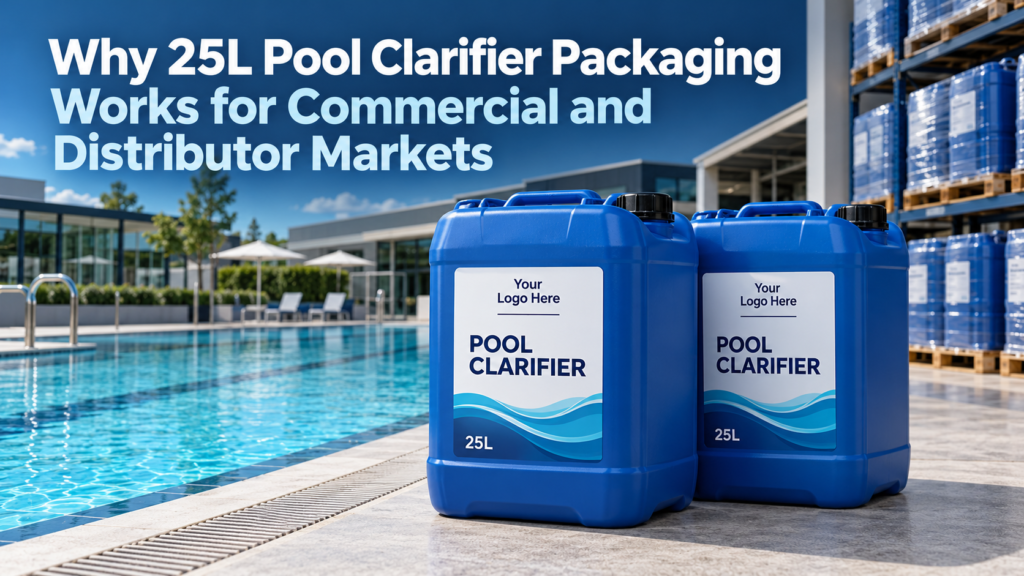
A small bottle of pool clarifier makes sense on a retail shelf. But when you supply hotels, manage several pools, or deliver chemicals to service contractors, your needs change.
You start asking different questions.
How often will we need to reorder? How many containers must the team handle? Can we keep enough stock without filling the storeroom? And does the packaging help us serve customers at a fair margin?
That’s where 25L pool clarifier packaging earns its place.
For buyers with steady demand, this format can offer a useful balance between small retail packs and much larger bulk containers. It holds enough product to support repeat use, yet it can be supplied as an individual jerrycan without the receiving setup needed for an IBC tote.
The benefits still depend on the details. A larger pack won’t fix a weak formula, poor stock control, or awkward dispensing.
But when the product, container, and customer fit each other, 25L packaging can make commercial pool care and chemical distribution much easier to manage.
Bigger Pools Bring Different Buying Habits
A homeowner may buy clarifier when the pool starts to look dull. A commercial buyer has more to think about: stock levels, staff routines, purchasing approvals, and a pool that guests expect to look inviting.
A hotel pool, leisure facility, or group of managed properties may need a more structured supply plan. Demand can also vary with weather, visitor numbers, and local operating seasons.
Clarifier use should follow actual water conditions and the product’s directions. It should never become a reason to add chemicals without checking the pool first.
Even so, sites with established demand can benefit from keeping a suitable working supply close at hand.
Imagine a maintenance team discovering that its last small bottle is almost empty just before a busy weekend. The issue isn’t just the price of another bottle. Someone has to find stock, arrange delivery, and make sure the correct product arrives.
A well-planned 25L purchase can reduce those interruptions.
For distributors, the same logic applies across several customers. Supplying one commercial pack may be more practical than supplying many small bottles to an account that uses the same formulation regularly.
A Useful Middle Ground Between Bottles and IBCs
Chemical packaging comes with tradeoffs. Small packs are easy to move and sell individually. Large bulk containers hold more product but require suitable space and handling equipment.
The 25L format sits between these ends of the range.
For a distributor, it can serve customers who have outgrown retail bottles but don’t need an IBC. For a pool operator, it can provide a working stock without committing to a much larger quantity.
Here’s how the formats can fit different needs:
| Packaging format | Typical buying situation | Main point to consider |
|---|---|---|
| 1L bottle | Retail sales, trials, occasional use | Convenient for small purchases |
| 5L jerrycan | Service routes and moderate demand | Easier to move between sites |
| 25L jerrycan | Established commercial accounts and trade supply | More product per container, with greater handling weight |
| IBC tote | High-volume storage or production needs | Requires suitable receiving and dispensing arrangements |
These are buying patterns, not fixed rules.
A large facility may still prefer smaller packs because staff work in separate areas. A distributor may carry all four formats. The right choice depends on how the product moves from delivery to storage to use.
Fewer Containers Can Mean Less Routine Work
When the formulation and actual fill volumes are the same, one 25L supply contains as much liquid as five 5L packs or twenty-five 1L packs.
That arithmetic is simple. Its effect on daily work is worth a closer look.
Each separate container needs a closure and label. Staff may also need to receive it, inspect it, count it, store it, open it, and manage the empty packaging afterward.
Reducing the number of units can cut some of that repetitive work.
A warehouse team, for example, may find it easier to pick two large jerrycans for a trade customer than fifty individual bottles. A commercial site may have fewer empty containers to track and remove.
Still, fewer units do not automatically mean easier handling. A full 25L pack is heavy. Moving it may call for a trolley, a suitable lifting aid, or another handling method based on the workplace assessment.
The benefit comes from designing the whole process well. Fewer containers help most when staff can move and dispense from them without strain or spills.
Look Beyond the Price Printed on the Quote
Bulk buyers often expect a lower price per litre from a larger pack. That may be possible, but it should be checked against a real quotation.
Container costs, order quantity, label design, freight, and delivery terms all affect the result.
A better comparison is the total delivered cost of usable product.
For example, consider two hypothetical offers for the same formulation:
| Item | Small-pack offer | 25L-pack offer |
|---|---|---|
| Total supplied volume | 100L | 100L |
| Product and packaging | $240 | $210 |
| Freight and local delivery | $60 | $70 |
| Total delivered cost | $300 | $280 |
| Delivered cost per litre | $3.00 | $2.80 |
These figures are examples, not Eautrix prices.
They show why a buyer should compare the full order. The larger pack has a higher delivery charge in this example, yet its total cost remains lower.
The result could also go the other way. A small shipment of heavy jerrycans may attract handling charges that reduce the saving.
And when comparing different formulations, cost per litre alone is not enough. Concentration, approved application rate, and observed performance under comparable conditions also matter.
A cheap litre isn’t always a cheap treatment.
Commercial Buyers Need a Pack They Can Actually Use
A 25L container should fit the working area, not just the purchasing budget.
Before placing an order, a pool operator should think through a normal day. Where will the delivery arrive? How will the container reach the chemical store? Where will staff measure the required dose?
That last step matters.
Lifting and tipping a full jerrycan to measure a small quantity can be awkward. A compatible dispensing pump or another supplier-approved transfer method may make the task more controlled.
The equipment must suit the formulation and container. Check the closure fit, chemical compatibility, output, and cleaning needs. Keep measuring tools dedicated to their intended product.
A dispensing pump also needs to match the size of the task. A high-output pump may be poor at measuring a small dose.
For any automatic dosing arrangement, confirm that the product, equipment, and treatment method are suitable together. A 25L pack does not, by itself, make a clarifier suitable for continuous dosing.
Good packaging supports a sound routine. It doesn’t replace one.
Distributors Can Build a Clearer Product Range
For a pool chemical distributor, pack size is part of the sales offer.
A homeowner, a mobile service company, and a resort purchasing manager may all need clarification support. They may want very different quantities, delivery schedules, and product information.
Offering a 25L size gives the distributor a way to serve established trade accounts within the same product family.
A simple range might include:
- 1L: small purchases and retail customers.
- 5L: service companies and customers with moderate use.
- 25L: commercial sites and accounts with repeat demand.
This makes the conversation more useful.
Instead of pushing the largest container, the sales team can ask about monthly use, storage space, and who will handle the product. Those answers help match the pack to the customer.
There is a stock-control benefit too. A distributor can keep retail and commercial demand visible as separate sales patterns, even when the underlying formulation is the same.
But adding another size should have a purpose. A 25L SKU that sits untouched for months ties up cash and warehouse space.
Start with identifiable demand, then build the stock plan around it.
Steady Turnover Matters More Than a Big First Order
A full pallet can look reassuring. It can also become slow-moving stock.
For distributors, the value of 25L pool clarifier packaging depends partly on how quickly it sells and how reliably it can be replenished.
Look at actual customer demand rather than the number of pools in your territory. Some accounts use clarifier only in specific circumstances. Others may already have an established treatment program.
Seasonality adds another layer.
A distributor serving outdoor pools may see demand rise before and during the swimming season. A supplier to indoor facilities may have a different pattern.
A practical forecast considers:
- Recent sales by customer and pack size.
- Known orders and confirmed projects.
- Delivery lead time.
- Usable stock already on hand.
- Remaining shelf life.
- Reasonable allowance for supply delays.
Use the manufacturer’s stated shelf life and storage conditions. Where dates differ, dispatching stock by earliest expiry can help reduce avoidable losses.
The aim is simple: enough stock to serve customers, with enough turnover to keep it moving.
Pallet Planning Can Make Orders Easier to Manage
For trade shipments, the individual jerrycan is only one part of the package.
The pallet layout affects receiving, storage, transport, and unloading. Buyers should ask for the proposed arrangement before confirming an order.
Useful details include the number of containers per pallet, pallet dimensions, loaded height, and total gross weight. Ask how the load will be secured and whether the receiving site can handle it.
A rectangular, stackable jerrycan may support an orderly layout, but “stackable” is not a complete transport specification.
The container design, load weight, stacking conditions, and supplier’s instructions all matter. Don’t assume that a stack shown in a product photo is suitable for every warehouse or shipment.
Distributors also need to consider the last delivery.
Will they sell full pallets, deliver several jerrycans at a time, or offer customer collection? Can the delivery vehicle unload at the customer’s site?
The best pallet plan supports both the incoming shipment and the smaller orders that follow.
Container Quality Deserves More Attention Than It Gets
A container is easy to overlook when the buyer is focused on the chemical.
Then a cap leaks, a handle feels weak, or a label becomes unreadable. Suddenly, packaging becomes the main issue.
A sound 25L pack needs a container and closure system suited to the formulation and expected transport conditions.
Review the practical details:
| Packaging feature | Why it matters |
|---|---|
| Container material | Must be compatible with the supplied formulation |
| Handle and body design | Affect grip and movement |
| Closure and seal | Help contain the product during storage and transport |
| Label surface | Needs to retain readable product information |
| Dispensing access | Should suit the intended transfer method |
| Batch marking | Supports stock checks and traceability |
Tamper evidence may also be useful, depending on the customer and market.
A packaging sample can help a buyer assess the handle, cap, label area, and fit within the storeroom. It should form part of the evaluation alongside product specifications and supply terms.
A good formula deserves a container that arrives intact and works well in use.
Don’t Confuse 25L Capacity with 25kg Net Weight
This is a small detail with a large effect on purchasing accuracy.
Litres measure volume. Kilograms measure mass. A container described as 25L does not automatically contain 25kg, and a 25kg fill does not automatically equal 25 litres.
The relationship depends on the liquid’s density.
For illustration, if a product has a density of 1.05kg/L, then 25L of that liquid would weigh about 26.25kg, before adding the container.
Likewise, a 25kg net fill would occupy about 23.8L at that density.
These are example calculations. Use the density of the actual supplied formulation.
The purchase order should make the basis clear:
- Nominal container capacity.
- Agreed net fill by mass or volume.
- Price basis.
- Net and gross shipment weights.
This helps distributors compare offers fairly and describe the product accurately to their own customers. It also prevents a container-size description from becoming an unintended promise about the quantity inside.
Private Label Packaging Can Support Trade Sales
A commercial pack still represents a brand.
It may spend most of its time in a storeroom, but technicians, warehouse staff, and purchasing teams see it throughout its working life.
A clear label helps them identify the product and find the information they need. That is more useful than a crowded design filled with vague claims.
For a private label 25L pool clarifier, the label should make the product name, agreed net contents, directions, storage guidance, and batch details easy to read. Required safety and supplier information must also be included for the destination market.
The product’s role should be clear. Don’t let wording imply that a clarifier provides disinfection or algae control unless the specific product and permitted claims support that message.
Eautrix lists custom labels, packaging choices, and formulation customization for its polymer pool clarifier range. Buyers can review the Eautrix Polymer Pool Clarifier page as a starting point for discussing their intended pack and market.
The final design should follow the agreed specification. A packaging mockup is a design aid, not a substitute for a finished product label.
A Larger Container Doesn’t Mean a Larger Dose
It sounds obvious, yet bulk packaging can make casual measuring more tempting.
A technician sees plenty of product in the container and adds “a little extra.” That is not a reliable treatment method.
The dose should follow the specific product directions, pool volume, and relevant water conditions. Container size has no role in that calculation.
Clarifiers are used to help address fine suspended particles as part of a suitable pool treatment and filtration program. They do not remove the need to investigate the cause of cloudy water.
A pool may need attention to filtration, circulation, water balance, or sanitation. Adding clarifier without checking those conditions may leave the real problem unresolved.
For distributors, clear technical guidance is therefore part of the value of a 25L sale. Customers need to understand how to use the product accurately, especially when they are moving from a familiar small bottle to a larger pack.
The packaging changes. Measurement still matters.
Less Packaging Is a Possibility, Not a Blanket Promise
Supplying the same volume in fewer containers may reduce packaging material per litre. It can also mean fewer caps and labels to manage.
That makes 25L packaging worth reviewing when a buyer wants to reduce empty-container handling.
But fewer containers do not prove a lower overall environmental impact.
A larger jerrycan may have thicker walls. Pallet materials, transport distances, product losses, and local waste arrangements also affect the result.
A useful comparison starts with actual data: packaging weight per litre supplied, transport efficiency, and how the empty containers will be managed.
Avoid assuming that a chemically contaminated container can enter an ordinary recycling stream. Follow the product guidance and applicable local requirements.
For the article’s main question, the practical benefit is easier to state: fewer individual packs can simplify empty-container management for suitable users.
Broader environmental claims need evidence.
When 25L Packaging May Be Too Much
There are good reasons to choose a smaller pack.
A customer with occasional demand may take too long to use 25L. A mobile technician may find a 5L container more convenient. A small storeroom may not have a suitable place for a heavy jerrycan and its dispensing equipment.
A new distributor may also want to test demand before carrying larger packs.
These are sensible buying decisions.
The question is not whether 25L is the most “professional” size. The question is whether it fits the customer’s use, handling setup, and purchasing cycle.
Before recommending it, ask:
How much product does the account actually use? Can staff dispense it accurately? Will it be used within the stated shelf life? Does the delivered cost justify the commitment?
If the answers are clear, the sale has a sound basis.
If they are uncertain, a smaller first order may help both supplier and buyer build a better forecast.
Build the Offer Around the Customer’s Routine
The strongest case for 25L pool clarifier packaging is practical.
For the right commercial account, it can reduce the number of containers handled, support a steadier working stock, and offer a useful delivered cost. For a distributor, it creates a pack size suited to repeat trade demand between small bottles and IBC supply.
Those benefits work together only when the details are right.
Confirm the formulation. Define the net fill. Check the container, dispensing method, pallet arrangement, and label. Then match the order quantity to realistic turnover.
A distributor who does this gives customers more than a bigger pack. They give them a product that fits how their business works.
That’s what makes 25L packaging worth considering.
Frequently Asked Questions
1. Is 25L pool clarifier packaging suitable for hotel and resort pools?
It can suit hotels and resorts with sufficient demand, suitable storage, and a safe dispensing method. Base the decision on actual product use and the manufacturer’s directions, rather than pool size alone.
2. Does buying pool clarifier in 25L jerrycans always cost less?
No. Compare the full delivered cost, including freight and handling. When comparing different formulations, also consider concentration, application rate, and performance under comparable conditions.
3. Can distributors sell 25L pool clarifier under a private label?
Yes, where the supplier offers that service. Agree on the formulation, net fill, label artwork, traceability details, and destination-market requirements before production.
4. What is the difference between a 25L container and a 25kg fill?
A 25L description refers to volume or nominal container capacity; 25kg refers to mass. The liquid’s density determines the relationship. Confirm the actual net contents and price basis in the order.
5. Should a pool service company choose 5L or 25L clarifier packaging?
A 5L pack may be easier for mobile work and lower-use accounts. A 25L pack may suit a central store or regular commercial demand. Compare handling needs, stock turnover, dispensing equipment, and delivered cost.