
GET IN TOUCH
Ask For Sample?
How OEM Pool Clarifier Manufacturing Helps Brands Expand Their Product Range?
A pool chemical brand can have strong products and still leave a gap on the shelf.
Perhaps your customers already buy your algaecide, chlorine treatment, or pH adjuster. They trust the brand. Your distributors know the range. Yet when a pool looks dull or slightly cloudy, those same customers reach for a clarifier from another supplier.
That missing bottle represents more than a lost sale. It may mean another brand gets the chance to build a relationship with your customer.
OEM pool clarifier manufacturing offers a practical way to fill that gap. By working with a manufacturing partner, brands can introduce a clarifier under their own name without building a dedicated production operation.
The value goes beyond putting a new label on a bottle. A well-planned OEM project can help you serve new buyers, offer useful pack sizes, and build a more complete pool care range.
There’s a catch, though: a larger catalog only helps when each product earns its place. The goal is to add something customers need, understand, and buy again.
What Does OEM Pool Clarifier Manufacturing Actually Mean?
In the pool chemical trade, OEM generally describes an arrangement in which a supplier makes a product for another company to sell under its own brand.
The scope can vary quite a bit.
One brand may choose an existing clarifier formula and request its own label. Another may need a different concentration, a clear appearance, or packaging designed for professional pool service teams. A third may supply a formula and ask the manufacturer to blend and fill it to an agreed specification.
The terms “OEM,” “private label,” and “contract manufacturing” sometimes overlap in supplier discussions. Rather than relying on the name of the service, define the work.
A useful agreement should make clear:
- Which formula and specifications apply.
- Who approves the label and product claims.
- Which tests are required before release.
- Who supplies bottles, caps, labels, and cartons.
- How formula or raw material changes are handled.
- Whether any formula, artwork, or market exclusivity applies.
These details turn a broad idea into a product that can be quoted, tested, and reordered.
They also help prevent a common misunderstanding: buying a private label product does not automatically give a brand exclusive ownership of the formula.
Fill a Real Gap in Your Pool Care Range
Before choosing a bottle or a product name, ask a simple question: What problem do our customers still need help with?
For many pool care brands, water clarity is a natural area to assess.
Pool owners may follow a treatment routine yet still notice a haze. Fine suspended particles can contribute to that dull look, and a suitable polymer clarifier can help bring particles together so a compatible filtration system can capture them more effectively.
That gives clarifier a distinct role in the range.
It supports water clarity. It does not replace proper disinfection, water balance, circulation, or filter care. Nor should a brand present it as a cure for every cause of cloudy water.
This distinction helps customers use the product with realistic expectations.
For example, a brand that already sells an algaecide can explain two separate jobs: algae control and the removal of fine suspended material through filtration. Customers gain a clearer understanding of why both products may have a place in a maintenance program.
A coherent range works much like a good toolbox. Each item has a purpose, and buyers can see when to reach for it.
Add a Product Without Building a New Production Operation
Making a liquid pool chemical involves more than mixing ingredients.
The work may include raw material checks, controlled blending, batch sampling, filling, cap application, labeling, and packing. Someone must also manage equipment care, production records, storage, and the release of finished goods.
For a brand whose strengths lie in sales and distribution, developing all those functions internally may be a large commitment.
OEM manufacturing allows the brand to purchase agreed production services while focusing its own resources on customer demand, distribution, and product support.
This can reduce the need for an initial investment in dedicated manufacturing equipment. It may also simplify a first launch when the supplier already has a suitable formula and compatible packaging.
Still, outsourcing production does not remove the need for oversight.
The brand should understand what it is buying, approve the product, and confirm that the supplier can repeat the result. A promising sample is the start of that process—not the whole process.
Reach New Buyers Through Useful Pack Sizes
Product range expansion does not always require a new formula.
Sometimes, the same approved clarifier can reach a different customer through a more suitable container.
Think about the difference between a homeowner buying one bottle and a service company treating several pools each day. They may need similar water treatment support, but their buying habits and handling needs differ.
| Packaging format | Potential buyer | Main point to assess |
|---|---|---|
| 1L bottle | Pool shops and residential users | Shelf presentation and clear measuring instructions |
| 5L jerrycan | Pool service companies | Carrying, pouring, and storage in service vehicles |
| 25L jerrycan | Larger users and distributors | Safe handling and suitable dispensing equipment |
| Bulk packaging | Qualified local filling businesses | Transfer controls, filling capability, and traceability |
These are starting points, rather than fixed rules. A small commercial site may prefer a compact pack, while a retail customer may buy a larger size for the season.
The right choice depends on consumption, dose, storage space, and how the product will be handled.
Larger packs can reduce packaging use per unit of liquid, but they also become harder to lift and pour. A lower container cost means little if the pack creates spills or discourages repeat orders.
Good packaging makes the product easier to buy and easier to use.
Build Different Offers Without Confusing Customers
Once a brand sees the scope for customization, it can be tempting to launch several versions at once.
A clear clarifier. A blue clarifier. A professional clarifier. A premium clarifier. A seasonal clarifier.
Soon, the catalog looks full—but the differences may be hard to explain.
A useful product variation needs a clear reason to exist. That reason might be a different concentration, a validated application, or a pack designed for a particular sales channel.
A color change can support visual identity. It does not, by itself, prove better performance.
The same principle applies to product names. Calling a formula “professional strength” should reflect a meaningful and supportable difference, rather than a darker label.
For an early launch, a focused offer is often easier to manage:
- One clearly defined clarifier formula.
- One primary customer group.
- One or two pack sizes.
- Simple, tested directions.
Additional versions can follow when buyer feedback reveals a real need.
A short range with clear differences can be more persuasive than a long range that needs a lengthy explanation.
Match the Formula to the User’s Routine
Concentration matters, but it is only one part of product design.
A stronger formula may reduce the volume needed for a treatment. It may also require more precise measuring. A less concentrated product may be easier for some users to dose, while increasing the amount of liquid they store and transport.
Neither approach is automatically better.
The useful question is: Which formula can the intended customer use correctly and consistently?
For a homeowner, straightforward directions and a practical measuring method may carry great value. For a trained service technician, a concentrated product may fit an established dosing routine.
Evaluation should consider the full product, including:
- Polymer type and agreed content.
- Performance at the proposed dose.
- Behavior when too much is added.
- Relevant filter compatibility.
- Storage stability.
- Appearance and handling.
- Bottle, cap, and label compatibility.
Do not assume that doubling the concentration allows every instruction to be cut in half. Formula changes need review and testing.
A product range grows more reliably when the instructions follow the validated product, rather than the marketing idea.
Use OEM Development to Strengthen Brand Identity
Customers often meet a pool care brand through its packaging.
They see a product on a shop shelf, in a distributor’s catalog, or beside a service technician’s equipment. A consistent appearance helps them recognize the range.
OEM development can bring a new clarifier into that visual family through label design, bottle selection, cap color, and carton presentation.
But recognition is only part of the job. The label must also help the buyer understand the product.
The front should make its purpose clear. The directions should make the next step clear. The supporting information should help users find the right advice when something goes wrong.
Consider two labels.
One promises “ultimate pool perfection” but leaves the dose buried in small print. The other explains the product’s role, states the treatment quantity clearly, and tells the user how to run the pool system afterward.
The second label may be less dramatic. It is also more useful.
That usefulness becomes part of the brand experience, especially when customers are already frustrated by cloudy water.
Make Quality Consistency Part of the Product
The first order introduces a product. Repeat orders establish its reputation.
If appearance, handling, or performance varies without explanation, distributors have to answer uncomfortable questions. Service teams may lose confidence in the dose they previously used.
OEM pool clarifier manufacturing works best when both parties agree on a written specification before routine supply begins.
Depending on the formula, that specification may cover appearance, polymer content, pH, density, viscosity, or other relevant measures. The parties should also agree on test methods and acceptance limits.
Those details matter. “Content” is not always the same measurement as “total solids,” and a specification should say which value is being controlled.
A practical quality arrangement can include:
- An approved reference sample.
- Batch identification and production records.
- A certificate of analysis with agreed results.
- Retained samples for later investigation.
- A process for reporting complaints.
- Written notice and review of material changes.
These controls help connect a complaint to a specific batch and make investigations more useful.
They also give the brand a firmer basis for discussing quality than a general promise of “consistent supply.”
Turn Customer Education Into a Sales Advantage
A new clarifier creates a new opportunity to help customers understand their pool care routine.
That support can start before the first sale.
A retailer needs a short explanation of when to recommend the product. A service company may need a technical sheet and a way to record results. A distributor may need clear answers about packaging, storage, and the difference between available versions.
The most useful questions are often quite basic:
What does it do? When should I use it? How do I measure it? What should I check if the water stays cloudy?
Answering those questions can make the product easier to sell and reduce avoidable misuse.
Be careful with instructions that sound universal. Pool conditions differ, and a clarifier label should reflect the actual formula and its evaluated uses.
Likewise, explain whether the product is intended to work through filtration or through another treatment procedure. Buyers should not have to guess from the word “clarifier.”
Clear education gives distributors a reason to recommend your brand beyond its purchase price.
Compare the Whole Cost, Not Just the Factory Price
A low price per kilogram can look attractive on a quotation.
It may look less attractive after freight, packaging, storage, and selling costs are included.
When comparing OEM pool clarifier offers, brands should examine both the landed cost and the product’s supported treatment dose.
A concentrated product might cost more per liter while requiring less liquid per treatment. Another product may have a lower purchase price but need more warehouse space for the same expected number of treatments.
Those comparisons only make sense when performance is suitable and the dose is properly established.
Build the calculation around the actual business:
Landed product cost + local handling + selling costs + expected losses = a more realistic cost base.
Then assess the intended selling price and margin.
Include less obvious items such as artwork setup, cartons, samples, inspections, damaged stock, and financing during the order cycle.
Also ask about the minimum order for each component. A supplier may accept a modest liquid order while the custom bottle or printed carton has a much larger minimum.
That mismatch can tie up cash in packaging before the product has proved its demand.
Start With a Launch You Can Learn From
A first OEM order should test more than customer interest.
It should also test how well the product moves through your business.
Can the warehouse handle it? Do cartons arrive in good condition? Can retailers explain it? Do users understand the dose? Does the chosen pack size match the rate of use?
A focused launch makes those questions easier to answer.
For example, a brand serving pool service companies might begin with one formula in a 5L pack. It can gather feedback on pouring, measuring, storage, and repeat use before adding a larger container.
A retail brand may instead start with a 1L bottle and concentrate on shelf communication and consumer directions.
These are hypothetical launch paths, not fixed recommendations. The point is to connect the first product to a known route to market.
Useful early measures include reorder frequency, complaints, packaging damage, distributor feedback, and margin after delivery costs.
Sales volume matters. So does finding out why customers come back—or why they don’t.
Agree on Responsibilities Before the First Shipment
A smooth OEM relationship needs clear responsibilities on both sides.
The manufacturer may control blending and filling. The brand may control artwork and local distribution. Other tasks, such as product documentation and label review, may require input from both.
Put those responsibilities in writing.
Confirm the approved formula, packaging, artwork version, order quantity, inspection process, and production lead time. Discuss what happens if a batch falls outside specification or a packaging component becomes unavailable.
Documentation should describe the supplied product accurately. The product name, technical documents, labels, and shipment details need to be consistent with the actual goods and their intended market.
Requirements vary by destination and product claims, so market review belongs early in the launch process.
A new brand name does not change the underlying composition or remove the need for accurate safety information.
Getting these points settled before printing labels can prevent expensive changes later.
How Eautrix Can Support a Clarifier Range Project
Eautrix lists a PolyDADMAC-based pool clarifier with a stated 10% active ingredient content, original or blue appearance options, formulation adjustment, and private label support. Its listed packaging includes 1L, 5L, and 25L formats, along with bulk options. These provide starting points for discussing a brand’s intended product range; final specifications and order terms should be confirmed for the project.
Explore the Polymer Pool Clarifier page to review the current offer.
For a useful first discussion, prepare your target market, buyer type, preferred pack size, expected order quantity, and any formula requirements. Share what customers need the product to do, rather than only asking for a matching bottle.
You can contact Eautrix to discuss samples, specifications, and packaging for evaluation.
The strongest range expansion starts with a clear customer need. OEM manufacturing then provides a way to turn that need into a product your brand can support, explain, and supply again.
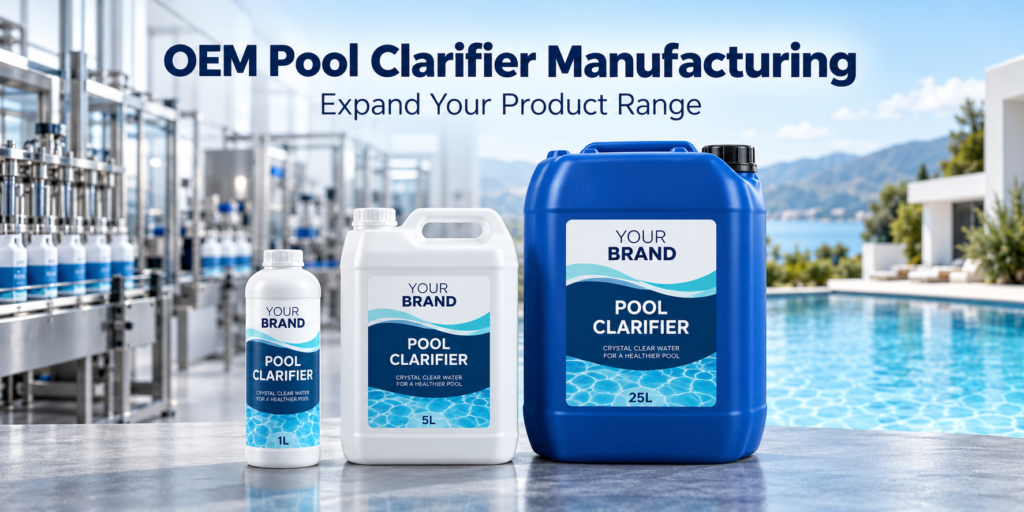
Illustration: Conceptual OEM pool clarifier packaging mockup; the generated scene does not depict an actual production facility.
Alt text: Private label pool clarifier in 1L, 5L, and 25L containers, with a conceptual filling line and swimming pool background.
Frequently Asked Questions
1. Can a small pool chemical brand launch an OEM pool clarifier?
Yes, provided the supplier’s minimum orders, development costs, and packaging requirements fit the brand’s budget. Starting with an established formula and standard containers may simplify the project, but samples and market requirements still need review.
2. What is the difference between OEM pool clarifier and private label pool clarifier?
Private label often refers to an existing product supplied with a buyer’s branding. OEM may include production to an agreed formula or specification. Suppliers use these terms differently, so confirm the exact development and manufacturing scope.
3. Can the same pool clarifier formula be sold in retail and professional packaging?
Potentially, yes. One approved formula may suit several pack sizes. Each pack still needs appropriate directions, a practical measuring method, and handling arrangements suited to its intended user.
4. Does blue private label pool clarifier perform better than clear clarifier?
Blue color alone does not establish better clarification. Performance depends on the full formula, dose, pool conditions, and filtration. Any clear or dyed version should be evaluated for its intended use.
5. What should brands check before placing a bulk OEM pool clarifier order?
Approve the sample, written specification, packaging, artwork, and test requirements. Confirm minimum quantities, lead time, batch traceability, documentation, change controls, and the process for handling goods that fail the agreed specification.