
GET IN TOUCH
Ask For Sample?
Understanding Polymer-Based Pool Water Clarification
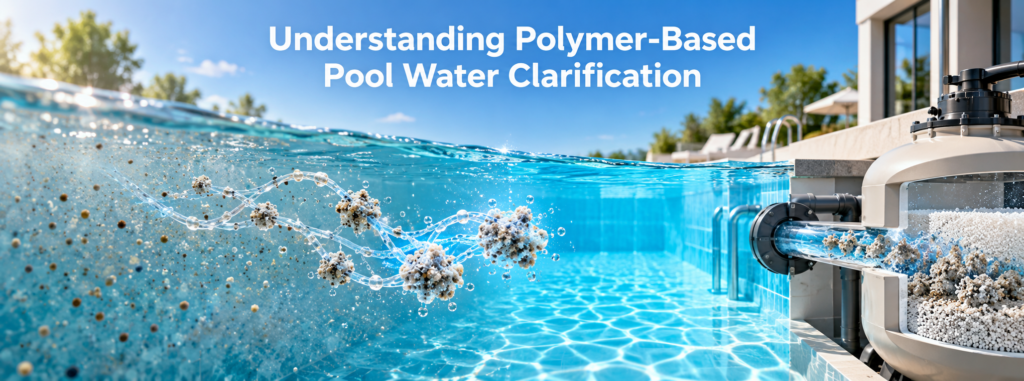
A swimming pool can have the right chlorine level, a balanced pH, and a working filtration system—and still look slightly dull or cloudy. It’s frustrating, isn’t it? The water may be chemically acceptable, yet it lacks that bright, polished appearance swimmers expect.
The problem often comes down to particle size.
Pool water can contain thousands of tiny suspended particles. Many are so small that they remain floating instead of sinking, and some pass straight through the filter. They may come from dust, pollen, cosmetics, body oils, dead algae, organic matter, or minerals carried into the pool by rain and source water.
Polymer-based pool clarifiers help solve this problem by gathering those fine particles into larger clusters. The filter can then capture them more effectively.
That sounds simple—and the basic idea is simple. Still, the chemistry behind it deserves a closer look. Understanding how clarification works can help pool operators select the right product, apply it correctly, and avoid turning a small clarity issue into a bigger one.
What Does Pool Water Clarification Mean?
Pool water clarification is the process of removing fine suspended matter that makes water appear hazy, dull, or cloudy.
It does not usually mean killing microorganisms. That is the job of disinfectants such as chlorine or bromine. Clarification focuses mainly on the physical removal of particles that are already present in the water.
Clear water depends on several connected processes:
- Sanitizers control bacteria, algae, and other microorganisms.
- Water balance helps prevent corrosion, scaling, and swimmer discomfort.
- Circulation carries suspended matter toward the filtration system.
- Filtration physically removes particles from the water.
- Clarifiers help the filter capture particles that would otherwise be too small.
A clarifier therefore supports filtration. It does not replace it.
Think of the filter as a fishing net. It catches material larger than its openings, but very small particles may slip through. A polymer clarifier effectively gathers those particles into larger groups, making the “fish” big enough for the net.
Why Can Pool Water Look Cloudy?
Cloudiness is not one single problem. It is a visible symptom with many possible causes.
Some cloudy-water cases are related to poor circulation or insufficient filtration time. Others result from an unbalanced pH, low sanitizer levels, an algae outbreak, heavy bather use, or a sudden change in weather.
Fine suspended matter is another common cause. These particles may include:
- Dust and airborne soil
- Pollen and plant material
- Dead algae cells
- Body oils and perspiration
- Sunscreen and cosmetic residues
- Tiny skin flakes
- Organic debris
- Precipitated calcium or other minerals
- Small particles carried in by rainwater
- Residues produced after oxidation
Some of these particles are almost invisible when viewed individually. Together, however, they scatter light as it passes through the water. Instead of seeing a sharp pool floor and crisp lane markings, you see a pale haze.
The water may not look dramatically dirty. It may simply seem tired, flat, or slightly milky. In a residential pool, that is annoying. In a hotel, resort, water park, school, or public facility, it can quickly become a concern about maintenance and safety.
Why Doesn’t the Filter Remove Every Particle?
Pool filters are very useful, but they have physical limits.
A sand filter, cartridge filter, or diatomaceous earth filter captures particles within a certain size range. Actual performance depends on the filter design, media condition, flow rate, operating pressure, maintenance schedule, and the nature of the particles.
Some suspended particles are too small to be retained efficiently. Others remain stable in the water because their surfaces carry similar electrical charges.
Imagine pushing the same poles of two magnets together. They resist contact. Fine particles in pool water can behave in a comparable way: they repel one another and remain dispersed.
Their low settling rate creates another challenge. A large piece of debris may fall to the bottom, where it can be vacuumed. A microscopic particle can remain suspended for a long time, especially when pumps, return jets, and swimmers keep the water moving.
As a result, the particle may circulate through the filter again and again without being captured.
That is where polymer chemistry becomes valuable.
What Is a Polymer-Based Pool Clarifier?
A polymer is a large molecule made from many repeating chemical units linked together. Its structure can be compared to a long chain, although real polymer molecules may be linear, branched, or arranged in more complex forms.
A polymer-based pool clarifier contains water-compatible polymer molecules that interact with suspended particles. Many pool clarifiers use positively charged, or cationic, polymers because numerous particles found in water carry a negative surface charge.
One commonly used category is cationic polymer chemistry based on compounds such as PolyDADMAC. In commercial formulations, the polymer concentration may be adjusted to suit the required performance, dosing method, packaging format, and target market.
Polymer clarifiers are commonly supplied as liquids. Depending on the formulation, the finished product may be colorless, pale yellow, or tinted blue for branding and easier product identification.
Typical retail and commercial packaging includes:
- 1-liter bottles
- 5-liter containers
- 25-liter drums or jerry cans
- Larger industrial packaging for professional users
Private-label versions can also be prepared for pool chemical distributors, maintenance companies, and regional brands.
The appearance of the product matters for marketing, but its performance comes from the polymer’s charge, molecular characteristics, concentration, and compatibility with the pool system.
How Polymer Clarification Works?
Polymer clarification may involve several related mechanisms. The two most important are charge neutralization and particle bridging.
Charge Neutralization
Many fine suspended particles carry a negative electrical charge on their surfaces. Because particles with similar charges repel one another, they remain separated and stable in the water.
A cationic polymer carries positive charges. When it contacts negatively charged particles, it reduces their surface charge. This weakens the repulsive force keeping them apart.
Once that electrostatic barrier becomes weaker, the particles can approach one another more easily. Collisions caused by normal water movement then help form larger groups.
This process is often associated with coagulation: the destabilization of finely dispersed particles.
Particle Bridging
Long polymer molecules can also attach to more than one particle. Part of the polymer chain adsorbs onto the surface of one particle, while another section remains available to attach to a different particle.
The polymer acts like a bridge.
As more particles become connected, loose clusters begin to form. These clusters are often called flocs, although clarifier-produced clusters may remain relatively small compared with the heavy flocs created during a full flocculation treatment.
The larger clusters are easier for the filter to retain. Instead of trying to capture countless microscopic particles one by one, the filter receives larger, more manageable groups.
Filtration Completes the Job
The clarifier does not make unwanted matter disappear. It changes the physical condition of that matter so the filtration system can remove it.
This is an important distinction.
After treatment, the circulation system must continue operating long enough to move the aggregated particles toward the filter. The filter then needs to be inspected, cleaned, or backwashed as required. Otherwise, captured material may restrict flow and reduce filtration efficiency.
Polymer chemistry starts the process. Circulation and filtration finish it.
Clarification Is a Team Effort
It is tempting to think that adding a clarifier will instantly solve every cloudy-water problem. Sometimes the improvement is quick, but reliable clarification depends on the whole pool system.
Four elements must work together:
- Correct water chemistry: Severe pH imbalance, active algae growth, or mineral precipitation must be addressed.
- Effective circulation: Treated water needs to move throughout the pool, including areas with weak flow.
- Suitable polymer dosing: Too little product may have a limited effect, while too much can create new problems.
- Proper filtration: The filter must be clean, correctly sized, and operated for an adequate period.
When one part of this chain is weak, clarification may be slow or incomplete.
For example, a clarifier cannot compensate for a blocked filter. Nor can it reliably correct water that is cloudy because calcium is precipitating after a sharp rise in pH. It may help collect some suspended material, but the underlying cause will remain.
Good diagnosis should always come before treatment.
Pool Clarifier or Pool Flocculant?
Clarifiers and flocculants are related, but they are not always used in the same way.
A pool clarifier usually forms relatively small particle clusters that can be removed through normal filtration. The pool often remains in circulation during treatment, and the process may require several filtration cycles.
A flocculant generally creates heavier clusters that settle on the pool floor. The circulation system is normally stopped after the product has been distributed, allowing the floc to settle. The material is then vacuumed carefully—often to waste rather than through the filter.
A clarifier is commonly suited to:
- Mild or moderate cloudiness
- Routine clarity maintenance
- Fine particles that escape normal filtration
- Pools that need to remain operational
- Gradual improvement through continued filtration
A flocculant may be considered when:
- The water is severely cloudy
- A large amount of suspended matter must be removed
- The facility can close the pool during treatment
- The system supports vacuuming to waste
- Rapid settling is more practical than repeated filtration
Neither method is automatically better. The correct choice depends on the cause and severity of the problem, the filtration system, and the operating needs of the facility.
What Happens After a Clarifier Is Added?
Once a liquid polymer clarifier enters the circulating water, it begins interacting with suspended matter. Distribution should be reasonably even, which is why circulation is so important.
The process generally follows this sequence:
- The polymer disperses through the pool.
- Charged polymer sites interact with particle surfaces.
- Stable fine particles become less resistant to contact.
- Polymer chains connect particles into larger clusters.
- Circulation transports the clusters toward the filter.
- The filter retains more of the suspended material.
- Water clarity improves as the particle concentration falls.
This does not always happen within minutes. The required time varies according to the level of cloudiness, water temperature, particle type, filter condition, circulation pattern, and product formulation.
In mild cases, a visible improvement may occur after several hours. More difficult cases may require a longer filtration period and filter maintenance before the water looks polished again.
Patience matters. Adding another dose too quickly can make the situation worse.
Why More Clarifier Is Not Always Better?
Clarifiers are effective at low treatment levels. That can lead to a common mistake: assuming that twice as much product will work twice as fast.
Polymer chemistry does not behave that way.
An excessive dose may coat particle surfaces so thoroughly that the particles become stable again. Instead of building useful bridges, the polymer can prevent effective aggregation. Surplus polymer may also leave the water hazy, increase filter loading, or create a slippery residue on some surfaces.
Overdosing can produce symptoms that look surprisingly similar to underdosing. The pool remains cloudy, so the operator adds more product—and the cycle continues.
The safer approach is to:
- Follow the instructions for the specific formulation.
- Calculate the pool volume accurately.
- Measure the product rather than estimating.
- Allow adequate circulation and filtration time.
- Check the filter before repeating treatment.
- Investigate the original cause if clarity does not improve.
Commercial pool operators should keep treatment records. Recording the pool volume, water conditions, product dose, filtration time, and result makes future adjustments far easier.
Factors That Affect Polymer Performance
A clarifier does not work in isolation. Several water and operating conditions can influence its performance.
pH
The pool’s pH can affect particle charge, sanitizer performance, mineral behavior, and the interaction between a polymer and suspended matter.
Clarification should normally take place within the pH range recommended for the pool system and the product. If the pH is far outside that range, correcting it first may deliver better results than simply increasing the clarifier dose.
Turbidity Level
Light cloudiness and severe turbidity are different treatment challenges.
A low dose may be sufficient for routine polishing. Water containing a large amount of dead algae, soil, or storm debris may require a different treatment plan, extended filtration, repeated filter cleaning, or flocculation followed by vacuuming.
Particle Type
Not all particles have the same size, density, shape, or surface charge. Pollen behaves differently from clay. Dead algae cells behave differently from precipitated minerals. Sunscreen residues may not respond like ordinary inorganic dust.
This is one reason small-scale testing can be useful when treating unusual water or developing a new commercial formulation.
Polymer Charge and Molecular Characteristics
The polymer’s charge density affects how strongly it interacts with oppositely charged particles. Its molecular size and structure influence adsorption and bridging.
A product with stronger charge is not automatically superior. If the chemistry is poorly matched to the suspended matter or added at the wrong dose, performance may suffer.
The formulation needs balance, not brute force.
Mixing and Circulation
The clarifier must contact the particles, but extremely aggressive mixing can sometimes break fragile clusters apart. Pool circulation is generally gentler than industrial mixing, yet hydraulic conditions still matter.
Dead zones, poorly directed return jets, and inadequate turnover can leave parts of the pool untreated.
Filter Condition
A clarifier may work chemically while the pool remains cloudy because the filter cannot complete the removal step.
Possible causes include:
- Dirty or channelled filter media
- Damaged cartridges
- Incorrect flow rates
- Insufficient filtration time
- A filter that is too small for the pool
- Improper valve settings
- Delayed backwashing or cleaning
If water clarity does not improve, inspect the equipment before blaming the polymer.
Can Polymer Clarifiers Work with Different Filters?
Polymer clarifiers can be used with several common pool filtration systems, but operators should always follow the product instructions and equipment manufacturer’s guidance.
Sand Filters
Sand filters can benefit noticeably from clarification because very fine particles may otherwise pass through the filter bed. Aggregated particles are easier for the sand media to retain.
Filter pressure should be watched carefully. As more material is captured, pressure may rise and backwashing may become necessary.
Cartridge Filters
A cartridge filter can capture small particles efficiently when the cartridge is clean and undamaged. A clarifier may increase the amount of material retained, so the cartridge may need cleaning sooner than usual.
An excessive polymer dose can contribute to rapid loading or leave deposits on the cartridge. Careful dosing is especially important.
Diatomaceous Earth Filters
DE filters already provide fine filtration. A compatible clarifier may still help collect difficult suspended material, but the dose should be controlled because the filter can load quickly.
In every case, filtration performance should be observed after treatment rather than assumed.
When Is a Polymer Clarifier Most Useful?
Polymer-based clarification is useful in many routine pool situations.
After Heavy Bather Use
A crowded pool receives a sudden increase in perspiration, cosmetics, sunscreen, skin particles, fibers, and other organic matter. Chlorine may oxidize part of this load, but fine residues can remain suspended.
Clarification can help restore the water’s polished appearance once sanitizer levels and water balance have been checked.
After Rain or a Storm
Rain can carry dust, pollen, soil, and organic debris into an outdoor pool. Wind adds even more material. If the water becomes slightly hazy after a storm, a clarifier may help the filter remove the fine particles.
Severe contamination may require additional cleaning and water-balance correction.
After Algae Treatment
When algae are killed, countless tiny cells may remain in the water. The pool can change from green to blue yet still look cloudy.
A polymer clarifier may help gather dead algae cells so the filter can capture them. The filter may need repeated cleaning because the total particle load can be high.
During Peak Pollen or Dust Seasons
Outdoor pools in dry, windy, or heavily planted areas may receive a steady supply of airborne particles. Routine clarification can support filtration when ordinary skimming cannot remove the finest material.
In Commercial Pools
Hotels, resorts, schools, fitness centers, apartment complexes, and public pools experience changing bather loads. Even a small loss of clarity can affect customer confidence.
A well-managed clarifier program can help maintain a bright appearance, but commercial facilities must still comply with local health regulations, water-testing requirements, and operational procedures.
What a Clarifier Cannot Do?
A clarifier is useful, but it has clear boundaries.
It cannot replace a registered sanitizer. It does not guarantee control of bacteria, viruses, or algae. It cannot repair damaged filtration equipment, correct poor hydraulic design, or permanently solve cloudiness caused by ongoing chemical imbalance.
A clarifier also cannot confirm that a pool is safe merely because the water looks clear.
Clear water can still contain microorganisms or incorrect chemical levels. Conversely, balanced and properly sanitized water may look cloudy because of particles. Appearance and safety are connected, but they are not identical.
Before using a clarifier, check:
- Free sanitizer level
- Combined chlorine, where relevant
- pH
- Total alkalinity
- Calcium hardness, when applicable
- Cyanuric acid in stabilized outdoor pools
- Water temperature
- Filter pressure and condition
- Circulation and turnover
- Signs of active algae growth
If one of these readings points to a larger problem, address that problem first.
Choosing a Polymer-Based Pool Clarifier
For distributors, pool service companies, and private-label brands, choosing a clarifier involves more than comparing prices.
Important questions include:
- What is the active polymer?
- What is the polymer concentration?
- Is the formulation compatible with common pool sanitizers?
- What appearance, color, and viscosity should the finished product have?
- Is the formulation intended for routine maintenance or corrective treatment?
- What dose will be practical for end users?
- Is the product compatible with sand, cartridge, and DE filters?
- What storage conditions are required?
- What shelf-life data are available?
- Can the supplier provide a specification sheet, COA, and SDS?
- Are private-label packaging and custom colors available?
- Does the packaging suit the intended sales channel?
A household product may need a simple dosing instruction and a convenient 1-liter bottle. A professional maintenance company may prefer 5-liter containers. A distributor or large facility may require 25-liter packaging and its own label.
The chemistry must work, of course. Yet packaging, instructions, documentation, and batch consistency also influence whether the finished product succeeds in the market.
The Importance of Product Consistency
Polymer clarifiers are often dosed in small quantities. That means variations in concentration or viscosity can affect how the product is measured, poured, diluted, and applied.
A reliable supplier should control key properties such as:
- Appearance
- Active content
- pH
- Viscosity
- Density
- Color
- Product stability
- Batch-to-batch consistency
Quality control becomes especially important for private-label products. The brand owner may never manufacture the liquid, but customers will associate every bottle with that brand.
A product that performs well one month and poorly the next damages trust quickly. Pool professionals notice inconsistent behavior—usually after they have already spent time checking pumps, filters, and water chemistry.
Consistent formulation saves more than chemical cost. It saves troubleshooting time.
Safe Handling and Storage
Pool clarifiers should be handled according to their labels and Safety Data Sheets. Even when a formulation is designed for routine pool care, workers should avoid unnecessary skin or eye contact.
Basic handling measures may include:
- Wearing suitable protective gloves and eye protection
- Keeping containers closed when not in use
- Preventing contamination of the original product
- Using clean measuring equipment
- Storing the product away from excessive heat or freezing conditions
- Keeping it out of reach of children
- Avoiding unapproved mixing with concentrated pool chemicals
Never pour different concentrated products together unless the formulation and procedure have been professionally evaluated. Chemicals that are compatible after dilution in thousands of liters of pool water may react very differently when mixed in concentrated form.
The product label should provide clear storage, dosing, and first-aid information suitable for the market in which it is sold.
From Hazy Water to a Polished Finish
Polymer clarification is not mysterious. It is a practical partnership between chemistry and filtration.
The polymer destabilizes or connects particles. Circulation moves them. The filter captures them. Proper maintenance removes them from the system.
When those steps work together, the result is more than water that simply meets a chemical target. The pool looks inviting. Tiles appear sharper, underwater lights look brighter, and the floor can be seen clearly.
That visual clarity matters. It reassures swimmers, supports lifeguard visibility, and reflects the professionalism of the pool operator.
Still, the most important lesson is restraint. A clarifier should be used for the right reason, at the right dose, with a functioning filtration system. It is not a bottle of magic—and honestly, that is good news. Once the mechanism is understood, the results become much easier to manage and repeat.
Frequently Asked Questions
1. How does a polymer-based pool clarifier make cloudy water clear?
A polymer-based pool clarifier neutralizes or reduces particle charges and connects fine suspended particles into larger clusters. The pool filter can then capture those clusters more effectively.
2. Is a polymer pool clarifier the same as an algaecide?
No. A clarifier helps remove suspended particles, while an algaecide is designed to prevent or control algae. Some pool treatment programs use both, but they perform different jobs.
3. How long does a polymer pool clarifier take to work?
A visible improvement may occur within several hours, but some pools require a longer filtration period. Treatment time depends on the level of cloudiness, circulation, filter condition, particle type, and product dose.
4. Can too much polymer clarifier make pool water cloudy?
Yes. Overdosing may interfere with effective particle bridging, leave excess polymer in the water, or load the filter too quickly. Accurate pool-volume calculations and measured dosing are essential.
5. Can a polymer clarifier be used with a sand or cartridge pool filter?
Many polymer clarifiers can be used with sand, cartridge, and DE filters. Compatibility and dosing depend on the specific formulation, so operators should follow the product label and monitor filter pressure or loading after treatment.