
GET IN TOUCH
Ask For Sample?
How Swimming Pool Filtration and Clarification Work Together?
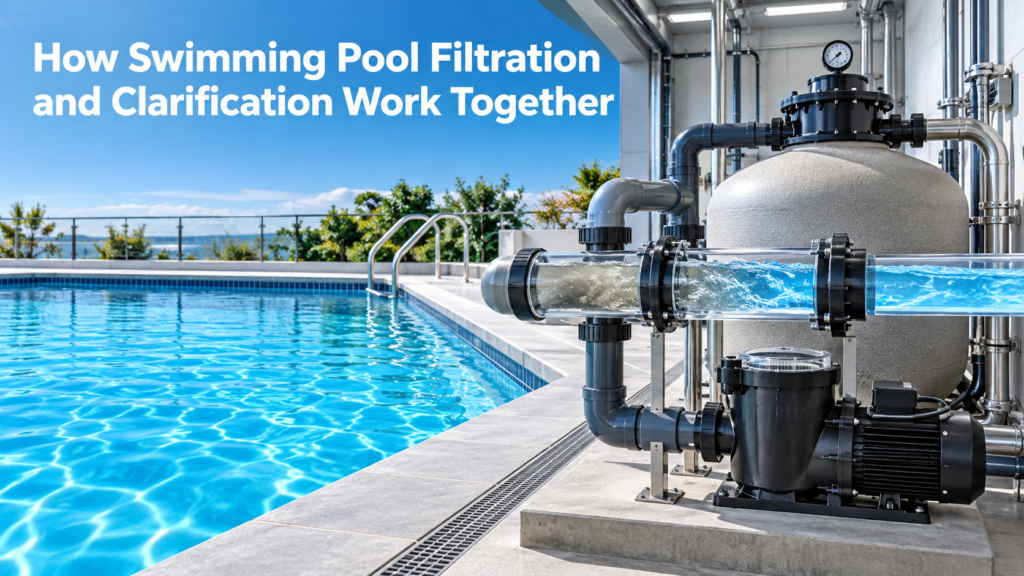
A swimming pool can have the correct chlorine level, a balanced pH, and a filter that seems to be running normally—yet the water may still look dull or hazy. That feels confusing. If the chemistry is right and the equipment is on, what is missing?
Often, the answer is not stronger sanitation or a bigger filter. It is better cooperation between filtration and clarification.
Filtration is the physical process that removes captured debris from circulating water. Clarification is a water-treatment step that helps very small suspended particles become easier for the filter to catch. One provides the removal equipment; the other improves the removability of the particles. When the two processes support each other, a pool can move from stubborn haze to a clean, polished appearance without turning routine maintenance into a guessing game.
That distinction matters. A clarifier cannot repair a blocked filter, weak circulation, or unbalanced water. A filter, meanwhile, may struggle with particles that are smaller than its practical capture range. Clear water usually comes from a complete system—not one “miracle” product.
Filtration Does the Heavy Lifting
Every recirculating pool relies on a basic loop. The pump draws water from the pool through skimmers, gutters, main drains, or a combination of these outlets. Water then passes through the strainer and filter before returning through the inlets.
As the water moves through the filter, the filter medium retains leaves, hair, insects, dust, organic matter, and other suspended solids. Larger debris is fairly easy to catch. Smaller material is where the job becomes more demanding.
Three filter families are common in swimming pools:
- Sand filters pass water through a bed of graded filter sand or another approved medium. They are robust, familiar, and easy to backwash.
- Cartridge filters use pleated filter elements. Their large surface area can provide fine filtration without routine backwashing, although the cartridges must be removed and cleaned.
- Diatomaceous earth, or D.E., filters use a thin layer of porous D.E. powder on filter grids. They are known for fine particle removal but require careful handling and maintenance.
The exact performance of any filter depends on its design, flow rate, condition, medium, loading, and maintenance—not simply the category printed on the equipment label. A neglected fine filter may perform worse than a properly operated filter with a less ambitious nominal rating.
Here is the key point: filtration only removes particles that reach the filter and can be retained by it. A particle that remains suspended in a low-circulation corner, or passes repeatedly through the filter medium, is still in the pool.
Clarification Makes Tiny Particles Easier to Capture
Many cloudy-water particles are extremely small. Windblown dust, pollen fragments, dead algae, skin cells, cosmetic residues, and fine organic matter may remain dispersed instead of settling quickly. Some carry surface charges that help keep them separate from one another.
A pool clarifier changes that behavior.
Many modern clarifiers contain water-soluble polymers. A cationic polymer carries positive charge sites along its molecular chain. Since many suspended particles in pool water have a negative surface charge, the polymer can attach to them. It may reduce the electrical repulsion between particles and form bridges from one particle to another.
As those tiny particles gather into larger clusters, the filter has a better chance of retaining them. The clusters do not need to become visible, heavy flakes. For routine clarification, they only need to become large or stable enough for the existing filter to remove them during normal circulation.
You could compare the process to collecting fine flour from a kitchen counter. A single dry speck is difficult to pick up. Once many specks gather into a small clump, removal becomes much easier. The chemistry is more refined than that analogy, of course, but the practical idea is similar.
Two Jobs, One Clear-Water Result
Filtration and clarification are sometimes discussed as competing solutions. They are not.
The filter is the collection point. The clarifier prepares difficult particles for collection. If the filter is the net, the clarifier helps the smallest particles form groups that the net can hold.
The working sequence generally looks like this:
- Fine contaminants enter the pool through swimmers, air, rain, source water, maintenance work, or surrounding landscaping.
- Some contaminants are too small or too stable to be removed efficiently during a normal pass through the filter.
- A correctly dosed clarifier disperses through the circulating water and interacts with these suspended particles.
- Particle charge is reduced, and polymer bridges help form larger particle groups.
- Circulation carries the treated particles toward the filter.
- The filter medium retains more of them.
- Backwashing or cartridge cleaning removes the captured material from the filtration system.
That final step is easy to overlook. Clarification moves contaminants from “hard to catch” to “caught in the filter.” It does not make the contaminant vanish. If the dirty filter is never cleaned, flow can fall and captured material can remain trapped far longer than intended.
Why a Good Filter May Still Need Help?
A properly sized filter is essential, but real pool water is not a controlled laboratory sample. Conditions change by the hour.
A busy hotel pool may receive sunscreen, body oils, lint, and skin particles throughout the day. An outdoor pool may collect dust and pollen overnight. A storm can wash fine soil and organic debris into the basin. Algae treatment can leave a large quantity of dead cellular material behind. Construction work nearby can add almost invisible mineral dust.
The filter may catch much of this load, but the finest fraction can keep circulating. Light scatters as it meets those suspended particles, creating a white, gray, or blue haze. The water may be chemically safe according to routine readings and still look disappointing.
There is another factor: turnover does not mean every molecule of water travels through the filter once in a perfectly orderly queue. Pool hydraulics involve mixing. Some water may pass through the system several times while water in a dead zone moves slowly. Good inlet direction, skimmer performance, pump operation, and brushing all influence how effectively particles are carried to the filter.
Clarification helps at the particle level, but circulation must still deliver the resulting clusters to the equipment.
Filtration, Clarification, and Disinfection Are Not the Same
Clear water and sanitary water are connected, yet they are not identical.
Disinfection controls harmful microorganisms. Chlorine, bromine, and other approved treatment systems perform this task.
Filtration physically removes suspended material from the water.
Clarification improves the filterability of fine suspended particles.
A clarifier is not a disinfectant. It should never be used as a substitute for maintaining the required sanitizer residual and pH. Likewise, a strong chlorine reading does not prove that the water is free of fine debris.
There is a practical safety reason to care about clarity as well. Operators and lifeguards must be able to see the pool floor and identify a person in trouble. The CDC’s Model Aquatic Health Code treats filtration, recirculation, and water clarity as core parts of aquatic-facility operation. For commercial pools, water clarity is more than a cosmetic promise; it supports supervision and safe operation.
Clarifier or Flocculant? Similar Chemistry, Different Operation
The words clarifier and flocculant are often used loosely, which can lead to poor treatment decisions.
A pool clarifier is normally applied at a relatively low dose. It forms filterable particle groups while the circulation system continues operating. The filter then captures the material over time. This approach suits mild haze, routine polishing, and conditions where the filter is functioning correctly.
A pool flocculant is normally used to form larger, heavier flocs that settle to the pool floor. The pump is commonly stopped after distribution, the water is allowed to stand, and the settled material is vacuumed to waste. That method may remove a heavy suspended load quickly, but it consumes water and requires careful vacuuming. It may also be unsuitable for some plumbing or filter arrangements.
In short, clarifier works with the filter. Flocculation followed by settling works mainly outside the filter. Always follow the chemical supplier’s instructions and the equipment manufacturer’s limits, since formulations and pool systems differ.
What Happens Inside Different Filter Types?
The same clarifier can behave differently across filter systems. That is one reason universal dose advice should be treated cautiously.
Sand filters: help for the finest haze
Sand filters are common in hotels, public pools, water parks, and residential installations. They tolerate substantial dirt loads and can be restored by backwashing. Yet very fine material may pass through a conventional sand bed, especially when the filter runs too fast, the sand is channelled, or the internal components are damaged.
A compatible polymer clarifier can enlarge fine particles so the sand bed retains them more readily. As the filter collects material, the pressure reading may rise. That is not always a sign of failure; it may show that the filter is doing its job. Backwash when the manufacturer’s pressure or flow guidance indicates—not every time the needle moves slightly.
Cartridge filters: more capture means more cleaning
Cartridge filters can capture fine debris across a large pleated surface. A clarifier may improve removal of lingering haze, but overdosing can coat the fabric, shorten the cleaning interval, and restrict flow.
After treatment, inspect the pressure and return flow. Clean the cartridge according to the manufacturer’s method. Aggressive brushing or unsuitable cleaning chemicals can damage the fibers, so “scrub harder” is not a sound maintenance plan.
D.E. filters: fine filtration still needs correct operation
D.E. systems already provide fine filtration. They may clear suspended material rapidly when operated correctly. Still, dead algae or a sudden debris load can challenge the system. Any clarifier used with a D.E. filter must be confirmed as compatible and dosed carefully.
The presence of fine filter media does not excuse poor circulation, torn grids, incorrect D.E. loading, or delayed maintenance. Chemistry can assist sound equipment; it cannot rebuild it.
The Right Operating Sequence Matters
When cloudy water appears, adding clarifier immediately can be tempting. Pause for a moment. A short inspection often saves a day of frustration.
1. Find the likely cause
Ask what changed. Was there a storm, a crowded weekend, landscaping work, an algae treatment, or a missed maintenance cycle? Is the cloudiness uniform, or does it appear only near certain inlets? Did it develop suddenly or gradually?
The cause affects the response. Fine dust may benefit from clarification. Active algae growth requires sanitation and brushing first. Calcium precipitation requires chemistry correction. Air bubbles from a suction leak will not be solved by a polymer.
2. Test and balance the water
Check free sanitizer, combined sanitizer where relevant, pH, total alkalinity, calcium hardness, and stabilizer according to the pool’s treatment program. Correct large imbalances before using a clarifier.
High pH can reduce chlorine effectiveness and encourage scale haze under certain conditions. An algae bloom needs proper disinfection. If the underlying condition remains, temporary clarity may disappear as quickly as it arrived.
3. Inspect circulation and filtration
Check the pump strainer, skimmer baskets, valves, return flow, pressure gauge, and filter condition. Confirm that the system is running for enough time and at the correct flow. Brush low-flow zones so settled material can enter circulation.
For a commercial facility, follow the applicable local code, operating plan, and equipment documentation. Continuous or extended filtration may be required; do not reduce run time merely because the water looks clear at one moment.
4. Add the correct clarifier dose
Use the label dose for the actual pool volume. If pre-dilution is required, use a clean container and follow the supplier’s directions. Distribute the product where it can mix safely and evenly.
More is not better. Polymer performance depends on the relationship between product dose and particle load. Too little may have a weak effect. Too much can leave excess polymer in the water, restabilize particles, create stringy residue, or load the filter prematurely.
5. Keep water moving and watch the filter
Routine clarifiers generally need circulation so treated particles reach the filter. Monitor clarity, pressure, and return flow during the following hours. Improvement is often gradual because the pool volume must circulate and particles must be physically captured.
6. Remove what the filter collected
Backwash a sand or D.E. filter when required by its operating instructions. Clean cartridges when the pressure rise or flow reduction calls for it. After cleaning, verify that valves are returned to their normal positions and that the system is free of leaks.
Why Overdosing Can Make Water Look Worse?
Clarifier labels often show surprisingly small treatment quantities. That can make a maintenance worker think, “Surely another cup will clear it faster.” Unfortunately, polymer chemistry does not reward that instinct.
At the correct dose, polymer chains attach to multiple particles and help bind them. At an excessive dose, particle surfaces may become saturated. Instead of forming strong bridges, particles can become stabilized again. Excess product may also produce residue, clog filter surfaces, or create water that looks no better than before treatment.
This is why pool volume matters. A rough visual estimate may be far from the true volume, particularly in free-form pools, sloped basins, spas connected to pools, and surge-tank systems. Calculate the volume carefully, measure the product, and record the dose. A simple logbook can prevent repeated treatment by different staff members during the same shift.
Common Reasons the Partnership Breaks Down
When filtration and clarification fail to produce clear water, one or more of these problems is often present:
- The filter is undersized, damaged, channelled, or overdue for cleaning.
- The pump flow is too low, too high for the filter, or interrupted too often.
- Return inlets do not distribute water effectively.
- The clarifier dose is inaccurate.
- The product is incompatible with the filter or another treatment chemical.
- The pool has active algae, scale precipitation, or another condition that clarification cannot correct alone.
- The debris load is too heavy for routine clarification and requires a different recovery method.
- Staff backwash too soon, before the filter has captured enough material.
- Staff wait too long to clean a heavily loaded filter.
- Several chemicals are added close together without checking label directions.
Notice how few of these issues can be solved by simply pouring in more product. Clear-water treatment is a process. The chemical, hydraulic, and mechanical parts must all make sense together.
How to Tell Whether the System Is Working?
Do not judge success only by looking straight down into the shallow end. View the water along the longest sightline and look toward the main drain or a contrasting floor marker. Underwater lights can reveal fine haze that daylight hides.
Useful signs include:
- Improved visibility across the pool
- Sharper definition of tile lines and floor markings
- Lower measured turbidity, where a turbidity meter is used
- A gradual, expected change in filter pressure or flow
- Visible debris removed during backwashing or cartridge cleaning
- Stable clarity after normal swimmer use resumes
If clarity improves for a few hours and then declines, investigate the source load, sanitizer demand, circulation pattern, and filter-cleaning routine. A clarifier can help the system catch particles, but it cannot stop new contaminants from entering.
Commercial Pools Need a Repeatable Clarification Plan
Hotels, resorts, schools, fitness centers, and public pools face variable bather loads. A quiet weekday morning and a packed holiday afternoon are two very different treatment conditions. Waiting until the water looks cloudy can leave the operator reacting too late.
A more reliable program connects clarification with real operating data:
- Daily bather load and weather conditions
- Water-test results
- Filter pressure and flow readings
- Backwash or cartridge-cleaning dates
- Clarifier product, batch, dose, and application time
- Visual or instrument-based clarity checks
- Notes on storms, algae treatment, special events, and maintenance work
These records help an operator see patterns. Perhaps haze appears every Monday after a busy weekend. Perhaps the pressure climbs unusually fast after a dust storm. Perhaps a lower, accurately measured maintenance dose works better than occasional heavy treatment.
For pool-service companies and chemical distributors, a repeatable program also makes product evaluation more meaningful. A clarifier should be assessed in a defined system—not by one dramatic before-and-after photograph with no information about pool volume, filter type, or starting water condition.
What Makes a Clarifier Suitable for Filter-Assisted Treatment?
A useful pool clarifier should perform consistently at its recommended concentration and disperse evenly in pool water. It should come with clear directions, storage guidance, compatibility information, and quality documentation appropriate to the market.
For private-label buyers, formulation is only part of the decision. Concentration, viscosity, color, packaging, label claims, local regulatory status, and dose instructions all affect the finished product. A strong concentrate may reduce freight per treatment, but it also requires accurate filling and clear dilution guidance. A ready-to-use formula may be easier for pool owners to measure.
The raw polymer identity matters as well. PolyDADMAC-based clarifiers, for example, are cationic polymers commonly used to gather suspended material. Yet two products using the same general polymer family may differ in active content, molecular characteristics, supporting ingredients, and recommended dose. Compare the complete specification and intended application rather than relying on a CAS number alone.
Clear Water Is a Team Effort
Filtration and clarification work best when each is allowed to do its own job.
The pump and circulation network bring contaminated water to the treatment system. The clarifier helps difficult fine particles associate. The filter captures the resulting material. Cleaning removes that collected load from the equipment. Balanced chemistry and disinfection keep the pool suitable for use while the cycle continues.
Miss one part, and the water may remain hazy. Put the parts together, and clarity becomes far more predictable.
So, does a pool need a better filter or a clarifier? Sometimes it needs equipment repair. Sometimes it needs chemical help. Quite often, it needs a well-operated filter and the right clarifier working as partners—quietly, repeatedly, and without unnecessary drama.
Frequently Asked Questions
1. Can I use a pool clarifier while the filter is running?
Most routine pool clarifiers are designed to work during circulation so treated particles can reach the filter. Follow the product label because application directions vary. Do not confuse a filter-assisted clarifier with a settling flocculant that may require the pump to be stopped.
2. How long should I run the pool filter after adding clarifier?
Run the system for the period stated on the clarifier label and consistent with the pool’s normal operating requirements. Many pools need several circulation cycles before the full improvement is visible. Commercial facilities must also follow local operating codes.
3. Why is my pool still cloudy after using a polymer clarifier?
Possible causes include active algae, incorrect pH, calcium precipitation, poor circulation, a dirty or damaged filter, an inaccurate dose, or a contaminant load that exceeds routine clarification capacity. Test the water and inspect the equipment before adding another dose.
4. Does a swimming pool clarifier replace chlorine?
No. A clarifier helps remove suspended particles; chlorine disinfects the water. Clear-looking water can still have an unsafe sanitizer level, and properly chlorinated water can still contain visible haze. Both sanitation and particle removal must be managed.
5. Which pool filter works best with a cationic polymer clarifier?
Sand, cartridge, and D.E. filters may all benefit from a compatible cationic polymer clarifier. The right dose and maintenance method depend on the filter design, pool conditions, and product formulation. Confirm compatibility with both the chemical supplier and filter manufacturer.