
GET IN TOUCH
Ask For Sample?
Can a Pool Have Cloudy Water Even with Good Chlorine Levels?
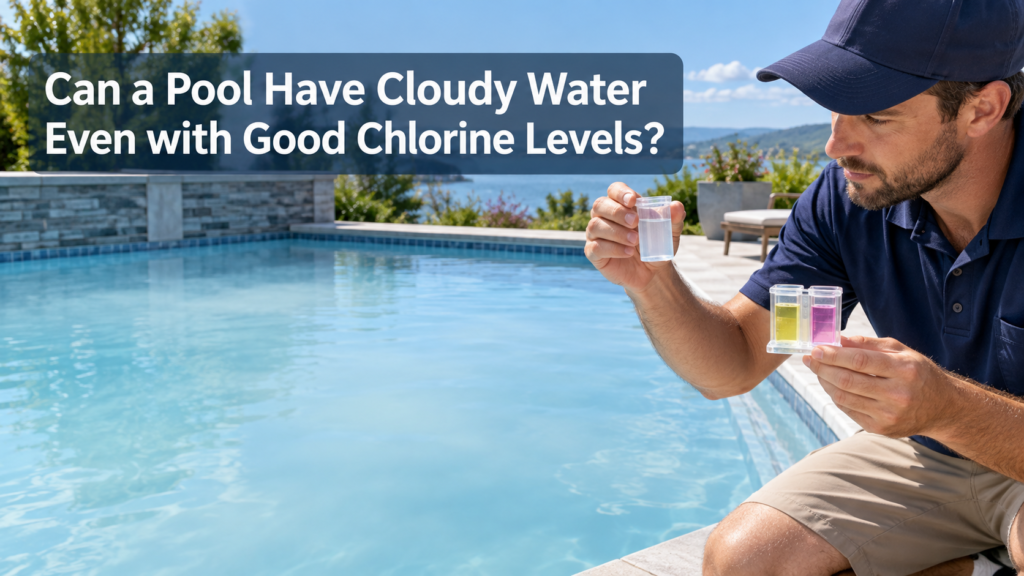
Yes. A swimming pool can have cloudy water even when the chlorine reading appears perfectly acceptable.
That answer surprises many pool owners. After all, chlorine is often treated as the star of the pool-care show. If the test strip says the chlorine level is good, shouldn’t the water look bright, blue, and almost invisible?
Not necessarily.
Chlorine and water clarity are related, but they are not the same thing. Chlorine mainly helps control germs and oxidize certain contaminants. Clear water also depends on filtration, circulation, pH, mineral balance, swimmer load, particle size, weather, and how recently the pool has been treated.
So, a good chlorine number is useful. It is not a complete health report for the pool.
If your chlorine level looks normal but the deep end has disappeared behind a pale haze, don’t keep adding sanitizer by reflex. Pause, test carefully, and find out what the water is trying to tell you.
Good Chlorine Does Not Automatically Mean Clear Water
The easiest way to understand the problem is to separate two jobs: sanitation and clarification.
Sanitation is about controlling harmful microorganisms. Chlorine performs a central role here. Clarification is about removing material that scatters light and makes the water look dull, milky, or hazy. That job relies heavily on circulation and filtration.
Imagine cleaning a kitchen after a busy dinner. Disinfecting the counter kills many germs, but it does not pick up crumbs from the floor. You still need a broom. In a pool, chlorine is part of the disinfection process; the filter is the broom.
The water may therefore contain an acceptable free chlorine residual while thousands of tiny particles remain suspended. These particles reflect and scatter light. The pool looks cloudy even though the chlorine test appears good.
This is why adding more chlorine does not solve every cloudy-water problem. Sometimes oxidation is needed. Sometimes the filter needs attention. Sometimes the water balance is causing mineral precipitation. And sometimes the particles are simply too small for the filter to catch efficiently.
The first question should not be, “How much more chlorine should I add?”
It should be, “What is causing the cloudiness?”
First, Make Sure the Chlorine Reading Is Truly “Good”
“My chlorine is good” can mean several different things.
Some pool owners check total chlorine only. Others check free chlorine. A basic test strip may give a broad color range, while a drop-based kit or digital instrument provides a more precise result. The sample location, test-kit condition, lighting, timing, and user technique can all affect the reading.
Free chlorine is the portion available to perform the main sanitizing work. Combined chlorine refers to chlorine that has reacted with nitrogen-containing contaminants and formed chloramines. Total chlorine is, in simple terms, free chlorine plus combined chlorine.
For example, a pool could show 3 ppm total chlorine but only 1 ppm free chlorine. The total number may look comforting, yet the difference suggests combined chlorine is present. That is not the same as having 3 ppm of active free chlorine.
A strong “chlorine smell” can also mislead people. It is often associated with chloramines and contamination rather than an excess of clean, effective free chlorine. That familiar public-pool smell is not a gold medal for good maintenance.
Before diagnosing the haze, confirm:
- The free chlorine level, not only total chlorine
- The combined chlorine level, calculated from the difference
- The pH at the time of testing
- Whether cyanuric acid is used
- Whether the test chemicals are fresh and stored correctly
- Whether the sample was collected away from a return jet, skimmer, or chemical feeder
- Whether a recent chemical addition temporarily affected the result
A single normal reading is a snapshot. It does not show what happened six hours earlier during heavy swimming, a hot afternoon, or a circulation failure.
pH Can Make a “Normal” Chlorine Reading Less Reassuring
Chlorine performance depends partly on pH. As pH rises, a smaller share of free chlorine is present in the more active hypochlorous-acid form. This means two pools with the same measured free chlorine can behave differently if their pH values are far apart.
High pH may also encourage calcium carbonate to come out of solution, especially when calcium hardness, water temperature, and total alkalinity are also high. The resulting microscopic mineral particles can create a white or grey haze.
Now the situation becomes clearer: the pool has chlorine, yet the sanitizer is working less efficiently and the water balance is producing particles. Adding more chlorine without correcting the pH may miss both causes.
Very low pH creates a different set of concerns, including corrosion, surface damage, and swimmer discomfort. The aim is balanced water—not forcing one number to an extreme.
For home pools, the CDC recommends keeping pH between 7.0 and 7.8 and free chlorine at no less than 1 ppm, or at least 2 ppm when cyanuric acid is used. Local codes, pool type, product labels, and operating conditions may require different targets, particularly for commercial venues.
Fine Suspended Particles May Be Smaller Than the Filter Can Easily Capture
Cloudy pool water is often a particle problem.
Wind carries dust, pollen, soil, and smoke into an outdoor pool. Swimmers add skin cells, fabric fibers, body oils, sunscreen, cosmetics, and traces of other organic material. Rain can wash fine debris from the deck or surrounding landscape. After an algae treatment, dead cells may remain suspended.
Many of these particles are extremely small. They may stay dispersed for a long time because their surface charges help keep them apart. A filter can run hour after hour while some of this material passes through or remains suspended.
Think of trying to catch flour with a kitchen sieve. The sieve may be working exactly as designed; the material is simply too fine.
In that situation, a properly formulated clarifier may help. Certain cationic polymers carry positive charges that interact with negatively charged suspended matter. This can help small particles associate into larger groups that the filter can capture more readily.
A Polymer Pool Clarifier is designed for this supporting role. It does not replace chlorine, brushing, or filtration. It helps the existing removal process work more effectively when fine suspended particles are the main problem.
More is not better, though. Excess clarifier can leave the water hazy or place an unnecessary load on the filter. Always follow the finished product label and allow time for circulation and filtration.
Your Filter May Be Running—but Is It Really Filtering?
A pump making noise does not prove that the filtration system is performing well.
Cloudiness can persist when:
- The filter is dirty or overdue for cleaning
- The filter medium is worn, channelled, clumped, or damaged
- Sand is the wrong grade or has lost effective performance
- A cartridge is torn, poorly seated, or coated with oils
- A DE filter has an internal grid problem or incorrect media charge
- The multiport valve is leaking internally
- The pump is too small, too large, or drawing air
- Circulation time is too short for the current contaminant load
- Return jets create dead zones
- The pool water level is too low for steady skimming
- Debris baskets are restricting flow
Pressure readings can offer clues, but they must be interpreted against the clean-filter baseline for that specific system. A higher-than-normal pressure may indicate loading or restriction. An unusually low reading may point to weak flow, a blockage before the pump, air entry, or another mechanical issue.
If you clean the filter and cloudy water returns through the jets, stop and inspect the equipment. The system may be sending captured material back into the pool.
This is also where patience matters. A large pool may need many hours of continuous circulation after a heavy contaminant event. The filter cannot remove material it has not yet received.
A Recent Algae Treatment Can Leave the Water Cloudy
A pool may move from green to cloudy blue after successful algae treatment. Oddly enough, that can be progress.
Living algae can give the water a green shade and make surfaces slippery. After the algae are controlled, the dead cells do not vanish. They can break apart into pale, fine particles. The green color fades, but the pool remains dull or milky until those particles are removed.
At this stage, repeatedly adding algaecide or chlorine may not be the most useful response. Brush the pool, vacuum settled material, run the circulation system, and clean the filter as required. If fine particles remain difficult to capture, a compatible clarifier may support the removal process.
For preventive algae control, a non-foaming polymeric treatment such as Polyquat 60 Algaecide can play a separate role within a complete maintenance program. It should not be confused with a dedicated clarifier. One primarily helps control algae; the other primarily supports fine-particle removal.
Do not premix concentrated pool chemicals. Apply products separately and according to their approved labels. Chemical compatibility after dilution in a full pool does not mean concentrates can be mixed safely in a bucket.
Heavy Bather Load Can Overwhelm an Otherwise Balanced Pool
Picture a hotel pool on a quiet Tuesday morning. The chlorine level is good, the filter is clean, and the water sparkles.
Now add sixty swimmers, warm sunshine, sunscreen, sweat, splashing children, and several hours of continuous use.
By late afternoon, the chlorine test may still fall within the facility’s operating range, yet the water can lose its brilliance. Swimmer-derived contaminants increase the oxidation and filtration load. Tiny particles accumulate faster than the system removes them. Local circulation zones may briefly experience lower sanitizer levels than the main test point suggests.
Commercial pools must therefore be managed as dynamic systems. More frequent testing, adequate turnover, good deck hygiene, clean filters, working chemical feeders, and sensible bather management all matter.
Cloudiness in a heavily used pool is also a safety concern. If lifeguards or operators cannot clearly see the bottom, drains, or a person beneath the surface, the venue should follow its closure procedure and applicable local rules. An acceptable chlorine number does not cancel poor underwater visibility.
That point is worth repeating: water can pass one chemical check and still be unsuitable for swimming.
Rain, Dust, and Pollen Can Cloud a Chemically Balanced Pool
Weather can change water clarity quickly.
A storm may introduce dust, pollen, leaves, soil, airborne pollution, and organic material. Heavy rain can dilute pool chemicals, change pH and alkalinity, raise the water level, and carry deck debris into the basin. Strong wind can deliver an impressive amount of fine material without leaving much visible debris on the surface.
Chlorine may recover to a normal reading soon after adjustment, while the physical contaminant load remains. The pool is sanitized, perhaps, but it has not yet been cleaned.
After severe weather:
- Remove leaves and large debris
- Restore the correct water level
- Test free chlorine, pH, and other relevant balance factors
- Brush steps, corners, and low-circulation areas
- Inspect pump and filter performance
- Run filtration long enough to process the added load
- Vacuum settled material
- Use a suitable clarifier only when fine suspended particles remain and the label allows it
This is a better response than pouring several treatments into the water at once and hoping one of them gets lucky.
Calcium Clouding Can Look Like a Chlorine Problem
Milky white water often points toward mineral precipitation, especially when pH, calcium hardness, total alkalinity, and temperature are elevated.
Calcium carbonate may leave solution and form tiny suspended crystals. The pool looks pale or cloudy, and rough scale may begin to form on surfaces or equipment. A recent addition of pH increaser, calcium hypochlorite, calcium hardness increaser, or another alkaline product can sometimes trigger temporary clouding when it is added too quickly or distributed poorly.
The chlorine reading may still be perfectly normal.
Before using a clarifier, test the broader water balance. If precipitation is continuing, gathering particles without correcting the cause may provide only brief improvement. Adjust the water carefully, allow circulation, and avoid making several large corrections in rapid succession.
Where source water is naturally hard, prevention is much easier than wrestling with a heavily scaled pool later. Slow, measured changes beat chemical whiplash every time.
Too Much Pool Chemical Can Also Create Haze
Cloudiness sometimes comes from the treatment itself—not because the product is inherently poor, but because the dose, order, or timing was wrong.
Common examples include:
- Overdosing a clarifier
- Adding multiple polymers too close together
- Combining cationic and anionic products without compatibility checks
- Adding concentrated chemicals to the same spot
- Applying calcium-containing sanitizer when the water is already near its scaling limit
- Using a maintenance product as though it were an emergency cure
- Treating before a previous chemical has fully dispersed
When several products are added within an hour, diagnosing the result becomes difficult. Was the haze caused by precipitation, incompatible charge, dead algae, poor filtration, or simple overdosing? Nobody can tell easily because too many variables changed at once.
Add one treatment at a time. Follow label directions. Allow adequate circulation. Record what was added and when. It sounds almost too simple, but good records can save a pool operator from repeating an expensive mistake.
Air Bubbles May Look Like Cloudiness
Not every white haze is made of solid particles.
Very small air bubbles can make water appear milky, especially near return jets. Fill a clear glass with pool water and watch it for a minute. If the cloudiness rises and disappears from the bottom upward, microbubbles may be the cause.
Possible sources include a low pool-water level, a skimmer drawing air, a loose pump-lid seal, a leaking suction-side fitting, a damaged O-ring, or cavitation caused by restricted flow.
If the haze disappears when the circulation system stops, inspect for air entry before reaching for another chemical bottle. Chlorine cannot repair a suction leak. Neither can clarifier.
A Practical Troubleshooting Sequence
Cloudy water encourages impatient decisions. Resist that urge. A calm sequence usually finds the cause faster.
Start with visibility. If the bottom or main drain cannot be seen clearly, keep swimmers out and follow the applicable safety procedure.
Then work through these checks:
- Test free chlorine, total chlorine, combined chlorine, and pH with a reliable method.
- Review cyanuric acid, total alkalinity, calcium hardness, and temperature where relevant.
- Look for algae on walls, steps, ladders, corners, and shaded areas.
- Check the pump, baskets, water level, return flow, and signs of air leakage.
- Compare filter pressure with the system’s clean baseline.
- Inspect and clean the filter according to the manufacturer’s instructions.
- Consider recent events: rain, dust, heavy use, algae treatment, construction, or chemical additions.
- Run circulation and filtration long enough to remove the contaminant load.
- Vacuum settled material and brush areas with weak circulation.
- If fine suspended particles remain, consider a compatible clarifier at the labeled dose.
The broader causes are explained in Why Does Swimming Pool Water Become Cloudy?, which can help separate sanitation issues from filtration, mineral, and particle problems.
Do not stack corrective chemicals simply because the first treatment has not produced instant sparkle. Pool water needs time to mix, react, circulate, and pass through the filter.
When a Polymer Pool Clarifier Makes Sense?
A polymer clarifier is most useful when water chemistry is reasonably balanced, circulation is working, the filter is in serviceable condition, and fine suspended particles remain the main source of haze.
The clarifier helps by changing particle behavior. Rather than allowing each tiny particle to stay separate, the polymer encourages particles to associate. Larger groups are generally easier for the filter to retain.
This approach can be useful after:
- Heavy swimmer use
- Windblown dust or pollen
- A controlled algae event that leaves dead cells
- Fine debris entering after rain
- Routine filtration struggles with persistent light haze
It is less likely to solve cloudiness caused by active algae, severe scaling, damaged filter components, poor circulation, or incorrect water balance. Fix the cause first.
For pool chemical distributors and private-label brands, formulation quality matters. Polymer type, active concentration, charge density, viscosity, dose, color, storage stability, packaging, and compatibility can affect performance and customer experience.
Clear directions matter just as much. A good clarifier should reduce confusion, not add another mystery to the equipment room.
Clear Water Is a System Result
So, can a pool have cloudy water even with good chlorine levels?
Absolutely.
Chlorine is essential, but it is only one part of clear pool water. The filter must remove suspended matter. The pump must circulate water through the whole basin. The pH and mineral balance must remain controlled. Algae debris, swimmer waste, dust, pollen, rainwater, and treatment residues all have to be managed.
The most useful lesson is simple: treat the cause, not merely the appearance.
If free chlorine and pH are correct, look beyond the sanitizer. Confirm the test result. Inspect the equipment. Review recent events. Give the filter time to work. When the remaining haze comes from very fine suspended particles, a correctly selected and dosed polymer clarifier may provide the missing support.
Clear water rarely comes from one heroic chemical addition. It comes from several ordinary things working together—quietly, steadily, and correctly.
Frequently Asked Questions
1. Why is my pool cloudy when free chlorine and pH are normal?
Fine suspended particles, poor filtration, weak circulation, dead algae, microbubbles, or mineral precipitation can cause cloudy water even when free chlorine and pH test within the target range. Inspect the filter and pump, review recent weather and chemical additions, and test the broader water balance before adding more sanitizer.
2. Will adding more chlorine clear a cloudy swimming pool?
More chlorine may help when the cloudiness is linked to algae, a high organic load, or insufficient oxidation. It will not repair a damaged filter, remove calcium scale, stop air leaks, or automatically capture very fine particles. Identify the cause and follow the applicable product label rather than dosing by guesswork.
3. How long should I run the filter to clear cloudy pool water?
The required time depends on pool volume, pump flow, filter type, contaminant load, and circulation pattern. After correcting the cause, many operators run filtration continuously until clarity returns, checking and cleaning the filter as needed. Follow equipment guidance and local operating requirements.
4. Can a polymer pool clarifier clear cloudy water with normal chlorine levels?
Yes, when fine suspended particles are the main cause and the filtration system is working properly. A polymer pool clarifier can help gather small particles into larger, filterable groups. It is not a substitute for sanitizer, balanced water, or equipment repair, and overdosing may make haze worse.
5. Is it safe to swim if chlorine is good but the pool is cloudy?
Do not rely on chlorine alone. If cloudiness prevents a clear view of the bottom, drains, or swimmers below the surface, keep the pool closed and follow local safety rules. Poor visibility can hide a person in distress and may also signal unresolved filtration, contamination, or water-balance problems.