
GET IN TOUCH
Ask For Sample?
How Polymer Technology Improves Swimming Pool Water Clarity?
A swimming pool can be chemically balanced and still look a little tired. The sanitizer level may be correct. The pH may sit comfortably within its target range. The filter may be running as usual. Yet the water has a faint haze, especially when sunlight cuts across the pool or an underwater light comes on at night.
That haze is often caused by particles too small for the filter to catch efficiently. They stay suspended, scatter light, and take away the crisp, glass-like appearance swimmers expect.
Polymer technology offers a practical answer. A pool clarifier does not make those particles disappear by magic. Instead, it changes how they behave. The polymer brings tiny suspended matter together into larger clusters, giving the filtration system a much better chance of removing it.
It sounds simple—and the basic idea is. But the performance depends on polymer charge, molecular structure, dosage, water balance, circulation, and filtration. Let’s look at what is really happening in the water and why a carefully formulated polymer clarifier can make such a visible difference.
Clear Water Is More Than a Pretty Finish
Water clarity shapes the whole swimming experience. Clear water looks inviting, helps tile colors appear brighter, and gives a pool a well-maintained character. For commercial facilities, it also supports better visibility across the pool and toward the floor.
Cloudiness, on the other hand, can make even a clean pool look neglected. Guests rarely ask whether the problem comes from fine dust, body oils, pollen, dead algae, or calcium particles. They simply see dull water.
That is why clarity is both a technical goal and a customer-perception issue. A hotel, aquatic center, pool service company, or private-label chemical brand is not only treating water. It is protecting confidence.
Still, clear-looking water is not automatically safe water. A clarifier supports particle removal, but it does not replace an approved sanitizer, routine testing, circulation, or physical cleaning. Good pool care works as a system, with each part doing its own job.
Why Tiny Particles Stay Suspended?
Pool water collects contaminants every day. Some arrive from the environment, while others come from swimmers or the treatment process itself. Common examples include:
- Dust, pollen, and windblown soil
- Sunscreen, cosmetics, and body oils
- Fine organic debris
- Dead algae after treatment
- Very small mineral precipitates
- Residues from construction or nearby landscaping
- Particles created by heavy swimmer use
Larger material can settle, enter a skimmer basket, or become trapped in the filter. The troublesome fraction is much smaller. These particles can remain dispersed for long periods because their low weight and surface properties keep them from settling quickly.
Many suspended particles also carry an electrical surface charge. Particles with similar charges repel one another—rather like trying to push together the matching poles of two magnets. Because they remain separate, each particle may be too small for the filter media to retain reliably.
One particle is nearly invisible. Millions of particles scatter enough light to create visible haze. This is known as turbidity, and it explains why water may look cloudy even when no large debris can be seen.
So, What Does a Polymer Actually Do?
A polymer is a large molecule made from repeating chemical units. In a pool clarifier, the useful feature is not simply its size. It is the way the polymer interacts with particle surfaces.
Many liquid pool clarifiers use water-soluble cationic polymers. “Cationic” means the polymer carries positive charge sites. Many common suspended impurities have a negative surface charge, so the opposites attract.
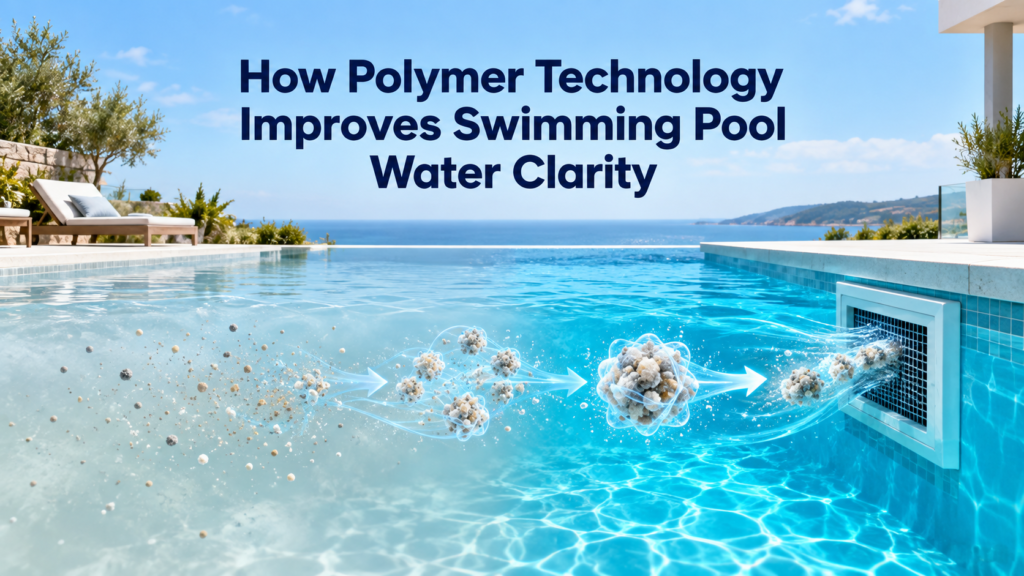
When the clarifier disperses through the water, polymer chains can attach to fine particles. Part of a chain adsorbs onto one particle while another part remains available to attach to a second particle. Repeated many times, this action creates loose clusters that are larger than the original particles.
This process is often described through two related mechanisms:
- Charge neutralization: The cationic polymer reduces the repulsive force between negatively charged particles.
- Polymer bridging: Long polymer chains connect several particles and help form larger aggregates.
The resulting clusters are commonly called flocs, although the flocs made by a pool clarifier are often light and relatively small. They are designed mainly to support filtration, not necessarily to sink rapidly to the pool floor.
Think of scattered grains of flour on a countertop. A fan can move the individual grains easily. If those grains gather into soft crumbs, however, they become easier to collect. Polymer clarification works on a comparable principle—but at a microscopic scale and in moving water.
From Invisible Haze to Filterable Clusters
The clarity improvement usually follows a sequence.
First, the liquid clarifier enters the circulating water and disperses. Good circulation matters here because the product must meet the suspended particles rather than remain concentrated in one area.
Next, the polymer adsorbs onto particle surfaces. Charge attraction begins to reduce the stability of the suspension. Fine particles that previously kept their distance can now approach one another.
Then bridging and aggregation take place. Small particles collect into larger clusters as the water continues moving through the pool.
Finally, the filter captures more of the aggregated material. As the concentration of suspended solids falls, less light is scattered. The water looks brighter, deeper, and more polished.
The polymer has not replaced the filter. It has made the contamination easier for the filter to handle. That distinction is the heart of polymer-assisted clarification.
For pools affected by recurring fine-particle haze, a purpose-formulated Polymer Pool Clarifier can support more efficient particle capture when it is matched with correct water balance and filter operation.
Why Filtration Alone Sometimes Falls Short?
Filters are indispensable, but no filter captures every particle equally well under every condition. Performance depends on filter type, media condition, flow rate, maintenance, particle size, and the chemical character of the water.
Sand filters, cartridge filters, and diatomaceous earth filters have different particle-retention characteristics. Even within one category, results vary with equipment design and operating condition. A dirty, channelled, damaged, undersized, or poorly maintained filter will not behave like a properly serviced one.
Very fine particles may pass through the media or take a long time to be removed. If new particles enter the water as quickly as old ones are captured, the pool can remain hazy despite extended circulation.
A polymer clarifier changes the particle-size problem. Instead of asking the filter to trap countless tiny particles, it helps group them into fewer, larger clusters. The filter can then work closer to the task it handles well.
There is a limit, of course. A clarifier cannot repair torn cartridges, restore worn filter media, correct severe channeling, or compensate forever for insufficient circulation. Chemistry can assist equipment; it cannot rescue equipment that is not working.
PolyDADMAC: A Practical Clarifier Chemistry
PolyDADMAC, or poly(diallyldimethylammonium chloride), is a cationic water-soluble polymer used in many water-treatment applications. In swimming pool clarification, formulations based on PolyDADMAC can help gather negatively charged suspended particles and improve their removal by filtration.
Its practical appeal comes from several features. It is easy to formulate as a liquid, disperses in water, works at relatively low treatment levels, and can be supplied in ready-to-use products. A finished clarifier may be colorless or lightly dyed blue to match market preferences, but the dye is mainly a visual and branding choice. The polymer function is what matters.
The active-polymer concentration must be considered when comparing products. Two bottles of the same volume may deliver different amounts of active material. Finished-product quality also depends on raw-material control, dilution water, mixing accuracy, viscosity, pH, packaging compatibility, and batch consistency.
For distributors and private-label buyers, this is important. A clarifier is not merely “blue liquid in a bottle.” Consistent polymer content and formulation control determine whether one batch performs like the next.
The Dose Makes the Difference—Quite Literally
With polymer clarifiers, more is not always better. This surprises some pool owners because many maintenance habits follow a simple assumption: if a little helps, a larger dose should help faster. Polymer chemistry does not always cooperate with that logic.
At an appropriate dosage, polymer chains contact particles, reduce repulsion, and form filterable clusters. At too low a dosage, there may not be enough polymer to treat the available particle surface. Clarification may be slow or incomplete.
At too high a dosage, excess polymer can remain in the water. Depending on the formulation and water conditions, overdosing may produce persistent haze, sticky residues, rapid filter-pressure changes, or particles that become stable again instead of aggregating well.
That is why label directions matter. The correct amount depends on the concentration of the finished product, pool volume, severity of cloudiness, filter type, and the manufacturer’s tested use instructions. A maintenance dose for slightly dull water should not automatically become the dose for severe post-algae cloudiness.
Measure the pool volume carefully. Add the product where circulation can distribute it evenly. Allow adequate filtration time. Then observe the response before adding more.
Patience may feel old-fashioned when the water is cloudy before a busy weekend, but repeated unmeasured additions often make troubleshooting harder, not easier.
Water Balance Still Runs the Show
Polymer performance does not happen in isolation. The condition of the water affects both the original haze and the way a clarifier behaves.
An unsuitable pH can reduce sanitizer efficiency and encourage scale-forming conditions. High calcium hardness combined with unfavorable pH and alkalinity can produce mineral cloudiness. Low sanitizer residual may allow algae or microorganisms to grow. Poor circulation can leave treated water unevenly mixed.
Before reaching for a clarifier, check the basics:
- Free sanitizer level
- pH
- Total alkalinity
- Calcium hardness where relevant
- Stabilizer level in outdoor pools where relevant
- Filter pressure and physical condition
- Pump runtime and return flow
- Visible signs of algae or scale
If the pool has an active algae bloom, address the biological problem with the appropriate sanitation and algae-control procedure first. The dead material left afterward may then create fine-particle cloudiness, and that is where filtration support becomes useful.
A polymer clarifier treats a symptom—suspended particles—very well when that symptom is correctly identified. It should not be used to hide a deeper water-balance or sanitation problem.
Clarifier, Flocculant, Algaecide: Same Shelf, Different Jobs
These products are sometimes grouped together in pool stores, which can blur their roles.
A clarifier encourages fine particles to form filterable aggregates while the circulation and filtration system continue operating. It is well suited to mild or moderate haze, routine water polishing, and fine debris left after another treatment.
A flocculant is generally intended to create heavier material that settles to the pool floor for removal, often by vacuuming to waste. The exact procedure depends on the product. Flocculation can be useful for severe cloudiness, but it may require more downtime, careful settling, and substantial water replacement during vacuuming.
An algaecide is formulated to control or help prevent algae. It does not serve the same primary role as a clarifier, even though some polymeric algae-control products may also contribute to water clarity.
For seasonal algae prevention, a non-foaming Polyquat 60 algae-control product may be included as one part of a broader maintenance program. During pool closing, a dedicated Winter Algaecide can support off-season water care. Neither removes the need for correct sanitizer management and a clean, working filtration system.
The easiest way to remember the difference is this: clarifier helps the filter catch fine particles; flocculant helps particles settle; algaecide targets algae. Some formulations offer overlapping benefits, but the main purpose should always be clear on the label.
Where Polymer Clarifiers Add the Most Value?
Polymer technology is especially useful when cloudiness comes from dispersed matter rather than a severe chemical imbalance or equipment failure.
Common situations include:
- After heavy swimmer use: Lotions, oils, fabric fibers, and fine organic material can leave the water dull.
- After wind or rain: Dust, pollen, and soil may enter faster than the filter can remove them.
- After algae treatment: Dead algae cells and fragments can remain suspended even after the algae has been controlled.
- During routine polishing: A low maintenance dose may help preserve a bright, finished appearance where the product label permits it.
- In commercial pools: High bather turnover creates a steady fine-particle load, making reliable filtration support valuable.
- Before an event or inspection: When the chemistry is already in range, better removal of residual haze can improve presentation.
Results still depend on the cause. If the pool is cloudy because calcium is precipitating, the source condition must be corrected. If sanitizer is inadequate, sanitation comes first. If the filter is blocked, cleaning it matters more than adding another chemical.
The best clarifier is not the one poured into every cloudy pool. It is the one used after a sensible diagnosis.
Polymer Technology Can Support More Efficient Pool Care
Efficient treatment is not only about achieving clear water. It is about reaching that result without creating unnecessary work, chemical use, or water loss.
When used correctly, a liquid polymer clarifier may help a functioning filtration system remove fine particles sooner. That can reduce the temptation to keep adding unrelated chemicals while guessing at the cause of haze.
Compared with a settling-and-vacuuming procedure, ordinary clarification may also avoid the water loss associated with vacuuming to waste—provided the condition is suitable for a clarifier in the first place.
For service companies, consistent results save visits and customer complaints. For commercial operators, they help maintain a dependable appearance across busy operating periods. For distributors, a stable and well-documented formulation supports fewer product claims and clearer instructions for end users.
There is also a quieter benefit: simplicity. A ready-to-use liquid is easy to measure, easy to package in 1 L, 5 L, or 25 L formats, and suitable for private-label programs aimed at different pool markets.
What Buyers Should Ask a Polymer Clarifier Supplier?
For B2B buyers, appearance alone tells very little. A sample can look bright and clean, yet long-term product value depends on specifications, production control, and application support.
Before purchasing, ask the supplier about:
- Active ingredient and active concentration
- Recommended dosage range for the finished formulation
- Appearance, pH, and viscosity specifications
- Batch test methods and certificate of analysis availability
- Safety data sheet and labeling support
- Compatibility with bottle, cap, label, and carton materials
- Color options, including original and dyed-blue versions
- Available package sizes and private-label service
- Sample evaluation and storage-stability testing
- Guidance for different filter systems and target markets
Application claims should be realistic. Be cautious with a product presented as a solution for every kind of cloudy water. A technically responsible supplier should explain where the clarifier works, what conditions affect it, and when another treatment step is needed.
Consistency matters just as much as initial performance. If viscosity, active content, or dilution varies from batch to batch, distributors may face uneven dosing results in the field. A good supply relationship is built on specifications that can be checked, not sparkling adjectives.
A Simple Routine for Better Clarity
Pool professionals may use different procedures based on local rules, equipment, and product labels, but a sound troubleshooting order usually looks like this:
- Identify whether the water is merely hazy or affected by active algae, scale, or another obvious problem.
- Test and correct the key water-balance and sanitizer parameters.
- Inspect the pump, filter, skimmers, and return flow.
- Clean or service the filter if required.
- Calculate the true pool volume and measure the clarifier accurately.
- Apply the product according to its label and maintain adequate circulation.
- Watch filter pressure and clean or backwash only as appropriate for the equipment and manufacturer’s instructions.
- Reassess the water before adding another dose.
This order keeps diagnosis ahead of chemical addition. It also makes performance easier to evaluate. When several products are added at once, it becomes difficult to know which treatment helped—or which one created a new problem.
The Real Strength of Polymer Technology
Polymer technology improves pool water clarity by changing particle behavior. A well-designed cationic polymer attracts fine suspended matter, reduces the forces keeping particles apart, and forms larger aggregates that a filter can capture more effectively.
That is the science. The practical result is easier to recognize: water that loses its dull veil and regains a clean, polished look.
Yet the strongest result comes from balance. The correct polymer must be used at the correct dose, in properly treated water, with effective circulation and a maintained filter. Miss one of those pieces and the improvement may be limited. Put them together and the chemistry feels almost effortless.
Almost—but not quite. Clear water is never the work of one bottle. It is the product of good diagnosis, controlled chemistry, and equipment doing what it was designed to do.
Frequently Asked Questions
1. How does a polymer pool clarifier make cloudy water clear?
A polymer pool clarifier binds very small suspended particles into larger clusters. These clusters are easier for the pool filter to capture, so less material remains in the water to scatter light and create haze.
2. Is PolyDADMAC pool clarifier the same as pool flocculant?
Not necessarily. A PolyDADMAC clarifier is commonly used to help filters remove suspended particles during normal circulation. A flocculant is generally intended to form heavier material that settles for vacuum removal. Always follow the specific product label.
3. Can I use polymer clarifier when pool water is green?
Green water often indicates active algae, so sanitation and algae control should be addressed first. A polymer clarifier may help remove fine dead algae after treatment, but it should not replace the required sanitizer or algae-control process.
4. Why is my pool still cloudy after adding clarifier?
Possible causes include incorrect dosage, poor circulation, a dirty or damaged filter, active algae, unbalanced water, mineral precipitation, or insufficient filtration time. Test the water and inspect the equipment before adding more product.
5. Can too much polymer pool clarifier make water cloudy?
Yes. Overdosing can leave excess polymer in the water and may worsen haze or increase filter loading. Calculate the pool volume carefully, follow the label dosage, and allow the recommended filtration time before considering another treatment.